
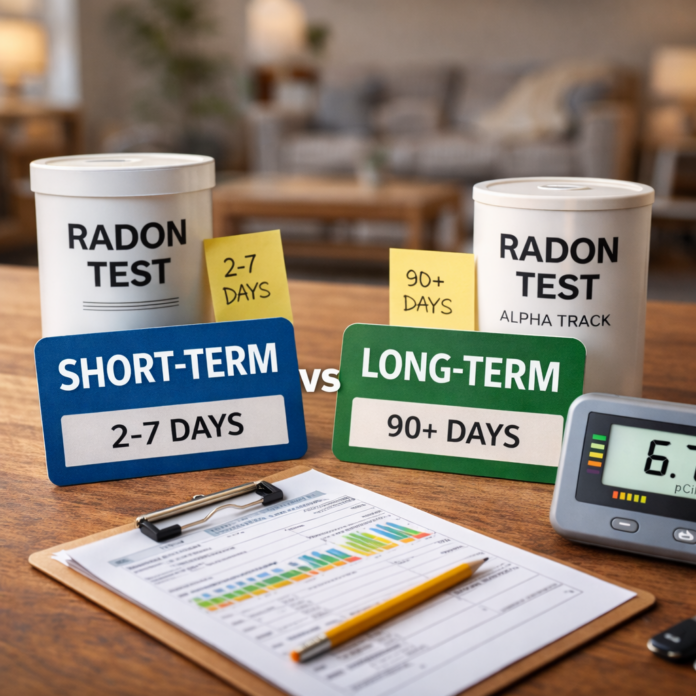
Short-Term vs Long-Term Radon Testing: Which One Should You Use?
If you are new to radon testing, one of the first confusing choices is whether to use a short-term test or a long-term test. Both are valid, and both can be useful. The right option depends on your goal. Do you want a quick screening result, or do you want a more accurate picture of your true average exposure over time?
This article explains the difference between short-term and long-term radon tests, when each is best, how to interpret results, and a simple decision plan you can follow.
Why the test type matters
Radon levels are not constant. They can change from day to day and season to season. Weather, barometric pressure, soil moisture, HVAC operation, and ventilation habits all influence how much radon enters a building and how much accumulates indoors.
Because of that variability, a single snapshot can be misleading. A test taken during a cold spell with windows closed might be higher than your yearly average. A test taken during a mild week with lots of ventilation might be lower than your yearly average. This is why the concept of average exposure matters for risk. Lung cancer risk is linked to long-term exposure, not a single day.
What is a short-term radon test?
A short-term radon test is designed to give a quick measurement over a relatively brief period. In most consumer and guidance materials, short-term tests typically run from about 2 to 7 days, though some devices and protocols may use slightly different durations.
Short-term tests are often used for:
- Quick screening of a home
- Real estate transactions where a result is needed fast
- Initial testing when you want to know whether radon might be a concern
Short-term tests are appealing because they are fast and often inexpensive. The tradeoff is that they capture a small slice of time, which can be influenced by unusual conditions.
Common types of short-term tests
- Charcoal canisters and charcoal liquid scintillation devices
- Electret ion chambers used for short durations
- Continuous radon monitors used for short test windows, often by professionals
Some consumer-grade digital radon monitors provide near-real-time readings, but it is important to understand what window the device is reporting. A two-day average can look very different from a thirty-day average, and both can look different from a yearly average.
What is a long-term radon test?
A long-term radon test measures radon over a much longer period and is intended to estimate your average exposure more accurately. EPA guidance commonly describes long-term tests as those lasting 90 days to one year.
Long-term tests are useful because they smooth out short-term fluctuations. If your goal is understanding long-term risk in a home where you plan to live for years, a long-term test is often the most informative option.
Common types of long-term tests
- Alpha track detectors
- Long-term electret ion chambers
Many long-term tests are passive devices you place and forget for several months. At the end of the period, you mail them to a lab and receive the average radon level for that time window.
Which is more accurate?
In general, a long-term test provides a better estimate of your true average radon level because it captures more conditions over time. That said, short-term tests can be very reliable for identifying elevated radon, especially when radon levels are significantly above the action level.
A simple way to think about it:
- Short-term tests are great for quick decisions and initial screening.
- Long-term tests are best for understanding average exposure and refining decisions when results are borderline.
When should you use a short-term test?
Short-term tests are usually the right first step when you need a quick answer, or when you want to see whether radon might be an issue at all.
Short-term testing is a strong fit when:
- You are buying or selling a home and need results quickly.
- You want to screen a home before investing in a long-term test.
- You suspect radon could be high and you want to move toward mitigation faster.
- You are testing multiple rooms or units and need a practical approach.
If your short-term result is clearly above the action level, many homeowners move directly into the next step, which is either a confirmatory test or mitigation planning, depending on the result and timeline.
When should you use a long-term test?
Long-term tests are the best choice when your main goal is accuracy over time, not speed.
Long-term testing is a strong fit when:
- You plan to live in the home for years and want the best picture of your average exposure.
- Your short-term test result is in a moderate or borderline range, and you want clarity before deciding on mitigation.
- You have a digital monitor and want to confirm the overall level with a lab-based long-term test.
- You already mitigated and want to confirm performance over a wide range of conditions.
If you work from home or spend a lot of time in a basement living area, long-term testing can be especially useful because it aligns with the way risk actually works: exposure over time.
What about real estate testing?
Real estate transactions are often the reason people test for the first time. The process typically relies on short-term tests because buyers and sellers need a result quickly. Many protocols use closed-house conditions during the test period to reduce variability and standardize results.
It is worth remembering that a real estate radon test is often designed to answer one question: does this home appear to be at or above the action level under controlled conditions? It is not always designed to estimate the long-term average as precisely as a long-term test would.
If you buy a home based on a short-term test, it can still be smart to run a long-term test later to confirm your true average exposure, especially if the short-term result was near the action level.
How to interpret results from different test types
In the U.S., the most common reference point is the EPA action level of 4.0 pCi/L. EPA also recommends considering action between 2.0 and 4.0 pCi/L because lower is better and no level is risk-free.
How test type fits into interpretation:
- If a short-term test is far above 4.0 pCi/L: take it seriously and move toward confirmation or mitigation.
- If a short-term test is near 4.0 pCi/L: a long-term test can help confirm the average before a major decision.
- If a short-term test is in the 2.0 to 4.0 pCi/L range: consider a long-term test if you want a better estimate of long-term exposure.
- If a long-term test is above 4.0 pCi/L: the case for mitigation is strong because it reflects sustained exposure.
Where to place the test
Placement matters as much as test type. Radon should be tested in the lowest level of the home that is used regularly. If the basement is finished and used as a living area, test there. If the basement is unfinished and never used, test the lowest lived-in level above it.
A common mistake is testing in a location that does not represent how the home is actually used. Another mistake is placing the device in a kitchen, bathroom, laundry room, or near drafts, windows, or vents that can distort results.
A simple decision plan
If you want a straightforward path, use this approach:
- Start with a short-term test if you want a quick screening or you are in a time-sensitive situation.
- If the short-term result is high, move toward mitigation or do a follow-up test if you need confirmation.
- If the result is borderline or moderate, use a long-term test to estimate your average exposure.
- After mitigation, retest, and consider a long-term follow-up test to verify performance through seasonal changes.
Bottom line
Short-term and long-term radon tests answer slightly different questions. Short-term tests are designed for speed and screening. Long-term tests are designed for accuracy and true average exposure. If you are unsure, a common best practice is to start with a short-term test to see where you stand, then use a long-term test for confirmation when results are close to decision thresholds.
The most important thing is to test. Radon is invisible, but it is measurable. Once you have a reliable number, you can make a clear decision about next steps.
Sources
- U.S. Environmental Protection Agency (EPA) – Health Risk of Radon
- U.S. Environmental Protection Agency (EPA) – How to get a radon test kit
- U.S. Environmental Protection Agency (EPA) – How to test your home for radon
- U.S. Environmental Protection Agency (EPA) – EPA action level for radon and what it means
- Centers for Disease Control and Prevention (CDC) – Testing for radon
- World Health Organization (WHO) – Radon and health (fact sheet)
- National Radon Program Services (Kansas State University) – Radon education and guidance
- National Cancer Institute (NCI) – Radon and cancer (fact sheet)