Radon Risk Levels: How to Interpret Your Test Result and What to Do Next
Radon is a naturally occurring radioactive gas that can build up indoors. You cannot see it, smell it, or taste it. Because of that, the only way to know your radon level is to test. Once you have a number, the next question is always the same: what does this level mean for risk, and what should I do about it?
This guide explains common radon risk level ranges, why long-term average exposure matters, and a practical action plan for each level. The goal is not to create fear. The goal is to help you make a clear decision based on your measurement.
First, what a radon number actually represents
In the United States, radon is commonly reported as pCi/L (picocuries per liter of air). This is a measure of radioactivity in the air, not a measure of how you feel. Radon generally does not cause short-term symptoms. The concern is long-term exposure, because radon and its decay products can damage lung tissue over time and increase the risk of lung cancer.
Radon levels also change. Weather, season, HVAC operation, and how often windows are opened can all affect indoor radon. That is why it is useful to think in terms of your long-term average rather than one moment in time.
The key benchmarks most people should know
Most radon guidance in the U.S. revolves around two thresholds:
- 4.0 pCi/L: This is the EPA action level. At or above this level, mitigation is generally recommended.
- 2.0 to 4.0 pCi/L: This is the range where EPA and CDC commonly recommend considering action, because there is no known completely safe level of radon and lower is better.
Internationally, radon is often reported in Bq/m³ (becquerels per cubic meter). If you see results in Bq/m³, your test provider or lab can convert units, and many official resources list both units. As a rough reference, 4.0 pCi/L is often shown as about 150 Bq/m³.
Radon risk levels, explained as practical ranges
These ranges are not a medical diagnosis. They are a decision framework that helps you decide whether to confirm, monitor, or mitigate.
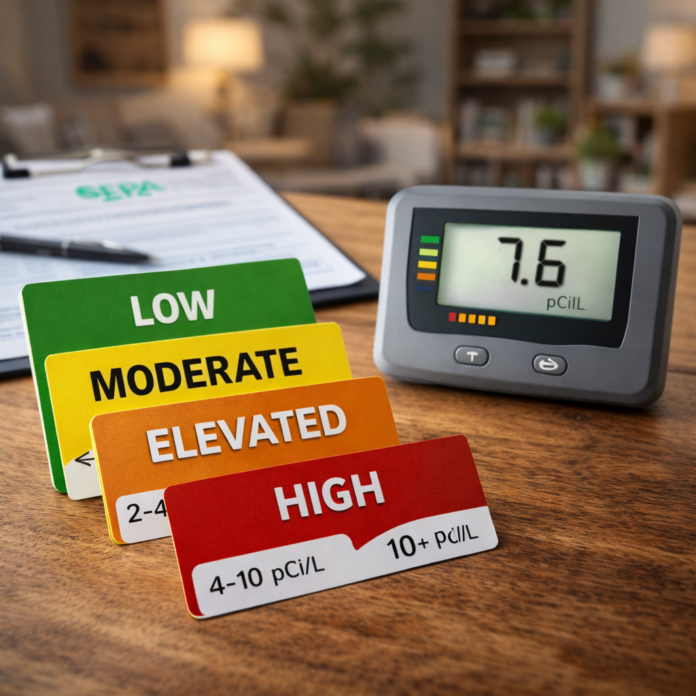
Below 2.0 pCi/L: Low, but not zero
If your radon level is below 2.0 pCi/L, your risk is generally considered lower. Many homes fall in this range. This is usually the point where people take a breath and move on.
What to do:
- Keep your result for your home records.
- Retest in the future, especially if you remodel, finish a basement, change HVAC, or do foundation work.
- If you spend a lot of time in a basement or lower level, consider a long-term test or continuous monitor to understand your average.
2.0 to 4.0 pCi/L: Moderate, worth addressing in many homes
This is the range where many homeowners are unsure what to do. It is below the EPA action level, but it is not a free pass. Because radon risk is cumulative and there is no known safe level, many agencies recommend considering action in this range. The decision often depends on your living patterns and risk factors.
Reasons to take this range more seriously:
- You use the basement as a bedroom, office, or main living area.
- You work from home and spend a lot of time indoors.
- Someone in the home smokes or used to smoke.
- You plan to live in the home for many years.
What to do:
- Consider a long-term test (90+ days) to estimate your true average.
- If results stay in this range and mitigation is affordable in your area, reducing radon can still be a reasonable risk-reduction step.
4.0 to 10.0 pCi/L: Elevated, action recommended
This range is above the EPA action level. It is the point where the standard guidance is to fix the home. Many homeowners start with a confirmatory test, especially if the first test was short-term and conditions were unusual. If a second test confirms similar results, mitigation is typically the next step.
What to do:
- Follow standard guidance for confirmation. Many people use either a second short-term test or a long-term test, depending on urgency.
- Contact a qualified radon mitigation professional and get a plan for your foundation type.
- After mitigation, retest to confirm the reduction.
Above 10.0 pCi/L: High, treat as urgent
If your result is above 10.0 pCi/L, most homeowners choose to move quickly. This is not because you will feel sick tomorrow, but because your long-term exposure could become significant if you do nothing. If you have a high short-term result, it can be reasonable to do a quick follow-up test for confirmation, but most people do not wait months to take action at this level.
What to do:
- Arrange mitigation as soon as practical.
- Reduce time spent in the lowest level temporarily if you can, especially if that is where the radon is highest.
- Retest after mitigation, and consider a long-term follow-up test to verify your average stays low.
Short-term vs long-term tests, and why it affects your decision
Two homes can have the same long-term average, but one may swing wildly day to day and the other may be stable. That is why test type matters.
- Short-term tests are useful for screening and for faster decisions. They are common in real estate transactions. They can also be influenced by short-term weather and ventilation patterns.
- Long-term tests are better for estimating true average exposure. They are especially useful when results fall in the 2.0 to 4.0 pCi/L range and you want clarity.
- Continuous radon monitors can show trends over days and weeks. They can be helpful for learning patterns, but decisions should still be based on reliable averages and follow-up testing where appropriate.
Why your home can have different readings over time
It is common to see different results between tests. Radon is affected by:
- Season and outdoor temperature
- Barometric pressure and storms
- HVAC operation and exhaust fans
- Window opening and ventilation habits
- Soil moisture and how air moves under the foundation
This variability is exactly why a long-term average is such a useful concept. It is also why retesting after mitigation matters.
Who should be most cautious about radon risk levels?
Radon increases lung cancer risk for everyone, but some situations raise the stakes:
- Smokers and former smokers: combined risk is much higher, so lowering radon can be especially valuable.
- Basement bedrooms and offices: more time in the lowest level can mean more cumulative exposure.
- Families planning long-term occupancy: time is a multiplier for risk.
Even if you are a non-smoker, radon still matters. It is widely recognized as a major cause of lung cancer among people who never smoked. That is why “I do not smoke” should not be the reason you skip testing.
A simple action plan you can follow
If you want a straightforward process that works for most homeowners, use this:
- Test using a reliable method, ideally on the lowest lived-in level.
- Decide based on the range (below 2, 2 to 4, 4 to 10, above 10).
- Confirm when needed, especially if results are near decision thresholds.
- Mitigate if elevated, especially at or above 4.0 pCi/L.
- Retest after mitigation to verify improvement.
- Retest over time, especially after major home changes.
Bottom line
Radon risk levels are not complicated once you view them as a decision framework. Below 2.0 pCi/L is generally lower risk. Between 2.0 and 4.0 pCi/L is a moderate range where action is worth considering, especially with higher time indoors or smoking history in the household. At or above 4.0 pCi/L, mitigation is typically recommended. Above 10.0 pCi/L, treat it as high and act quickly.
The most important step is the first one. Test. Radon is invisible, but it is measurable, and once you know your level you can make an informed choice.
Sources
- U.S. Environmental Protection Agency (EPA) – EPA action level and what it means
- U.S. Environmental Protection Agency (EPA) – Health risk of radon
- U.S. Environmental Protection Agency (EPA) – Radon measurement units (pCi/L, WL, Bq/m³)
- Centers for Disease Control and Prevention (CDC) – Testing for radon in your home
- Centers for Disease Control and Prevention (CDC) – Reducing radon levels in your home
- World Health Organization (WHO) – Radon and health (fact sheet)
- National Institute of Environmental Health Sciences (NIEHS) – Radon
- National Cancer Institute (NCI) – Radon and cancer (fact sheet)
- EPA – Consumer’s Guide to Radon Reduction (PDF)