
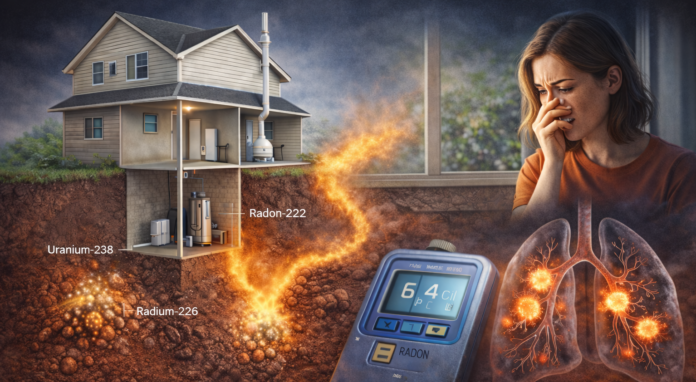
Radon is often introduced with a simple headline: “an invisible gas that can cause lung cancer.” That’s true, but the actual science of radon is deeper and more interesting than most people realize. Radon sits at the intersection of nuclear physics, geology, building science, aerosol science, and epidemiology. If you understand those basics, you understand why radon can be high in one home and low next door, why levels change with seasons and house operation, why testing works, and why mitigation is consistently effective.
This is a “pillar” science article. It’s long on purpose. It’s written to be readable, but it stays anchored to documentation from major authorities such as the U.S. Environmental Protection Agency (EPA), World Health Organization (WHO), International Commission on Radiological Protection (ICRP), the National Academies (BEIR VI), and UNSCEAR (United Nations Scientific Committee on the Effects of Atomic Radiation). (Source: EPA – https://www.epa.gov/radon; Source: WHO – https://www.who.int/news-room/fact-sheets/detail/radon-and-health; Source: ICRP – https://www.icrp.org/publication.asp?id=ICRP+Publication+126)
Table of Contents
- What radon is (in scientific terms)
- Radon in the uranium decay chain (why it exists)
- Half-life and why radon can reach your home
- The real hazard: radon progeny (decay products)
- How radon is measured (pCi/L vs Bq/m³)
- Geology and soil gas: where radon comes from
- Transport physics: diffusion vs pressure-driven entry
- Building science: why basements and winter are often higher
- Testing science: why short-term varies and long-term is stronger
- From concentration to dose: how scientists estimate risk
- Health science: evidence radon causes lung cancer
- Why smoking multiplies radon risk
- Mitigation engineering: why sub-slab depressurization works
- Why sealing alone usually isn’t enough
- Radon in water: when it matters
- Advanced note: radon-222 vs thoron (radon-220)
- Primary sources and further reading
1) What radon is (in scientific terms)
Radon is a radioactive noble gas. “Noble gas” matters because radon is chemically inert—it doesn’t easily react or bind like many other pollutants. Instead, the main “chemistry” of radon is nuclear: it naturally undergoes radioactive decay. The isotope most relevant to indoor air is radon-222 (often just called “radon”). It forms continuously underground and can accumulate indoors depending on how it moves through soil and how your home exchanges air with the outdoors. (Source: EPA – https://www.epa.gov/radon)
2) Radon in the uranium decay chain (why it exists)
Radon-222 is produced in the uranium-238 decay chain. Uranium-238 is naturally present in Earth’s crust. Over very long timescales it decays through multiple steps until it becomes stable lead. One of those steps produces radium-226, which then decays to radon-222. This is the fundamental reason radon is “everywhere”: uranium (and thus radium) is naturally distributed across soils and rocks, though not evenly. (Source: EPA – https://www.epa.gov/radon; Source: WHO – https://www.who.int/news-room/fact-sheets/detail/radon-and-health)
Because radon is continually generated, the question isn’t “Is radon present?” The question is: how efficiently can it travel from the ground into your indoor air, and once it enters, how quickly is it removed or diluted? (Source: EPA “A Citizen’s Guide to Radon” PDF – https://www.epa.gov/sites/default/files/2016-12/documents/2016_a_citizens_guide_to_radon.pdf)
3) Half-life and why radon can reach your home
A key concept in radioactive decay is half-life: the time it takes for half of a quantity of radioactive atoms to decay. Radon-222 has a half-life of about 3.8 days. That’s long enough for radon atoms formed in soil pores to migrate through soil gas pathways and enter buildings, but short enough that radon near its source is constantly being replenished. In practical terms, radon behaves like a “freshly produced” indoor pollutant: it’s continuously generated and continuously decaying. (Source: WHO Handbook on Indoor Radon PDF – https://iris.who.int/server/api/core/bitstreams/47a93281-8a11-476f-aa7d-5488014ae433/content)
This half-life is one reason why radon problems often relate to soil gas flow. If radon had an extremely short half-life, it would decay before it could travel far. If it had an extremely long half-life, it could spread more uniformly in the atmosphere. Radon-222’s half-life lands in a “sweet spot” that allows it to enter buildings in meaningful concentrations. (Source: WHO – https://www.who.int/news-room/fact-sheets/detail/radon-and-health)
4) The real hazard: radon progeny (decay products)
Here’s the most important scientific nuance most people never hear: the main health hazard is not the radon gas itself, but the particles created when radon decays.
When radon-222 decays, it becomes a series of radioactive “progeny” (also called “decay products”), including isotopes like polonium-218 and polonium-214. These progeny are solids, not gases. They are often electrically charged and can attach to tiny airborne particles (aerosols) such as dust or smoke. Once attached, they can be inhaled and deposited in the lungs. When they decay, they emit alpha radiation that can damage nearby lung tissue. (Source: WHO Handbook PDF – https://iris.who.int/server/api/core/bitstreams/47a93281-8a11-476f-aa7d-5488014ae433/content; Source: National Academies BEIR VI overview – https://www.nationalacademies.org/publications/5499)
Alpha particles do not travel far through materials, which is why external alpha sources are often less dangerous than internal ones. But if alpha-emitting particles deposit in the lung, the dose is delivered right where it can do harm. This is the physical basis of radon’s lung cancer risk. (Source: WHO – https://www.who.int/news-room/fact-sheets/detail/radon-and-health)
5) How radon is measured (pCi/L vs Bq/m³)
Radon concentration is typically reported as the activity in air—how many radioactive decays occur in a given volume over time. In the U.S., the common unit is pCi/L (picocuries per liter). Internationally, you’ll often see Bq/m³ (becquerels per cubic meter).
A widely used conversion is:
- 1 pCi/L ≈ 37 Bq/m³
- 4 pCi/L ≈ 150 Bq/m³ (approximate)
The EPA “action level” is 4.0 pCi/L (about 150 Bq/m³). EPA also notes there is no known safe level of radon exposure, and encourages homeowners to consider fixing homes between 2 and 4 pCi/L as well. (Source: EPA action level – https://www.epa.gov/radon/what-epas-action-level-radon-and-what-does-it-mean)
6) Geology and soil gas: where radon comes from
Radon originates from radium in soils and rocks. But the presence of uranium/radium alone does not perfectly predict indoor radon, because indoor radon depends heavily on how easily radon can move through the ground and how readily soil gas can be pulled into a building. (Source: EPA – https://www.epa.gov/radon)
Soil permeability (how easily gas moves)
Soil is not solid; it contains pores. Radon can move through these pores in the gas phase (soil air). Coarse soils (like gravels and some sands) can be highly permeable and allow soil gas to move easily. Some clays are less permeable, but cracks, drying patterns, and preferential pathways can still allow soil gas movement. EPA’s radon-resistant construction guidance emphasizes that soil gas transport is a major driver of indoor radon variability. (Source: EPA “Building Radon Out” PDF – https://www.epa.gov/sites/default/files/2014-08/documents/buildradonout.pdf)
Why radon maps are useful but not definitive
EPA provides radon zone maps to show broad regional potential, but repeatedly emphasizes that any home can have elevated radon and that the only way to know a specific home’s radon level is to test. (Source: EPA Radon Zones – https://www.epa.gov/radon/epa-map-radon-zones; Source: EPA Citizen’s Guide PDF – https://www.epa.gov/sites/default/files/2016-12/documents/2016_a_citizens_guide_to_radon.pdf)
7) Transport physics: diffusion vs pressure-driven entry
Radon can move from soil into a building through two broad mechanisms:
Diffusion (slow)
Diffusion is movement from higher concentration to lower concentration by random molecular motion. Radon in soil can diffuse into a building if concentrations are higher in soil than indoors. Diffusion is real, but for many elevated-radon homes, it isn’t the dominant mechanism. (Source: EPA “Building Radon Out” PDF – https://www.epa.gov/sites/default/files/2014-08/documents/buildradonout.pdf)
Pressure-driven soil gas entry (often dominant)
This is where “building science” really matters. Many homes operate at a slightly lower pressure than the soil beneath them. That pressure difference can pull soil gas into the structure through openings such as:
- Cracks in slabs and foundation walls
- Construction joints
- Sump pits and floor drains
- Utility penetrations (pipes, cables)
- Crawlspace soil (if exposed)
- Hollow-block foundation walls (in some designs)
EPA materials explain these entry pathways and why radon levels can vary sharply with weather, HVAC operation, and ventilation. (Source: EPA Citizen’s Guide PDF – https://www.epa.gov/sites/default/files/2016-12/documents/2016_a_citizens_guide_to_radon.pdf)
Key idea: when a house “pulls” on the soil (even slightly), it can import a surprising amount of soil gas. Radon is simply a tracer inside that soil gas.
8) Building science: why basements and winter are often higher
Basements and lowest levels
Radon levels are often highest on the lowest level because that level is closest to the source (soil gas) and has the most direct pathways for entry. EPA recommends testing the lowest lived-in level because it best represents exposure where people spend time. (Source: EPA Citizen’s Guide PDF – https://www.epa.gov/sites/default/files/2016-12/documents/2016_a_citizens_guide_to_radon.pdf)
Winter and “closed house” behavior
Radon can fluctuate day-to-day and season-to-season. In colder months, homes are often closed up (less natural ventilation), and temperature-driven “stack effect” can be stronger. The result: more soil gas entry and less dilution. This is one reason EPA emphasizes the difference between short-term and long-term testing and why long-term results are more representative of an annual average. (Source: EPA Citizen’s Guide PDF – https://www.epa.gov/sites/default/files/2016-12/documents/2016_a_citizens_guide_to_radon.pdf)
9) Testing science: why short-term varies and long-term is stronger
Radon testing works because radon’s radioactivity is measurable. EPA describes multiple test approaches (short-term and long-term) and explains why results can vary. (Source: EPA Citizen’s Guide PDF – https://www.epa.gov/sites/default/files/2016-12/documents/2016_a_citizens_guide_to_radon.pdf)
Short-term tests
Short-term tests often run 2–7 days (depending on device). They are useful for quick screening and common in real estate timelines. But because radon varies with weather, ventilation, and house operation, a short-term result can be a “snapshot” rather than a stable average. EPA provides decision guidance that often involves follow-up testing depending on the result. (Source: EPA Citizen’s Guide PDF – https://www.epa.gov/sites/default/files/2016-12/documents/2016_a_citizens_guide_to_radon.pdf)
Long-term tests
Long-term tests typically run 90 days to a year. They average over many conditions and generally provide a better estimate of year-round exposure. This is why long-term testing is often considered the “more scientific” basis for decisions when you have time. (Source: EPA Citizen’s Guide PDF – https://www.epa.gov/sites/default/files/2016-12/documents/2016_a_citizens_guide_to_radon.pdf)
Continuous radon monitors (CRMs)
Electronic continuous monitors can show hour-by-hour variation. They can be very informative for understanding how HVAC operation and weather influence radon, but EPA still emphasizes that decision-making should be based on properly performed tests and validated results (particularly when used for real estate or compliance contexts). (Source: EPA Consumer’s Guide to Radon Reduction PDF – https://www.epa.gov/sites/default/files/2016-12/documents/2016_consumers_guide_to_radon_reduction.pdf)
10) From concentration to dose: how scientists estimate risk
Radon concentration (pCi/L or Bq/m³) is not the same thing as biological dose. Dose depends on multiple factors, including how much radon progeny is present, how those progeny attach to aerosols, how particles deposit in the lungs, and how much time a person spends in that environment.
Scientific and radiation protection bodies use frameworks that relate radon exposure to dose and risk. The ICRP provides updated guidance on radiological protection against radon exposure, including practical approaches for controlling radon in homes and workplaces and how radon fits into radiation protection systems. (Source: ICRP Publication 126 – https://www.icrp.org/publication.asp?id=ICRP+Publication+126)
WHO’s indoor radon handbook frames radon risk and reference levels from a public health perspective, including policy recommendations and risk communication strategies. (Source: WHO Handbook PDF – https://iris.who.int/server/api/core/bitstreams/47a93281-8a11-476f-aa7d-5488014ae433/content)
UNSCEAR evaluates global evidence on ionizing radiation exposures and health effects, and its reports provide a broad scientific context for environmental radiation sources, including indoor radon in the overall exposure landscape. (Source: UNSCEAR 2024 Report Vol. II PDF – https://www.unscear.org/unscear/uploads/documents/unscear-reports/UNSCEAR_2024_Report_Vol.II.pdf; Source: UNSCEAR publication page – https://www.unscear.org/unscear/en/publications/2024_2.html)
11) Health science: evidence radon causes lung cancer
Radon’s link to lung cancer is supported by multiple independent lines of evidence, which is one reason radon is treated as a serious public health issue by agencies worldwide.
Line of evidence #1: miner studies
Underground miners exposed to high levels of radon progeny showed increased lung cancer risk. These studies were historically important because they provided a strong signal of harm from radon progeny inhalation. (Source: National Academies BEIR VI – https://www.nationalacademies.org/publications/5499; Source: NCBI Bookshelf (BEIR VI) – https://www.ncbi.nlm.nih.gov/books/NBK233262/)
Line of evidence #2: residential case-control studies
As radon was discovered to be a common indoor pollutant, researchers studied residential radon levels and lung cancer outcomes. Large pooled analyses and national studies found evidence that lung cancer risk increases with long-term radon exposure in homes, even at levels below those found in mines. These data support the “no known safe level” framing used by EPA and others. (Source: WHO fact sheet – https://www.who.int/news-room/fact-sheets/detail/radon-and-health)
Line of evidence #3: biological plausibility
The mechanism is scientifically plausible and consistent with radiobiology: alpha radiation from deposited progeny can damage DNA and cellular structures in lung tissue. Over time, cumulative damage increases the probability of cancer development. (Source: WHO Handbook PDF – https://iris.who.int/server/api/core/bitstreams/47a93281-8a11-476f-aa7d-5488014ae433/content)
Radon burden in the U.S.
Public health agencies cite that radon is responsible for thousands of lung cancer deaths each year and is often described as the second leading cause of lung cancer after smoking. (Source: CDC – https://www.cdc.gov/radon/about/index.html)
12) Why smoking multiplies radon risk
Radon and smoking are a particularly dangerous combination. Smoking already raises lung cancer risk substantially. When radon progeny are added, the combined risk is higher than either exposure alone. Public health guidance emphasizes that reducing radon is important for everyone, and quitting smoking is one of the most powerful single steps for reducing overall lung cancer risk—especially for those living in homes with elevated radon. (Source: CDC radon feature – https://www.cdc.gov/radon/features/reduce-radon.html)
Scientifically, smoking changes the “lung environment” and aerosol behavior, increasing deposition and damage pathways, and compounding baseline susceptibility. This is why many risk charts show dramatically higher predicted lung cancer risk for smokers at the same radon concentration. (Source: EPA Citizen’s Guide PDF – https://www.epa.gov/sites/default/files/2016-12/documents/2016_a_citizens_guide_to_radon.pdf)
13) Mitigation engineering: why sub-slab depressurization works
The most common residential mitigation method is sub-slab depressurization (SSD). Its effectiveness is not magic; it directly targets the dominant entry mechanism: pressure-driven soil gas flow.
The core physics
In many homes, indoor air pressure is slightly lower than the pressure in the soil beneath the slab. That draws soil gas inward. SSD flips the pressure relationship by creating a lower pressure under the slab than inside the home, so soil gas is pulled into the mitigation piping and vented outdoors above the roofline, instead of entering living space. (Source: EPA Consumer’s Guide to Radon Reduction PDF – https://www.epa.gov/sites/default/files/2016-12/documents/2016_consumers_guide_to_radon_reduction.pdf)
Why it works in “most homes”
EPA states that with modern mitigation technology, radon levels in most homes can be reduced, often to 2 pCi/L or below, and emphasizes post-mitigation testing to confirm performance. (Source: EPA Consumer’s Guide to Radon Reduction PDF – https://www.epa.gov/sites/default/files/2016-12/documents/2016_consumers_guide_to_radon_reduction.pdf)
Radon-resistant new construction (RRNC)
RRNC techniques essentially “pre-build” the features that make soil gas control easier: a gas-permeable layer, plastic sheeting, sealing, vent piping, and provisions for fan installation if needed. EPA’s “Building Radon Out” guidance is a primary technical reference for these techniques. (Source: EPA “Building Radon Out” PDF – https://www.epa.gov/sites/default/files/2014-08/documents/buildradonout.pdf)
14) Why sealing alone usually isn’t enough
Sealing cracks and openings can help reduce radon entry, and it’s often used as a supportive step during mitigation. But sealing alone rarely solves elevated radon because:
- Homes have many hidden and microscopic leakage pathways
- Pressure differences will “find” remaining openings
- Soil gas movement can occur through complex routes (including block walls or beneath slabs)
EPA’s mitigation guidance frames sealing as helpful but generally not a stand-alone solution compared with active soil depressurization methods. (Source: EPA Consumer’s Guide to Radon Reduction PDF – https://www.epa.gov/sites/default/files/2016-12/documents/2016_consumers_guide_to_radon_reduction.pdf)
15) Radon in water: when it matters
Radon can dissolve in groundwater. This matters most for private wells in certain geological settings. Radon in water can contribute to indoor air radon when water is used (showering, cooking, laundry), because radon can be released from water into air.
In many situations, indoor air radon from soil gas is the dominant driver of risk, but if a home has high radon in air and uses a private well, testing water may be part of a comprehensive assessment. (Source: EPA RadTown radon education – https://www.epa.gov/radtown/radtown-radon-teacher-information)
16) Advanced note: radon-222 vs thoron (radon-220)
When most people say “radon,” they mean radon-222. There is also radon-220, commonly called thoron, which comes from the thorium decay chain and has a much shorter half-life (on the order of seconds). Because thoron decays so quickly, it typically matters very close to its source and is less likely to distribute evenly throughout an entire home. Some specialized measurement contexts account for thoron to avoid measurement bias. (Source: WHO Handbook PDF – https://iris.who.int/server/api/core/bitstreams/47a93281-8a11-476f-aa7d-5488014ae433/content)
Practical takeaway (science translated into action)
When you strip away the jargon, the radon story becomes a clear chain:
- Radon is continuously produced by natural decay in soil and rock.
- It can travel through soil gas and enter buildings—often driven by pressure differences.
- It decays into radioactive progeny that attach to particles and can lodge in lungs.
- Over long exposure periods, that increases lung cancer risk.
- Testing is how you measure the concentration, and mitigation works because it changes pressure/flow pathways.
If your home is at or above EPA’s action level (4.0 pCi/L), mitigation is recommended; and because there is no known safe level, many homeowners also choose to reduce radon between 2 and 4 pCi/L. (Source: EPA action level – https://www.epa.gov/radon/what-epas-action-level-radon-and-what-does-it-mean)
Primary sources and further reading
- EPA – Radon overview hub: https://www.epa.gov/radon
- EPA – A Citizen’s Guide to Radon (PDF): https://www.epa.gov/sites/default/files/2016-12/documents/2016_a_citizens_guide_to_radon.pdf
- EPA – Consumer’s Guide to Radon Reduction (PDF): https://www.epa.gov/sites/default/files/2016-12/documents/2016_consumers_guide_to_radon_reduction.pdf
- EPA – Building Radon Out (Radon-resistant construction) (PDF): https://www.epa.gov/sites/default/files/2014-08/documents/buildradonout.pdf
- WHO – Radon and Health fact sheet: https://www.who.int/news-room/fact-sheets/detail/radon-and-health
- WHO – Handbook on Indoor Radon (PDF): https://iris.who.int/server/api/core/bitstreams/47a93281-8a11-476f-aa7d-5488014ae433/content
- ICRP Publication 126 – Radiological Protection against Radon Exposure: https://www.icrp.org/publication.asp?id=ICRP+Publication+126
- National Academies – BEIR VI overview page: https://www.nationalacademies.org/publications/5499
- NCBI Bookshelf – BEIR VI content page: https://www.ncbi.nlm.nih.gov/books/NBK233262/
- UNSCEAR 2024 Report Volume II (PDF): https://www.unscear.org/unscear/uploads/documents/unscear-reports/UNSCEAR_2024_Report_Vol.II.pdf
- UNSCEAR publication page for the 2024 volume: https://www.unscear.org/unscear/en/publications/2024_2.html
- CDC – Radon overview: https://www.cdc.gov/radon/about/index.html
- CDC – Reducing radon risk: https://www.cdc.gov/radon/features/reduce-radon.html