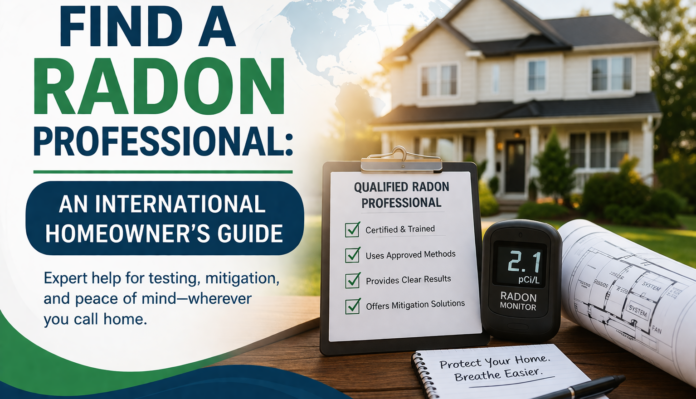
Find a Radon Professional: An International Homeowner’s Guide
Finding the right radon professional can be harder than many homeowners expect. You may start by searching for a radon company near you, only to find test kit sellers, mitigation contractors, general indoor air companies, and directories that vary by country. In some places there is a formal certification system. In others, the best path is to start with a national health agency, radiation authority, or public radon program. That can make the process feel unclear, especially if you are trying to compare information from the United States, Canada, the United Kingdom, and the European Union.
This guide is designed to simplify that process. It explains how to find a radon professional in major English-language and European markets, how to tell whether you need a measurement professional or a mitigation contractor, what questions to ask before hiring, and what warning signs to watch for. The goal is not just to help you find someone who says they work on radon. The goal is to help you find someone qualified to test properly, recommend the right fix, and verify that the work actually reduced the radon level.
Across regions, the details differ, but the overall process is surprisingly similar. First, test the home properly. Second, compare the result to your country’s radon guidance or action level. Third, if the level is elevated, use a qualified professional who understands radon-specific standards and follow-up testing. That basic approach applies whether you live in the U.S., Canada, the UK, or an EU member state.
- Canada
- European Union
- United Kingdom
- United States
Table of Contents
- Why Finding the Right Pro Matters
- What Kind of Radon Professional Do You Need?
- How to Find a Radon Professional in Canada
- How to Find a Radon Professional in the European Union
- How to Find a Radon Professional in the United Kingdom
- How to Find a Radon Professional in the United States
- Questions to Ask Before You Hire
- Red Flags to Watch For
- What a Good Radon Quote Should Include
- What Should Happen After the Work Is Done
- DIY vs Hiring a Professional
- Final Thoughts
Why Finding the Right Pro Matters
Radon is not a cosmetic issue or a minor air-quality annoyance. It is a radioactive gas that can accumulate indoors and increase lung cancer risk over time. Because it is invisible and odorless, homeowners rely heavily on testing and professional guidance to understand whether there is a problem and how serious it may be. That means the quality of the professional you choose matters quite a bit.
A poor-quality radon test can create false confidence. A poor-quality mitigation system can leave high radon levels in place while still costing you a significant amount of money. In some cases, bad work can even create additional problems such as noise, poor system placement, or ineffective suction. That is why public health agencies tend to make the same general recommendation: when radon levels are elevated, use a qualified radon professional rather than assuming a general contractor or handyman will know the correct solution.
This matters even more because radon guidance differs by region. In the United States, the EPA action level is 4 pCi/L, and homeowners may also consider fixing between 2 and 4 pCi/L. In Canada, the guideline is 200 Bq/m³. In the United Kingdom, homes above 200 Bq/m³ are generally recommended for remediation. The World Health Organization recommends a reference level of 100 Bq/m³ where possible and says it should not exceed 300 Bq/m³. Those numbers are not identical, but the message is consistent: once the level is high enough to warrant action, professional help should be credible, specific, and measurable.
What Kind of Radon Professional Do You Need?
Before you search for a radon professional, it helps to decide what type of service you actually need. Many homeowners use the term “radon professional” to mean anyone involved with radon, but there are usually two main roles.
The first is a radon measurement professional. This person or company handles radon testing, places the devices correctly, helps interpret the result, and may provide reporting or guidance on next steps. If you have not tested your home yet, or if you want a professional rather than a do-it-yourself test kit, this is the type of provider you may need first.
The second is a radon mitigation professional. This person or company designs and installs a system to reduce radon levels when testing shows the level is too high. Depending on the property, that could involve sub-slab depressurization, a sump-based system, under-floor ventilation, positive input ventilation, a crawlspace solution, or another building-specific method.
Some companies offer both testing and mitigation. That can be convenient, but you should still ask what certifications apply to each service, whether the firm follows recognized standards, and whether post-mitigation testing is built into the job. Testing and fixing are related, but they are not the exact same service.
How to Find a Radon Professional in Canada
Canada gives homeowners a fairly clear path. Health Canada says there are two main ways to test a home for radon: purchase a do-it-yourself test kit or hire a radon measurement professional. It also recommends a long-term test for a minimum of three months. For many homeowners, that is the best first step. Test properly before spending money on mitigation.
If your result is elevated, the most helpful place to begin your professional search is the Canadian National Radon Proficiency Program (C-NRPP). This is the main certification body most Canadian homeowners will encounter when looking for radon-specific help. The C-NRPP directory allows you to search for certified professionals involved in testing and mitigation.
Another strong consumer resource is Take Action on Radon, which provides homeowner education and points people toward qualified professionals. If you want a practical Canadian sequence, it is this: start with a long-term test, compare the result to the Health Canada guideline of 200 Bq/m³, and if the level is above the guideline, look for a certified mitigation professional through C-NRPP.
When comparing Canadian providers, ask whether they are currently certified, what type of mitigation method they expect to use, whether they have experience with homes like yours, and whether follow-up testing is included. Health Canada notes that many homes can be reduced substantially, often by more than 80 percent, but only if the system is designed and installed correctly. That is why certification and radon-specific experience matter much more than a generic promise to fix the air.
How to Find a Radon Professional in the European Union
The European Union is more complex from a homeowner perspective because there is not one single EU-wide consumer directory that works the same way in every country. Instead, the EU provides the legislative framework, while individual member states develop their own radon action plans, public resources, and implementation systems.
For homeowners, that means the best starting point is usually your own country’s official radon authority, public health agency, radiation protection office, environmental authority, or geological survey. The right pathway in Ireland may not look the same as the right pathway in Germany, France, Spain, Sweden, or the Czech Republic. The EU framework matters, but the national implementation matters more when you are actually trying to hire someone.
One of the most useful Europe-wide context resources is the European Commission Joint Research Centre indoor radon map. This can help you understand broader radon patterns and why some regions may see greater concern. However, it is not a contractor directory and should not be treated as one.
Another helpful resource is the European Radon Association (ERA). ERA is more of a professional and educational hub than a direct homeowner hiring portal, but it can still help you understand the radon landscape in Europe and point you toward the broader network of professionals, events, and organizations involved in the field.
If you live in an EU country and want a simple rule to follow, start local first. Search for your national radon or radiation-protection authority. Look for your country’s official radon action plan or homeowner guidance. Then look for approved, recognized, or certified radon professionals within that country. That process is usually much more reliable than typing a vague phrase into a search engine and hoping the top result is trustworthy.
It is also important to understand that the EU framework generally requires indoor radon reference levels that do not exceed 300 Bq/m³, although some countries choose lower national levels. Because of that, homeowners should always rely on the exact guidance that applies where the home is located rather than assuming one number applies everywhere in Europe.
How to Find a Radon Professional in the United Kingdom
In the United Kingdom, one of the clearest homeowner resources is UKradon. The site lays out the process in a very practical way: check, measure, and act. That structure makes it easier for homeowners to understand where they are in the process and what they should do next.
The first step is checking whether the property is in a radon-affected area or has known radon potential. The second step is measurement. UKradon explains that domestic radon measurement is generally carried out over three months using detectors placed in rooms such as a living area and a bedroom so the result reflects real occupancy. The third step is taking action when levels are high.
The UK radon action level is generally presented as 200 Bq/m³ for homes. If your result is above that level, the next step is to evaluate reduction options. UKradon explains several common approaches, including active radon sumps, positive ventilation, and under-floor ventilation. Which one is best depends on the home’s construction.
That is why a UK homeowner should look for a professional who can explain the reason for the chosen system, not just quote a price. A serious radon contractor should be able to explain why a sump is appropriate, why a ventilation strategy is appropriate, or why another method makes more sense for the structure involved. If the explanation is vague or sounds copied from a generic sales script, that is a reason to slow down.
UKradon is also useful because it reinforces the importance of re-measurement after remedial work. That is a theme that shows up across every good radon program: installation alone does not prove success. Follow-up measurement proves success.
How to Find a Radon Professional in the United States
The United States has one of the most structured public pathways for homeowners. The EPA’s radon professional page tells homeowners to contact their state radon program for help finding qualified providers. That is one of the best places to begin because state programs often maintain public lists and state-specific information.
In addition to state programs, U.S. homeowners commonly encounter two national credentialing organizations: the National Radon Proficiency Program (NRPP) and the National Radon Safety Board (NRSB). These directories allow homeowners to verify whether a provider is certified for radon measurement, mitigation, or related work.
The EPA action level is 4 pCi/L, and the EPA also notes that people may want to consider fixing between 2 and 4 pCi/L. If a homeowner has a result at or above the action level, the smart next step is to use the EPA page, check the state radon program, and then verify the contractor in a national certification directory.
When you speak with a U.S. contractor, ask whether they follow current radon standards of practice, what type of homes they usually work on, what kind of system they expect to install, and whether post-mitigation testing is part of the job. It is also worth asking how they typically route pipe, where fans are placed, whether the discharge point will meet good practice, and how they handle follow-up if the first post-mitigation result is still too high.
One good habit for American homeowners is to cross-check a contractor in three places: EPA guidance, the state radon program, and the certification directory itself. That extra effort can filter out providers who are marketing to radon homeowners without having strong radon-specific credentials behind the work.
Questions to Ask Before You Hire
Before hiring any radon professional, ask who trained or certified them. In Canada, that usually means C-NRPP. In the United States, that often means NRPP or NRSB. In the UK and EU, the answer may be more country-specific, but there should still be a clear professional pathway or recognized authority behind the work.
Ask whether they are being hired for testing, mitigation, or both. That may sound obvious, but it helps clarify the scope immediately. A company that handles measurement is not automatically the best fit for mitigation, and vice versa.
Ask what type of reduction method they expect to use and why. A real radon professional should be able to explain the likely method in plain language based on the home’s foundation type, layout, and construction. If the answer sounds like a generic script that could apply to every house, that is not ideal.
Ask whether post-mitigation testing is included. This is one of the best screening questions available. A contractor who takes radon seriously should expect the work to be measured afterward, not just installed.
Ask where visible components will go. That includes fan placement, piping route, discharge point, and any electrical work. A good system should be effective, but it should also be thoughtfully planned around noise, appearance, service access, and weather exposure.
Finally, ask what happens if the post-mitigation result is still above the target. Good providers usually have a process for troubleshooting, adjusting, and retesting. Weak providers sometimes act as though installation itself ends their responsibility.
Red Flags to Watch For
One of the biggest red flags is a company that says sealing cracks alone will solve a significant radon problem. Sealing may be part of a broader mitigation approach, but it is usually not the whole solution for homes with elevated radon. If a provider acts as though a little sealant is the full answer, be cautious.
Another red flag is a one-size-fits-all sales pitch. Different homes behave differently. A basement home, crawlspace home, slab-on-grade home, or mixed-foundation home can all need different approaches. A real radon professional should sound specific and thoughtful, not generic.
Be cautious if the provider cannot clearly explain the test result, the action level that applies in your region, or the reason for the proposed system. Be cautious if they avoid talking about follow-up testing. Be cautious if they promise absolute outcomes without first understanding the property.
Also be cautious if the company seems only loosely connected to radon work. Some HVAC companies, waterproofing companies, and general contractors do excellent radon mitigation. Others treat it as a side service. The difference usually becomes obvious once you start asking technical and process-based questions.
What a Good Radon Quote Should Include
A strong radon quote should describe the problem and the proposed solution clearly. It should explain whether the quote is based on your existing test result or on the company’s own measurement. It should describe the likely mitigation approach in homeowner-friendly language rather than hiding behind jargon.
The quote should also make clear what equipment is included, whether electrical work is included, where major visible components will likely go, whether sealing work is included, and whether post-mitigation testing is part of the job. These details matter because they show whether the provider is selling a complete radon reduction job or simply installing a fan and pipe with little accountability afterward.
A weak quote tends to be vague. A strong quote is clear enough that a homeowner can understand the plan without needing engineering knowledge. That clarity is often a good sign that the contractor has done this process many times and has nothing to hide.
What Should Happen After the Work Is Done
After installation, the next step should be verification. That means a post-mitigation radon test after the system has been operating long enough to provide a meaningful result. The exact timing and method may differ by program, but the principle is the same everywhere: you do not assume success. You measure success.
This is the step homeowners sometimes skip because the visible work feels finished. The fan is installed, the pipe is in place, and the job looks complete. But none of that proves the radon level is now acceptable. Only follow-up testing can do that.
It is also worth remembering that radon is not always a one-time issue. Fans can fail. Renovations can change airflow. Additions, basement finishing, insulation changes, and ventilation changes can all affect indoor radon behavior. That is why a good radon professional should not only install a system but also explain what the homeowner should monitor over time.
DIY vs Hiring a Professional
DIY testing is often completely reasonable. In fact, official guidance in multiple countries supports it as one option. Health Canada says homeowners can buy a test kit or hire a measurement professional. UKradon offers measurement packs. The EPA also helps people locate radon test kits. If your first question is simply whether your home has elevated radon, a reputable long-term test can be a smart and cost-effective place to begin.
DIY mitigation is a different issue. Once the home has elevated radon and a reduction system is needed, the risk of poor decisions rises quickly. Mitigation is technical work. It depends on the building structure, the pressure dynamics, the entry points, and the correct system design. For that reason, most homeowners are better served by a qualified radon mitigation professional than by trying to piece together a solution from scattered online advice.
A practical rule is this: DIY testing can make sense. DIY fixing deserves much more caution.
Final Thoughts
If you are trying to find a radon professional, the most important idea to keep in mind is that this is not just a directory search. It is a credibility search. You are looking for someone whose qualifications, methods, and follow-up process can be checked.
For U.S. homeowners, that usually means starting with the EPA, your state radon program, and directories such as NRPP or NRSB. For Canadians, it usually means Health Canada guidance and the C-NRPP directory. For UK homeowners, UKradon is the natural first stop. For homeowners in the EU, the best path is usually through your own country’s official radon or radiation-protection authority, with broader EU resources used for context rather than as your only guide.
In every region, the best radon professional is not simply the person who installs a fan or sells a test. It is the person who understands the building, uses the right method, and proves the result with follow-up measurement.
Sources
- U.S. EPA – Find a Radon Test Kit or Measurement and Mitigation Professional
- U.S. EPA – What Is EPA’s Action Level for Radon?
- U.S. EPA – Consumer’s Guide to Radon Reduction
- U.S. EPA – Radon Standards of Practice
- NRPP – Find a Radon Mitigation or Measurement Professional
- NRSB – Find a Pro
- Health Canada – Testing Your Home for Radon
- Health Canada – Government of Canada Radon Guideline
- Health Canada – Radon Reduction Guide for Canadians
- C-NRPP – Find a Professional
- Take Action on Radon
- UKradon
- UKradon – Radon Action Level and Target Level
- UKradon – Measuring Radon
- UKradon – How to Reduce Radon Levels
- European Radon Association – Radon Professionals
- European Commission JRC – Indoor Radon Concentration Map
- World Health Organization – Radon and Health