
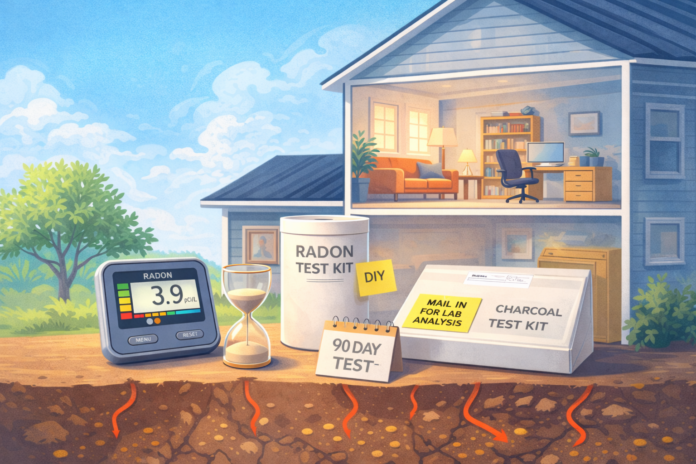
How Long Does a Radon Test Take? A Clear Guide by Test Type
If you are about to test your home for radon, one of the first questions is simple: how long will it take? The answer depends on the type of radon test you use. Some tests can give a useful screening result in a few days. Others are designed to measure your average exposure over months.
This guide breaks down the time required for each common radon testing method, why time matters for accuracy, and how to choose the right approach for your situation.
Why radon test duration matters
Radon levels change. Weather, season, ventilation, and HVAC operation can all cause radon levels to rise and fall. Because of that, a shorter test captures a smaller slice of time and can be more sensitive to temporary conditions. A longer test averages over many conditions and usually provides a better estimate of your true long-term exposure.
Radon health risk is linked to long-term exposure, so the goal of testing is not to capture the highest possible reading on one day. The goal is to understand your typical radon level and decide whether you should reduce it.
Short-term radon tests: how long they take
Short-term tests are designed for speed. They are often used for initial screening and real estate transactions.
Typical duration
- 2 to 7 days is the most common short-term test window for consumer kits and many standard guidance materials.
Some professional protocols and devices may use slightly different short-term windows, but 2 to 7 days is a good general expectation.
When short-term tests make sense
- You want a quick screening result.
- You are buying or selling a home and need a result fast.
- You want to decide quickly whether radon might be an issue.
How long until you get results?
That depends on the kit type:
- Mail-in DIY kits: add shipping time plus lab processing. Many people receive results within several days to a couple of weeks after mailing, depending on the lab and mail speed.
- Professional continuous monitors: results can often be available immediately after the test window ends, since the device stores data.
Charcoal-based kits are often time sensitive after the test ends, so it is important to mail them promptly as instructed.
Long-term radon tests: how long they take
Long-term tests are designed to estimate your average radon level more accurately by capturing more conditions over time.
Typical duration
- 90 days to 1 year is commonly used to describe long-term radon tests in many guidance materials.
Long-term testing is slower, but it is often the best method for understanding true average exposure, especially if your short-term result is in a moderate range and you want clarity before deciding on mitigation.
When long-term tests make sense
- You want the best estimate of your long-term average radon level.
- Your short-term result is near a decision threshold.
- You want to understand radon exposure under normal living conditions across seasons.
- You are tracking performance after mitigation and want confirmation across varied conditions.
How long until you get results?
Long-term tests are usually mail-in lab tests, so your timeline looks like this:
- Test duration (90+ days)
- Mailing time to the lab
- Lab processing time
Many labs process quickly once they receive the kit. The long part is the test itself because the point is capturing an average over time.
Digital radon monitors: how long before the reading is meaningful?
Digital radon monitors are different because they do not have one fixed test window. They provide rolling averages, often across multiple time periods.
Most monitors provide:
- A short-term average (often 1 to 2 days)
- A mid-range average (often 7 days)
- A longer-term average (often 30 days or longer)
How long a digital monitor takes depends on what number you plan to use:
- First 48 hours: you may see an initial estimate, but it can swing sharply.
- After 7 days: you get a better sense of typical weekly behavior.
- After 30 days: you start getting a more stable average that is better for decisions.
If you are using a digital monitor to decide whether mitigation is needed, focus on the longest averaging window it provides. Short spikes can be useful for learning patterns, but they should not drive major decisions by themselves.
Real estate radon tests: common timing
In a real estate transaction, time is often the main constraint. Many real estate radon tests use a short-term measurement under closed-house conditions.
A typical real estate radon testing timeline is:
- Prepare closed-house conditions (commonly at least 12 hours before testing begins, depending on protocol)
- Run a short-term test (commonly 2 days or longer)
- Retrieve the device and generate the report
Because this is a defined test window, results are usually available quickly once the measurement period ends, especially when a continuous monitor is used.
How to choose the best test length for your situation
Use this quick decision guide:
If you need a quick answer
- Use a short-term test (2 to 7 days).
- Expect a few days plus mailing and lab time if using a mail-in kit.
If you want the best estimate of long-term exposure
- Use a long-term test (90 days or longer).
If you want ongoing awareness and trend data
- Use a digital monitor and focus on 30-day or longer averages.
If your result is borderline
- Use a long-term test to refine the decision.
What to do while you are waiting for results
Most people do not need to change their lives during a radon test. For short-term tests, follow closed-house guidance if required. For long-term tests, live normally so the result reflects your typical conditions.
If you already have reason to believe radon may be high, such as a previous test result, and you spend a lot of time in a basement living area, you can temporarily reduce time spent in that space until you have more information. This is a practical precaution, not a substitute for testing or mitigation.
Bottom line
A radon test can take as little as 2 to 7 days for a short-term screening result or as long as 90 days to one year for a long-term average. Digital monitors can provide early readings within days, but the most meaningful averages usually require weeks.
If you want speed, use a short-term test. If you want accuracy for long-term exposure, use a long-term test. If you want ongoing insight, use a monitor and focus on longer averages.
Sources
- U.S. Environmental Protection Agency (EPA) – How to test your home for radon
- Centers for Disease Control and Prevention (CDC) – Testing for radon
- EPA – A Citizen’s Guide to Radon (PDF)
- National Radon Program Services (Kansas State University) – Radon education and testing guidance
- EPA – How do I get a radon test kit?