
Types of Radon Test Kits: A Homeowner’s Guide to Short-Term, Long-Term, and Digital Options
Radon is a naturally occurring radioactive gas that can build up indoors. You cannot see it, smell it, or taste it, so testing is the only way to know your radon level. Once you start shopping, it can get confusing fast because there are multiple types of radon test kits and devices, and each one is designed for a different purpose.
This guide breaks down the main types of radon test kits, what each one measures, how long each test runs, when each option makes sense, and the most common mistakes to avoid. By the end, you should be able to choose the right test kit with confidence and interpret your results correctly.
Two big categories: passive kits vs active devices
Most radon tests fall into one of two categories:
- Passive test kits: These do not require power. You place them, leave them for a defined period, then mail them to a lab (or read them as instructed). Many DIY kits are passive.
- Active devices: These require power and continuously measure radon levels in real time. This category includes professional continuous radon monitors and many consumer digital radon monitors.
Within those categories, tests are also described by duration:
- Short-term tests: Typically a few days. Useful for quick screening.
- Long-term tests: Typically 90 days or more. Useful for estimating your average exposure over time.
Radon risk is linked to long-term exposure, so long-term averages matter. Short-term tests are still valuable because they can quickly identify whether radon is likely elevated.
Short-term passive test kits
Short-term kits are commonly used when you want a fast answer, such as initial screening or real estate timelines. They are also the most widely available DIY option.
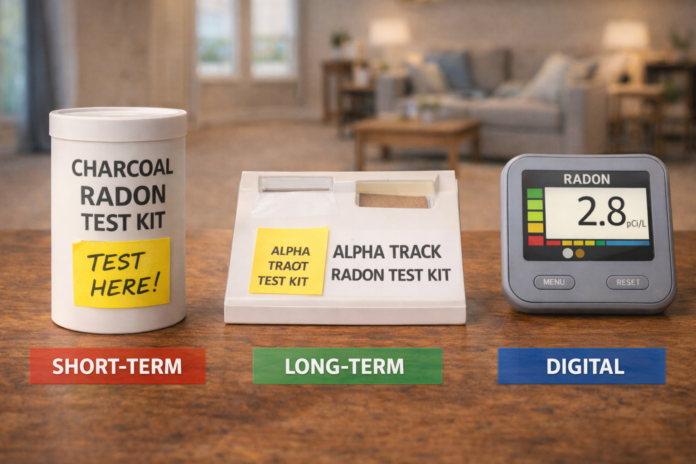
1) Charcoal canister kits
Charcoal canisters are one of the most common DIY radon tests. The charcoal adsorbs radon during the test period. After the test ends, the kit is sealed and mailed to a lab for analysis.
Best for: Quick screening, first-time testing, real estate timeframes.
Key considerations:
- These tests are time-sensitive. Follow instructions closely and mail promptly after the test ends.
- Short-term conditions can influence results, so a follow-up test may be needed if results are close to decision thresholds.
2) Charcoal liquid scintillation kits
These are similar to charcoal canisters, but the charcoal is analyzed using a liquid scintillation method. In practical homeowner terms, they are still short-term, mail-in charcoal-based tests, and the instructions and handling requirements are similar.
Best for: Short-term screening when the kit provider uses this lab method.
Key considerations: Treat it like a charcoal test. Accurate timing and fast return shipping matter.
3) Electret ion chamber kits (short-term)
Electret ion chamber tests use a charged disk (the electret) inside a small chamber. Radon entering the chamber ionizes the air and reduces the electret’s charge. The change in charge is used to calculate radon concentration over the test period.
Best for: Short-term screening, sometimes used by professionals and some advanced DIY programs.
Key considerations:
- These can be accurate, but availability to consumers varies.
- They still require careful placement and correct timing.
Long-term passive test kits
Long-term tests are designed to estimate your average radon level more accurately by capturing changes across weather and living patterns. If your goal is long-term risk clarity, long-term tests are usually the best fit.
4) Alpha track detectors
Alpha track tests are one of the most common long-term DIY kits. They contain a small piece of material that records tracks from alpha particles released by radon decay products. After the test period, the detector is mailed to a lab, where the tracks are counted to calculate the average radon level for that time period.
Best for: Understanding true average exposure, confirming moderate results, establishing a long-term baseline, post-mitigation follow-up.
Key considerations:
- Long-term tests typically run for 90 days to a year.
- They are less sensitive to a single unusual day because they average over a long period.
5) Electret ion chamber kits (long-term)
Electret ion chambers can also be used long-term. The concept is the same as short-term electret tests, but the test duration is longer, and the result is a better estimate of your average exposure.
Best for: Long-term averaging when using an electret-based program.
Key considerations: Follow the test provider’s duration and handling instructions precisely.
Active test devices
Active devices measure radon continuously. They are useful for professional testing, diagnostics, and ongoing home monitoring.
6) Professional continuous radon monitors (CRMs)
Continuous radon monitors are commonly used by radon measurement professionals. They typically record hourly values and produce a short-term average for the test window. These devices can be useful in real estate transactions and formal testing protocols because they create time-stamped data.
Best for: Professional short-term measurement, real estate testing, diagnosing patterns, compliance-focused testing.
Key considerations:
- Professional use often includes documentation and controlled test conditions.
- These are usually not the cheapest option, but they provide strong documentation and trend visibility.
7) Consumer digital radon monitors
Consumer digital radon monitors are designed for ongoing home awareness. Many provide a short-term average and a longer-term rolling average (such as 7-day or 30-day). This can help homeowners see patterns and confirm mitigation performance.
Best for: Ongoing awareness, learning patterns, tracking seasonal changes, monitoring after mitigation.
Key considerations:
- Do not overreact to single-day spikes. Focus on longer averages.
- Placement matters. Keep the device away from drafts, vents, and high humidity areas.
- For decisions near key thresholds, a lab-based long-term test can provide cleaner confirmation.
Which type should you choose?
Use your goal to choose the device:
- Quick screening: Charcoal canister or other short-term kit.
- Best estimate of average exposure: Long-term alpha track (or long-term electret).
- Real estate transaction: Short-term testing is common, often professional, then consider a long-term test after move-in for a better baseline.
- Post-mitigation verification: A follow-up test using a recognized method, plus optional use of a digital monitor for ongoing tracking.
If you want a simple plan that works for most homeowners: start with a short-term test. If it is elevated or borderline, follow up with a long-term test to understand your average exposure.
Placement basics apply to every kit type
Even the best test kit fails if it is placed poorly. Most kits follow the same placement logic:
- Test the lowest level that is used regularly.
- Choose a room people actually occupy, such as a bedroom, office, or family room.
- Avoid kitchens, bathrooms, laundry rooms, and areas near vents, windows, or exterior doors.
- Keep the test where it will not be disturbed by pets or children.
Closed-house conditions: important for short-term tests
Many short-term test instructions require closed-house conditions, meaning windows and exterior doors remain closed except for normal entry and exit. This helps reduce variability and makes the test more representative of typical indoor conditions when a home is sealed up.
Long-term tests are less sensitive to short-term ventilation changes, but you should still follow the kit instructions.
What your result means and what to do next
In the U.S., the EPA action level is 4.0 pCi/L. Many health agencies also encourage considering action in the 2.0 to 4.0 pCi/L range because lower is better and radon risk is cumulative.
A practical next-step approach:
- Below 2.0 pCi/L: lower risk, keep records, retest in the future or after major home changes.
- 2.0 to 4.0 pCi/L: consider a long-term test to estimate your average more accurately and consider mitigation depending on your situation.
- At or above 4.0 pCi/L: follow guidance for confirmation and mitigation planning, especially if the result is confirmed or sustained.
Common mistakes with radon test kits
- Testing on the wrong level of the home
- Placing the kit near a window, door, or HVAC vent
- Running a short-term test while windows are frequently open
- Ending a charcoal test and waiting too long to mail it
- Moving the kit during the test period
- Overreacting to digital monitor spikes instead of focusing on longer averages
Bottom line
There are several valid types of radon test kits. Short-term charcoal tests are a popular first step because they are fast. Long-term alpha track tests are often the best way to estimate average exposure. Digital monitors can provide valuable ongoing insight when you focus on longer averages and trends.
Pick the kit that matches your goal, follow the placement and timing instructions carefully, and use follow-up testing when results are near decision thresholds. That approach makes radon testing practical and reliable.
Sources
- U.S. Environmental Protection Agency (EPA) – Find a radon test kit or measurement and mitigation professional
- U.S. Environmental Protection Agency (EPA) – Home Buyer’s and Seller’s Guide to Radon (PDF)
- U.S. Environmental Protection Agency (EPA) – A Citizen’s Guide to Radon (PDF)
- Centers for Disease Control and Prevention (CDC) – Testing for radon
- ATSDR (CDC) – Radon Toxicity: Methods of detection and measurement
- National Radon Program Services (Kansas State University) – Testing devices overview
- ANSI and AARST – Radon standards (measurement device performance and protocols)
- California Department of Public Health – Radon testing overview and test types