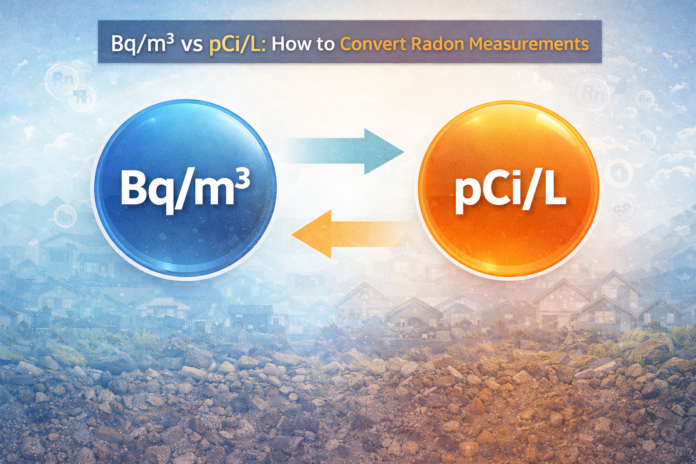
Bq/m³ vs pCi/L: How to Convert Radon Measurements
If you have ever searched radon information online, you have probably seen two different units used for the same thing:
Bq/m³ (becquerels per cubic meter), used in most countries, and pCi/L (picocuries per liter), commonly used in the United States.
The numbers look totally different, which is why conversion matters. A result that looks “small” in one unit can look “huge” in the other. For example, 4.0 pCi/L is roughly the same as about 148 Bq/m³. Once you know the conversion, comparing guidance from the EPA, WHO, Health Canada, the UK, and other countries becomes much easier.
This guide explains what these units mean, why both exist, the exact conversion factor, and the fastest way to convert in either direction. It also includes a cheat sheet table you can bookmark.
Table of Contents
- What Bq/m³ and pCi/L actually mean
- The conversion factor (the one line you need)
- Why the conversion is 37 (simple explanation)
- How to convert, in both directions
- Common conversion cheat sheet
- Comparing action levels and reference levels worldwide
- Rounding rules and why your numbers may not match exactly
- Common conversion mistakes
- FAQs
- Sources
What Bq/m³ and pCi/L actually mean
Radon measurements describe how much radioactivity is present in a volume of air. Radon is radioactive, so it “decays” over time. These units are both ways to express the rate of radioactive decay in air.
Bq/m³ (becquerels per cubic meter) means: how many radioactive decays happen each second in one cubic meter of air. One becquerel is defined as one decay per second. So 100 Bq/m³ means, on average, 100 decays per second in each cubic meter of air.
pCi/L (picocuries per liter) means: how many curies (a different radioactivity unit) are present in one liter of air. A curie is an older unit that is still widely used in the US for radon. “pico” means trillionth. So a picocurie is a very small fraction of a curie.
Both units measure the same physical reality, they just use different base units and different volumes of air.
The conversion factor (the one line you need)
This is the conversion that matters:
1 pCi/L = 37 Bq/m³
Which means:
Bq/m³ = pCi/L × 37
pCi/L = Bq/m³ ÷ 37
That is it. If you remember only one thing, remember 37.
Why the conversion is 37 (simple explanation)
You do not have to understand the math to use the conversion, but it helps to see why it is so clean.
Step 1: Convert curies to becquerels.
By definition, 1 curie (Ci) equals 3.7 × 10¹⁰ becquerels (Bq). That means 1 Ci represents 37 billion decays per second.
Step 2: Convert picocuries to becquerels.
A picocurie (pCi) is 10-12 curies. So:
1 pCi = 10-12 Ci = 10-12 × 3.7 × 1010 Bq = 3.7 × 10⁻² Bq
That equals 0.037 Bq.
Step 3: Convert liters to cubic meters.
1 liter (L) is 0.001 cubic meters (m³). A cubic meter contains 1000 liters.
Step 4: Put it together.
If you have 0.037 Bq in 1 liter, then in 1000 liters (which is 1 m³) you have:
0.037 × 1000 = 37 Bq per m³
That is why the conversion is exactly 37, not an approximation.
How to convert, in both directions
Most people only need two practical conversions. Here they are with examples.
Convert pCi/L to Bq/m³
Multiply by 37.
Example: 4.0 pCi/L × 37 = 148 Bq/m³
Convert Bq/m³ to pCi/L
Divide by 37.
Example: 200 Bq/m³ ÷ 37 = 5.405… pCi/L (about 5.4 pCi/L)
If you do not want decimals, use the quick mental version:
Multiply by 40 to get a rough upper estimate, multiply by 35 to get a rough lower estimate. But for anything important, use 37.
Common conversion cheat sheet
This table covers the most common radon numbers you will see in articles, test results, and national guidelines.
| pCi/L | Approx Bq/m³ | Why this number matters |
|---|---|---|
| 1.0 | 37 | Low, but not “zero risk” |
| 2.0 | 74 | Often referenced as a “consider action” zone in the US |
| 2.7 | 100 | WHO recommended reference level where feasible |
| 4.0 | 148 | EPA action level (commonly rounded to 150 Bq/m³) |
| 5.4 | 200 | Common national guideline level in several countries |
| 8.1 | 300 | Upper cap used in several international frameworks for national reference levels |
| 10.0 | 370 | High, mitigation is typically urgent |
If you want the same table the other way around, here are common Bq/m³ values converted to pCi/L.
| Bq/m³ | Approx pCi/L | Why this number matters |
|---|---|---|
| 50 | 1.35 | Common low-to-moderate result in many homes |
| 100 | 2.7 | WHO recommended reference level where feasible |
| 150 | 4.05 | Close to the EPA action level equivalent |
| 200 | 5.4 | Common national guideline level in some countries |
| 300 | 8.1 | EU cap for national reference levels (annual average) |
| 500 | 13.5 | Very elevated, mitigation typically needed |
| 1000 | 27.0 | Extremely high in a home, immediate action recommended |
Comparing action levels and reference levels worldwide
Once you can convert the units, global guidance becomes much easier to compare. Here are a few examples that homeowners commonly run into.
United States (EPA): EPA’s action level is 4.0 pCi/L, which equals about 148 Bq/m³. Many international discussions round that to 150 Bq/m³ for simplicity. EPA also recommends considering action between 2.0 and 4.0 pCi/L, which is roughly 74 to 148 Bq/m³.
World Health Organization (WHO): WHO recommends a reference level of 100 Bq/m³ where feasible, which converts to about 2.7 pCi/L. WHO also states that where 100 Bq/m³ is not achievable, the chosen reference level should not exceed 300 Bq/m³, which is about 8.1 pCi/L.
European Union (EU guidance framework): EU Member States establish national reference levels for indoor radon, and the reference level for annual average should not be higher than 300 Bq/m³ (about 8.1 pCi/L). Many countries choose lower values.
Canada (Health Canada): Canada’s guideline is 200 Bq/m³, which converts to about 5.4 pCi/L.
The big takeaway is not that one country thinks 8.1 pCi/L is “safe.” It is that countries pick policy trigger points based on international frameworks, feasibility, and national programs. Risk still increases as radon increases, regardless of where the “line” is drawn.
Rounding rules and why your numbers may not match exactly
You will often see small differences in published conversions, such as 4.0 pCi/L being described as 148 Bq/m³ in one place and 150 Bq/m³ in another. That is usually just rounding. The exact conversion uses 37.
Here are the most common rounding behaviors:
Rounding to clean public numbers. Many public health pages round 148 to 150 because it is easier to remember.
Rounding based on measurement uncertainty. Radon tests have uncertainty. If your measurement is 4.0 pCi/L, the “true” value might not be exactly 4.0 when accounting for measurement uncertainty, seasonal variation, and test method. In that context, a few Bq/m³ of rounding does not change your decision.
Using “about” language. When you see “about 150 Bq/m³,” it is usually not a different conversion. It is a communication choice.
Practical rule: if you are making decisions, use the exact conversion (× 37 or ÷ 37). If you are writing educational content, rounding to clean values can be fine as long as you clearly indicate it is approximate.
Common conversion mistakes
Mistake 1: Mixing up which direction to convert. If you multiply when you should divide, you can get a value that is off by a factor of 1000 in your head. Quick sanity check: Bq/m³ numbers are usually bigger than pCi/L numbers for the same radon level.
Mistake 2: Forgetting that many guidelines assume an annual average. Many reference levels are designed for long-term average exposure, not a single 48-hour snapshot. A short-term test can still be useful, but borderline results often deserve follow-up testing.
Mistake 3: Treating the threshold as a “safe line.” Radon risk does not turn on at one number. It generally increases as the radon level increases. Thresholds are practical triggers for action.
Mistake 4: Comparing a basement test to a whole-house assumption. Units conversion is important, but placement and testing conditions often matter just as much. A basement can be much higher than upper floors. Your exposure depends on where you spend time.
FAQs
What is the fastest way to convert Bq/m³ to pCi/L?
Divide by 37. Example: 300 Bq/m³ ÷ 37 ≈ 8.1 pCi/L.
What is the fastest way to convert pCi/L to Bq/m³?
Multiply by 37. Example: 4.0 pCi/L × 37 = 148 Bq/m³.
Why does the United States use pCi/L instead of Bq/m³?
It is mostly historical. The US has long used curies in radiation measurement contexts, while many other countries and modern radiation standards use becquerels. Both measure the same thing.
If my radon is 100 Bq/m³, what is that in US units?
100 ÷ 37 ≈ 2.7 pCi/L.
If my radon is 4 pCi/L, what is that in metric units?
4 × 37 = 148 Bq/m³, often rounded to about 150 Bq/m³ in public guidance.
Sources
- US EPA: What is EPA’s Action Level for Radon and What Does it Mean?
- CDC: Radon and Your Health
- CDC: Testing for Radon in Your Home (notes no known safe level)
- WHO: Handbook on Indoor Radon (PDF)
- WHO: Radon and health
- European Union: Council Directive 2013/59/Euratom (PDF)
- Health Canada: Government of Canada radon guideline