
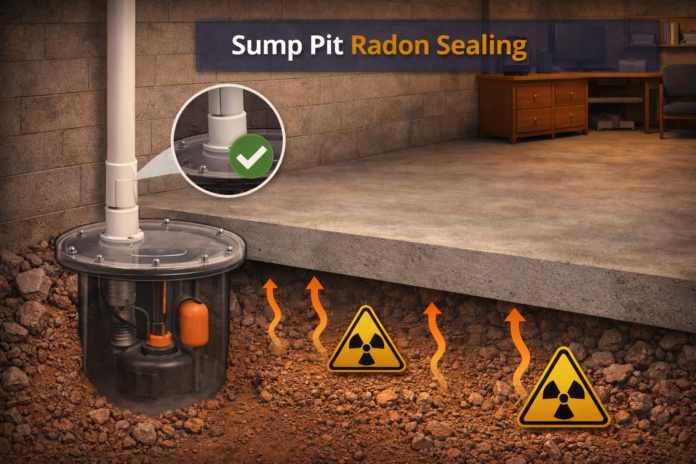
Sump Pit Radon Sealing: When It Helps (and When It Doesn’t)
If your basement has a sump pit, you already have one of the most direct openings between your home and the soil beneath it. That matters for radon, because radon is a soil gas. An open or loosely covered sump can act like a large entry point where radon-rich soil air can flow into the basement.
Sealing a sump pit can absolutely help in the right context. It can also be wildly overrated when homeowners treat it as a standalone fix. The truth sits in the middle: sump sealing is often a high-value supporting step, and in certain homes it can make a noticeable difference, but it is rarely the complete solution when radon levels are truly elevated.
This guide explains exactly when sump pit sealing helps, when it doesn’t, and how to approach it in a practical way without creating new problems.
Radon decision anchor: The EPA recommends fixing a home if radon is 4.0 pCi/L or higher, and also recommends considering action between 2.0 and 4.0 pCi/L. EPA action level guidance.
Table of Contents
- What a sump pit is and why it matters for radon
- Why sealing can reduce radon (the simple physics)
- When sump pit sealing helps
- When it doesn’t help (or doesn’t help much)
- Why sealing alone is usually not enough
- How to seal a sump pit for radon the right way
- Common sump sealing mistakes
- Sump sealing with an active radon system
- What to do after sealing: testing and next steps
- FAQs
- Sources
What a sump pit is and why it matters for radon
A sump pit is a basin set into the basement floor where groundwater can collect and be pumped out. Many homes with interior drain tile or perimeter drains route water toward the sump. From a radon perspective, the important detail is that the sump pit is typically connected to the soil and drainage layers under the slab. That connection can also provide a pathway for soil gas.
EPA’s radon-resistant construction guidance calls this out clearly: an open sump may allow radon into the house from beneath the foundation, and the sump should be covered and sealed. EPA Building Radon Out (PDF).
Minnesota’s radon program also describes drain tile suction systems and notes that covers are placed on sump baskets as part of mitigation system designs. Minnesota Department of Health: Radon Mitigation Systems.
Why sealing can reduce radon (the simple physics)
Radon moves from higher pressure to lower pressure. Many homes naturally create lower pressure in the basement compared to the soil around and beneath the foundation. That pressure difference can pull soil gas into the home through openings in the slab and foundation. When a sump pit is open or loosely covered, it can become one of the easiest paths for soil gas to enter.
Sealing the sump pit reduces that direct air pathway. It also helps in a second way that is easy to miss. If you have an active radon mitigation system, any large opening inside the basement (like an open sump) can allow the system to pull conditioned indoor air instead of pulling soil gas. This can reduce the efficiency of the system and increase the loss of heated or cooled indoor air. Both EPA and NRPS describe sealing as a basic part of most radon reduction approaches because it limits radon entry and makes other techniques more effective and cost-efficient, while also reducing the loss of conditioned air. EPA Consumer’s Guide to Radon Reduction (PDF) and NRPS Mitigation Basics.
So sump sealing can help as a direct “block an opening” step and as an “improve system efficiency” step. The bigger benefit depends on whether you already have a mitigation system and whether the sump is a dominant entry point in your specific home.
When sump pit sealing helps
Sump pit sealing helps most when the sump is acting like a major air leak between the soil and the basement, or when an active radon system needs the sump area sealed to work efficiently.
Here are the most common “high impact” scenarios, written the way homeowners actually experience them.
Scenario 1: The sump pit is open, or the lid is loose and obviously leaky. If you can see the water and the perimeter gap is wide or irregular, you essentially have a direct soil-gas opening into the basement. EPA’s radon-resistant construction guidance treats open sumps as a meaningful pathway and recommends covering and sealing them. EPA Building Radon Out (PDF).
Scenario 2: Your radon system is connected to drain tile or the sump. Some mitigation designs pull soil gas through drain tile or a sump connection. In these designs, a sealed sump lid is not optional. It is part of how the system works. Minnesota’s radon mitigation system overview describes drain tile suction systems and specifically mentions covers on sump baskets. Minnesota Department of Health.
Scenario 3: Radon is only moderately elevated and you are trying to reduce obvious entry points first. If your test is in the “consider action” range (2.0 to 4.0 pCi/L) and you have a very leaky sump, sealing can contribute to a meaningful drop in some homes. It is not guaranteed, but it is one of the more logical “first improvements” because the sump can be such a direct opening. EPA’s action level guidance is the correct reference point for deciding whether you are in a “must fix” versus “consider improvements” situation. EPA action level guidance.
Scenario 4: You already have mitigation, but your system seems less effective than expected. If your post-mitigation radon level is still higher than you want, sealing major openings like the sump can improve efficiency and help the system focus suction where it should. EPA describes sealing as a supporting step that can make other techniques more effective and cost-efficient. EPA Consumer’s Guide (PDF).
When it doesn’t help (or doesn’t help much)
This is where homeowners get frustrated. They seal the sump, feel good about it, and then the radon number barely changes. That outcome is common, and it is usually not because sealing is “fake.” It is because the sump was not the dominant entry pathway, or because pressure forces are still pulling soil gas in through many other openings.
Scenario 1: Your radon is high because of multiple pathways, not one big opening. A basement slab can have dozens of micro-openings and pathways that add up: slab cracks, the slab-to-wall joint, pipe penetrations, floor drains, and foundation wall pathways. Sealing one big hole may not move the needle much if the rest of the system is still pulling soil gas in.
Scenario 2: The sump was already effectively sealed. Some homes already have a decent cover with a gasket or tight fit. If the sump is not leaking much air, “sealing it again” will not change much.
Scenario 3: You are trying to use sealing as a substitute for mitigation at higher radon levels. If your radon is well above 4.0 pCi/L, sump sealing alone rarely produces the consistent, reliable reduction most homeowners want. EPA explicitly states that sealing alone has not been shown to lower radon levels significantly or consistently and does not recommend sealing as the only strategy. EPA Consumer’s Guide (PDF).
Scenario 4: The basement is not your lived-in level and your test placement does not match exposure. If you test in a basement storage area but you do not spend time there, you might seal the sump and still feel unclear about what you accomplished. This is not a sump problem. It is a “testing strategy” problem. The goal is measuring the level where you live and use the home regularly.
Why sealing alone is usually not enough
It is worth saying plainly: sump sealing is often a smart move, but it is not a complete mitigation plan by itself for most elevated homes.
EPA’s Consumer’s Guide explains why. Sealing cracks and other openings is a basic part of most approaches because it limits radon entry and makes other techniques more effective, but EPA does not recommend sealing alone because it has not been shown to lower radon levels significantly or consistently. EPA Consumer’s Guide (PDF).
NRPS makes the same point and adds a practical reason homeowners can relate to: even if you seal well today, new cracks and openings can appear as a house settles. NRPS Mitigation Basics.
If your goal is dependable radon reduction, sealing is usually a supporting step paired with an active mitigation method (most commonly active soil depressurization for basement and slab homes). That active system changes the pressure relationship under the slab so radon is pulled into the mitigation system instead of into the house.
How to seal a sump pit for radon the right way
A good sump cover for radon has three jobs. It needs to be airtight enough to block soil gas. It needs to be sturdy enough to stay sealed over time. And it needs to remain serviceable, because sump pumps do need maintenance and replacement.
Minnesota’s post-mitigation checklist gives a clear picture of what professionals look for: a rigid and durable sump lid that is mechanically fastened and sealed with silicone caulk or a gasket, plus an access hole for servicing the sump pump. Minnesota Department of Health: Post-Mitigation System Checklist (PDF).
Also, the EPA Radon Mitigation Standards include a direct requirement that sump pits that permit entry of soil gas or would allow conditioned air to be drawn into a sub-slab depressurization system should be covered and sealed. EPA Radon Mitigation Standards (PDF).
In practical homeowner terms, a good sump sealing setup usually includes:
A rigid lid: Commonly a clear polycarbonate lid or a sturdy cover designed for the sump size. Clear lids are popular because you can visually inspect the pump and water level without opening anything.
Mechanical fastening: Screws or fasteners that hold the lid down evenly so it stays sealed, rather than a loose cover that can shift.
A continuous seal: Either a gasket or a bead of sealant that creates an airtight perimeter seal.
Sealed penetrations: Any pipes, discharge lines, electrical cords, or radon suction connections passing through the lid should be sealed with grommets or appropriate fittings so the lid is not “airtight except for five holes.”
An access port: A small access opening (with a plug or cover) that allows inspection and pump service without destroying the entire seal. This matters long-term. If your lid can only be removed by cutting everything, homeowners tend to avoid maintenance, and that becomes a new problem.
Important caution: Some homes have a sewage ejector pit (not a groundwater sump pit). Those systems have different venting and safety considerations. If you are not sure which you have, it is worth asking a qualified radon mitigator or plumber before sealing anything aggressively. The goal is airtight for radon, but still correct and safe for the plumbing system.
Common sump sealing mistakes
Making it airtight but not serviceable. If your only way to service the pump is to cut the seal, the seal will eventually be left unsealed after a maintenance event. A good design expects future access.
Sealing the perimeter but ignoring penetrations. A sealed lid with unsealed pipe gaps can still leak a surprising amount of soil gas.
Using a flimsy lid that bows or warps. If the lid flexes, the seal breaks. Rigid and mechanically fastened is the safer long-term pattern. Minnesota post-mitigation checklist (PDF).
Assuming sealing is “the fix” at high radon levels. This leads to disappointment. EPA does not recommend sealing alone because it has not been shown to lower radon significantly or consistently. EPA Consumer’s Guide (PDF).
Not retesting after sealing. The point of sealing is measurable improvement. Without testing, you have no idea what changed.
Sump sealing with an active radon system
If you have an active soil depressurization system, sump sealing usually becomes more important, not less. The reason is efficiency. A mitigation fan will pull from the path of least resistance. If the sump is open, the fan can pull large amounts of indoor air instead of soil gas, which reduces effectiveness and increases conditioned air loss. EPA describes sealing as a step that improves the effectiveness and cost-efficiency of other radon reduction techniques and reduces the loss of conditioned air. EPA Consumer’s Guide (PDF).
Some systems intentionally use the sump or drain tile as the collection pathway for soil gas. In those designs, sealing the sump cover is part of the system design. State guidance often describes drain tile suction systems and explicitly includes sump covers. Minnesota Department of Health: mitigation systems.
If your system is connected to the sump, a sealed lid should not be treated as optional. It is part of what makes the system predictable.
What to do after sealing: testing and next steps
Sump sealing is a measurable intervention. The best way to treat it is as a mini-experiment with a before-and-after radon measurement plan.
If you sealed the sump as a standalone improvement, retest. If the number is still above 4.0 pCi/L, the next step is typically an active mitigation approach, not more sealing. EPA’s action level guidance is the correct anchor for that decision. EPA action level.
If you sealed the sump as part of a mitigation upgrade, retest as well. EPA emphasizes that you should test after mitigation work to confirm the system is working effectively and also suggests periodic retesting to ensure radon remains low over time. EPA: Is my mitigation system working?.
The simple rule is: sealing is never “done” until the radon number confirms the improvement.
FAQs
Will sealing my sump pit lower my radon from 10 pCi/L to under 4 pCi/L?
Sometimes it could reduce radon, but it is not a reliable standalone strategy for most high-radon homes. EPA does not recommend sealing alone because it has not been shown to lower radon significantly or consistently. At 4.0 pCi/L and above, EPA recommends fixing the home using proven mitigation methods. EPA Consumer’s Guide (PDF) and EPA action level.
Do I need a sealed sump lid if I already have a radon mitigation system?
Often yes. A sealed sump can improve system efficiency and reduce conditioned air loss. EPA describes sealing as a step that makes other techniques more effective and cost-efficient. EPA Consumer’s Guide (PDF).
Should the sump lid be completely permanent?
No. A good lid stays sealed during normal operation, but still allows service access. Minnesota’s post-mitigation checklist includes both sealing and accessibility concepts. MDH checklist (PDF).
Is an open sump really that big of a radon issue?
It can be. EPA’s Building Radon Out guidance explicitly warns that open sumps may allow radon into the house from beneath the foundation and recommends covering and sealing them. EPA Building Radon Out (PDF).
What if I seal it and radon barely changes?
That usually means the sump was not the dominant entry pathway or that multiple pathways contribute. In that case, sealing is still a reasonable supporting improvement, but the next meaningful step is usually an active mitigation system if radon remains elevated.
Sources
- EPA: What is EPA’s Action Level for Radon and What Does it Mean?
- EPA: Consumer’s Guide to Radon Reduction (PDF)
- EPA: How do I know if my radon mitigation system is working properly?
- EPA: Building Radon Out (PDF)
- National Radon Program Services (Kansas State University): Intro to Mitigation
- Minnesota Department of Health: Radon Mitigation Systems
- Minnesota Department of Health: Post-Mitigation System Checklist (PDF)
- EPA: Radon Mitigation Standards (402-R-93-078) (PDF)