
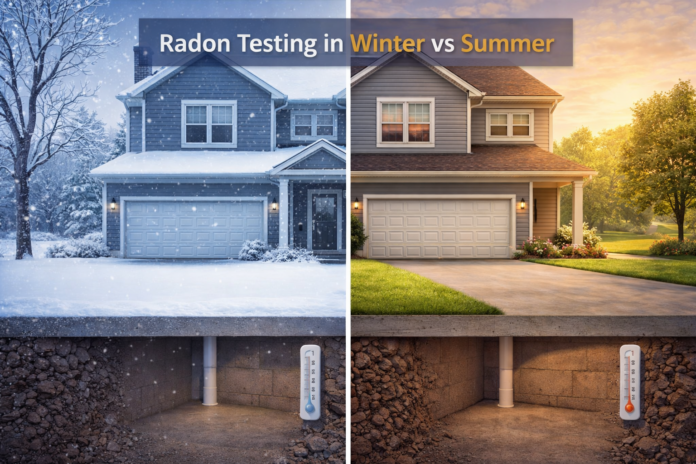
Radon Testing in Winter vs Summer: What Changes and How to Get Accurate Results
Radon levels can change throughout the year. Homeowners often notice the topic comes up most in winter, but many people test in summer because it is convenient. The question is not “is one season valid and the other not?” Both can be valid. The real question is whether your test reflects how your home is normally operated and whether the result represents your typical exposure.
EPA’s guidance is clear that radon levels can vary from day to day and season to season, which is why a short-term test is less likely than a long-term test to represent your year-round average. EPA: A Citizen’s Guide to Radon (PDF) The good news is you do not need to overthink it to get useful results. If you follow closed-house conditions for short-term testing and interpret results using EPA’s action guidance, you can make the right decision in any season.
Decision anchor: EPA recommends fixing the home if radon is 4.0 pCi/L or higher, and also recommends considering action between 2.0 and 4.0 pCi/L. EPA action level guidance
Table of Contents
- Quick takeaways
- Why seasons matter for radon testing
- Winter testing: why levels are often higher
- Summer testing: when levels can be lower and when they can still be high
- Closed-house conditions explained (this is the key)
- Short-term vs long-term tests: which is better for seasonal questions
- How to interpret results if you test in winter vs summer
- When you should retest because of seasonality
- If you already have a mitigation system
- FAQs
- Sources
Quick takeaways
If you want the practical answer without reading the entire article, here it is.
Winter often produces higher readings because homes are typically closed up and heating can increase the pressure-driven pull from the soil. EPA has even published seasonal messaging stating winter is the best time to test when windows are closed. EPA archive news release (winter testing message)
Summer results can be artificially low if you run the test while windows are frequently open. That does not mean the home is safe. It means the test did not reflect normal closed-building conditions.
Summer results can still be high if you run air conditioning and keep the home closed. “Closed building” is meant to reflect normal winter heating and normal summer air conditioning. HUD: Summary of Radon Standards of Practice (PDF)
The best way to avoid seasonal confusion is a long-term test (more than 90 days), because it is more likely to reflect your year-round average than a short-term test. EPA Citizen’s Guide (PDF)
Why seasons matter for radon testing
Radon is not a “constant output” appliance in your house. It is a soil gas problem influenced by how your home exchanges air with the outdoors and how pressure differences pull soil gas into the foundation. Those conditions change with weather, HVAC operation, and how often doors and windows are open.
EPA’s Citizen’s Guide states that radon levels tend to vary from day to day and season to season. It also explains why this matters: short-term tests are less likely than long-term tests to tell you your year-round average radon level. EPA Citizen’s Guide (PDF)
This does not mean short-term tests are useless. It means you should treat a short-term test as a “decision test” rather than as a perfect annual average. If the result is clearly high, you act. If it is borderline, you follow up.
Winter testing: why levels are often higher
Many homes see higher radon readings in winter for a simple reason: winter creates “closed-house” living by default. Windows are shut, doors are opened less, and fresh-air exchange tends to be reduced. When radon enters a home but less fresh air is coming in to dilute it, indoor concentrations can rise.
EPA has published winter-focused messaging that says the best time to test is during winter months when windows are closed. EPA archive news release Missouri Extension makes the same practical point from the testing side: winter is a good time because doors and windows need to be kept closed as much as possible during a radon test. University of Missouri Extension: winter testing
In colder climates, heating can also intensify pressure differences in a home. Minnesota’s radon guidance explains that Minnesota homes are closed up or heated most of the year, which can result in higher radon levels. Minnesota Department of Health: Radon in Homes The takeaway is not “winter is dangerous and summer is safe.” The takeaway is that winter often reveals a more conservative, closed-house radon condition that many homes experience for long stretches each year.
Summer testing: when levels can be lower and when they can still be high
Summer is tricky because it includes two very different “home operation styles.”
Summer with open windows can produce lower readings because ventilation dilutes indoor radon. If you test during a week where windows are open for hours a day, you may get a result that looks great but does not represent how the home is normally lived in for much of the year.
Summer with air conditioning is often closer to winter-style conditions than people realize. Many households keep windows closed and run AC regularly. In that setup, the home is still in a “closed building” mode, and radon can still accumulate.
That is why standards-based guidance defines closed-building conditions as the way the building is set up during winter heating and summer air conditioning. HUD: Summary of Radon Standards of Practice (PDF) A summer test can be completely valid if it reflects how you normally operate the home, especially if you run AC and keep windows shut.
Closed-house conditions explained (this is the key)
If you only take one thing from this article, take this: seasonal arguments usually disappear when the test is done under proper closed-house conditions.
EPA’s Citizen’s Guide says that for a short-term test you should close windows and outside doors and keep them closed as much as possible during the test. It also says that if you are doing a short-term test lasting just 2 or 3 days, you should close windows and outside doors at least 12 hours before beginning the test. EPA Citizen’s Guide (PDF)
EPA’s detailed testing protocols reinforce the same concept: for short-term tests lasting less than four days, closed-house conditions should be maintained for at least 12 hours before the test and during the test period. The protocols also state you should operate the home’s heating and cooling systems normally during the test and avoid operating machines that bring in air from outside. EPA: Home Radon Testing Protocols (PDF)
In plain English, closed-house conditions mean you test your home as you actually live in it during heating season or AC season. You are not creating a weird laboratory environment. You are creating consistency.
Short-term vs long-term tests: which is better for seasonal questions
A short-term test (2 to 90 days) is great for quick decision-making, especially if you are buying a home or you just want a fast answer. A long-term test (more than 90 days) is the best tool for reducing seasonal uncertainty because it is more likely to represent your year-round average. EPA Citizen’s Guide (PDF)
If you are worried that your summer test might have been “too low,” the solution is not to panic. The solution is to run a long-term test or to retest under better closed-house conditions.
How to interpret results if you test in winter vs summer
Start with EPA’s action guidance. If the number is clearly above 4.0 pCi/L, the season does not change the recommendation to fix. EPA action level guidance
Where season matters most is in the borderline range. EPA notes that radon varies season to season and that short-term tests are less likely to represent your year-round average. EPA Citizen’s Guide (PDF) That means a summer short-term test that comes back at 3.8 pCi/L should not be treated as “problem solved forever.” It should be treated as “close enough to follow up.” The clean follow-up choices are either a second short-term test under proper closed-house conditions or a long-term test.
If you test in winter and the number is elevated, that is often a conservative view of your risk during the season when many homes are closed up. EPA’s winter testing messaging frames winter as a good time to test for exactly that reason. EPA archive news release
When you should retest because of seasonality
Retesting is most valuable when your first result is near a decision boundary or when your testing conditions were not consistent.
Consider a retest or a long-term test if any of these are true:
- Your summer test was done with frequent window opening or unusual ventilation patterns.
- Your short-term result is close to 4.0 pCi/L, and you want higher confidence in your year-round average. EPA Citizen’s Guide (PDF)
- You tested only in an “unusual living period,” such as a vacation week when the house was empty or a week with severe storms or high winds. EPA advises avoiding short-term testing during unusually severe storms or periods of unusually high winds. EPA Citizen’s Guide (PDF)
Retesting is not a sign you did something wrong. It is how you turn a single snapshot into a confident decision.
If you already have a mitigation system
If your home has a radon mitigation system, seasonal testing still matters because your goal is confirming the system is keeping levels low year-round.
EPA’s testing protocols state that in homes with an active radon reduction system, you should check that the fan is running at least 24 hours before starting a short-term test lasting less than four days, and that the mitigation system should be operated normally and continuously during the measurement. EPA: Home Radon Testing Protocols (PDF)
In practical terms, do not turn the fan off to “see what happens” unless you are working with a professional and have a specific reason. If you want a conservative confirmation test, winter is often a useful time because the home is naturally closed. Minnesota’s guidance emphasizes that closed-up, heated operation can increase radon levels, which is one reason winter confirmation testing can be valuable. Minnesota Department of Health
FAQs
Is winter the best time to test for radon?
Winter is often a good time because homes are typically closed up, which can produce a conservative result. EPA has published winter messaging stating the best time is during winter months when windows are closed. EPA archive news release That said, you can test in any season if you follow closed-house conditions and use follow-up testing when needed. EPA Citizen’s Guide (PDF)
Can summer testing miss a radon problem?
It can if the test is run with windows open frequently, because ventilation can dilute indoor radon and produce a lower result than typical closed-building operation. A summer test can still be valid if it reflects your normal summer operation, especially if you run AC and keep windows closed. HUD standards summary (PDF)
What is the best test if I want to avoid seasonal confusion?
A long-term test (more than 90 days) is more likely to represent your year-round average than a short-term test. EPA Citizen’s Guide (PDF)
If my result is above 4.0 pCi/L, should I wait and retest in another season?
EPA recommends fixing the home at 4.0 pCi/L or higher. A second test can provide confirmation, but season should not be used as a reason to delay action when the result is clearly elevated. EPA action level guidance
Sources
- EPA: A Citizen’s Guide to Radon (PDF)
- EPA: Protocols for Radon and Radon Decay Product Measurements in Homes (PDF)
- EPA Archive: Winter is the time to test your home for radon (news release)
- EPA: What is EPA’s Action Level for Radon and What Does it Mean?
- HUD: Radon Factsheet, Summary of Radon Standards of Practice (PDF)
- University of Missouri Extension: Winter a good time to test for radon
- Minnesota Department of Health: Radon in Homes