Can a Home Fail Inspection Because of Radon?
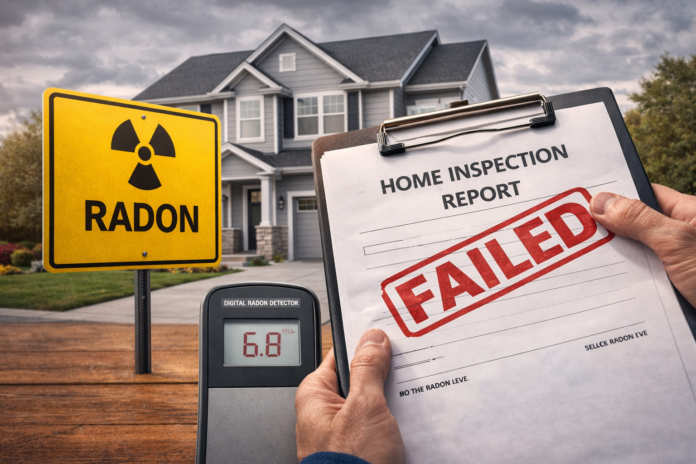
Homebuyers often hear “the house failed the radon test” and assume it means the home failed the inspection, the sale must stop, or the lender will reject the loan. Most of the time, none of those are automatically true.
Here is the simple reality: a standard home inspection is typically not a pass or fail event. It is an objective report of conditions so the buyer can make an informed decision. The American Society of Home Inspectors (ASHI) explains it clearly: a home inspector does not pass or fail a house, and a home inspection is not an appraisal or a municipal inspection. ASHI: What is a home inspection?
Radon is different because it is measured as a number. That number can trigger contract terms, negotiation decisions, or local requirements. So while a home usually does not “fail inspection” because of radon, a deal can fall apart because the parties cannot agree on what to do next.
In this article, we will break down what “fail” really means in real estate, when radon can become a true obstacle, and how to handle it cleanly as a buyer or seller.
Key benchmark: EPA recommends fixing a home if the radon level is 4.0 pCi/L or higher, and also recommends considering action between 2.0 and 4.0 pCi/L. EPA action level guidance.
Table of Contents
- What people mean when they say a home “fails” because of radon
- Home inspection vs radon test vs appraisal
- So can a home actually fail inspection because of radon?
- When radon can stop a deal in the real world
- What to do when the radon result is high
- How to avoid disputes, retests, and delays
- Buyer strategy and seller strategy
- FAQs
- Sources
What people mean when they say a home “fails” because of radon
In real estate conversations, “fail” is usually shorthand for one of these situations.
Meaning 1: The radon result is above a threshold. Many radon reports are summarized as “pass” if below a chosen number and “fail” if above it. The most common threshold in the U.S. is 4.0 pCi/L because it aligns with EPA’s action level. EPA action level explanation.
Meaning 2: The buyer considers radon a deal breaker. If a buyer is unwilling to move forward unless mitigation occurs, then a high radon result can “fail” the buyer’s personal comfort test, even though the house is still legally sellable.
Meaning 3: The contract says high radon triggers an obligation. Some purchase agreements or radon addendums define a specific remedy (seller installs mitigation, credit, escrow holdback, etc.) if the number is above a threshold. If the parties cannot agree, the deal can fall apart.
Meaning 4: A local rule or program requirement is triggered. In some locations or in certain program contexts, radon steps may be required or strongly expected. These are not universal and should be verified locally.
Home inspection vs radon test vs appraisal
Clarity here prevents a lot of confusion.
Home inspection: A general home inspection is an assessment of visible systems and components. ASHI notes that a home inspection does not pass or fail a house and is not an appraisal or a municipal inspection for code compliance. ASHI: What is a home inspection?
Radon test: A radon test measures radon gas levels over a set period and reports a numeric result. Radon testing is often a separate service from the general home inspection. National Radon Program Services (Kansas State University) describes that the buyer commonly requests radon testing as part of the overall inspection process and notes it is generally a separate service. NRPS: Radon During Real Estate Transactions
Appraisal: An appraisal is about value for lending purposes, not a full condition assessment. Many buyers confuse “appraisal requirements” with “inspection results.” These are different steps that can overlap, but they are not the same thing.
So can a home actually fail inspection because of radon?
In most transactions, the best answer is: no, a home does not fail inspection because of radon, because home inspections are typically not pass or fail. The inspection report provides information that the buyer uses to decide whether to proceed, renegotiate, or walk away under the inspection contingency. ASHI explanation
However, if you broaden the question to “Can radon stop a home sale?” then the answer becomes: yes, it can, but usually because of contract decisions, negotiation breakdown, or a required process in a specific program or location.
EPA’s real estate guidance exists because radon is common in transactions and the best outcomes happen when testing and next steps are handled as a structured process. EPA: Radon and Real Estate Resources
When radon can stop a deal in the real world
Even though an inspection is not pass or fail, there are real scenarios where radon becomes a true obstacle.
Scenario 1: The buyer has an inspection contingency and chooses to terminate. If the contract allows the buyer to back out based on inspection findings, then high radon can lead to cancellation if the buyer is uncomfortable and the seller refuses to address it. NRPS explicitly discusses the common transaction pattern where buyers negotiate mitigation when results are at or above 4.0 pCi/L. NRPS real estate testing guidance
Scenario 2: The parties cannot agree on a remedy within the timeline. High radon is usually fixable, but contractor scheduling and closing deadlines can create pressure. Deals fail most often when the radon response is vague or delayed, not because the technical fix is impossible.
Scenario 3: The test itself is disputed or invalid and time runs out. If closed-house conditions were not maintained or the test was interfered with, the result may be questioned and a retest may be required. EPA’s Home Buyer’s and Seller’s Guide includes a testing checklist and warns that interfering with test conditions may invalidate results and may be illegal in some states. EPA Home Buyer’s and Seller’s Guide to Radon (PDF)
Scenario 4: A consumer monitor reading creates conflict. A growing problem is one party using screenshots from a consumer digital monitor as “proof.” CRCPD published an advisory stating consumer digital radon monitors are not for testing during real estate transactions and emphasizes verification using an approved method. CRCPD advisory (PDF)
Scenario 5: Special program or funding contexts. Some HUD-related program contexts discuss radon policies where testing is not required but mitigation is required if testing is conducted and results are 4.0 pCi/L or higher. This is not the same as a typical private single-family purchase, but it is an example of how radon can become a required step in certain contexts. HUD Exchange: HUD departmental radon policy notice
What to do when the radon result is high
A high radon result is usually a “solve it” moment, not a panic moment. EPA recommends fixing at 4.0 pCi/L or higher. EPA action level guidance
In most transactions, one of these resolution structures keeps closing on track:
| Resolution option | How it works | Best when |
|---|---|---|
| Seller installs mitigation before closing | Seller hires a mitigator, installs a system, provides documentation, and retests | There is enough time and contractor availability |
| Seller credit at closing | Seller provides credit and buyer installs after closing | Closing timeline is tight and buyer wants control of contractor |
| Price reduction | Price lowered and buyer handles mitigation after closing | Parties want minimal repair paperwork |
| Escrow holdback | Funds held until mitigation is completed after closing | Work cannot be completed before closing but buyer wants protection |
NRPS describes the negotiation logic that commonly happens in transactions when radon is at or above 4.0 pCi/L. NRPS real estate guidance
How to avoid disputes, retests, and delays
Most radon-related deal headaches are preventable. The goal is not perfection. The goal is credibility and agreement.
Use a transaction-appropriate test method. EPA’s real estate guide is built for the timing and constraints of a sale and includes a checklist approach that helps prevent mistakes. EPA Home Buyer’s and Seller’s Guide (PDF)
Maintain closed-house conditions when required. Closed-house conditions reduce variability during short-term testing and help prevent disputes about whether the result is valid. EPA also warns against interference with the test device or conditions. EPA checklist and interference warning (PDF)
Do not rely on consumer monitor screenshots for negotiations. If a consumer monitor suggests elevated radon, confirm with an accepted real estate testing method. CRCPD’s advisory exists specifically because consumer monitors create confusion in transactions. CRCPD advisory (PDF)
Write clear next steps into the contract. A radon addendum can define the test method, the threshold, the remedy, and the verification step, turning an emotional issue into a procedural issue. EPA’s real estate resources discuss radon in transaction contexts. EPA radon and real estate resources
Buyer strategy and seller strategy
If you are the buyer: schedule the radon test early in the inspection window, and decide in advance what outcome you want. If the result is high, aim for a clean structure (install, credit, reduction, escrow) rather than vague “we will figure it out later” language. EPA recommends action at 4.0 pCi/L or higher, so you are not asking for something random. EPA action level
If you are the seller: cooperate with the test conditions to avoid retests, and respond with structure if the result is elevated. Many sellers choose to mitigate before listing to reduce surprises and protect the closing timeline. EPA’s real estate guide supports addressing radon in the buying and selling process and includes practical checklists. EPA Home Buyer’s and Seller’s Guide (PDF)
FAQs
Does a radon level above 4.0 pCi/L automatically cancel the contract?
No. A high result typically triggers negotiation under the inspection contingency or under a radon addendum, if one exists. EPA recommends fixing at 4.0 pCi/L or higher, which is why mitigation is a common negotiation outcome. EPA action level
Is radon testing part of a standard home inspection?
Often it is a separate service requested by the buyer. NRPS describes radon testing as generally separate from the overall home inspection and something that must be specifically requested. NRPS real estate testing
If the seller refuses to fix high radon, what happens?
The buyer may proceed and mitigate after closing, negotiate a credit or price reduction, or walk away if the contract allows it. The outcome depends on the contract language and market leverage.
Can I use my own consumer radon monitor reading for the transaction?
Consumer monitors can be useful for homeowner awareness, but CRCPD advises they are not for testing during real estate transactions and recommends verification using an approved method. CRCPD advisory (PDF)
Sources
- ASHI: What is a home inspection? (includes “no pass or fail” explanation)
- EPA: What is EPA’s action level for radon and what does it mean?
- EPA: Radon and Real Estate Resources
- EPA: Home Buyer’s and Seller’s Guide to Radon (PDF)
- National Radon Program Services (Kansas State University): Radon During Real Estate Transactions
- CRCPD: Radon Testing with Consumer Digital Radon Monitors (Publication 25-4) (PDF)
- HUD Exchange: HUD Departmental Radon Policy Notice (context for certain HUD-related projects)