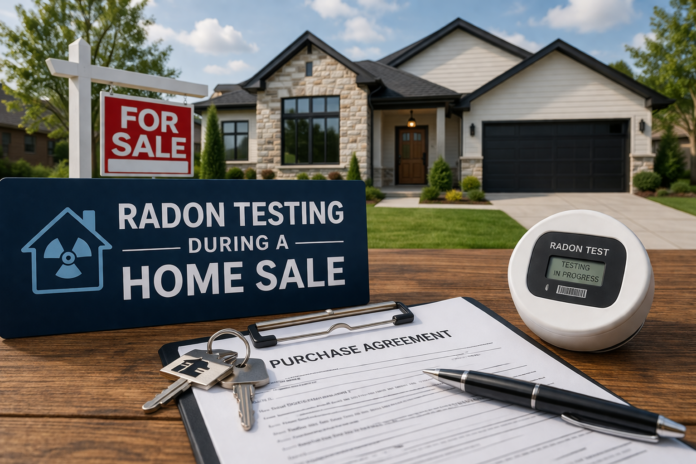
Radon Testing During a Home Sale: A Practical Guide for Buyers, Sellers, and Agents
Radon testing during a home sale is one of the most common “extra” inspections buyers request and one of the most common sources of confusion for sellers. The confusion is not because radon is complicated. It is because real estate timelines are tight, testing conditions matter, and people use the word “pass” and “fail” even though most inspections are not truly pass or fail.
The good news is that a clean radon workflow exists. When everyone follows the same playbook, radon testing becomes predictable: schedule the test early, run it under credible conditions, interpret the result using public guidance, and if needed, resolve it with a standard mitigation option that fits the closing timeline.
Key benchmark: The U.S. Environmental Protection Agency (EPA) recommends fixing a home if the radon level is 4.0 pCi/L or higher and also recommends considering action between 2.0 and 4.0 pCi/L. EPA action level guidance.
Important note: This article is educational and not legal advice. Contract language, disclosure rules, and local practices vary by state and sometimes by city.
Table of Contents
- Why radon testing matters during a home sale
- Who orders and pays for the radon test?
- When to schedule the test during the transaction
- Test types used during a home sale (and which one is best)
- What makes a radon test credible in real estate
- Closed-house conditions explained in plain English
- Where the test should be placed during a home sale
- Consumer digital monitors and why they create disputes
- How to interpret results and decide next steps
- What happens if radon is high: the 4 clean resolution options
- Retesting, invalid tests, and how to avoid delays
- Seller playbook: how to cooperate without stress
- Buyer playbook: how to protect yourself without stalling closing
- Agent notes: how to keep the deal calm
- Sources
Why radon testing matters during a home sale
Radon is an invisible, odorless radioactive gas that can build up indoors. Because you cannot detect it with your senses, testing is the only way to know a home’s radon level. The CDC summarizes radon as a public health concern and links it to lung cancer risk. CDC radon overview.
From a real estate perspective, radon is not usually a “defect” like a broken furnace. It is a measurable indoor air condition that varies from home to home, even between neighbors. That is why EPA recommends testing all homes, regardless of where they are located. EPA also explains that the Map of Radon Zones is not intended to determine whether an individual home should be tested and that elevated levels have been found in all zones. EPA Map of Radon Zones guidance.
Testing during the sale gives both parties a clean moment to address radon before move-in. If a buyer tests after closing and finds a high result, the buyer has no negotiation leverage and must handle the entire process alone. If a buyer tests before closing, the parties can choose a resolution structure that fits the deal timeline.
Who orders and pays for the radon test?
In many markets, the buyer requests and pays for the radon test as part of the inspection period. National Radon Program Services (Kansas State University) describes the most common procedure as the potential buyer requesting the radon test as part of the overall home inspection, noting it is generally a separate service and must be requested. NRPS: Radon During Real Estate Transactions.
Sellers typically “pay” in a different way. The seller’s role is usually cooperation: maintaining required testing conditions, allowing access for device placement and retrieval, and avoiding actions that could invalidate the test.
There are exceptions. Some sellers perform a pre-list radon test to reduce surprises. Some local markets treat radon as standard and include it more routinely. The contract addendum language and local norms matter more than a universal rule.
When to schedule the test during the transaction
Timing is the biggest controllable factor in whether radon causes stress. A radon test can be valid and still create deal chaos if it is scheduled late.
A practical rule is: schedule the radon test as early as possible in the inspection period. That gives you time to receive the report, negotiate, and if needed, schedule mitigation without rushing the closing date.
EPA’s Home Buyer’s and Seller’s Guide to Radon is built for transaction timelines and includes a Radon Testing Checklist designed to prevent mistakes that lead to delays and retesting. EPA Home Buyer’s and Seller’s Guide to Radon (PDF).
If you want a quick mental model, use this timeline:
| Transaction phase | Best radon action | Why it helps |
|---|---|---|
| Pre-list (seller) | Optional pre-list test, consider mitigation if elevated | Reduces surprises and prevents rushed decisions |
| Inspection period (buyer) | Schedule radon test early, use credible method | Leaves time for negotiation and contractor scheduling |
| Post-test (both parties) | Choose resolution structure quickly if elevated | Prevents timeline slippage and disputes |
| Before closing | If mitigation is completed, require documentation and post-mitigation test | Creates confidence and reduces future conflict |
Test types used during a home sale (and which one is best)
Radon tests fall into three broad categories: short-term tests, long-term tests, and continuous monitoring. During a home sale, short-term tests are the most common because they fit transaction timelines.
Short-term test: Typically a minimum 48-hour test window. EPA’s real estate guide is structured around short-term testing because it is the practical option for most transactions. EPA Home Buyer’s and Seller’s Guide (PDF). CRCPD’s advisory also states the minimum length for any radon test is 48 hours. CRCPD advisory (PDF).
Long-term test: Often 90 days or more. Long-term testing is excellent for understanding a home’s year-round average, but it rarely fits the purchase contract timeline. Many buyers choose to do a long-term test after move-in if their short-term result is borderline and they want a clearer average.
Continuous monitor testing: In professional real estate testing, the term “continuous radon monitor” often refers to professional-grade continuous monitors used by qualified testers for transaction testing. This is different from consumer digital monitors sold for homeowners. Professional methods are usually more accepted in transactions because they align with recognized practice and reporting.
Professional standards of practice exist for measuring radon in homes, including ANSI/AARST MAH-2019. ANSI/AARST MAH-2019 overview. EPA also lists radon standards of practice and references AARST standards as important resources. EPA radon standards of practice.
What makes a radon test credible in real estate
A radon test becomes controversial when it is not credible to the other party. The buyer wants a result the seller cannot dismiss. The seller wants a result that is fair and not manipulated. The easiest way to get both is to use a qualified professional and follow recognized procedures.
EPA’s Home Buyer’s and Seller’s Guide includes a Radon Testing Checklist and emphasizes that improper testing may yield inaccurate results and require another test. EPA checklist (PDF).
In practical terms, credibility usually comes from these factors:
- The test runs long enough, often at least 48 hours for a short-term real estate test.
- The test location is appropriate and documented.
- Closed-house conditions are followed and documented.
- Reporting includes start and stop times and basic test details.
- The device used is appropriate for the transaction and accepted locally.
If you are a buyer, credibility protects leverage. If you are a seller, credibility prevents endless retesting and accusations of interference.
Closed-house conditions explained in plain English
Closed-house conditions exist because a short-term radon test can be influenced by unusual ventilation. The idea is not to create a “sealed bunker.” The idea is to keep conditions stable enough that the result is meaningful and not easily disputed.
EPA’s Home Buyer’s and Seller’s Guide includes a warning that disturbing or interfering with the test device or with closed-house conditions may invalidate the test results and may be illegal in some states. If the tester cannot confirm that conditions were maintained, EPA advises taking another test. EPA interference warning (PDF).
What “closed-house” usually means in practice is simple: keep windows closed, keep exterior doors closed except for normal entry and exit, and do not run unusual ventilation that is not part of normal living. Your tester should provide written instructions. Sellers should follow them carefully because the easiest way to delay a closing is to create an invalid test that needs to be repeated.
Where the test should be placed during a home sale
Placement matters because radon is typically highest in the lowest levels that are in contact with the ground. During a transaction, the question is: where will the buyer actually spend time? EPA’s buyer and seller guide addresses transaction testing in terms of practical occupancy and provides a checklist approach for reliable testing. EPA Home Buyer’s and Seller’s Guide (PDF).
In many transactions, testers place the device in the lowest level that could be used regularly. If the home has a basement that could be finished or used as living space, it is common to test the basement. If the home is slab-on-grade, it may be tested on the first floor. The tester’s placement and reporting should make this clear.
If the buyer intends to finish the basement after closing, the buyer should treat basement radon as highly relevant, even if the basement is currently unfinished. A future living space becomes a present decision point.
Consumer digital monitors and why they create disputes
Consumer digital radon monitors are increasingly common. They can be useful for homeowner awareness, but they often create conflict in a real estate transaction because the other party may not accept the device or the number.
CRCPD published an advisory that states consumer digital radon monitors are not for testing during real estate transactions and that results should be verified using an approved method. CRCPD advisory (PDF).
The most efficient approach is this: if a consumer monitor suggests high radon, schedule a transaction-appropriate test rather than negotiating based on a screenshot. A defensible test saves time because it reduces the chance of dispute.
How to interpret results and decide next steps
Radon is reported in pCi/L in the United States. EPA’s action level is 4.0 pCi/L. EPA also encourages considering reduction between 2.0 and 4.0 pCi/L because there is no known safe level of radon exposure. EPA action level explanation.
In a home sale, most decisions fall into three categories:
Clearly low result: Many buyers proceed without radon-related concessions, while still understanding that retesting later is reasonable if they remodel, change ventilation, or begin living in a lower level.
Borderline result: This is where deals can wobble if the contract is vague. Some buyers request a credit or mitigation for peace of mind. Others plan a long-term test after move-in to get a better year-round average. The “right” choice depends on timeline and risk tolerance.
Clearly high result: The deal usually shifts to mitigation. This is often a simpler negotiation than many other inspection items because mitigation is standardized and widely available.
What happens if radon is high: the 4 clean resolution options
When radon is elevated, the deal rarely needs drama. It needs structure. These are the four most common options that keep closing on track.
| Option | How it works | Best when |
|---|---|---|
| Seller installs mitigation before closing | Seller hires a mitigator, installs a system, provides documentation, and completes a post-mitigation test | There is enough time and contractor availability |
| Seller credit at closing | Seller provides a credit and buyer installs after closing | Closing is tight or buyer wants contractor choice |
| Price reduction | Sale price reduced and buyer mitigates after closing | Parties want minimal repair logistics |
| Escrow holdback | Funds held until mitigation is completed after closing | Work cannot be completed pre-close but buyer wants protection |
NRPS describes the real estate transaction pattern and notes that buyers commonly request radon testing and negotiate mitigation when results are elevated. NRPS real estate testing overview.
Retesting, invalid tests, and how to avoid delays
Retests are the silent deal-killer. They consume time, drain goodwill, and often create accusations of interference. The easiest way to avoid a retest is to treat the initial test like a protocol.
EPA’s transaction guide emphasizes that improper testing may yield inaccurate results and require another test, and it warns about disturbing the device or interfering with closed-house conditions. EPA testing checklist (PDF).
If a test truly is invalid, the cleanest path is usually to schedule a new test immediately using a method both parties accept, then extend deadlines if needed through clear contract amendments. What causes deal damage is delay combined with uncertainty.
Seller playbook: how to cooperate without stress
Sellers often feel tested by the testing. The home is being shown, doors are opening, and life is happening. The best seller move is to treat radon testing like a short protocol window that protects the sale.
Three seller actions prevent most problems:
- Follow the tester’s written closed-house instructions carefully.
- Do not move the device and do not allow anyone else to move it.
- Communicate with your agent about showings and access so no one accidentally violates conditions.
If the result is elevated, respond quickly with a defined resolution option. A fast, structured response protects your timeline and prevents the buyer from escalating demands out of uncertainty.
Buyer playbook: how to protect yourself without stalling closing
Buyers should treat radon like standard due diligence, not like a last-minute surprise. NRPS notes that buyers most commonly request the radon test during the overall home inspection process. NRPS real estate testing.
Buyer best practices are simple:
- Schedule the radon test early in the inspection period.
- Use a transaction-appropriate method that is credible and documented.
- Decide in advance what outcome you want if the result is elevated.
- If mitigation is part of the deal, require documentation and a post-mitigation test if completed before closing.
Also, do not let consumer monitor screenshots become your negotiation foundation. If you want leverage, you want a test the seller cannot reasonably dispute. CRCPD’s advisory exists specifically because consumer monitors are a poor fit for real estate transaction testing. CRCPD advisory (PDF).
Agent notes: how to keep the deal calm
Agents are often the difference between “radon is a deal problem” and “radon is a solved checklist item.” EPA maintains a page of radon resources for the real estate community, including the buyer and seller guide and other transaction materials. EPA radon resources for real estate.
The best agent habits around radon are procedural. Encourage early scheduling. Encourage credible testing. Set expectations about closed-house conditions. When results are elevated, move quickly to one of the clean resolution structures rather than leaving the issue vague.
If a party brings up consumer monitor readings, the fastest neutral response is: “Let’s confirm with a transaction-appropriate test method that both parties accept.” This reduces conflict and protects the closing date.
Sources
- EPA: Home Buyer’s and Seller’s Guide to Radon (PDF) (March 2024 revised)
- EPA: Radon Resources for Real Estate Community
- EPA: What is EPA’s Action Level for Radon and What Does it Mean?
- EPA: The EPA Map of Radon Zones
- EPA: Radon Standards of Practice
- ANSI/AARST MAH-2019: Protocol for Conducting Measurements of Radon and Radon Decay Products in Homes
- National Radon Program Services (Kansas State University): Radon During Real Estate Transactions
- CRCPD: Radon Testing with Consumer Digital Radon Monitors (Publication 25-4) (PDF)
- CDC: Radon and Your Health