
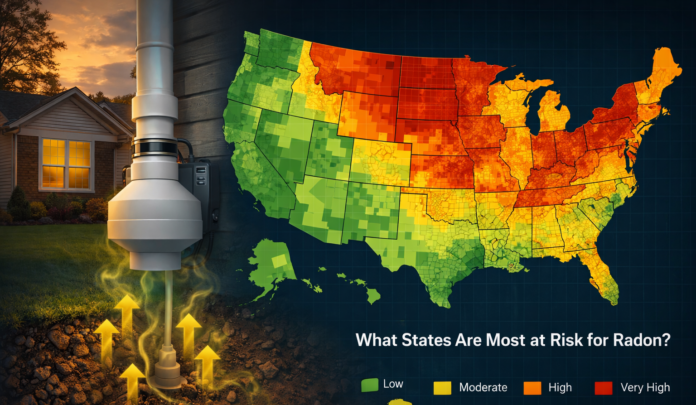
What States Are Most at Risk for Radon?
Radon risk in the United States is not evenly distributed, but it is also not confined to a few states. High radon levels have been found in every state, and the only way to know a specific home’s radon level is to test.
So what does “most at risk” actually mean at a state level?
For this article, we use the most widely referenced national framework for comparing radon potential across the U.S.: the EPA Map of Radon Zones. The EPA assigns each county to one of three zones based on predicted average indoor radon screening levels, using a combination of indoor radon measurements and environmental factors. Zone 1 counties have the highest predicted potential for elevated indoor radon (greater than 4 pCi/L on average). Zone 2 counties are moderate potential (2 to 4 pCi/L). Zone 3 counties are lower potential (less than 2 pCi/L). The EPA is also clear that the zone map should not be used to determine whether a specific home needs testing, because elevated radon has been found in all zones. All homes should be tested.
This guide explains the zones, ranks states using the county zone data, and then adds practical context on why these regions tend to be high-risk and what to do if you live in one of them.
Table of Contents
- What “most at risk” means for radon
- EPA Radon Zones explained (Zone 1, 2, 3)
- How this state ranking was calculated
- Top states by radon potential (EPA Zone 1 county share)
- States with the biggest Zone 1 footprint (most Zone 1 counties)
- Tier list: very high, high, and mixed-risk states
- Why these regions tend to have more radon
- Important limitations and how not to misuse state rankings
- How to check your local risk beyond the state level
- What to do if you live in a high-risk state
- FAQs
- Sources
What “most at risk” means for radon
There are two different concepts people mix together when they ask about “radon risk by state.”
1) Radon potential (likelihood of elevated indoor radon)
This is the question the EPA zone map is designed to answer. It uses county-level predictions to identify areas with greater potential for elevated indoor radon so programs and building codes can be targeted.
2) Measured test outcomes (what people actually find when they test)
This can be tracked using large lab datasets and state datasets. The CDC Environmental Health Tracking program describes radon testing data availability at the state and county level and provides tools to explore it. Testing data can be extremely useful, but it is not random sampling. It often reflects who chose to test, where testing programs exist, and which labs participated in data sharing.
This article focuses on radon potential because it provides a consistent, nationwide comparison for all states. When possible, you should still treat your county and your specific home as the real unit of decision-making.
EPA Radon Zones explained (Zone 1, 2, 3)
The EPA Map of Radon Zones assigns each county a zone based on predicted average indoor radon screening levels:
- Zone 1: highest potential; average indoor radon may be greater than 4 pCi/L
- Zone 2: moderate potential; average indoor radon may be between 2 and 4 pCi/L
- Zone 3: lower potential; average indoor radon may be less than 2 pCi/L
EPA also emphasizes two critical warnings:
- The map should not be used to determine whether an individual home should be tested.
- Homes with elevated radon have been found in all three zones, so all homes should be tested.
This is why “low-risk state” is not the same as “safe home.” A state-level view is useful for understanding where radon problems are more common, but it is never a substitute for testing.
How this state ranking was calculated
To rank states consistently, we used the EPA radon zones spreadsheet (county-by-county zone assignments) and calculated, for each state:
- Total number of counties (and county-equivalents)
- Number of Zone 1 counties
- Zone 1 share: Zone 1 counties divided by total counties
Note on Virginia: The EPA dataset treats Virginia’s independent cities as county-equivalents in a separate grouping, so this analysis combines Virginia counties and Virginia independent cities into one Virginia total for a more realistic state view.
How to interpret the results: This ranking does not claim that the “top state” has the highest radon in every home. It means that, based on EPA’s framework, a larger share of the state’s counties are in the highest radon potential category.
Top states by radon potential (EPA Zone 1 county share)
This table answers the question most people mean when they ask “what states are most at risk for radon?” It highlights states where the largest share of counties are classified as Zone 1 (highest radon potential).
| Rank | State | Zone 1 counties | Zone 2 counties | Zone 3 counties | Total counties | Zone 1 share |
|---|---|---|---|---|---|---|
| 1 | Iowa | 99 | 0 | 0 | 99 | 100.0% |
| 2 | North Dakota | 53 | 0 | 0 | 53 | 100.0% |
| 3 | Wyoming | 21 | 2 | 0 | 23 | 91.3% |
| 4 | Montana | 50 | 7 | 0 | 57 | 87.7% |
| 5 | Colorado | 53 | 11 | 0 | 64 | 82.8% |
| 6 | Minnesota | 68 | 19 | 0 | 87 | 78.2% |
| 7 | Maine | 12 | 4 | 0 | 16 | 75.0% |
| 8 | Pennsylvania | 49 | 17 | 1 | 67 | 73.1% |
| 9 | South Dakota | 48 | 18 | 0 | 66 | 72.7% |
| 10 | Indiana | 57 | 35 | 0 | 92 | 62.0% |
| 11 | Kansas | 65 | 40 | 0 | 105 | 61.9% |
| 12 | Ohio | 53 | 35 | 0 | 88 | 60.2% |
| 13 | Nebraska | 53 | 24 | 16 | 93 | 57.0% |
| 14 | Illinois | 56 | 43 | 3 | 102 | 54.9% |
| 15 | New York | 34 | 13 | 15 | 62 | 54.8% |
| 16 | Nevada | 9 | 7 | 1 | 17 | 52.9% |
| 17 | Connecticut | 4 | 3 | 1 | 8 | 50.0% |
| 18 | Virginia | 64 | 28 | 44 | 136 | 47.1% |
| 19 | Idaho | 19 | 20 | 5 | 44 | 43.2% |
| 20 | Tennessee | 39 | 32 | 24 | 95 | 41.1% |
Takeaway: If you live in Iowa or North Dakota, you are in the rare situation where every county is classified as the highest radon potential category. In the next tier, large parts of the Northern Plains, Upper Midwest, and Rockies show very high potential.
States with the biggest Zone 1 footprint (most Zone 1 counties)
Some states have a high share of Zone 1 counties, while others have a large total number of Zone 1 counties simply because they have many counties. This matters for statewide programs and public health planning because it reflects how much geographic area may need high-intensity radon outreach.
| Rank | State | Zone 1 counties | Zone 2 counties | Zone 3 counties | Total counties | Zone 1 share |
|---|---|---|---|---|---|---|
| 1 | Iowa | 99 | 0 | 0 | 99 | 100.0% |
| 2 | Minnesota | 68 | 19 | 0 | 87 | 78.2% |
| 3 | Kansas | 65 | 40 | 0 | 105 | 61.9% |
| 4 | Virginia | 64 | 28 | 44 | 136 | 47.1% |
| 5 | Indiana | 57 | 35 | 0 | 92 | 62.0% |
| 6 | Illinois | 56 | 43 | 3 | 102 | 54.9% |
| 7 | North Dakota | 53 | 0 | 0 | 53 | 100.0% |
| 8 | Colorado | 53 | 11 | 0 | 64 | 82.8% |
| 9 | Ohio | 53 | 35 | 0 | 88 | 60.2% |
| 10 | Nebraska | 53 | 24 | 16 | 93 | 57.0% |
| 11 | Montana | 50 | 7 | 0 | 57 | 87.7% |
| 12 | Pennsylvania | 49 | 17 | 1 | 67 | 73.1% |
| 13 | South Dakota | 48 | 18 | 0 | 66 | 72.7% |
| 14 | Tennessee | 39 | 32 | 24 | 95 | 41.1% |
| 15 | New York | 34 | 13 | 15 | 62 | 54.8% |
| 16 | Kentucky | 30 | 82 | 8 | 120 | 25.0% |
| 17 | Wisconsin | 28 | 44 | 0 | 72 | 38.9% |
| 18 | Wyoming | 21 | 2 | 0 | 23 | 91.3% |
| 19 | West Virginia | 20 | 29 | 6 | 55 | 36.4% |
| 20 | Idaho | 19 | 20 | 5 | 44 | 43.2% |
Takeaway: Even when Zone 1 is not the majority statewide (for example, Kentucky), a large Zone 1 footprint can still mean many communities face high radon potential.
Tier list: very high, high, and mixed-risk states
Tables are precise, but tier lists are easier to remember. Here is a practical way to think about state-level radon potential based on Zone 1 county share.
Tier 1: Very high radon potential states
These states have Zone 1 as the majority of counties (60% or more). They are the states most likely to feel like “radon is everywhere” because, at a county level, the highest potential category dominates.
- Iowa
- North Dakota
- Wyoming
- Montana
- Colorado
- Minnesota
- Maine
- Pennsylvania
- South Dakota
- Indiana
- Kansas
- Ohio
Tier 2: High radon potential states (large Zone 1 presence, but not a majority)
These states still have substantial Zone 1 coverage. In these states, it is common to see high radon in many counties, but the state also has more moderate or mixed regions.
- Nebraska
- Illinois
- New York
- Nevada
- Connecticut
- Virginia
- Idaho
- Tennessee
- Rhode Island
- Wisconsin
- West Virginia
States with no Zone 3 counties
This list is useful because it means every county is predicted to have at least moderate radon potential (Zone 1 or Zone 2). These states are:
- Arizona
- Colorado
- Indiana
- Iowa
- Kansas
- Maine
- Minnesota
- Montana
- New Hampshire
- New Mexico
- North Dakota
- Ohio
- South Dakota
- Utah
- Wisconsin
- Wyoming
Important: Being outside Tier 1 or Tier 2 does not mean radon is unlikely in your home. It means the state has fewer counties in the highest potential category. Many “mixed” states still have high-radon clusters and extremely high homes.
Why these regions tend to have more radon
At a simplified level, radon risk begins with geology. Radon is produced by the natural decay of uranium in rock and soil. Where uranium and radium are more present, or where the soil and rock structure allows gas to move efficiently, radon potential tends to be higher.
The EPA Map of Radon Zones was developed using indoor radon measurements plus geology, aerial radioactivity, soil parameters, and foundation types. That combination is why the map is useful for statewide and regional planning, even though it cannot predict a specific home’s level.
The USGS also created a national “geologic radon potential” dataset using a Radon Index based on five factors: geology, soil permeability, aerial gamma radioactivity, home architecture, and screening indoor radon data. The USGS grouped these into three zones compatible with EPA’s radon zones approach.
Here are the major high-risk regions that show up again and again across national radon frameworks:
Upper Midwest and Northern Plains
This includes states like Iowa, Minnesota, North Dakota, South Dakota, Nebraska, and parts of Wisconsin and Illinois. Many counties in this region fall into Zone 1 because the underlying geology and soil conditions often support higher radon potential. In practical homeowner terms, this is one of the most consistent radon regions in the country. If you are in this band of states, radon testing should be treated as routine home maintenance, not as an optional check.
Appalachians and parts of the Northeast
This includes states like Pennsylvania and West Virginia, plus parts of New York and New England. The zone map reflects high radon potential in many counties in these regions. For homeowners, the practical message is that radon risk can change quickly over short distances in mountainous and mixed-bedrock areas, so county-level data may still hide neighborhood-level variation. Testing remains the only reliable answer.
Rockies and Intermountain West
This includes Colorado, Wyoming, Montana, Utah, and parts of Idaho and Nevada. Many counties in these states are Zone 1, and several have no Zone 3 counties at all. From a public health perspective, these states are consistently highlighted for high radon potential. For homeowners, a basement home in these regions should be assumed “worth testing” even if your neighbors have not tested.
Important limitations and how not to misuse state rankings
State rankings are helpful, but they are easy to misuse. Here are the most important guardrails.
1) The EPA map is about county-level potential, not your house.
EPA explicitly warns that the map should not be used to decide whether a specific home should be tested. Elevated radon can occur in every zone.
2) County averages hide extremes.
A Zone 2 county can still contain neighborhoods where many homes test above 4.0 pCi/L. A Zone 3 county can still contain a small area with very high readings.
3) Testing data is powerful but imperfect.
Measured test data often comes from voluntary testing, which means it is not a random sample. Data quality and completeness vary by state and by year. This is why the best approach is to use both: zone potential for broad context, and your own test for your home’s truth.
4) “Radon risk” is not the same as “lung cancer risk.”
Radon is a major lung cancer risk factor, but total lung cancer risk also depends heavily on smoking and secondhand smoke exposure. A state can have moderate radon potential and still have significant lung cancer burden because of smoking prevalence and other factors.
How to check your local risk beyond the state level
If you want to go from “state-level” to “actionable,” use this process:
- Find your county’s EPA radon zone. Use the EPA state radon zone documents and the county zone map resources.
- Check your state radon program guidance. Many states publish local testing data or county-level summaries.
- Use CDC tracking data when available. The CDC tracking program explains how radon testing data can be explored at state and county level and provides an API and tools for maps and tables.
- Test your home. This is the only step that answers your actual risk.
What to do if you live in a high-risk state
If you live in a Tier 1 or Tier 2 state, here is the simplest practical plan:
1) Test now if you have never tested.
Short-term testing is fine for an initial decision. If you want a better estimate of your year-round average, use a long-term test.
2) Use EPA’s action guidance as your decision anchor.
Fix at 4.0 pCi/L or higher. Consider fixing between 2.0 and 4.0 pCi/L, especially if you use the lowest level frequently.
3) Retest over time.
Radon levels can change with renovations, HVAC changes, foundation changes, and how the home is used. Retesting is a normal part of managing radon risk.
4) If you are buying or selling, test during the transaction.
Real estate is one of the most common moments when radon gets discovered. If you wait until after closing, you lose negotiation leverage and timing control.
5) Consider radon-resistant new construction (RRNC) if you are building.
In high-potential areas, RRNC features are a proactive step that can reduce future radon problems and make mitigation easier if it is needed later.
FAQs
Is my state “safe” if it has mostly Zone 2 or Zone 3 counties?
No. It only suggests lower predicted average potential at the county level. EPA emphasizes that elevated radon has been found in all zones, and all homes should be tested.
Why do I see different “top radon states” lists online?
Many lists mix different things together: EPA zones, measured testing outcomes, small lab samples, and sometimes outdated or nontransparent datasets. When comparing states, always ask: is this based on predicted potential, actual tests, or something else?
What is the most reliable way to know my risk?
Test your home. State and county context can help you prioritize, but the test result is what matters.
Does a high-risk state mean every home has high radon?
No. Even in a state like Iowa, where every county is Zone 1, individual homes still vary. The point is that the probability of elevated radon is higher, not guaranteed.
Sources
- EPA: EPA Map of Radon Zones (zone definitions and purpose)
- EPA: Map of Radon Zones and Supplemental Information (background and links to data)
- EPA: Maps of Radon Zones and Supporting Documents by State
- EPA: Radon Zones Spreadsheet (county-level zone assignments used for rankings)
- USGS: Geologic Radon Potential Map of the United States (data release and methodology factors)
- CDC: Radon and Your Health
- CDC Environmental Health Tracking: Radon Testing data (state and county level availability)
- American Lung Association: Radon Testing Disparities in States (high levels found in every state)