
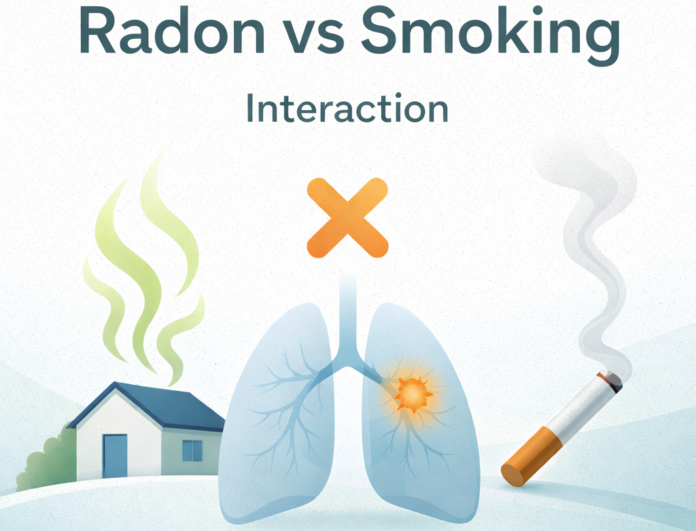
Radon vs Smoking Interaction: Why the Combination Raises Lung Cancer Risk
Radon and cigarette smoking are each major lung cancer risk factors on their own. What many people don’t realize is that when they occur together, the risk isn’t simply additive. The interaction is often described as synergistic—meaning the combined effect is worse than you’d expect from either exposure alone.
This matters because radon is common in homes, and smoking (including past smoking) is also common. The overlap is where a large portion of preventable lung cancer risk lives. Understanding how radon and smoking interact can help you prioritize the two actions that make the biggest difference: test for radon and reduce tobacco smoke exposure.
Quick refresher: what radon is and why it affects lungs
Radon is a radioactive gas that forms naturally as uranium breaks down in soil and rock. Outdoors, radon quickly dilutes into the air and usually isn’t a concern. Indoors, it can seep in through tiny openings in foundations and build up—especially in lower levels like basements and crawl spaces.
The main danger comes from radon’s decay products (often called “radon progeny”). These are radioactive particles that can be inhaled. Once they settle in the lung, they release radiation as they continue to decay. Over long periods, that radiation can damage cells and DNA in lung tissue. That cumulative damage is what increases lung cancer risk.
What “synergy” means in plain language
If you’ve ever heard someone say, “Radon is the second leading cause of lung cancer,” that’s true. But it can be misleading if people interpret it as “radon is only a big problem for smokers” or “radon isn’t a big problem if I don’t smoke.” Both of those misunderstand the interaction.
Synergy means radon and smoking reinforce each other in ways that raise the likelihood of cancer beyond what either factor would do alone. Public health agencies summarize this by noting that smokers who are exposed to radon face a much higher lung cancer risk than non-smokers exposed to the same radon level. In fact, CDC messaging commonly states that people who smoke and are exposed to radon have about a 10 times greater risk of developing lung cancer from radon exposure compared with non-smokers exposed to the same radon levels.
That’s not a subtle difference—it’s a major shift in risk.
Why radon and smoking interact so strongly
There are a few practical reasons the combination is so dangerous:
1) Smoking damages lung tissue and weakens the lungs’ defenses
Cigarette smoke irritates and inflames the airways and damages the delicate lining of the lungs. It also interferes with the lungs’ ability to clear particles. When radon decay particles are inhaled, they can remain in contact with lung tissue longer, which increases the chance of radiation damage where it matters most.
2) Smoking adds carcinogens and DNA damage on top of radiation damage
Radon-related radiation can damage DNA. Cigarette smoke contains many carcinogenic compounds that also damage DNA and promote abnormal cell growth. When both exposures occur, lung cells can face multiple types of injury and stress at once, increasing the probability that damaged cells survive, multiply, and eventually become cancerous.
3) The combined exposure affects risk across many years
Radon risk is typically related to long-term exposure. Smoking risk also accumulates over time. Many people spend a large portion of their lives in the same home (or in homes with similar construction and soil conditions), meaning radon exposure can be chronic. When chronic radon exposure overlaps with smoking history, the risk multiplier can apply for a long time.
What this means for different groups of people
Current smokers
If you currently smoke, radon is especially important to address. You don’t need a “very high” radon level for the combination to matter. Even moderate radon exposure adds another major risk factor to lungs that are already under stress from smoke exposure. Testing and mitigation are among the few ways to remove a meaningful environmental cancer risk from your daily life.
Former smokers
Many former smokers feel like they “closed the book” on lung cancer risk when they quit. Quitting is one of the best health decisions anyone can make, but radon exposure can still matter—especially for people with a long smoking history. If you’re a former smoker, a high radon level is not something you should ignore just because the smoking is in the past.
Never-smokers in a smoking household
Sometimes the question isn’t only “Do I smoke?” but “Is my home a smoking environment?” Secondhand smoke is harmful on its own, and it may also worsen the radon situation by adding irritation and damage to the lungs of non-smokers in the household. If smoking occurs indoors (or near entrances where smoke is drawn inside), it increases the urgency of controlling radon levels.
Never-smokers overall
It’s also important not to overcorrect and assume radon is only a “smoker’s issue.” It isn’t. EPA messaging emphasizes that radon is the number one cause of lung cancer among non-smokers. That means testing and mitigation still matter even in smoke-free homes.
Radon levels: what number should trigger action?
In the U.S., radon is measured in pCi/L (picocuries per liter). The EPA’s most widely used benchmark is the action level of 4.0 pCi/L. If your home’s radon level is at or above 4.0 pCi/L, EPA guidance recommends taking steps to reduce it.
However, there’s another key point that’s easy to miss: public health guidance also notes that no level of radon exposure is completely risk-free. That’s why the EPA recommends considering mitigation even when levels are between 2.0 and 4.0 pCi/L.
In the context of radon + smoking synergy, those “consider mitigation” levels can matter more. If someone currently smokes (or has a long smoking history), lowering radon further can be a reasonable risk-reduction choice because the combined risk is higher.
The two most effective actions to reduce combined risk
1) Test your home for radon
You cannot reliably guess radon levels based on how a home looks, how new it is, or what your neighbors found. Radon levels can vary widely house-to-house. Testing is the only way to know.
Short-term tests can provide a quick snapshot. Long-term tests provide a better picture of average exposure over time. If the result is elevated, the next step is typically mitigation or confirmatory testing depending on how high the reading is and how quickly you want to reduce risk.
2) Reduce tobacco smoke exposure (ideally eliminate it)
For current smokers, quitting reduces a massive portion of lung cancer risk. For households, making the indoor environment smoke-free reduces secondhand smoke exposure and removes a major lung irritant and carcinogen from the home.
The important idea is that you don’t have to choose between “radon fixes” and “smoking fixes.” The best strategy is to address both. Radon reduction removes an environmental radioactive exposure. Smoking reduction removes a powerful chemical carcinogen exposure. Together, these steps target the combined risk where it’s strongest.
What mitigation does (and why it’s worth it)
Radon mitigation is designed to prevent radon from accumulating indoors. The most common approach in many homes uses a venting system that draws radon from beneath the foundation and exhausts it outdoors, where it can dilute harmlessly in the open air. The goal is simple: lower indoor radon levels so the lungs aren’t breathing radioactive decay particles day after day.
After mitigation, retesting matters. It’s how you confirm the system actually reduced levels. Periodic retesting also helps ensure the system continues working properly over time.
A practical way to think about prioritization
If you’re deciding where to start, this framework helps:
- If anyone in the home currently smokes: treat radon testing and smoke-free indoor rules as urgent. The interaction multiplies risk.
- If someone is a former smoker: radon mitigation can still be a meaningful way to reduce ongoing risk.
- If no one smokes: radon still matters because it can be a leading cause of lung cancer in non-smokers.
In all cases, radon is an unusual health risk because it’s invisible but measurable, and it’s often fixable with proven building methods.
Bottom line
Radon and smoking are each dangerous, but together they are especially harmful. Public health guidance emphasizes that smokers exposed to radon face dramatically higher lung cancer risk compared with non-smokers exposed to the same radon level, reflecting a synergistic interaction. The good news is that the key risk-reduction steps are clear and actionable: test for radon, mitigate elevated levels, and reduce tobacco smoke exposure.
If you want to lower lung cancer risk in a way that’s practical and measurable, this is one of the most effective places to start.
Sources
- U.S. Environmental Protection Agency (EPA) – Health Risk of Radon: https://www.epa.gov/radon/health-risk-radon
- Centers for Disease Control and Prevention (CDC) – Radon and Your Health (Reduce Radon): https://www.cdc.gov/radon/features/reduce-radon.html
- World Health Organization (WHO) – Radon and health (fact sheet): https://www.who.int/news-room/fact-sheets/detail/radon-and-health
- EPA – Assessment of Risks from Radon in Homes (PDF): https://www.epa.gov/system/files/documents/2025-06/2025-epa-assessment-of-risks-from-radon-homes.pdf
- ATSDR/CDC – Who Is at Risk of Radon Exposure? (Environmental Medicine): https://archive.cdc.gov/www_atsdr_cdc_gov/csem/radon/who_risk.html
- American Lung Association – Double Risk: How Radon and Smoking Fuel Lung Cancer: https://www.lung.org/blog/radon-smoking-synergy