
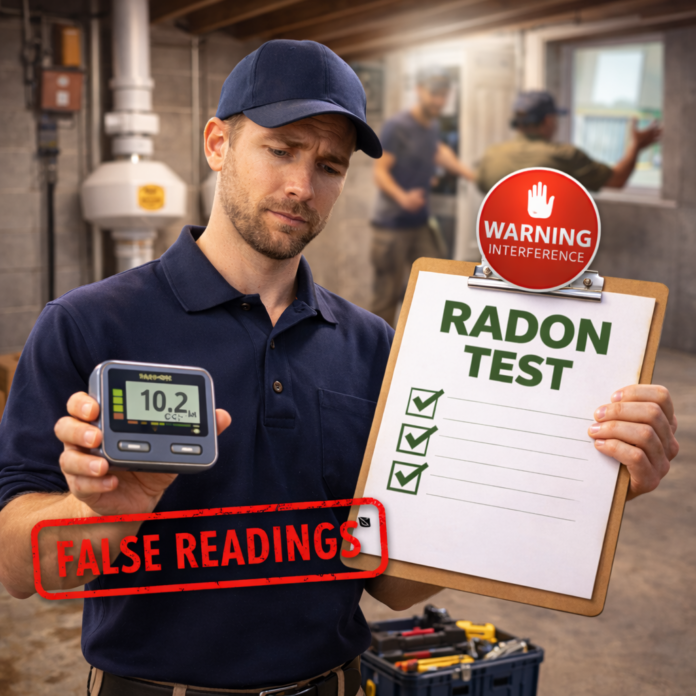
Radon Test Interference and False Readings: A Deep Dive Guide
Radon testing is one of the simplest home health checks you can do. Place a device, follow the instructions, wait, and get a number. The problem is that radon levels naturally change over time, and small mistakes in placement or test conditions can push results higher or lower than your true average exposure.
This is where “interference” and “false readings” come in. Most misleading radon results are not caused by broken equipment. They are caused by testing the wrong area, placing the device in a bad location, changing ventilation during the test, or misunderstanding what a digital monitor is reporting.
This article explains the most common causes of false low and false high readings, how interference differs by test type, and a step-by-step troubleshooting plan you can use when results look suspicious or inconsistent.
What interference and false readings really mean
“Interference” is a broad term. In radon testing, it usually means anything that causes the test result to be meaningfully different from the radon level you would expect under normal living conditions, in the area you actually use.
A “false reading” can take a few forms:
- False low: the reading is lower than your real average exposure, causing you to underestimate risk.
- False high: the reading is higher than your real average exposure, causing unnecessary alarm or confusion.
- Non-representative: the reading is accurate for that exact spot, but that spot does not represent where people spend time.
It is also important to separate interference from normal variability. Radon levels can legitimately rise and fall with weather, barometric pressure, season, and ventilation patterns. A changing number is not automatically “wrong.” The question is whether the test was conducted in a way that produces a reliable, representative result.
Test types and how each can be thrown off
Different devices fail in different ways. Before you diagnose interference, you need to know what type of test you used.
Short-term kits
Short-term tests are commonly used for screening and real estate transactions. Because they measure a short window, they are more sensitive to unusual conditions. A few days of open windows, a major storm, or strong exhaust fan use can shift the result.
Short-term kits can be reliable, but they are snapshots. If you are close to a decision threshold or if the home has large swings, a snapshot can be misleading.
Long-term kits
Long-term tests usually run 90 days or longer. They are designed to average out short-term swings, which makes them less sensitive to one unusual weekend or one storm. Long-term tests are often the best way to reduce uncertainty when results are borderline or inconsistent.
Even long-term tests can be affected by major placement errors. A long-term test in the wrong level of the home still gives a non-representative result, even if it is stable.
Digital radon monitors and continuous devices
Digital monitors provide rolling averages and show you changes over time. Their biggest “interference” problem is not physical interference. It is interpretation interference.
People often treat a one-day spike as the truth, even though the longer averages are what matter. Many monitors also need time to stabilize, and early readings can swing.
Professional continuous radon monitors (CRM)
Professional CRMs are commonly used in real estate testing and other formal protocols. These devices collect time-series data (often hourly) and may include tamper indicators. The device may be accurate, but the test can still be compromised by ventilation changes, unusual building operation, or improper placement.
False low readings: what causes them and how to avoid them
False low results are the bigger risk because they can convince someone that radon is not a problem when it actually is.
1) Testing with windows open or heavy ventilation
The most common false low cause is increased ventilation during a short-term test. Opening windows, running whole-house fans, or leaving exterior doors open for long periods can dilute indoor radon. Your test result may look great, but it may not reflect typical closed-house conditions.
Closed-house conditions exist for a reason. For short-term tests, guidance commonly emphasizes keeping windows and exterior doors closed except for normal entry and exit, and maintaining those conditions during the test.
2) Testing on the wrong level of the home
Radon often enters from the soil, so the lowest lived-in level is usually the highest risk area. If you test on the first floor but spend daily time in a basement office, you may underestimate your true exposure.
This also matters in split-level homes. Testing in an upper level living room while a lower-level den is used daily can produce a number that feels reassuring but does not represent your real exposure pattern.
3) Placing the device near a supply vent, return vent, or strong draft
Drafts can dilute the air around the device and lower the reading compared to the rest of the room. Placing a test near HVAC airflow, exterior doors, open stairwells with strong air movement, or direct fan airflow can create a false low.
4) Testing in a room that is rarely used
This is a “non-representative low.” If you test in an unused storage room upstairs because it is convenient, you may get a low result that does not reflect where you spend time. For risk decisions, you want a result that reflects breathing-zone air in the occupied space you actually use.
5) Short-term test performed during an unusually mild period
Radon levels can be lower during seasons or periods when windows are open often. If you test during a week when the house is unusually ventilated, your short-term result may be lower than your winter average.
This does not mean the test is invalid, but it means you should interpret it as “radon under these conditions,” not as a guaranteed year-round average.
False high readings: what causes them and how to interpret them
False high results happen too, but many “high” results are not false. They are real radon behavior under common conditions.
1) Placing the device in a non-representative hotspot
Radon can be much higher near entry pathways such as sump pits, floor cracks, uncovered drains, or crawl space openings. If you place a test directly next to these pathways, you may measure a localized maximum rather than the room average.
That reading might be “accurate” for that spot, but misleading for decision-making if it is not representative of the occupied breathing zone.
2) Negative pressure events that temporarily increase soil gas entry
Exhaust fans, fireplaces, dryers, and some HVAC configurations can create negative pressure, especially in basements. Negative pressure can pull more soil gas into the home and raise radon temporarily.
That does not automatically make the reading false. It may be showing a real condition that occurs in your home when you live normally.
3) Weather-driven spikes
Storms and barometric pressure changes can influence soil gas movement and radon entry. A short-term test that happens to coincide with a period that drives radon higher can produce a result above your longer-term average.
In these cases, a follow-up long-term test often provides clarity.
4) Closed-house testing that is stricter than your normal lifestyle
Some people naturally ventilate their homes a lot. If you run a strict closed-house short-term test but you normally keep windows open many hours a day, the short-term result might overstate your typical living pattern.
However, closed-house testing is designed to identify whether a home can trap radon under common closed conditions. Many homes operate closed for large parts of the year, especially during heating and cooling seasons. If the closed-house result is high, you still have a radon issue under those conditions.
Placement interference: where people go wrong
Placement is one of the biggest controllable factors in test accuracy. A well-made device can produce a misleading result if placement is wrong.
These placement mistakes are common:
- Too close to windows or exterior doors, where dilution and drafts are common.
- Near HVAC supply or return vents, where airflow distorts local concentration.
- In kitchens, bathrooms, or laundry rooms, where ventilation and humidity are often unusual.
- On the floor or directly against an exterior wall, where airflow and temperature gradients can differ from the breathing zone.
- In direct sunlight or near heat sources, which can affect some devices and create abnormal airflow.
General guidance emphasizes placing test units away from windows, doors, and vents, and following written instructions carefully. It also emphasizes testing in the lowest inhabited area and placing the device at an appropriate height.
Closed-house conditions and ventilation mistakes
Closed-house conditions are one of the most misunderstood parts of short-term radon testing. The goal is not to “trap radon to make a scary number.” The goal is to standardize the test so results are comparable and so you do not accidentally dilute radon during the test.
Key concepts from widely used protocols:
- For short tests lasting less than 4 days, closed-house conditions should be maintained for at least 12 hours before starting the test, and during the test.
- For tests lasting 4 to 90 days, closed-house conditions are not required in the same way, but are still recommended as much as possible during the test.
Common ventilation mistakes that compromise a short-term test:
- Leaving windows open for extended periods.
- Propping exterior doors open during moving, cleaning, or renovation work.
- Running large exhaust fans continuously (some protocols allow normal use, but unusual use can distort results).
- Running whole-house fans or attic fans that dramatically increase air exchange.
If closed-house conditions are not met, you do not necessarily need to throw away the result. You do need to treat it as “radon under those ventilation conditions.” If a decision depends on it, retest under proper conditions or use a long-term test.
Kit handling and shipping problems that can skew results
Mail-in kits are convenient, but they add one more failure mode: handling.
Charcoal tests are time-sensitive
Charcoal tests adsorb radon during the test period. After the test ends, the radon captured in the media begins to decay. If you wait too long to seal and ship the kit, the measured activity can drop, potentially producing a lower result than expected.
This is why kit instructions often emphasize mailing promptly after the test ends. If you run a charcoal kit and then leave it on a counter for several days before shipping, you can compromise the measurement.
Incorrect test duration
Starting late, ending early, or running a kit longer than specified can lead to inaccurate analysis. Labs calibrate their analysis for the expected exposure period. If the test duration is wrong, the result can be skewed.
Expired kits or improper storage
Some kits have expiration dates. Others can be affected by storage conditions (heat, humidity) before use. If a kit sat in a garage for years or was exposed to moisture, it might not perform as intended. Always check kit documentation and condition.
Contamination and disturbance
Do not open, tamper with, or move a passive test device once started. A common real-world issue is kids or pets moving the kit. That can change exposure conditions and location, producing a number that does not match any one spot reliably.
Digital monitor confusion: spikes, warm-up time, and moving devices
Digital monitors are powerful, but they are also the easiest to misinterpret.
1) Early readings are not final
Many monitors provide an initial estimate within the first day or two. That number can swing sharply and should not be treated as the final answer. The longer averages (often 7-day, 30-day, or longer) are far more meaningful for decisions.
2) Short spikes are normal
If your monitor shows hourly or daily spikes, that does not automatically mean something is wrong. Radon can rise overnight, during storms, or during periods of low ventilation. What matters is the trend and the longer average.
3) Moving the monitor breaks comparability
When you move a monitor to a new room, you are effectively starting a new test. Comparing yesterday’s number in the basement to today’s number upstairs is not a reliable way to judge “accuracy.” Leave the device in one location long enough to build meaningful averages, then compare over time.
4) Comparing a rolling average to a lab test without context
A lab test gives an average over a defined time window. A monitor might show a rolling 7-day or 30-day value that shifts daily. These numbers can differ even when both are “right” for their averaging method. If you want to compare, align the time windows as closely as possible.
Quality control and confirmation: how pros reduce bad data
Professionals reduce false readings by building redundancy and quality control into the measurement process.
Two important ideas appear in professional practice guidance:
- Start with short-term testing under closed-building conditions to quickly identify if a hazard is present.
- Use more than one measurement data point for mitigation decisions, rather than trusting a single reading.
In practice, this can include:
- Running duplicate measurements to check consistency.
- Using follow-up tests when results are near decision thresholds or when conditions were questionable.
- Using long-term tests to estimate the true average when short-term results fluctuate.
- Checking device performance through quality systems and documentation.
For homeowners, the simplified version is easy: if your result is surprising, borderline, or inconsistent, confirm it with a follow-up test. A long-term test is often the most informative confirmation tool.
Real estate testing: special rules and common interference issues
Real estate radon testing often uses strict protocols because the results may influence negotiations. These tests typically require closed-house conditions and are often conducted in the lowest occupiable level of the home for each foundation type.
Common interference problems in real estate testing:
- People open windows or doors during the test, sometimes unintentionally.
- Contractors are working, creating unusual ventilation patterns.
- HVAC settings are changed from normal operation.
- Test is placed incorrectly to make the result look better or worse.
Many professional CRMs include tamper indicators and time-stamped data, which helps detect unusual changes. Still, the biggest real-world issue is closed-house compliance. If a real estate test is compromised, the clean solution is to redo the test under proper conditions.
Troubleshooting playbook: what to do when results look wrong
Use this step-by-step approach when you suspect interference or false readings.
Step 1: Identify the problem type
- Is the result unexpectedly low compared to your situation or prior tests?
- Is the result unexpectedly high compared to prior tests or typical expectations?
- Are results inconsistent between devices or rooms?
Step 2: Confirm the basics
- Was the test on the lowest lived-in level?
- Was it placed away from windows, doors, and vents?
- Was it kept away from kitchens, bathrooms, and laundry areas?
- Was the test undisturbed?
Step 3: Review test conditions
- Were windows or doors opened frequently during a short-term test?
- Was there a major storm or unusual weather event?
- Were exhaust fans, fireplaces, or other systems used unusually?
- Was construction or moving happening during the test?
Step 4: Review kit handling (if mail-in)
- Was the kit sealed immediately after the test ended?
- Was it mailed promptly as instructed?
- Was the duration correct?
- Was the kit expired or stored improperly?
Step 5: Choose the right confirmation method
- If you used a short-term kit and the result is questionable, run a second test under proper conditions.
- If results are borderline or inconsistent, use a long-term test (90+ days) to estimate your true average.
- If you rely on a digital monitor, leave it in one spot and focus on longer averages.
Step 6: Escalate when the pattern suggests a real issue
If repeated testing consistently shows elevated radon, treat it as real. At that point, you are not troubleshooting measurement error. You are confirming a radon problem that should be addressed with mitigation planning.
Step 7: Document your results
Keep a simple record: test type, dates, level of home, room, closed-house compliance, and result. This makes it much easier to spot patterns and explain results during a home sale or to a professional.
Bottom line
Most “false” radon readings are not caused by defective devices. They are caused by interference from placement and ventilation, using a short-term test when you need a longer average, mishandling mail-in kits, or misreading digital monitor data.
If you want the most reliable path:
- Place the test correctly on the lowest lived-in level, away from drafts and vents.
- Follow closed-house conditions for short-term tests.
- Mail charcoal kits promptly.
- Use long-term testing to reduce uncertainty when results are borderline or inconsistent.
- Confirm suspicious results with a second data point before making major decisions.
Radon is invisible, but it is measurable. Good testing practices turn radon from a guessing game into a controlled, documented home variable.
Sources
- U.S. Environmental Protection Agency (EPA) – Are radon measurements accurate and reliable?
- Centers for Disease Control and Prevention (CDC) – Testing for Radon in Your Home
- ATSDR (CDC) – Clinician Brief: Radon (testing conditions and placement guidance)
- EPA (Archived) – Protocols for Radon and Radon Decay Product Measurements in Homes (PDF)
- Minnesota Department of Health – Radon in Real Estate (closed-house conditions and testing rules)
- U.S. Environmental Protection Agency (EPA) – Radon Standards of Practice (links to measurement and QA standards)
- ANSI/AARST MAH-2019 – Summary of testing procedures (closed building conditions and multiple data points)