Radon & Real Estate (2026): A Practical Guide for Buyers, Sellers, and Agents
Radon is one of the most common surprises in a real estate transaction because it is invisible, it varies from home to home, and it rarely shows up on a typical walkthrough. The good news is that radon is also one of the most solvable inspection issues. Testing is straightforward, mitigation is well understood, and there is a clear public-health benchmark for action.
This pillar guide explains how radon fits into buying and selling a home, how radon testing is typically handled during inspections, what results mean for negotiations, and how to avoid the most common mistakes that cause delays, disputes, or retesting. It is written for homeowners and real estate professionals who want a calm, repeatable process instead of uncertainty.
Key reference point: The U.S. Environmental Protection Agency (EPA) recommends fixing a home if the radon level is 4.0 pCi/L or higher, and also recommends considering action between 2.0 and 4.0 pCi/L. EPA action level guidance.
Important note: This article is educational and not legal advice. Real estate practices and disclosure requirements vary by state, locality, and contract. When in doubt, use your state radon program as a starting point and consult qualified local professionals.
Table of Contents
- Radon basics that matter in real estate
- Why you should test any home, in any radon zone
- Where radon fits in a typical transaction timeline
- Radon testing options during a home sale
- The rules that make a real estate radon test credible
- Closed-house conditions and test interference
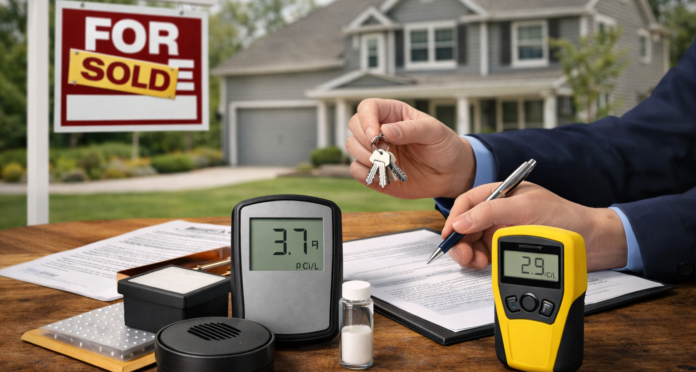
- Consumer digital monitors and why they are a bad fit for transactions
- How to interpret results and decide on next steps
- Negotiation playbook: who pays and what solutions look like
- Seller strategy: how to reduce surprises and protect the deal
- Buyer strategy: how to protect yourself without stalling closing
- Radon mitigation in a transaction: what buyers should verify
- New construction and radon-resistant features
- Condos, apartments, and rentals
- Radon in well water: when it matters in a sale
- Notes for agents: best practices and wording pitfalls
- Sources
Radon basics that matter in real estate
Radon is a radioactive gas that comes from the natural breakdown of uranium in soil and rock. Outdoors, radon is usually diluted. Indoors, it can accumulate, especially in the lowest levels of a building where the home is in contact with soil. Because radon is invisible and odorless, you cannot reliably guess a home’s radon level based on how it looks, how new it is, or what a neighbor measured.
From a real estate perspective, radon is less like a “defect” and more like a measurable environmental condition. The question is not whether radon exists. It exists everywhere. The practical question is whether the level inside the home is elevated enough to justify mitigation, and whether that mitigation can be completed in a way that fits your timeline.
Health is the reason radon matters at all. The Centers for Disease Control and Prevention (CDC) notes that radon is the second leading cause of lung cancer deaths in the United States after cigarette smoking, and that risk increases significantly for people who smoke. CDC radon overview.
Why you should test any home, in any radon zone
Many buyers first hear about “radon zones” and assume a Zone 3 area is low risk. That assumption causes missed testing, and missed testing causes avoidable surprises after move-in. EPA is very direct on this point: the Map of Radon Zones is not intended to determine whether an individual home should be tested, and elevated radon levels have been found in all zones. EPA’s guidance is to test any home, no matter where it test any home, no matter where it is located. EPA Map of Radon Zones.
In real estate terms, that means you should treat radon like you treat a sewer scope or a termite inspection in certain markets. It is not about fear. It is about avoiding uncertainty. A short-term test during the inspection period often provides enough information to make a clean decision before closing. EPA provides radon resources specifically for the real estate community and points buyers and sellers to transaction-focused guidance. EPA radon resources for real estate.
Where radon fits in a typical transaction timeline
Most radon testing during a home purchase happens during the inspection period, often as an add-on service separate from the general home inspection. In many markets, the buyer requests the radon test and pays for it, just like other optional inspections. The seller usually cooperates by maintaining the required testing conditions, but local customs vary.
Radon becomes most important when it impacts the buyer’s willingness to proceed, the seller’s willingness to remediate, and the ability to finish any mitigation work before closing. This is why radon is often handled with a specific addendum or inspection contingency language that defines who orders the test, how it must be conducted, and what happens if the result is above a chosen threshold.
EPA’s Home Buyer’s and Seller’s Guide to Radon was designed specifically to address the time-sensitive nature of home purchases and sales and provides practical testing guidance for transaction scenarios. EPA Home Buyer’s and Seller’s Guide to Radon (PDF).
Radon testing options during a home sale
Radon tests fall into three broad categories: short-term tests, long-term tests, and continuous monitoring. In a real estate transaction, short-term tests are the most common because of timing. Long-term tests can provide a more representative annual average, but a 90-day test often does not fit the contract timeline.
EPA’s transaction guide emphasizes that short-term testing is typically used in home sales and includes instructions that account for the realities of scheduling and occupancy. A core recommendation is that the test should run a minimum of 48 hours, and some devices require longer. EPA Home Buyer’s and Seller’s Guide (PDF).
For professional practice, a widely recognized standard of practice for measuring radon in homes is ANSI/AARST MAH-2019. This standard specifies procedures and minimum requirements for measuring radon concentrations in single-family residences and is relevant for both real estate and non-real estate purposes. ANSI/AARST MAH-2019 overview. EPA also references standards of practice and points the public to AARST standards as a key reference. EPA radon standards of practice.
In practical terms, here is what these choices usually look like during a sale:
Short-term test (most common for transactions): A 48-hour minimum test window, often using a professional continuous radon monitor (CRM) or other approved short-term method. This is the normal approach when you need an answer within the inspection period.
Long-term test (best average, rarely used in the contract window): A 90-day or longer test that provides a more stable estimate of year-round exposure. This is great for homeowners, but often not realistic during closing timelines.
Consumer digital radon monitor: Useful for homeowner awareness over time, but not a good substitute for an approved transaction test. More on this later, because this is a common point of confusion.
The rules that make a real estate radon test credible
Radon results can be questioned when testing conditions are not controlled, the device is not appropriate for the situation, or the report lacks basic documentation. During a transaction, credibility matters because you are using the result to negotiate repairs, credits, or changes to the contract.
EPA’s transaction guide highlights several practical requirements for short-term tests. One of the most important is a minimum test duration of 48 hours. EPA also notes that for short-term tests in the 2 to 4 day range, closed-house conditions should be maintained for at least 12 hours before the test begins and throughout the test period. For 4 to 7 day short-term tests, EPA recommends maintaining closed-house conditions as well. EPA Home Buyer’s and Seller’s Guide (PDF).
ANSI/AARST MAH-2019 also discusses professional practice in the context of real estate transactions and encourages that testing associated with a real estate transaction be conducted by a qualified radon measurement professional. ANSI/AARST MAH-2019 guidance (real estate note).
If you are trying to keep a deal clean, this is the mindset that helps: a real estate radon test should be conducted in a way that both parties can accept without arguing about the basics. That usually means a qualified professional, a documented start and stop time, a clear statement of closed-house conditions, and a report format that matches what local inspectors and state programs recognize.
Closed-house conditions and test interference
Closed-house conditions exist to reduce variability. During a short-term test, large ventilation changes can temporarily raise or lower radon readings relative to typical living conditions. That is why EPA and professional standards emphasize keeping windows and external doors closed as much as practical, with normal entry and exit allowed.
EPA’s Home Buyer’s and Seller’s Guide includes a direct warning that disturbing or interfering with the test device or with closed-house conditions may invalidate the test results and is illegal in some states. If the tester cannot confirm that conditions were maintained, EPA advises taking another test. EPA Home Buyer’s and Seller’s Guide text (NEPIS).
In the real world, this matters because selling a home involves showings, contractors, movers, and people who may not understand the importance of the instructions. Many professional testers use a written non-interference agreement to notify occupants and reduce disputes. For example, NRPP provides a Radon Test Authorization and Non-Interference Agreement template that references conducting a 48-hour minimum test according to MAH-2019. NRPP non-interference agreement (PDF).
If you are a seller, the takeaway is simple. If you agree to a radon test, treat it like a protocol, not like a suggestion. It reduces the chance that you will need to repeat the test, and it reduces the chance that a buyer will accuse you of interference.
Consumer digital monitors and why they are a bad fit for transactions
Homeowners increasingly buy consumer digital radon monitors because they provide ongoing readings and a sense of control. That makes sense for living in a home. It does not automatically make sense for buying or selling a home.
The Conference of Radiation Control Program Directors (CRCPD) published an advisory on Consumer Digital Radon Monitors (CDRMs) with clear cautions. The advisory states that consumer digital radon monitors are not for testing during real estate transactions. It also cautions against using CDRMs to make mitigation decisions and emphasizes verifying results using an approved method. CRCPD advisory on CDRMs (PDF).
In transaction terms, a buyer and seller need a method that is broadly accepted and defensible. A consumer device that has not been independently evaluated for accuracy and reliability in the same way as professional devices creates room for dispute. Even if the number is accurate, the other party may not accept it. When money and deadlines are involved, acceptance matters.
How to interpret results and decide on next steps
In the United States, radon is commonly reported in picocuries per liter (pCi/L). The decision-making benchmark most often referenced in transactions is EPA’s action level of 4.0 pCi/L. EPA recommends fixing at or above 4.0 pCi/L and considering action between 2.0 and 4.0 pCi/L. EPA action level explanation.
In a real estate setting, you should interpret a single short-term result as a decision tool, not as a perfect statement of year-round average. Short-term tests are used because they fit the timeline. If a result comes back clearly low, many buyers proceed without further steps. If it comes back clearly high, negotiations usually focus on mitigation. If it comes back near the middle, follow-up becomes a judgment call based on timeline and risk tolerance.
EPA’s transaction guide is designed for exactly this scenario and provides follow-up guidance when results are elevated. One common approach is a second short-term test or a longer follow-up test when timing allows. EPA Home Buyer’s and Seller’s Guide (PDF).
One detail that is often missed in negotiation is that “below 4.0” does not mean “zero risk.” EPA emphasizes that there is no known safe level of radon exposure and encourages considering reduction even below 4.0 pCi/L. That does not mean every transaction must involve mitigation below 4.0. It means you should make the decision with clear information rather than a false sense of safety.
Negotiation playbook: who pays and what solutions look like
Radon negotiations are usually easier than other inspection issues because the solutions are standardized. A typical radon mitigation system for many homes is a sub-slab depressurization system, often installed in one day. Because it is a known solution, the conversation becomes less emotional and more procedural: confirm the level, agree on the remedy, verify the post-mitigation result.
Who pays varies by market and leverage. In a buyer’s market, sellers often agree to install a system. In a seller’s market, buyers may accept the home as-is and plan mitigation after closing. Many contracts land in the middle with a credit, a price reduction, or an escrow holdback that ensures the work is completed even if closing timing is tight.
| Common option | What it means | Why buyers like it | Why sellers like it |
|---|---|---|---|
| Seller installs mitigation before closing | Seller hires a qualified mitigator, installs system, provides documentation | System is done and verified before moving in | Clean close, fewer open-ended obligations |
| Seller credit at closing | Seller gives buyer a set amount toward mitigation | Buyer controls contractor choice and timing | Simple negotiation and avoids coordination work |
| Price reduction | Sale price reduced by an agreed amount | Finances mitigation through purchase economics | Sometimes easier than repair paperwork |
| Escrow holdback | Money held in escrow until mitigation is completed after closing | Ensures funds exist even if delays occur | Allows closing to stay on schedule |
The negotiation becomes simpler if you anchor on credible standards and professional work. EPA suggests using qualified measurement and mitigation professionals and provides guidance on finding them. EPA guidance on finding qualified providers. Many buyers and sellers also look for credentialing through programs such as NRPP or NRSB. NRPP and NRSB.
One negotiation trap is arguing over whether the radon result is “real.” If the test was conducted under recognized protocols and reported clearly, move directly to the solution discussion. That is where time and money are saved.
Seller strategy: how to reduce surprises and protect the deal
Sellers who handle radon proactively usually have smoother transactions. The reason is not that radon is rare. The reason is that uncertainty creates leverage. If a buyer discovers an elevated radon result late in the process and you scramble to schedule mitigation, the buyer feels risk and delay. If you already tested, documented, and mitigated if needed, radon becomes a solved item rather than a negotiation bomb.
The simplest seller strategy is pre-list testing. If you test before listing, you can choose your timeline and avoid the compressed inspection window. If the result is elevated, you can install mitigation and then retest, keeping documentation ready for buyers. EPA’s Home Buyer’s and Seller’s Guide includes practical guidance on what to do if a home has not been tested and encourages testing as part of the buying or selling process. EPA Home Buyer’s and Seller’s Guide (PDF).
From a disclosure standpoint, requirements vary widely. The National Association of Realtors notes that radon notification and disclosure laws differ by state and locality, and some ordinances may require radon testing at point of sale. NAR points readers to the Environmental Law Institute’s database for state indoor air quality laws, including a radon section. NAR radon key messages. For legal specifics, ELI publishes a radon excerpt of its database that summarizes enacted state laws through a defined period, which can be a useful starting point for research. ELI IAQ database radon excerpt (PDF) and ELI database landing page.
Even when there is no legal disclosure mandate, buyers may ask for prior radon test results and details of any mitigation system. Providing a clean folder of documents reduces friction. A seller “radon packet” often includes a test report, mitigation invoice, any warranty paperwork, and a post-mitigation test result.
Buyer strategy: how to protect yourself without stalling closing
Buyers should treat radon as a standard part of environmental due diligence, especially for homes with basements or lower levels where time is spent. The key is to request the test early enough that you can receive the report and still have time to negotiate or schedule mitigation without panic.
A common buyer mistake is assuming that a home without a basement does not need testing. Radon can enter through slab-on-grade foundations as well, and EPA emphasizes that all homes should be tested regardless of location. EPA Map of Radon Zones guidance.
Another buyer mistake is choosing a testing method that the seller or agent will not accept. If you want a smooth negotiation, use a qualified professional and a method aligned with recognized protocols. ANSI/AARST MAH-2019 encourages qualified professional testing in association with a real estate transaction. MAH-2019 real estate note.
Finally, keep the decision framework simple. If the result is below 4.0 pCi/L, many buyers proceed, while still recognizing that radon risk exists below that level. If the result is at or above 4.0 pCi/L, EPA’s guidance supports action and the negotiation typically shifts toward mitigation solutions. EPA action level.
Radon mitigation in a transaction: what buyers should verify
Mitigation is usually not complicated, but buyers should verify the basics so the “fix” is real and durable. If a seller installs mitigation before closing, ask for the scope of work, the installer’s credentials, and any warranty information. EPA recommends using qualified professionals and provides guidance on finding them. EPA qualified provider guidance.
Post-mitigation testing is a crucial piece of closing confidence. A mitigation system should be followed by a test to confirm radon reduction. In many transactions, the agreement includes a requirement that the post-mitigation result be below a specified threshold, often 4.0 pCi/L or lower depending on local practices and risk tolerance.
If the home already has a mitigation system, ask for details that help you evaluate ongoing reliability. How old is the fan. Has it been replaced. Is there a visible indicator that shows the system is operating. Has the home been retested since installation. Even a good system should be verified periodically because homes change over time.
New construction and radon-resistant features
New does not mean radon-free. Radon comes from the ground and the pressure dynamics of the building, not the age of the property. New homes can still test high, and in some cases can test higher than expected due to modern building tightness and the way a home interacts with soil gas.
The smart move with new construction is to treat radon resistance as a design feature, not a retrofit. EPA provides extensive guidance on radon-resistant new construction (RRNC), including building codes and standards by state. EPA RRNC building codes and standards.
EPA also provides consumer-facing guidance for home buyers and notes that RRNC typically costs a builder between $250 and $750, and that it is generally less expensive to install radon-resistant features during construction than to retrofit later. EPA RRNC for home buyers. Even if a builder includes RRNC features, testing after construction remains important because a passive system may still need a fan to achieve lower levels depending on the home and site conditions.
If you are building, a practical contract approach is to ask for RRNC features and to include a post-build radon test requirement. That way the home is designed for mitigation if needed, and you still verify real performance after completion.
Condos, apartments, and rentals
Radon can be relevant in multifamily buildings, especially for ground-contact units. The decision question is still the same: what is the radon level in the occupied space. Buyers in condos sometimes assume the building structure eliminates risk. In reality, units on the lowest floors or those adjacent to ground-contact areas can still experience elevated radon.
If you are buying a condo, ask the association whether radon testing has been conducted, and focus on the unit level and nearby ground-contact common areas. EPA provides radon resources for the real estate community and also includes a radon guide for tenants within its real estate resource pages. EPA real estate radon resources.
If you are renting, your leverage is different, but the basic health guidance remains the same. If a radon test indicates elevated levels, mitigation options depend on building layout and ownership responsibilities. State and local programs can be helpful starting points for guidance.
Radon in well water: when it matters in a sale
Most transaction discussions focus on radon in indoor air. For homes with private wells, buyers sometimes ask about radon in water as well, especially in regions where groundwater radon can be elevated. The health relevance and testing approach differ from air testing, and not every well requires radon-in-water testing.
If radon in water is a concern, EPA’s radon hotlines and information resources include the Safe Drinking Water Hotline for general information on drinking water, radon in water, testing, treatment, and standards. EPA radon hotlines and resources.
In practical transaction terms, you can treat radon-in-water as a specialized add-on test for well homes where local guidance or geology suggests it might be relevant. If a water result is elevated, treatment approaches exist, but they should be discussed with qualified water treatment professionals.
Notes for agents: best practices and wording pitfalls
Agents are often the first people to normalize radon as a standard part of due diligence. The best approach is calm and procedural. Avoid language that downplays radon as “not a big deal” and avoid language that overstates risk or implies that a home is defective. Radon is a measurable condition with a well-established test-and-fix workflow.
One of the most useful agent habits is to standardize the referral path. When clients ask questions, you can direct them to EPA’s real estate resources, explain the testing timeline, and encourage the use of qualified professionals. EPA radon resources for real estate community.
Another key habit is preventing disputes. Closed-house conditions and non-interference matter. EPA warns that interference with testing conditions can invalidate the test and may be illegal in some states. EPA guide text (NEPIS). Encouraging sellers to follow the tester’s written instructions protects everyone and reduces the chance of a retest.
Finally, do not let consumer monitors derail deals. CRCPD’s advisory is clear that consumer digital radon monitors are not for use during real estate transactions. CRCPD advisory (PDF). If a buyer shows up with a screenshot from a consumer device, the fastest resolution is to schedule a test using accepted methods rather than arguing about the screenshot.
Conclusion
Radon does not need to be a deal-killer, but it does deserve a structured process. The winning pattern is consistent across markets: test using credible protocols during the inspection period, interpret results using EPA guidance, and if mitigation is needed, treat it like a standard repair with documentation and confirmation testing. When both parties aim for defensible testing and a clean fix, radon becomes one of the more straightforward items in a transaction.
If you want to build confidence fast, start with the most stable anchors: test any home regardless of zone, use a qualified professional for transaction testing, follow closed-house conditions, and use EPA’s action level to guide next steps. EPA testing guidance by zone and EPA action level.
Sources
- EPA: Home Buyer’s and Seller’s Guide to Radon (PDF)
- EPA: Radon Resources for Real Estate Community
- EPA: What is EPA’s Action Level for Radon and What Does it Mean?
- EPA: The EPA Map of Radon Zones
- EPA: Radon Standards of Practice
- ANSI/AARST MAH-2019: Protocol for Conducting Measurements of Radon and Radon Decay Products in Homes
- ANSI/AARST MAH-2019: Real estate transaction guidance note
- CRCPD: Radon Testing with Consumer Digital Radon Monitors (Publication 25-4) (PDF)
- CDC: Radon and Your Health
- National Association of Realtors: Radon Key Messages and Resources
- Environmental Law Institute: Database of State Indoor Air Quality Laws
- Environmental Law Institute: IAQ Database Radon Excerpt (PDF)
- EPA NEPIS text: Home Buyer’s and Seller’s Guide to Radon excerpt (test interference warning)
- NRPP: Radon Test Authorization and Non-Interference Agreement (PDF)
- NRPP: National Radon Proficiency Program
- NRSB: National Radon Safety Board
- EPA: Building Codes and Standards for Radon-Resistant New Construction (RRNC)
- EPA: Radon-Resistant New Construction for Home Buyers
- EPA: Radon Hotlines and Inform
::contentReference[oaicite:0]{index=0}
ation Resources