Radon in Real Estate: Who Pays for Testing and Mitigation?
Radon is one of the most common inspection items that turns into a money question. Not because the fix is mysterious, but because the responsibility is not universal. In most markets, radon testing and mitigation are handled through negotiation, local custom, and sometimes local ordinances. If you understand the usual patterns, you can keep the deal calm and avoid last-minute conflict.
This guide explains who typically pays for radon testing, who typically pays for mitigation, and how buyers and sellers can structure agreements that protect everyone’s timeline. It is designed for homeowners, buyers, and real estate professionals.
Baseline reference: The U.S. Environmental Protection Agency (EPA) recommends fixing the home if the radon level is 4.0 pCi/L or higher, and also recommends considering action between 2.0 and 4.0 pCi/L. EPA action level guidance.
Table of Contents
- Short answer: who pays most often
- Why payment responsibility varies so much
- Who pays for radon testing?
- Who pays for radon mitigation?
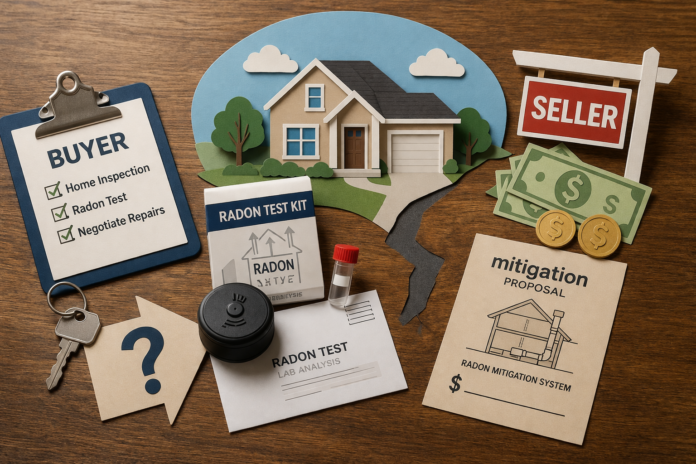
- The 4 deal structures that solve radon cleanly
- How to write radon terms that reduce disputes
- Seller playbook: reduce surprises and protect the deal
- Buyer playbook: protect yourself without stalling closing
- Common mistakes that cost money and time
- FAQs
- Sources
Short answer: who pays most often
Testing: In many transactions, the buyer pays for radon testing because it is usually ordered as part of the buyer’s inspection period and treated as an optional add-on service. National Radon Program Services (Kansas State University) describes the most common procedure as the potential buyer requesting a radon test as part of the overall home inspection, noting that it is generally a separate service that must be requested. Radon during real estate transactions (NRPS).
Mitigation: Mitigation is usually a negotiation item. Many sellers end up paying in some form (installing the system, providing a credit, or reducing the price) because mitigation is a direct “fix” to an elevated result. In other markets, buyers accept the home as-is and pay after closing, especially in competitive situations. There is no universal rule because contracts, leverage, and local norms vary.
Use this mindset: radon is typically not a blame issue. It is a measurable condition with a standard solution. The payment question is simply part of how the transaction allocates costs and risk.
Why payment responsibility varies so much
Radon differs from many inspection items because it is not a visible defect and it is not necessarily tied to property neglect. A home can be in perfect condition and still test high. That makes it hard to apply a simple fairness rule like “seller pays for repairs” because buyers can argue it is a safety issue while sellers can argue it is a naturally occurring condition that can be addressed after purchase.
What actually determines who pays is usually a combination of:
Market leverage: In a seller’s market, buyers often absorb more costs to win the home. In a buyer’s market, sellers often agree to more concessions to keep the deal alive.
Timeline pressure: If closing is tight and there is no time to install a system before closing, a credit or escrow holdback becomes more common than “seller installs before close.”
Local norms and ordinances: Some areas have stronger radon customs or point-of-sale expectations. The National Association of Realtors notes that radon notification and disclosure laws differ by state and locality and that ordinances may require radon testing at point of sale. NAR radon resources.
Risk tolerance: Some buyers want mitigation completed and verified before moving in. Others prefer a credit so they can choose their own contractor and schedule.
Documentation quality: If the seller can provide credible prior results and mitigation records, buyers may not push as hard for new testing or new concessions. If documentation is weak, buyers typically request their own test and use the results as negotiation leverage.
Who pays for radon testing?
In most transactions, radon testing is treated like other buyer-driven due diligence. The buyer requests it, pays for it, and uses the result to decide whether to negotiate further. National Radon Program Services describes this as the most common pattern, with the radon test generally being a separate service that must be requested as part of the overall home inspection. NRPS real estate testing overview.
That said, there are common exceptions.
Seller-paid pre-list testing: Some sellers test before listing to reduce surprises. If a seller tests and the result is elevated, the seller may mitigate before going on the market to keep the listing clean. NRPS notes that homeowners can test prior to listing and discusses how elevated results often need to be addressed in the transaction. NRPS seller guidance.
Local ordinance or program expectations: Some areas require certain disclosures or have stronger point-of-sale radon expectations. These rules are local, so buyers and agents should check the state radon program or local guidance. NAR points readers to the Environmental Law Institute (ELI) database for state indoor air quality laws, including a radon section. NAR reference to ELI.
Seller-provided test accepted by buyer: Sometimes the seller has a prior radon report and the buyer chooses to accept it. The decision should be based on whether the test appears credible and relevant. EPA’s Home Buyer’s and Seller’s Guide to Radon is the best public reference for transaction testing context and includes a radon testing checklist concept. EPA Home Buyer’s and Seller’s Guide (PDF).
Who pays when a retest is needed: If the first test is invalid (for example, closed-house conditions were not maintained), the party demanding a valid result often pays to retest, but this is pure negotiation. The best solution is preventing the retest by using a qualified tester and clear non-interference expectations from day one.
Who pays for radon mitigation?
Mitigation payment is rarely fixed in law. It is usually negotiated based on the test result, the contract language, and the balance of leverage.
A useful anchor for negotiations is EPA’s action level guidance. If a test result is at or above 4.0 pCi/L, EPA recommends fixing the home. EPA action level guidance. In that scenario, mitigation requests are not random. They are tied to a public health benchmark that many professionals recognize.
NRPS describes a common negotiation approach: if the radon test is 4 pCi/L or greater, the EPA recommends the potential buyer negotiate with the seller to have a radon mitigation system installed with the stated goal of bringing the radon level below 4 pCi/L. NRPS negotiation guidance.
In practical terms, mitigation cost responsibility usually lands in one of three buckets.
Seller pays (directly or indirectly): The seller installs the system before closing, gives a credit for the system, reduces the price, or agrees to an escrow holdback that funds mitigation after closing. This is common when the seller wants to protect the sale, avoid buyer anxiety, and avoid “known issue” stigma for future buyers if the first deal falls through.
Buyer pays: The buyer agrees to handle mitigation after closing, often in exchange for winning the home or keeping the deal simple. This is common in highly competitive markets, or when the buyer prefers to pick the contractor and design details.
Shared cost: The parties split the burden through partial credits, shared pricing adjustments, or capped concessions. This is common when both parties want fairness and speed.
There is no single “right” choice. The best choice is the one that closes without resentment and without hidden risk.
The 4 deal structures that solve radon cleanly
When a radon test comes back elevated, a good deal structure focuses on clarity and verification. These are the four structures that resolve most radon situations without drama.
| Structure | Who pays in practice | Why it works | Common risk |
|---|---|---|---|
| Seller installs mitigation before closing | Seller pays up front | Buyer moves into a mitigated home; documentation is clean | Scheduling delays can threaten closing |
| Seller credit at closing | Seller pays through credit; buyer installs after closing | Closes on time; buyer chooses contractor and timing | Buyer must actually complete mitigation after move-in |
| Price reduction | Seller pays indirectly through lower price | Simple negotiation; fewer “repair” logistics | Buyer may underestimate real cost and time |
| Escrow holdback | Seller funds escrow; mitigation completed after closing | Protects buyer while allowing close; ensures money is available | Paperwork complexity; must define deadlines and release terms |
All four can be fair. The difference is what each party values more: certainty before closing or flexibility after closing.
How to write radon terms that reduce disputes
If the contract language is vague, payment fights are almost guaranteed. The strongest radon terms do three things. They define the testing method, they define the decision threshold, and they define what “resolution” means.
Testing method language: For transactions, use a qualified radon measurement professional and a method aligned with recognized practice. EPA’s buyer and seller guide provides transaction testing guidance and a testing checklist concept. EPA transaction guide (PDF).
Threshold language: Many contracts use 4.0 pCi/L as the threshold for required action because it aligns with EPA’s recommended action level. Some buyers choose a lower threshold for peace of mind. This is a negotiation choice, but it should be explicit.
Resolution language: Define whether resolution means seller installs a system, seller provides credit, or another arrangement. Also define whether a post-mitigation test is required and what result is acceptable.
When you do this, the “who pays” question becomes a predictable workflow instead of a debate.
Seller playbook: reduce surprises and protect the deal
Sellers have the most power when they reduce uncertainty early. A seller who tests before listing can choose the test schedule, choose the contractor, and avoid rushed decision-making inside the inspection window.
If your pre-list test is below 4.0 pCi/L, buyers may still test, but the conversation usually stays calm because you already demonstrated awareness and transparency. If your test is 4.0 pCi/L or higher, pre-list mitigation can prevent a buyer from using radon as a lever for broader concessions.
NRPS explicitly notes that homeowners can test prior to listing and that elevated results will need to be addressed in the real estate transaction. NRPS seller testing guidance.
A seller who installs mitigation should keep a simple documentation packet. Include the mitigation invoice, any warranty information, system basics (fan model, install date), and post-mitigation test results. Buyers are not just buying the system. They are buying confidence that the system is real.
Buyer playbook: protect yourself without stalling closing
Buyers should treat radon testing as normal due diligence. EPA recommends testing if you are buying or selling a home. EPA buyer and seller guide (PDF).
The most important buyer strategy is timing. Order the radon test early in the inspection period so you have room to negotiate. If the result is elevated, you can shift into one of the clean resolution structures (seller installs, credit, price reduction, escrow holdback) without racing the closing date.
Do not fall into the trap of using a consumer monitor reading as “proof” in a transaction. CRCPD’s advisory states that due to time constraints and the need for reliable results, consumer digital radon monitors should never be used in real estate transactions. CRCPD advisory (PDF). If you want a defensible number, use an accepted transaction method.
If the home already has a mitigation system, ask for documentation and ask when it was last tested. A system can be present but not necessarily operating as intended. A current test is still valuable.
Common mistakes that cost money and time
Waiting too long to schedule the test: When the radon test is scheduled late, everyone is forced into rushed mitigation decisions. This increases the odds of disputes and delays.
Using unclear responsibility language: If the contract does not define what happens above a threshold, the “who pays” argument becomes personal instead of procedural.
Invalid test conditions: Radon testing protocols often require closed-house conditions for short-term tests. If conditions are not maintained, you may need to retest, and the retest becomes another negotiation point. The EPA buyer and seller guide emphasizes preventing device interference and following a checklist approach. EPA guide (PDF).
Letting a consumer device derail the deal: Even if a consumer monitor is reading high, it is rarely the right transaction tool. Confirm with an accepted method to avoid dispute. CRCPD advisory (PDF).
Assuming “below 4.0” means “no risk”: EPA notes that radon levels below 4.0 pCi/L still pose a risk and may be reduced in many cases. EPA buyer and seller guide (PDF). In a transaction, this does not automatically mean mitigation is required below 4.0, but it does mean buyers should understand the decision they are making.
FAQs
Is the buyer required to pay for radon testing?
No universal rule exists. In many markets, the buyer pays because it is part of the buyer’s inspection choices. NRPS describes the most common procedure as the buyer requesting the test as part of the home inspection and notes it is generally a separate service. NRPS real estate testing.
If radon is high, does the seller have to fix it?
Usually not by law, but the seller may choose to fix it to keep the deal. EPA recommends fixing at 4.0 pCi/L or higher, which is why many negotiations focus on mitigation when results meet or exceed that level. EPA action level guidance.
What is the cleanest option: mitigation before closing or a credit?
Both can be clean. Mitigation before closing gives the buyer certainty. A credit keeps closing on schedule and lets the buyer choose the contractor. The best option depends on timeline and leverage.
Can a seller refuse a radon test?
They can refuse, but refusal can change buyer confidence and deal terms. In many markets, refusal increases the chance the buyer requests stronger concessions or walks away. The practical solution is usually cooperating with a professional test conducted under clear conditions.
Should I accept a seller’s old radon result?
Sometimes, but only if it seems credible and relevant. Many buyers still prefer a test during their own inspection period because it reduces uncertainty. EPA’s buyer and seller guide explains transaction testing context and encourages using a checklist approach. EPA Home Buyer’s and Seller’s Guide (PDF).
Sources
- EPA: Home Buyer’s and Seller’s Guide to Radon (PDF)
- EPA: What is EPA’s Action Level for Radon and What Does it Mean?
- EPA: Radon Resources for Real Estate Community
- National Radon Program Services (Kansas State University): Radon During Real Estate Transactions
- CRCPD: Advisory, Radon Testing with Consumer Digital Radon Monitors (Publication 25-4) (PDF)
- National Association of Realtors: Radon Key Messages and Resources