
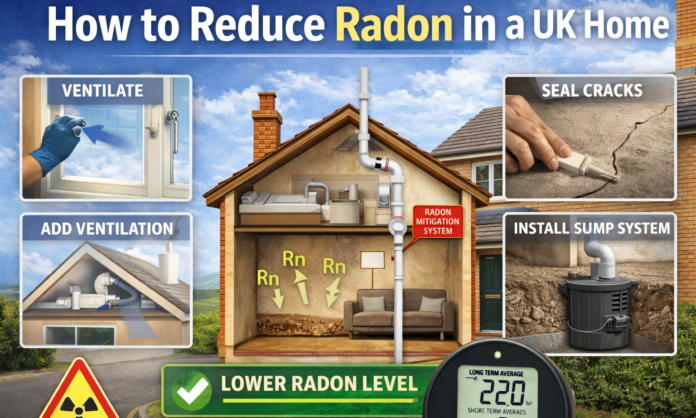
How to Reduce Radon in a UK Home
If you have tested your home and found an elevated radon level, the next question is usually simple: how do you actually reduce it? In the UK, the good news is that radon mitigation is usually a building problem with building solutions. You do not need to guess, panic, or assume you have to live with it. In many cases, the level can be brought down with straightforward remedial work that targets the way radon is entering and building up inside the property.
The most important thing to understand at the start is that there is no single universal fix for every house. The right remedy depends on how the home was built. A property with a solid concrete ground floor may need a different solution than a property with a suspended timber floor. A basement or cellar changes the conversation again. That is why UK guidance focuses on matching the remedy to the structure of the building rather than treating all homes the same.
In the UK, the Action Level for homes is 200 Bq/m³, which is the point where radon reduction is recommended, while the Target Level is 100 Bq/m³, which is the ideal outcome for remediation work. So if your home has already tested high, the goal is not just to “do something.” The goal is to choose the right method, reduce the level as far as practical, and then test again to confirm the work actually solved the problem.
Table of Contents
- Quick Answer
- Before You Start: Make Sure the Result Is Worth Acting On
- The Main Ways to Reduce Radon in a UK Home
- 1. Radon Sump Systems
- 2. Positive Ventilation Systems
- 3. Natural and Active Under-Floor Ventilation
- 4. Basements and Cellars
- What Usually Does Not Work Well on Its Own
- Reducing Radon in New-Build Homes
- Should You DIY or Use a Contractor?
- Why You Must Test Again After Remediation
- Final Thoughts
- Sources
Quick Answer
In most UK homes, radon is reduced by either removing it from beneath the building, improving ventilation, or doing both. The most effective solution in many cases is an active radon sump fitted with a fan. For homes with suspended floors, improving under-floor ventilation or installing fan-assisted under-floor ventilation may be more appropriate. In some houses, a positive ventilation system can also help by diluting indoor radon and reducing entry from the ground.
The best fix depends mainly on whether your home has a solid ground floor, a suspended floor, mixed floor types, or a basement. In all cases, you should base the decision on a proper three-month measurement, choose a remedy that fits the structure of the building, and then retest once the work is complete.
Before You Start: Make Sure the Result Is Worth Acting On
Before spending money on mitigation, make sure you are acting on a useful radon result. In the UK, the standard domestic approach is a three-month test using two detectors, usually placed in the living area and an occupied bedroom. This matters because radon varies over time and from room to room. A short-term reading can be interesting, but it is not the best basis for deciding which building works to pay for.
If your result is 200 Bq/m³ or above, radon reduction is recommended. If your result falls between 100 and 200 Bq/m³, reduction should still be considered, especially if anyone in the home is a smoker or ex-smoker. That middle range is easy to underestimate, but the UK Target Level is 100 Bq/m³, so there is a good reason not to shrug off a result that is below the Action Level but still higher than ideal.
If you have not tested yet, start there first. UKHSA and UK Radon encourage homeowners to check whether they are in a radon Affected Area, but an address search is only a probability tool. It tells you the likelihood of a high result, not the actual level in your living room or bedroom. The only way to know what is happening in your home is to measure it.
The Main Ways to Reduce Radon in a UK Home
Most effective radon remedies follow one of two basic principles. The first is to stop radon from collecting under pressure beneath the building by drawing it away from the ground below the home. The second is to dilute indoor radon or improve the movement of air so radon does not build up to the same extent inside occupied rooms.
That sounds simple, but the method you use depends on construction. UK guidance effectively divides homes into broad groups. Some have solid concrete floors. Some have suspended timber or concrete-beam floors with a void underneath. Some are mixed. Some have cellars or basements that sit partly or fully below ground. Each of those setups changes where radon is entering and which remedy is most likely to work.
That is why the right question is not just, “How do I reduce radon?” It is, “How do I reduce radon in this type of UK home?”
1. Radon Sump Systems
For many homes, the most effective remedy is a radon sump. UK Radon states that an active radon sump fitted with a fan is the most effective way to reduce indoor radon levels. A sump works by creating a low-pressure collection point beneath the floor so radon is drawn out from below the building and vented safely outside before it can enter the living space.
In practical terms, a sump is usually a small cavity created beneath the ground floor and connected to pipework. When fitted with a fan, it actively pulls soil gas away from the property. This method works especially well under solid floors. It can also work under suspended floors if the ground beneath is covered with concrete or a membrane.
Why are sumps so effective? Because they target the source rather than merely trying to dilute the symptom. If radon is entering from the ground, removing it from beneath the house before it gets indoors is often more reliable than trying to deal with it once it is already inside.
There are also passive sumps, which do not use a fan. These can sometimes reduce radon, but UK guidance makes clear that the active version is the stronger and more dependable option. In older homes without built-in radon protection, a sump may need to be installed from scratch. In newer homes in radon areas, there may already be a capped sump pipe present as part of the original protective measures, which can sometimes be activated later if the house tests high.
If your home has a high radon result and a solid ground floor, a sump is often the first remedy worth discussing.
2. Positive Ventilation Systems
Another recognised UK remedy is positive ventilation. UK Radon describes this as a system where a small quiet fan blows fresh air, usually from the roof space, into the building. The basic idea is to increase the supply of fresh air indoors so radon is diluted, while also changing the indoor pressure balance enough to reduce radon entry from the ground in some homes.
Positive ventilation is often discussed for properties where a sump is not the easiest fit, or where the building is relatively well insulated and draft-free. It can also be a useful option in certain bungalows and homes where air movement can be managed more predictably. The system does not remove radon from under the house in the same direct way as a sump, but it can still be effective in the right property.
One advantage of positive ventilation is that it may also improve the general indoor environment by reducing stale air, stuffiness, and sometimes condensation issues. But that should not distract from the main point: it is still a radon remedy, and like any radon remedy it should be judged by the follow-up test result rather than assumptions.
In plain English, positive ventilation is not “just opening a window more often.” It is a purpose-built mechanical system designed to change how air moves through the home. That is a very different thing from casual ventilation habits.
3. Natural and Active Under-Floor Ventilation
If your home has a suspended ground floor, improving the ventilation beneath that floor may be one of the most sensible remedies. UK Radon explains that many homes have a space below the ground floor and that good ventilation of this space can reduce indoor radon concentrations. This is especially relevant for suspended timber floors, though some concrete-beam floors also have ventilated voids.
The first step is sometimes surprisingly basic. Existing vents and airbricks may be blocked by dirt, leaves, paving, insulation work, garage additions, or previous attempts to cut draughts. In those cases, simply restoring the intended airflow under the floor can help. If the vents are there but not doing their job, the remedy may begin with clearing obstructions and making sure the under-floor void is actually being ventilated as designed.
Natural under-floor ventilation is usually the simpler end of the spectrum. It relies on passive airflow through vents rather than mechanical assistance. It can be quite effective in the right house, especially where the under-floor void is continuous and easy to ventilate well.
When passive airflow is not enough, active under-floor ventilation becomes an option. UK Radon says this can be installed when natural ventilation under a suspended floor is inadequate. A fan is used to either blow air into or extract air from the under-floor space. Both approaches can work, and the guidance notes that it is often normal to try one direction and then retest. If the result is still too high, the fan direction can sometimes be reversed.
This is a good example of why radon reduction is practical rather than theoretical. The exact way a home responds can vary, so sometimes the process is not about finding the perfect answer on paper. It is about choosing the best evidence-based option for that floor type, installing it properly, and then checking the outcome with a measurement.
Under-floor ventilation solutions also come with practical cautions. UK guidance notes that fan placement matters, especially around doors, windows, vents, and combustion appliances such as gas boilers, wood-burners, or open fires. This is one more reason many homeowners choose to involve a contractor who already understands radon systems and the building safety issues around them.
4. Basements and Cellars
Basements and cellars need their own section because they are not just another room. They sit closer to the source of radon entry and are often more enclosed, which makes them more vulnerable to elevated levels. UK Radon advises that occupied basements should be monitored regardless of general radon potential, and the mitigation approach for these spaces often differs from the rest of the house.
If a basement or cellar is used as living space, office space, a playroom, a study, or anywhere people spend meaningful time, ventilation becomes a serious issue. UK Radon’s guidance for underground rooms points toward several possibilities, including increasing ventilation, installing a sump with a fan, or adding a positive ventilation system. Which one works best depends on whether the space is already vented to the outside and how the rest of the home connects to that lower-level room.
One detail that often gets overlooked is separation. If you are ventilating a basement or cellar, it may also make sense to reduce air leakage from that space into the main house by improving seals around doors and access points. That does not mean simple sealing is a standalone cure for the property as a whole. It means that in a basement setup, controlling how air moves between the lower level and the main living space can be part of a broader solution.
Because cellars and basements can be awkward to diagnose and may involve mixed construction details, they are one of the situations where specialist advice is especially worthwhile.
What Usually Does Not Work Well on Its Own
This is the part many homeowners need to hear clearly: simple sealing alone is usually not enough. UK Radon states that actions such as sealing around loft hatches, sealing large openings in floors, and adding a bit of extra ventilation do not reduce radon levels on their own. These steps may help as part of a wider package, but they are not considered the main remedy.
That matters because sealing sounds intuitive. If gas is coming in, surely sealing cracks should fix it. In reality, fully sealing all entry routes in a home is difficult, often unrealistic, and sometimes unwise. UK guidance also notes that completely sealing floors can create other issues, including the risk of rot in wooden floors. So while draught-proofing and minor sealing work may support a proper mitigation system, they should not be treated as the core strategy.
The same goes for informal, inconsistent ventilation habits. Opening windows now and then is not the same thing as installing a tested radon reduction system. It may make you feel proactive, but it does not provide the kind of controlled, durable reduction most elevated homes need.
Reducing Radon in New-Build Homes
Some people assume that if a home is newly built, radon is already dealt with. That is not always true. In higher radon areas, Building Regulations require protective measures, which may be basic or full protection depending on the radon probability for the site. Full protection can include a radon-proof barrier plus provision for sub-floor depressurisation or a ventilated sub-floor void.
But even where full protection is installed, the house is not automatically guaranteed to be below the Action Level. UK Radon says that if you move into a new-build home, you should do a three-month radon test during the first year of occupation. That is because the protective barrier may not, by itself, reduce the level sufficiently in every case.
If a new-build home tests high and full protection has been built in, the solution may be relatively straightforward. The capped sump can often be activated by adding a fan, or under-floor ventilation can be increased depending on the design. In other words, some new homes already contain the framework for further action if the first real-world test shows that more reduction is needed.
Should You DIY or Use a Contractor?
Some radon work can be simple enough for a confident homeowner, especially basic vent clearing or minor supporting work. But many of the most effective remedies involve fans, pipe routes, floor construction, under-floor voids, or sub-floor extraction, which means the quality of the installation matters. A system that is badly positioned, poorly sealed, too weak, too noisy, or simply unsuitable for the building may do much less than expected.
That does not mean every job must be expensive or highly complex. It means you should be honest about the structure of your property and your own comfort level. If your home has a basement, mixed floor types, combustion appliances, or a very high radon result, professional input becomes more valuable. Good remediation is usually cheaper than installing the wrong solution and then having to start over.
A practical middle-ground approach is often best. Learn the basics yourself so you understand what the contractor is recommending, but do not assume that all ventilation or extraction work is interchangeable. Radon systems are supposed to solve a specific problem in a specific type of building.
Why You Must Test Again After Remediation
The most important step after any radon work is to test again. This is not optional in any meaningful sense. It is the only way to know whether the remedy has actually worked. UK Radon specifically notes that once you have taken steps to reduce the level, a follow-up measurement is needed, and some homeowners may even be eligible for a free retest from UKHSA after remediation.
This is where a lot of homeowners accidentally stop too early. They install a fan, improve ventilation, or activate a sump and then assume the problem is solved. Sometimes it is. Sometimes it is only partly solved. Sometimes the chosen method helps but does not bring the house below the level you want. The post-remediation test is what turns guesswork into a confirmed result.
Ideally, the outcome should be below 100 Bq/m³, which is the UK Target Level for remediation work. If the level is reduced but still not where you want it, further adjustment or an additional method may be needed. That does not mean the first attempt failed. It means radon reduction sometimes works in stages, especially in more complex homes.
Final Thoughts
Reducing radon in a UK home is usually less about finding a miracle cure and more about matching the right remedy to the building. If your home has a solid floor, an active sump may be the strongest option. If it has a suspended floor, under-floor ventilation may be the right place to start. If it includes a basement or cellar, you may need a more specialised approach that focuses on underground rooms. In some homes, positive ventilation also plays an important role.
The key is to stay methodical. Check whether your property is in a radon Affected Area. Get a proper long-term measurement. Use the result to choose a remedy that fits the construction of the property. Then test again after the work is done. That is how radon is handled properly in the UK: not by guesswork, not by fear, but by measurement, targeted building work, and verification.
If you already know your result is high, the reassuring part is this: elevated radon is a real issue, but it is often a manageable one. Most of the time, you are not facing an unsolvable mystery. You are facing a fixable home ventilation and ground-gas problem, and there is well-established UK guidance on how to deal with it.
Sources
- UK Radon: Radon Action Level and Target Level
- UK Radon: Measuring Radon
- UK Radon: How to Reduce Radon Levels
- UK Radon: Radon Sumps
- UK Radon: Natural Under-Floor Ventilation
- UK Radon: Active Under-Floor Ventilation
- UK Radon: Positive Ventilation
- UK Radon: Reducing Radon Levels in Cellars and Basements
- UK Radon: Radon and Building Regulations
- UK Radon: Radon and House Sales
- UK Radon: Address Search
- GOV.UK: Radon Collection