
How Long Should a Radon Test Run in the UK?
If you are planning a radon test in the UK, one of the first questions is usually how long the test actually needs to run. That matters because radon is not something you can judge well from a quick snapshot. It changes from day to day, from room to room, and with changing conditions in the home. If the test is too short, the result may not tell you enough to make a confident decision.
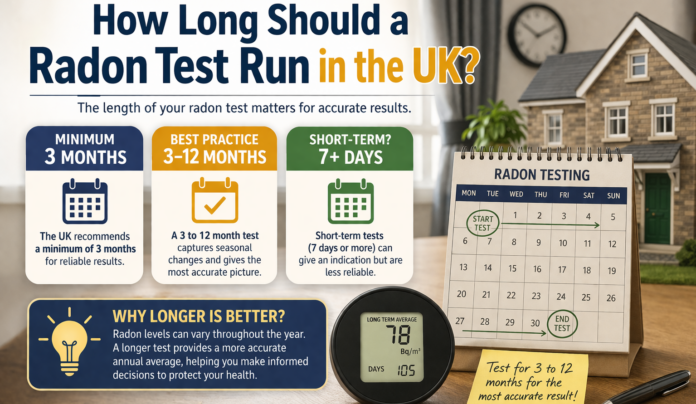
For most homes in the UK, the standard answer is simple. A proper home radon test should usually run for three months. That is the approach recommended through UK Radon’s home measurement guidance, and it is tied directly to the fact that the UK Action Level refers to the annual average radon concentration in a home. In other words, the test is not trying to capture one day or one week. It is trying to estimate your normal long-term exposure.
That does not mean every radon-related situation works exactly the same way. House purchases, holiday homes, new-build homes, and follow-up testing after remediation can add some extra context. But for a normal occupied UK home, if you want the result that most closely matches official guidance, three months is the benchmark to keep in mind.
Table of Contents
- Quick Answer
- The Standard UK Answer: Three Months
- Why the UK Uses a Three-Month Test
- Why Two Detectors Are Used
- Can a Shorter Radon Test Work?
- What About House Sales and Moving Home?
- How Long Should a Radon Test Run in a New-Build Home?
- What If the Home Is Empty for Part of the Test?
- How to Get the Best Result from a UK Radon Test
- What Happens After the Test Ends?
- Final Thoughts
- Sources
Quick Answer
For a normal UK home, a radon test should usually run for three months. That is the standard domestic approach used by UK Radon and it is designed to estimate the home’s yearly average radon level. The usual setup is two detectors, with one placed in the living area and the other in an occupied bedroom.
Shorter tests can be tempting because they feel faster and easier, but they come with more uncertainty. UK Radon explains that shorter tests are more likely to produce ambiguous or inconclusive results because radon levels can vary substantially from day to day. If you want a result you can use with more confidence, especially when deciding whether you may need remediation, three months is the length most homeowners should plan for.
The Standard UK Answer: Three Months
In the UK, the normal home radon measurement runs for three months. This is clearly set out in the UK Radon measuring guidance, which explains that the amount of radon varies over time and from room to room, so the test is carried out over three months to allow for those variations.
This three-month approach is also tied directly to the way the UK defines action on radon. The UK Action Level of 200 Bq/m³ refers to the annual average concentration in a home. That means the testing method needs to do a reasonable job of reflecting long-term exposure, not just a temporary spike or a quiet week. UK Radon therefore uses two detectors over three months to average out short-term fluctuations and produce a more useful estimate of the annual picture.
For most homeowners, that is the key point. If you are asking how long a radon test should run in the UK, the official homeowner answer is not a weekend, not seven days, and not a couple of weeks. It is normally three months.
Why the UK Uses a Three-Month Test
Radon is not steady in the way many people imagine. Indoor levels can move up and down depending on weather, temperature differences, ventilation habits, how often doors and windows are opened, and the way the building interacts with the ground beneath it. That is why a quick reading can be misleading.
UK Radon states that radon levels in houses vary substantially from day to day and that shorter tests therefore carry greater uncertainty. A three-month test smooths out much of that short-term noise. It is not the same as measuring for a full year, but it is long enough to provide a practical estimate of long-term exposure while still being realistic for householders.
This is the balance the UK system is trying to strike. A very short test is faster, but less dependable. A full-year test might sound ideal in theory, but it would be slow, inconvenient, and easy to disrupt. The three-month model sits in the middle. It is long enough to be meaningful and short enough to be workable for ordinary homeowners.
Why Two Detectors Are Used
UK home tests usually use two detectors, not just one. According to UK Radon, one detector is placed in the living area and the other in an occupied bedroom. The reason is straightforward. Those are usually the rooms where people spend the most time, so they give a better indication of typical exposure than a random location would.
This matters because radon is not evenly distributed throughout a house. One room can test noticeably higher or lower than another. A bedroom on one side of the property and a living room on another can experience different airflow patterns, different usage patterns, and different entry points from the ground. Using two detectors helps the result reflect how the home is actually lived in rather than relying on a single point measurement.
If your property includes an occupied basement, that also deserves special attention. UK Radon notes that all occupied basements, meaning those used for more than 50 hours per year, should be monitored regardless of general radon potential. That is another example of how testing duration and detector placement work together. It is not just about how long the test runs. It is also about whether it is measuring the rooms that matter.
Can a Shorter Radon Test Work?
This is where many homeowners get curious, especially if they want a quick answer before buying a house or making a renovation decision. Technically, shorter radon tests do exist, and shorter measurements may sometimes be used for screening or for situations where time is limited. But that is not the same as saying they are the preferred way to assess a UK home.
UK Radon says that tests carried out over shorter periods have greater uncertainty and are more likely to lead to ambiguous and inconclusive results. The UKHSA validation scheme for laboratories also notes that shorter measurements, especially those of less than a month, may be useful for screening where time is short, but they provide a less accurate assessment of the annual average radon concentration than long-term measurements do.
That distinction matters. A short test may give you a rough signal. It may even show that a home is very likely low or obviously high. But if you are trying to make an important decision, such as whether a home is above the Action Level or whether remedial work has truly solved the problem, the standard UK advice still points back to the long-term approach.
In practical terms, shorter testing is better thought of as a shortcut with trade-offs, not as the gold standard. For most homeowners, it makes more sense to follow the normal three-month route from the start rather than chase a quick answer that may need to be confirmed later anyway.
What About House Sales and Moving Home?
House purchases are one of the few situations where people naturally want a faster answer than the radon guidance ideally allows. If a property is in a radon Affected Area and has not already been tested, UK Radon recommends that the property be tested. The challenge is that a proper home test still takes three months, which does not always fit neatly into a sale timeline.
That is why the UK guidance for house sales often talks about practical workarounds rather than pretending the test can be rushed without consequence. On the house sales guidance page, buyers are advised to ask whether the current owners have already completed a three-month radon test and, if not, to discuss a retention with their solicitor and test when they move in.
So the length of the test does not really change just because a house is being sold. It is still normally a three-month measurement. What changes is the timing of when that test can realistically happen. If there is not enough time before completion, the solution is often to build the radon uncertainty into the transaction rather than pretending a shorter test is an equal substitute.
How Long Should a Radon Test Run in a New-Build Home?
New-build homes do not automatically avoid this issue. In radon Affected Areas, new homes may be constructed with basic or full radon protective measures under building regulations and associated guidance. Even so, UK Radon explains that it is not guaranteed the finished home will be below the Action Level.
That is why the new-build guidance says homeowners should do a three-month radon test during the first year of occupation. This is an important point because some buyers assume a new house has already “passed” radon simply because it is modern. UK guidance does not treat it that way. The home still needs a proper real-world measurement once people are actually living in it.
Again, the duration stays the same. Even in a new-build home, the standard domestic answer is still three months.
What If the Home Is Empty for Part of the Test?
A radon test works best when the home is being used in a fairly normal way. If the property is unoccupied for a significant part of the test period, the result becomes less reliable. UK Radon states that results are less reliable if the home is unoccupied for more than a few weeks during the three months.
This is one reason holiday homes can be awkward. The house sales and holiday home guidance says it is not advisable to test an unoccupied property. If there is a period of three months when it will actually be occupied, that may provide an opportunity to complete a measurement. Otherwise, the result may not reflect a normal lived-in pattern.
The same principle applies if there is a change of occupier during the test, or if the home is effectively in a transitional state. Radon testing works best when the building is being used in a stable, ordinary way for the full measurement period.
How to Get the Best Result from a UK Radon Test
Getting a useful result is not only about choosing the correct duration. It is also about avoiding the things that make the result less dependable. UK Radon notes that results are less reliable if the test period is shorter than three months, if there are ongoing building works, if the home is unoccupied for more than a few weeks, or if the detectors are not put in place within a week of arriving.
That means the best time to test is usually when the home is being lived in normally and nothing unusual is happening. You do not want major extensions underway, rooms ripped open, or the family away for a long stretch. You also do not want the detectors sitting unopened on a sideboard for two or three weeks before placement. A good radon test is supposed to reflect normal use, not a disrupted or half-started version of it.
It also helps to follow the instructions carefully about where the detectors go. The standard approach is one in the living area and one in an occupied bedroom. Those locations are part of what makes the three-month test meaningful, because they focus on the rooms that matter most for day-to-day exposure.
What Happens After the Test Ends?
Once the three-month period is over, the detectors are returned for analysis. According to UK Radon, the result is intended to give the yearly average radon level in your home and to tell you whether it is above or below the Action Level.
UK Radon says it aims to post the result and an explanation within four weeks of receiving the returned detectors. If the result is at or above the UK Action Level of 200 Bq/m³, homeowners are directed toward information on reducing radon levels. If the result falls between the Target Level of 100 Bq/m³ and the Action Level, reduction may still be worth considering, especially where a smoker or ex-smoker lives in the home.
That is the whole purpose of allowing the test to run for the full three months. It gives you a result you can actually do something with.
Final Thoughts
If you want the shortest honest answer to this topic, it is this: in the UK, a home radon test should usually run for three months. That is the standard approach because radon fluctuates too much for very short measurements to be as dependable when you are trying to judge annual exposure.
Shorter tests may sound appealing, especially if you are in a hurry, but they come with more uncertainty and are more likely to produce results that are harder to interpret. For most householders, it is better to do the standard test properly once than to rush a shorter test and then wonder whether the answer can be trusted.
If your property is in a radon Affected Area, if you have an occupied basement, if you are moving into a new-build home, or if you are buying a property with no previous result, the same basic rule still holds. The dependable UK homeowner test is built around a full three-month measurement in the rooms you actually use.