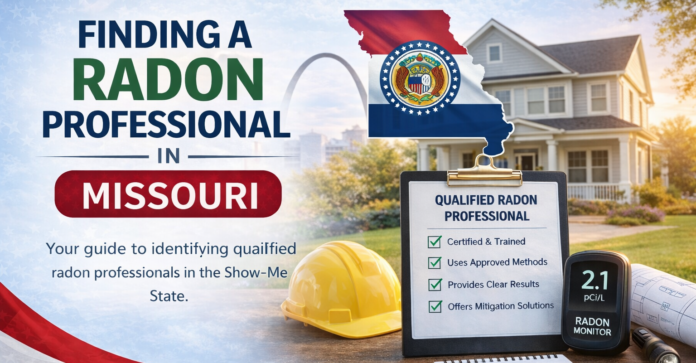
Finding a Radon Professional in Missouri
Finding a radon professional in Missouri can be more confusing than many homeowners expect. You may start with a simple search for radon contractors near you and immediately run into mitigation companies, home inspectors, indoor air businesses, national directories, and general contractors who only mention radon as one of many services. The problem is not just finding someone willing to do the work. The real challenge is finding someone who understands Missouri’s radon context, follows recognized standards, and can show that the work actually solved the problem.
This guide is designed to make that process easier. It walks Missouri homeowners through the practical steps of finding a radon professional, understanding Missouri-specific resources, comparing bids, and knowing what should happen after testing or mitigation. It is also written in a way that international readers can follow, even if they are more familiar with Canadian, UK, or European radon guidance. In the United States, radon is usually measured in pCi/L rather than Bq/m³, and the EPA action level is 4 pCi/L.
Missouri homeowners have a useful advantage: the state has an official Missouri Radon Program through the Missouri Department of Health and Senior Services, and the state provides radon education, free short-term test kits while supplies last, home buying and selling guidance, and links to certified professionals. That gives Missouri residents a much better starting point than a generic online search.
Table of Contents
- Why Missouri Homeowners Should Pay Attention to Radon
- Why Finding the Right Radon Professional Matters
- Start With Testing, Not Guessing
- How to Use the Missouri Radon Program
- How to Find a Radon Professional in Missouri
- NRPP, NRSB, and Why Certification Matters
- What Radon Mitigation Usually Costs in Missouri
- Questions to Ask Before You Hire
- Radon When Buying or Selling a Home in Missouri
- What Should Happen After the Work Is Done
- Final Thoughts
Why Missouri Homeowners Should Pay Attention to Radon
Radon is a serious issue in Missouri. The state’s radon education materials say that 1 out of 3 homes in Missouri have high radon levels. That is a striking figure, and it helps explain why Missouri has built a dedicated radon education program around testing, mitigation, and consumer awareness.
Radon is a naturally occurring radioactive gas. You cannot see it, smell it, or taste it, which is why homeowners cannot rely on instinct or visible warning signs. It enters buildings from the soil and can build up indoors over time. The CDC and EPA both describe radon as a major health concern, and the Missouri Department of Health and Senior Services treats it the same way.
Missouri also sits within the broader U.S. radon framework, where the EPA Map of Radon Zones is used for planning and public education. But EPA is clear that the map should not be used to decide whether an individual home needs testing. Homes with elevated radon have been found in all three EPA zones, which is why Missouri residents should think in terms of testing the actual home rather than assuming a city, county, or neighborhood is automatically safe.
Why Finding the Right Radon Professional Matters
Radon is not a cosmetic problem. It is a health and indoor-environment problem that requires accurate measurement and, when necessary, a properly designed mitigation system. A poor test can create false confidence. A poor mitigation job can leave elevated radon in place while still costing the homeowner thousands of dollars. That is why finding the right professional matters so much.
Missouri’s own radon guidance reflects this. The state explains that radon mitigation is the process of lowering radon levels in a home or building and notes that an expert should evaluate the building to determine the most appropriate way to address the issue. That is a very different standard than simply hiring the first contractor willing to install a fan and pipe.
A strong radon professional should understand building structure, testing methods, pressure dynamics, mitigation design, and follow-up verification. In Missouri, the best contractors tend to be the ones who can explain the process clearly, reference recognized standards, and show homeowners exactly how success will be measured afterward.
Start With Testing, Not Guessing
The best first step for most Missouri homeowners is still testing. Before you worry about mitigation quotes, system design, or contractor selection, it helps to know whether your home actually has elevated radon and how high the level is. This keeps the process grounded in evidence rather than anxiety or vague assumptions.
The good news is that Missouri makes testing accessible. The Missouri Radon Program says it offers short-term radon test kits to Missourians at no cost while supplies last. The state explains that homeowners can request a kit, follow the included instructions, and mail the sample back for lab analysis. That is one of the easiest places to begin if you are a Missouri homeowner who has never tested before.
Testing matters in every kind of home. New homes, old homes, finished basements, slab-on-grade homes, and homes with crawlspaces can all have radon issues. Missouri’s radon materials emphasize that radon can be found in both new and old homes, which is another reason not to assume your house is fine simply because it looks modern or well maintained.
How to Use the Missouri Radon Program
One of the smartest moves a Missouri homeowner can make is to start with the official Missouri Department of Health and Senior Services radon page rather than with general search results. The state’s site brings several important tools together in one place: test-kit information, testing and mitigation guidance, home-buying information, educational resources, and contact information for the program itself.
EPA’s state contact page also points homeowners directly to the Missouri state program and lists the Missouri radon office contact information, including the state site and phone number. That matters because a state program can give you more specific and more relevant direction than a national overview page alone.
In practice, the Missouri Radon Program is useful in three stages. First, it helps you test. Second, it helps you understand what elevated radon means and when mitigation makes sense. Third, it helps you connect with radon-specific contractor resources instead of leaving you to sort through random local advertising on your own.
How to Find a Radon Professional in Missouri
Once you have a radon result that needs action, the next step is finding the right kind of professional. In Missouri, the cleanest path is usually this: review your result, use the Missouri Radon Program’s guidance, and then check recognized certification directories before hiring anyone.
The Missouri testing page specifically says that a searchable listing of Missouri radon contractors certified by the National Radon Proficiency Program (NRPP) can be found on NRPP’s site. That is a strong signal from the state itself about how homeowners should approach the search. Rather than relying only on advertising, Missouri points residents toward nationally recognized certification.
That does not mean every good Missouri radon company will feel the same when you first talk to them. Some may focus on testing. Some may focus on mitigation. Some may work more heavily in one part of the state than another. But the important part is that you have a structured way to narrow the field. You are not just asking, “Who says they do radon?” You are asking, “Who has radon-specific credentials that can be checked?”
This is especially helpful in larger Missouri markets such as Kansas City, St Louis, Springfield, Columbia, Joplin, and Jefferson City, where homeowners may find many contractors online and need a better way to separate specialists from general service companies.
NRPP, NRSB, and Why Certification Matters
In the United States, the two national credentialing names homeowners will most often encounter are NRPP and NRSB. Both organizations provide public tools that help consumers verify whether a provider has radon-specific credentials.
Missouri’s own radon resources directly reference NRPP, which is why many Missouri homeowners start there. But it can also be useful to understand the broader U.S. credentialing landscape. If a company says it is certified, you should verify that claim. If it says it handles testing, make sure the credential matches testing. If it says it handles mitigation, make sure the credential matches mitigation. Those distinctions matter.
Certification matters because radon work is technical. A qualified professional should understand not only how to install a system, but also how to evaluate the building, determine which mitigation approach makes sense, and verify performance after the system is in place. A generic contractor may be excellent at many kinds of work and still not be the right person to diagnose or solve a radon problem.
What Radon Mitigation Usually Costs in Missouri
One of the most common homeowner questions is cost. Missouri’s testing guidance gives a useful benchmark here: the state says that the cost of a radon mitigation system in Missouri is typically $2,000 or less for a 2,000 square foot home. That does not mean every house will fall neatly into that number, but it does give homeowners a realistic general starting point.
Actual cost depends on the structure of the home, the foundation type, how accessible the work areas are, whether electrical work is needed, and what mitigation method is appropriate. A simple layout is not the same as a complicated one. A home with a straightforward sub-slab path is not the same as a home that needs additional diagnostic work or more complicated routing.
That is why a quote should never be judged on price alone. A lower quote may simply leave out diagnostic steps, follow-up testing, electrical work, or design details that matter. A better quote is one that clearly explains what the company intends to do, why that method fits the home, and how the result will be checked when the work is complete.
Questions to Ask Before You Hire
Before hiring any Missouri radon contractor, ask who certified or trained them. If they mention NRPP or NRSB, verify it. If they describe themselves only in broad indoor-air terms, ask them to be more specific about their radon credentials and the exact scope of the work they perform.
Ask whether they are being hired for testing, mitigation, or both. These are related services, but they are not identical. A company that performs testing is not automatically the best choice for mitigation, and a company that installs systems is not automatically the best choice for measurement.
Ask what kind of system they expect to use and why. A serious radon professional should be able to explain the likely mitigation approach in plain language based on the structure of the house. Missouri’s mitigation page also suggests useful homeowner questions, including whether the contractor charges for diagnostic tests and whether they inspected the home’s structure before giving an estimate.
Ask whether post-mitigation testing is included. Ask where the fan and pipe routing will go. Ask what happens if the level is still too high after installation. Good Missouri contractors should be used to these questions and should have direct, understandable answers.
Radon When Buying or Selling a Home in Missouri
Radon often becomes a more urgent issue during a home sale. Missouri’s home buying and selling guidance says that buyers and sellers often test for radon during real estate transactions and that 4 pCi/L is commonly used as the point for deciding whether mitigation is necessary.
Missouri also makes an important legal point: the state says there are no laws in Missouri that require radon testing during a sale or require the seller to mitigate. That does not mean radon should be ignored. It means the issue is usually handled through negotiation, inspection decisions, and buyer-seller agreements rather than through a blanket legal requirement.
For both buyers and sellers, this is another reason to use a verified radon professional instead of simply choosing whoever can come out the fastest. Real estate timelines can create pressure, and pressure often leads to weak hiring decisions. A little extra care at this stage can prevent a lot of frustration later.
What Should Happen After the Work Is Done
Installation is not the end of the process. Verification is. A radon system that looks complete does not prove the indoor radon level is now acceptable. The only way to know whether the system worked is to test again after the system is operating.
This is where strong contractors stand out from weak ones. A serious radon professional should expect follow-up testing and should not treat visible installation alone as proof of success. The goal is not to leave behind a fan and some pipe. The goal is to lower the radon level in a measurable way.
Missouri homeowners should also remember that homes change over time. Renovations, basement finishing, changing ventilation patterns, and equipment failure can all affect indoor radon levels. A good radon contractor should treat mitigation as part of long-term home health, not as a one-time cosmetic project.
Final Thoughts
Finding a radon professional in Missouri gets much easier once you stop treating it like a random contractor search and start treating it like a verification process. Missouri gives homeowners a better starting point than many states through its official radon program, its free short-term testing while supplies last, its educational guidance, and its links to certified contractor resources.
The best path is usually straightforward. Test the home. Review the result. Use the Missouri Radon Program for guidance. Verify any contractor through recognized certification tools such as NRPP or NRSB. Compare quotes carefully. Then confirm the result after the work is done.
For Missouri homeowners, the best radon professional is not simply the first person who says they can install a system. It is the person whose qualifications can be checked, whose plan makes sense for the structure of the home, and whose work is confirmed with follow-up testing.
Sources
- Missouri Department of Health and Senior Services – Radon Program
- Missouri Department of Health and Senior Services – Radon Testing
- Missouri Department of Health and Senior Services – Mitigation
- Missouri Department of Health and Senior Services – Home Buying & Selling
- Missouri Department of Health and Senior Services – Radon Bookmark 2024
- U.S. EPA – Radon
- U.S. EPA – What Is EPA’s Action Level for Radon?
- U.S. EPA – EPA Map of Radon Zones
- U.S. EPA – EPA Map of Radon Zones and Supplemental Information
- CDC – Radon and Your Health
- NRPP – National Radon Proficiency Program
- NRPP – Find a Radon Mitigation or Measurement Professional
- NRSB – National Radon Safety Board
- NRSB – Find a Pro