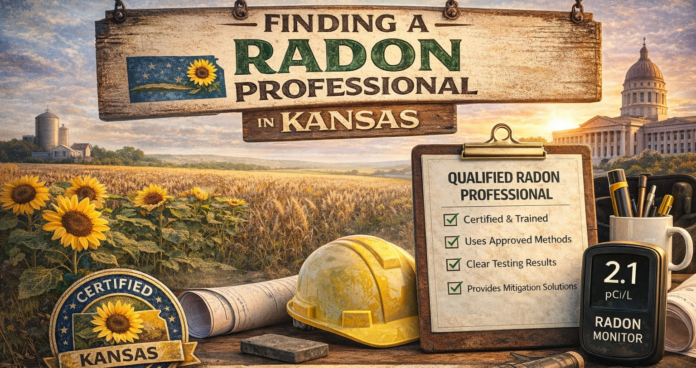
Finding a Radon Professional in Kansas
Finding a radon professional in Kansas can feel more complicated than many homeowners expect. A quick online search will usually show mitigation contractors, home inspectors, test kit sellers, indoor air companies, and national certification directories. Some of those results are helpful. Some are not. The real challenge is not simply finding someone who says they work on radon. It is finding someone who understands Kansas requirements, follows recognized standards, and can show that the work actually solved the problem.
This guide is designed to make that process easier. It explains how Kansas homeowners can test for radon, use the state’s official radon resources, verify professional credentials, compare mitigation bids, and understand what should happen after the work is complete. It is also written in a way that international readers can follow. In the United States, radon is usually measured in pCi/L rather than Bq/m³, and the EPA action level is 4 pCi/L.
Kansas homeowners have a strong starting point because the state has both the official Kansas Department of Health and Environment radon resources and the consumer-facing Kansas Radon Program. Together, those resources give homeowners a practical path: test first, review the result, verify any professional you are considering, and confirm the outcome after the work is done.
- Wichita
- Overland Park
- Topeka
- Lawrence
- Manhattan
- Salina
Table of Contents
- Why Kansas Homeowners Should Pay Attention to Radon
- Why Finding the Right Radon Professional Matters
- Start With Testing, Not Guessing
- How to Use the Kansas Radon Program
- How to Find a Radon Professional in Kansas
- Kansas Certification Rules and Why They Matter
- What Radon Mitigation Usually Costs in Kansas
- Questions to Ask Before You Hire
- Radon When Buying or Selling a Home in Kansas
- What Should Happen After the Work Is Done
- Final Thoughts
Why Kansas Homeowners Should Pay Attention to Radon
Radon is a major issue in Kansas. The Kansas Radon Program and KDHE both say that about 1 in 4 Kansas homes test high for radon. KDHE also notes that the average observed residential radon test in Kansas is above the EPA action level and that elevated radon levels have been detected across the state. In practical terms, that means radon is not a niche concern limited to one part of Kansas. It is a statewide homeowner issue.
That matters because radon has no obvious warning sign. You cannot see it, smell it, or taste it. The only way to know whether a home has elevated radon is to test. The CDC and EPA both describe radon as a serious health risk, and Kansas public health resources treat it the same way.
Kansas county and state radon maps can help provide context, but they are not a substitute for testing. The Kansas county radon map itself explains that it cannot be used to predict the radon level in any specific house and that measurement is required to determine radon levels in a given residence or building. That is one of the most important ideas in this entire topic. A county trend is not the same thing as a result for your home.
Why Finding the Right Radon Professional Matters
Radon is not the kind of issue where a homeowner should be satisfied with a vague answer or a generic contractor pitch. A poor radon test can create false confidence. A poor mitigation job can leave the house above the action level while still costing the homeowner a significant amount of money. That is why finding the right professional matters so much.
Kansas’s own consumer guidance reflects this. The Kansas Radon Program explains that qualified radon professionals should understand testing protocols, mitigation methods, and the standards that apply to residential radon work. The goal is not simply to install equipment. The goal is to lower the radon level and verify the result.
A strong radon professional should be able to explain what they are proposing, why it fits the structure of the home, and how success will be measured afterward. In Kansas, that conversation should also include whether the person doing the work is properly certified by the state for measurement, mitigation, or both.
Start With Testing, Not Guessing
The best first step for most Kansas homeowners is still testing. Before you start comparing mitigation bids or calling contractors, it helps to know whether your home actually has elevated radon and how high the result is. Testing gives you a real decision point. Without it, the process quickly turns into guesswork.
The Kansas Radon Program makes testing fairly accessible. Its Testing in Kansas page says that testing is easy and inexpensive and notes that many county extension offices offer test kits for Kansas residents. The program’s FAQ also says that the Kansas Radon Program distributes short-term radon test kits through Kansas State University Research and Extension offices. That gives homeowners a practical, local way to begin.
Testing matters in every type of home. New homes, older homes, finished basements, slab homes, and homes with crawlspaces can all have radon problems. Kansas guidance is clear on the basic point: the only way to know the level in a given home is to test that home.
How to Use the Kansas Radon Program
One of the smartest moves a Kansas homeowner can make is to start with the Kansas Radon Program instead of relying entirely on search-engine results. The program brings together testing information, contractor selection guidance, fact sheets, county radon data, real estate information, and contact details in one place.
KDHE’s radon pages are also useful because they provide the official state-side framework for radon certifications and certified professional listings. Together, the Kansas Radon Program and KDHE form a very practical homeowner path. First, test the home. Second, understand what the number means. Third, use the state’s contractor and certification tools to narrow your options.
In practice, the Kansas Radon Program is especially useful for homeowners who feel overwhelmed by the number of radon-related businesses online. Instead of sorting through random advertising, you can start with the state program, review the consumer guidance, and then move into verified contractor selection from there.
How to Find a Radon Professional in Kansas
Once you have an elevated radon result, the next step is to find the right type of professional. In Kansas, the cleanest path is to use official or state-connected resources rather than relying only on paid ads or general contractor listings.
The Kansas Radon Program has a dedicated Kansas Certified Contractors page that tells homeowners how to check whether a technician’s Kansas certification is current and in good standing. KDHE also provides a Certified Radon Professionals Map that allows users to search by address or map location and filter for measurement technicians, mitigation technicians, or professionals certified for both.
That matters because not every company that mentions radon online is necessarily the right fit for your situation. Some may handle testing only. Some may focus on mitigation. Some may do both. The important point is that Kansas gives homeowners a way to verify who is actually certified before hiring anyone.
This is especially useful in larger Kansas markets like Wichita, Overland Park, Topeka, Lawrence, Manhattan, and Salina, where multiple options may appear online and homeowners need a clear method for separating specialists from general service businesses.
Kansas Certification Rules and Why They Matter
Kansas takes radon certification seriously. KDHE’s Radon Professionals page states that in Kansas, you need a current certificate to perform radon testing or mitigation work. KDHE also notes that the certification period is two years and publishes updated lists of certified laboratories and technicians.
That makes Kansas different from a state where homeowners are left to infer quality almost entirely from reviews or marketing language. Here, there is a formal state certification structure. For homeowners, that is a real advantage. It means you can verify whether the person you are considering is actually current and recognized for the work they are offering to do.
It also helps to remember that certification is not just a box to check. It matters because radon work is technical. A measurement professional should understand how testing protocols work. A mitigation professional should understand pressure dynamics, system design, discharge placement, and follow-up verification. Those are not small details. They are the core of whether the job is done correctly.
What Radon Mitigation Usually Costs in Kansas
One of the most common homeowner questions is cost. Kansas Radon Program guidance gives a useful benchmark here. Its mitigation page says that the average cost for a contractor to lower radon levels in a home is about $1,200, although the range is often around $800 to about $2,000. The program FAQ gives a similar general range.
That does not mean every house will fit neatly inside the same price range. Cost depends on the size and design of the home, the foundation type, the ease of routing pipe, whether additional diagnostic work is needed, and whether electrical work or other adjustments are part of the project. A simple slab home is not the same as a more complex basement or mixed-foundation house.
This is why homeowners should be careful not to compare bids on price alone. A cheaper quote may simply leave out important details, follow-up testing, or design elements that matter. A stronger quote usually explains the approach, the equipment, the expected routing, and what will happen if the post-mitigation result is still too high.
Questions to Ask Before You Hire
Before hiring any Kansas radon contractor, ask whether they are currently certified by Kansas for the work they are proposing. Do not rely only on a verbal claim. Verify it through the state’s map or list. Ask whether they are being hired for measurement, mitigation, or both. Those are related services, but they are not identical.
Ask what kind of mitigation method they expect to use and why. A serious radon professional should be able to explain the likely approach in plain language based on the structure of the home. If they cannot explain why the proposed system fits your house, that is a warning sign.
Ask whether post-mitigation testing is included. Ask where the fan and pipe routing will go. Ask how noise is handled. Ask what happens if the first post-mitigation result is still above the action level. Good contractors are used to these questions and should answer them clearly.
The Kansas Radon Program’s contractor-selection guidance is helpful here because it encourages homeowners to think in practical terms, not just price terms. The goal is not only to buy a system. It is to solve the radon problem properly.
Radon When Buying or Selling a Home in Kansas
Radon often becomes more urgent during a home sale. Kansas has specific real-estate guidance that makes this stage especially important. Kansas radon materials explain that state law requires sellers to disclose known information showing elevated concentrations of radon gas in residential property. Kansas also requires that radon testing performed during a real estate transaction be conducted by a state-certified radon measurement professional.
The Kansas real-estate guidance also explains that Kansas does not currently require radon testing or radon reduction to be included in every transaction. Instead, the issue is usually handled through disclosure, inspection, negotiation, and contract decisions. That means both buyers and sellers should take contractor and tester selection seriously, especially when time pressure is involved.
For buyers, this is one of the strongest reasons to verify certification before moving forward. During a transaction, a rushed or poorly handled test can create confusion, delay negotiations, or lead to weak decisions. A verified, state-certified professional helps reduce that risk.
What Should Happen After the Work Is Done
Installation is not the end of the process. Verification is. A system that looks complete does not prove the radon level is now acceptable. The only way to know whether the mitigation system worked is to test again after the system has been operating.
This is where strong contractors stand out. A serious radon professional should expect follow-up measurement and should not treat visible installation alone as proof of success. The goal is not to leave behind a fan and some pipe. The goal is to lower the radon concentration in a measurable way.
Kansas homeowners should also remember that houses change. Fans can fail. Renovations can alter air movement. Basement finishing, additions, and other home changes can affect radon behavior. A good contractor should explain that radon is part of long-term home health, not just a one-time repair item.
Final Thoughts
Finding a radon professional in Kansas becomes much easier once you stop treating it like a random contractor search and start treating it like a verification process. Kansas gives homeowners strong tools through KDHE and the Kansas Radon Program, including low-cost testing access, contractor selection guidance, certification tools, county data, and real-estate information.
The best path is usually straightforward. Test the home. Review the result. Use the Kansas Radon Program and KDHE resources for guidance. Verify any professional through the state’s certification tools. Compare quotes carefully. Then test again after the work is done.
For Kansas homeowners, the best radon professional is not simply the first person who says they can install a system. It is the person whose qualifications can be checked, whose plan makes sense for the structure of the home, and whose work is confirmed with follow-up testing.
Sources
- Kansas Department of Health and Environment – Kansas Radon
- Kansas Department of Health and Environment – Radon Professionals
- Kansas Department of Health and Environment – Certified Radon Professionals Map
- Kansas Department of Health and Environment – Radon Laws
- Kansas Radon Program – Home
- Kansas Radon Program – Testing in Kansas
- Kansas Radon Program – Kansas Certified Contractors
- Kansas Radon Program – Frequently Asked Questions
- Kansas Radon Program – Mitigation
- Kansas Radon Program – Radon Data
- Kansas Radon Program – County Map
- U.S. EPA – Radon
- U.S. EPA – What Is EPA’s Action Level for Radon?
- CDC – Radon and Your Health