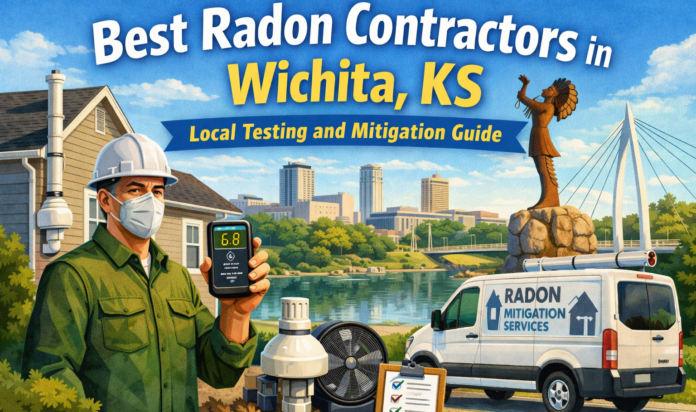
Best Radon Contractors in Wichita, KS: Local Testing and Mitigation Guide
Wichita homeowners have solid reasons to take radon seriously. This is not a niche issue and it is not limited to a few older houses. Sedgwick County’s environmental health profile reported a county average radon level of 3.6 pCi/L in tested homes for 2010, with 30.9% of measurements at or above the EPA action level of 4.0 pCi/L. At the statewide level, KDHE says the current observed residential radon test average in Kansas is 5.4 pCi/L, which is above the EPA action level. In practical terms, radon should be treated as a normal homeowner issue in Wichita, not an unusual exception.
This guide is designed to help Wichita homeowners make practical decisions. Below, you will find local radon context for Wichita and Sedgwick County, the patterns that matter in this part of south-central Kansas, a curated list of contractors serving the area, and a section on how to choose a company without relying on guesswork. The goal is to create something more useful than a thin city page or a generic contractor list.
Table of Contents
Why Radon Matters in Wichita
Radon should not be treated as a fringe issue in Wichita. Sedgwick County’s environmental health profile reported an annual average radon level of 3.6 pCi/L in tested homes in 2010. That is below the EPA action level of 4.0 pCi/L, but the more useful number for homeowners is the county percentage that still tested high enough to matter. In that same county profile, 30.9% of Sedgwick County radon measurements were at or above 4.0 pCi/L. That means nearly one in three tested homes in that dataset reached the level where EPA recommends action.
The statewide picture reinforces the point. KDHE says the current observed residential radon test average in Kansas is 5.4 pCi/L, which is above the EPA action level. KDHE also says one in four houses in Kansas may have elevated levels. Wichita homeowners should not assume south-central Kansas is somehow outside the broader Kansas radon pattern. Even when a county average lands below 4.0 pCi/L, a meaningful share of homes can still come back elevated.
EPA classifies Sedgwick County as Zone 2, which means moderate radon potential with predicted average indoor screening levels between 2 and 4 pCi/L. That should not be read as reassurance that a particular home is safe. EPA’s own radon map guidance says homes with elevated levels have been found in all three zones and that all homes should be tested regardless of zone designation. For Wichita homeowners, that is the right mindset. Zone maps are useful context, but they do not answer the question for any specific house.
Radon also matters in Wichita because of how often it intersects with normal homeownership decisions. Kansas Radon Program materials say residential real estate contracts in Kansas are legally required to include language strongly encouraging buyers to include radon testing in the inspection process. In other words, radon is not just a technical issue. It is a recurring practical issue that shows up during buying, selling, remodeling, and long-term occupancy.
Local Radon Trends and Risk Factors
One reason radon deserves attention in Wichita is that local geology can still create uneven results from one house to another even though Sedgwick County is not treated as one of Kansas’ highest-zone counties. The Kansas Geological Survey says Sedgwick County is underlain by sedimentary rocks ranging from Permian to Recent age, and its county geohydrology materials describe unconsolidated clay, silt, sand, and gravel overlying older rock units. The county’s geologic formations pages also describe near-surface solution of gypsum in parts of the Wellington Formation and local deformation tied to solution areas. Homeowners do not need to become geologists, but these details are a reminder that the ground under Wichita homes is not perfectly uniform.
That variability matters because radon is a soil gas problem first and a house problem second. One home may have foundation cracks, slab joints, sump features, drain tile access, utility penetrations, or basement conditions that make radon entry easier, while a nearby home with a different layout may test differently. EPA and CDC both note that radon commonly enters through cracks and openings in floors and walls, construction joints, gaps around service pipes, and sump openings.
Housing style also matters in Wichita. Many area homes are slab-on-grade, but plenty of properties still include basements, crawlspaces, split-level spaces, or remodeled lower levels. EPA’s guidance is very clear that any home can have a radon problem, including new homes, old homes, well-sealed homes, and drafty homes. That matters in Wichita because homeowners sometimes assume basements are the only concern or that newer suburban homes are automatically safer. Radon does not follow those assumptions.
Another local factor is how people actually use the lowest level of the house. Even when a basement is partly unfinished, it may still be used for storage, laundry, workouts, a home office, or time with family. On slab homes, radon can still be relevant in ground-contact living spaces. The issue is not whether a room looks finished. The issue is whether it sits where radon can enter and whether people spend meaningful time there.
Wichita also has a practical homeowner resource that many cities do not. Wichita Public Library publicly offers radon detectors through its Library of Things. That does not replace professional testing in real estate or mitigation situations, but it does make it easier for homeowners to get an initial read on the issue without delaying for months. That kind of local access helps make radon testing feel more like standard home care and less like a specialized project.
What Homeowners in Wichita Should Know
Radon has no smell, no color, and no obvious warning sign. A home can feel perfectly normal and still test high. That is why EPA, CDC, KDHE, and Kansas Radon Program materials all come back to the same message: testing is the only way to know your home’s radon level.
Newer and older homes can both have radon issues. Some Wichita homeowners assume older homes are the main concern because of foundation age or visible cracking. Others assume newer construction must be safer. EPA’s guidance does not support either assumption. Any home can have a radon problem, which is why guessing based on age is not a substitute for testing.
Neighboring homes can have very different results. Two homes in the same subdivision can test differently because of differences in slab design, cracks, utility penetrations, sump details, ventilation patterns, drainage, and how the house interacts with the ground. A low result next door is not proof your house is fine.
You should also test even if your immediate part of Wichita is not casually talked about as high-risk. Sedgwick County’s official county data already shows a meaningful percentage of elevated results, and EPA warns that zone maps are not intended to determine whether an individual home needs testing. The right approach is simple: test the home you live in, not the reputation of the neighborhood.
Buying or selling a house is one of the most common times to test, but it should not be the only time. If you finish a basement, tighten the building envelope, make HVAC changes, add onto the house, or simply have not tested in years, that is a reasonable time to test again. A result is most useful when it reflects how the home is actually being lived in now.
Radon Contractors in Wichita
Radon Services of Kansas
Website: Radon Services of Kansas
Phone: (316) 821-9611
Service Area: Wichita, Kansas, and northern Oklahoma
Services: Testing, mitigation, awareness, residential and commercial work
Summary: Radon Services of Kansas is one of the strongest Wichita-area names because it is clearly radon-focused and clearly local. The company says it has been operating since 2007 and provides both testing and mitigation rather than only one side of the process. The current KDHE certified technician list also shows multiple Radon Services of Kansas personnel in Wichita, which adds credibility for homeowners who want a company centered specifically on radon work rather than general inspection or remodeling.
Wichita Radon Testing, LLC
Website: Wichita Radon Testing, LLC
Phone: (316) 285-1008
Service Area: Wichita and the surrounding area
Services: Short-term professional radon measurement testing
Summary: Wichita Radon Testing, LLC is a testing-focused option rather than a general radon contractor that tries to do everything. Its site emphasizes 48-hour continuous radon monitor testing and clear hourly data reporting. The current KDHE certified technician list also shows Wichita Radon Testing personnel in Wichita, which makes this a useful option for buyers, sellers, and homeowners whose immediate question is simply whether a radon problem exists.
Pure State Construction
Website: Pure State Construction
Phone: (316) 665-0633
Service Area: Wichita and surrounding areas
Services: Radon testing and mitigation
Summary: Pure State is broader than a radon-only company, but its radon service page is detailed and homeowner-friendly. The company explains its testing, mitigation planning, and post-mitigation verification process clearly, and its about page says the business was founded in part to meet local demand for higher-quality radon services. The current KDHE technician list also shows Pure State personnel in Wichita with both measurement and mitigation credentials, which makes it one of the more grounded local options in this market.
SWAT Environmental
Website: SWAT Environmental
Phone: (316) 788-5858
Service Area: Wichita and Sedgwick County
Services: Radon mitigation, with broader company testing and radon service capabilities
Summary: SWAT is the largest-name operator in this list and may appeal to homeowners who want a bigger company with a broad footprint and standardized processes. Its Wichita page is specific to the local market and makes it easy to confirm local service. This is often the kind of company homeowners want on their shortlist when comparing system style, scheduling speed, and pricing against smaller local providers.
TFB Building Inspections
Website: TFB Building Inspections
Phone: (316) 773-0200
Service Area: Wichita and the surrounding areas
Services: Home inspections and radon testing
Summary: TFB is a good fit for homeowners who want a testing-oriented company tied closely to the home inspection process. Its site openly says it offers 48-hour radon tests and also notes that the testing company it contracts with does not perform mitigation, which helps reduce conflict-of-interest concerns. That makes TFB especially practical for buyers and sellers who want testing and a broader inspection workflow, even if they plan to use a separate mitigation installer later.
Welcome Home Property Inspections
Website: Welcome Home Property Inspections
Phone: (316) 214-1510
Service Area: Wichita and surrounding communities
Services: Radon testing and broader inspection services
Summary: Welcome Home Property Inspections is another strong testing-first option for the Wichita market. Its radon page is direct, easy to understand, and clearly oriented toward homeowners who need certified testing rather than a full mitigation install. This is the kind of company that can make sense when the first question is “Do we have a radon problem?” and a homeowner wants clear results without jumping immediately into system proposals.
Insight Inspections LLC
Website: Insight Inspections LLC
Phone: (316) 570-0549
Service Area: Wichita and surrounding communities within roughly a 40-mile radius
Services: Home inspections and radon testing
Summary: Insight Inspections is a local Wichita-based inspection company with a dedicated radon testing page and a clearly published Wichita address and phone number. The site positions radon testing as part of a practical real estate and homeowner due diligence process. For homeowners who want a local testing-oriented service with a smaller-company feel, this is a reasonable option to compare.
Kansas REI
Website: Kansas REI
Phone: (316) 409-6985
Service Area: Wichita and nearby communities including Andover, Augusta, Bel Aire, Derby, Goddard, Haysville, Maize, Rose Hill, and North Wichita
Services: Radon inspection and broader home and office inspection services
Summary: Kansas REI is a local, family-owned inspection company that publicly highlights radon inspection in Wichita as one of its services. It appears especially useful for homeowners who want radon testing handled alongside broader property due diligence. Because it is clearly inspection-led rather than mitigation-led, it makes the most sense when documentation and initial diagnosis are the immediate need.
How to Choose a Radon Contractor
Start by deciding whether you need testing, mitigation, or both. That sounds simple, but it changes which company may actually be the best fit. A homeowner early in the process may only need a professional radon test with clear reporting. A homeowner with a confirmed elevated result may need a mitigation installer who can explain fan placement, piping route, foundation strategy, and post-install verification. A company that is great at testing is not automatically the same company that is best for a more involved mitigation job.
Next, ask how the company evaluates your specific home. Wichita housing is not all built the same way, and a good radon professional should be willing to talk about slab-on-grade layouts, basements, crawlspaces, sump features, utility penetrations, and where vent piping would actually run. You want a company that explains why a certain approach fits your house, not one that sounds like it gives every property the same answer.
Follow-up testing matters too. If a mitigation system is installed, the real question is not whether the pipe looks neat from the outside. The real question is whether the radon level actually came down. Contractors that discuss post-install verification or clear testing after the work is done are usually giving homeowners more value than companies that focus only on installation day.
Because this is Kansas, certification should be part of your screening process. KDHE says a current certificate is required to perform radon testing or mitigation work in Kansas, and the state maintains a current list of certified technicians and a professional locator tool. For Wichita homeowners, that means it is reasonable to ask directly whether the person doing the work is currently certified in Kansas and to verify that for yourself.
Finally, compare specialization honestly. A radon-only company may be the best fit for a straightforward elevated result. A testing-led inspection company may be more useful when the immediate need is documentation during a transaction. A broader contractor may be attractive when radon overlaps with remodeling, ventilation, or other home-system concerns. The best choice depends on what problem you are actually trying to solve.
Conclusion
Wichita is not a place where homeowners should assume radon is somebody else’s issue. Sedgwick County’s official data, the broader Kansas averages, the local geology, and the realities of Wichita housing all point in the same direction: testing is worth doing, and elevated levels are worth fixing. The only way to know what is happening in your home is to test it, and choosing a qualified local contractor can make that process much easier and much more confident.
Sources
- Sedgwick County Environmental Health Profile
- Kansas Department of Health and Environment – Radon
- KDHE – Locate a Kansas Certified Radon Professional
- KDHE – Kansas Certified Radon Measurement and Mitigation Technicians
- KDHE – Radon Laws
- Kansas Radon Program – Is Radon a Real Problem?
- Kansas Radon Program – Radon & Real Estate Fact Sheet
- Kansas Radon Program – Radon Data
- EPA – Radon Zones by County
- EPA – Map of Radon Zones
- EPA – How Does Radon Get in Your Home?
- CDC – Radon and Your Health
- Kansas Geological Survey – Geohydrology of Sedgwick County
- Kansas Geological Survey – Sedgwick County General Geology
- Kansas Geological Survey – Sedgwick County Geologic Formations
- Wichita Public Library – Services
- Wichita Public Library – Library of Things
- Radon Services of Kansas
- Wichita Radon Testing, LLC
- Pure State Construction – Radon Testing & Mitigation
- Pure State Construction – About
- SWAT Environmental – Wichita, KS
- TFB Building Inspections – Radon FAQ
- TFB Building Inspections – Services & Fees
- Welcome Home Property Inspections – Radon Testing
- Insight Inspections LLC – Radon Testing
- Insight Inspections LLC – Contact
- Kansas REI – Radon Inspection Wichita
- Kansas REI – Contact
- Kansas REI – Service Areas