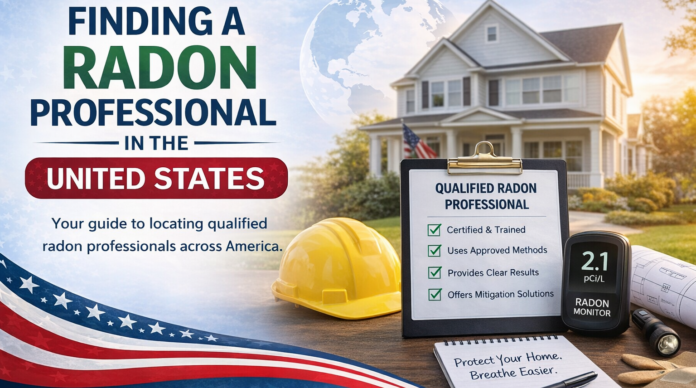
Finding a Radon Professional in the United States
Finding a radon professional in the United States can be more confusing than many homeowners expect. You may search online and immediately see mitigation contractors, test kit sellers, home inspectors, indoor air companies, and certification directories. Some states have strong radon programs and public resources. Others rely more heavily on private certification systems and state-level contact information. That means the smartest way to hire is usually not to click the first company that appears in search results. It is to understand how the U.S. radon system actually works.
This guide is designed to walk you through that process. It explains how to find a radon professional in the United States, how state radon programs fit into the process, how to use national certification directories, what questions to ask before hiring, and how to compare proposals. It is written for a broad audience, including international readers who may be used to Canadian, UK, or European radon guidance. In the U.S., radon results are typically discussed in pCi/L rather than Bq/m³, and the EPA action level is 4 pCi/L, which is about 150 Bq/m³.
The good news is that there is a reliable path. In most cases, the best process is to test the home properly, review the result against EPA guidance, check your state radon program, and then verify any company you are considering through a national credentialing directory such as NRPP or NRSB. That extra structure helps you avoid weak contractors, vague sales pitches, and costly work that may not solve the problem.
Table of Contents
- U.S. State Directory
- Why the Process Feels Confusing
- How the U.S. Radon Professional System Works
- Start With Testing, Not Guessing
- How to Use Your State Radon Program
- How to Use NRPP and NRSB
- What the EPA Radon Zone Map Can and Cannot Tell You
- Questions to Ask Before You Hire
- How to Compare Radon Quotes
- Radon During a Home Sale
- What Should Happen After Installation
- Final Thoughts
U.S. State Directory
If you are trying to find a radon professional in the United States, state-level information often matters more than homeowners realize. Some states maintain strong radon education pages, some point residents toward certified professionals, and some have their own additional requirements, registration rules, or consumer resources. That is why it helps to think in state terms first, even before you start comparing contractors.
| Alabama | Alaska | Arizona | Arkansas |
| California | Colorado | Connecticut | Delaware |
| Florida | Georgia | Hawaii | Idaho |
| Illinois | Indiana | Iowa | Kansas |
| Kentucky | Louisiana | Maine | Maryland |
| Massachusetts | Michigan | Minnesota | Mississippi |
| Missouri | Montana | Nebraska | Nevada |
| New Hampshire | New Jersey | New Mexico | New York |
| North Carolina | North Dakota | Ohio | Oklahoma |
| Oregon | Pennsylvania | Rhode Island | South Carolina |
| South Dakota | Tennessee | Texas | Utah |
| Vermont | Virginia | Washington | West Virginia |
| Wisconsin | Wyoming |
Later, this section can easily be turned into an internal-link hub by replacing each state name with a link to its own state radon page. For now, it works as a quick visual reminder that radon guidance in the U.S. often becomes more useful when you narrow the question to the state level.
Why the Process Feels Confusing
The U.S. radon system can feel scattered because it is partly national and partly state-based. The EPA provides the main federal guidance, public education, standards references, and state contact pathways. At the same time, each state may have its own radon program, its own consumer information, and in some cases its own legal or practical rules for who can provide services. That means there is no single national contractor list that answers every question by itself.
Another reason it feels confusing is that there are different kinds of providers. A homeowner may need a radon measurement professional, a mitigation contractor, a home inspector who includes radon testing, or a company that does both testing and mitigation. On top of that, you may run into businesses that are broadly in the indoor air or waterproofing space but are only loosely connected to radon-specific work. The result is a market where the best professional is often not the loudest one online.
For international readers, one more layer of confusion is the measurement unit. Canada, the UK, and most of Europe usually discuss radon in Bq/m³, while the U.S. most often uses pCi/L. That difference can make an American result look unfamiliar even when the underlying risk is easy to compare.
How the U.S. Radon Professional System Works
In practical terms, the U.S. system rests on three main pillars. First, there is EPA guidance, including the EPA page for finding a radon test kit or professional, the EPA action level explanation, and the EPA standards of practice page. Second, there are state radon programs, which often provide local contacts, state-specific resources, public education, and in some cases test-kit or contractor guidance. Third, there are national credentialing organizations such as NRPP and NRSB.
That layered approach is actually helpful once you understand it. EPA gives you the broad national framework. Your state program gives you local and legal context. NRPP and NRSB help you verify whether a professional has radon-specific credentials. Used together, they give homeowners a much better decision process than a simple online search.
The important thing to understand is that this is not only about finding a company. It is about finding a company that is appropriate for your state, your home type, and the exact service you need.
Start With Testing, Not Guessing
The best first move for most homeowners is still testing. The EPA explains that radon test kits are widely available and that some state or local programs even offer free or discounted kits. If you have not tested your home yet, it is often smarter to begin there before calling mitigation contractors. That way, you know whether you have a problem, how significant it may be, and whether you need a measurement professional, a mitigation contractor, or no immediate contractor at all.
You can start with a do-it-yourself kit, hire a radon measurement professional, or contact your state radon program to learn what options exist in your area. The EPA also links homeowners to test kit information and notes that some programs provide discounted access to testing.
Once you have a confirmed result, the hiring process becomes much more focused. If the level is below concern, you may simply retest later according to good practice or after home changes. If the level is elevated, you can move into the mitigation stage with a clear reason for doing so.
How to Use Your State Radon Program
One of the most overlooked resources in the U.S. is the EPA page that routes homeowners to state radon contacts and state-specific resources. This matters because some states provide very useful consumer guidance, some list qualified providers, and some explain state-specific requirements or restrictions that a national directory may not spell out clearly.
Your state radon program can help answer questions such as whether the state has special certification or registration rules, whether there are public resources for testing, whether there is state-specific guidance for home buyers and sellers, and where the official consumer education pages are located. Even when you already have a contractor in mind, checking the state program first is a smart screening step.
This is especially important because NRSB itself notes that some states have their own certification or registration programs and that homeowners should contact the state radon program to get a complete listing of who is legally able to provide services in that area. In other words, a national certification directory is useful, but it is not always the only thing that matters.
How to Use NRPP and NRSB
After checking EPA and your state radon program, the next step is usually to verify the professional through NRPP or NRSB. These organizations are widely recognized in the U.S. radon industry and provide searchable directories for consumers.
NRPP explains that its credentials indicate mastery of the specific skills needed to complete radon testing and remedial work. That makes the directory useful for checking whether a company’s claims line up with a real credential. NRSB also provides a public “find a pro” tool so homeowners can confirm whether a person or company is certified through its program.
When using these directories, do not stop at seeing a company name. Look at the type of credential involved, whether it is related to measurement or mitigation, and whether the provider appears to be active and relevant to the service you need. A measurement credential is not the same as a mitigation credential, and a provider who mostly handles one type of work may not be the ideal fit for the other.
The best approach is to cross-check. If a contractor says they are certified, verify it. If they say they serve your state, make sure that works within your state’s rules. If they propose a mitigation system, make sure they are the kind of professional whose training and credentialing actually match that task.
What the EPA Radon Zone Map Can and Cannot Tell You
The EPA Map of Radon Zones is useful, but it is also one of the most misunderstood radon tools in the United States. The map was developed to help identify areas with the potential for elevated radon and to support planning, public education, and building-code efforts. It is useful as a background tool.
What it does not do is tell you whether your individual home is safe. EPA is clear that the map should not be used to determine whether a specific home needs testing. Homes with elevated radon have been found in all three zones. That means even if your county is not shown as high-risk on the map, the correct next step is still to test the home rather than assume the home is fine.
For homeowners looking to hire a professional, the radon zone map is most useful as context. It can help explain why radon awareness is stronger in some regions, why radon-resistant construction may be more common in some parts of the country, and why state programs may devote more attention to radon than others. It should never replace an actual test result.
Questions to Ask Before You Hire
Once you have identified a few candidates, the next step is to ask questions that reveal whether the company is actually radon-focused. Ask who certified or trained them. Ask whether they are being hired for measurement, mitigation, or both. Ask what standards of practice they follow. The EPA standards page is useful here because it points homeowners toward the current radon standards framework used in the U.S.
Ask what type of system they expect to use and why. A serious radon professional should be able to explain the likely mitigation method in plain English based on the home’s structure. If they cannot explain why a certain method makes sense for your house, that is not a great sign.
Ask whether post-mitigation testing is included. This question is one of the easiest ways to separate serious providers from weak ones. A company that installs equipment but does not care how success will be verified is not approaching radon work the right way.
Ask where the fan, pipe routing, and discharge point will go. Ask how noise is handled. Ask what happens if the first result after installation is still too high. Good providers are used to these questions and should have straightforward answers.
How to Compare Radon Quotes
A good radon quote should tell you more than just a price. It should explain what problem is being solved, what method is likely to be used, what equipment is included, where major visible components are likely to go, and whether any electrical work or sealing is part of the scope. It should also tell you whether post-mitigation testing is included and what happens if the result remains high after the initial work.
This is where homeowners sometimes get pulled off track by a lower bid. A quote that is vague may be cheaper at first because it leaves out important details or follow-up responsibilities. A stronger quote often looks more complete because it reflects a fuller understanding of the job rather than a bare-minimum install.
Be cautious of companies that suggest sealing alone will solve a meaningful radon problem, companies that sound overly generic, or companies that cannot clearly connect the proposed system to the home’s actual structure. Radon mitigation is not supposed to sound mystical, but it also should not sound like a one-size-fits-all script.
Radon During a Home Sale
Radon often becomes urgent during a real estate transaction. The EPA’s real estate resources and its Home Buyer’s and Seller’s Guide to Radon are useful starting points for this situation.
If a radon test during a home sale comes back high, the buyer and seller usually need to decide who will handle the mitigation work, when it will be completed, and how the result will be verified. EPA notes that it is often better to correct a radon problem before listing a home because that gives the seller more time to address it properly rather than rushing under contract deadlines.
For buyers, this is another reason to use the EPA-state-certification pathway instead of simply accepting whatever contractor is suggested first. Time pressure during a real estate transaction can lead to weak hiring decisions. A short pause to verify credentials and scope can save a lot of frustration later.
What Should Happen After Installation
Installation is not the end of the process. Verification is. The EPA’s Consumer’s Guide to Radon Reduction makes it clear that homeowners should confirm that the system has actually lowered the radon level. A visually complete system does not prove that the home is now at an acceptable level. Only testing can do that.
This is also where a strong contractor stands out. A serious radon professional expects follow-up testing. They understand that the goal is not to install a fan and leave. The goal is to reduce indoor radon to a safer level and document that result.
Longer term, homeowners should also remember that houses change. Fans can fail. Renovations can alter airflow. Finished basements, additions, insulation changes, and ventilation changes can all affect how radon behaves indoors. That is why radon should be treated as an ongoing home-health issue rather than a one-time checkbox.
Final Thoughts
Finding a radon professional in the United States is easier once you stop treating it like a simple contractor search and start treating it like a verification process. The best path is usually to test first, review your result against EPA guidance, use your state radon program for local context, and then verify any provider through NRPP or NRSB before signing anything.
For international readers, the U.S. system may look more state-driven and certification-driven than what you see elsewhere. But the core principle is the same as it is in Canada, the UK, and Europe: do not rely on guesswork, do not assume every contractor understands radon, and do not treat installation alone as proof of success.
The best radon professional is not just someone who says they do radon work. It is someone whose qualifications can be checked, whose plan makes sense for the home, and whose results are confirmed after the work is done.
Sources
- U.S. EPA – Radon
- U.S. EPA – Find a Radon Test Kit or Measurement and Mitigation Professional
- U.S. EPA – What Is EPA’s Action Level for Radon?
- U.S. EPA – EPA Map of Radon Zones and Supplemental Information
- U.S. EPA – The EPA Map of Radon Zones
- U.S. EPA – Radon Standards of Practice
- U.S. EPA – How Do I Get a Radon Test Kit? Are They Free?
- U.S. EPA – Consumer’s Guide to Radon Reduction
- U.S. EPA – Radon Resources for Real Estate Community
- U.S. EPA – Home Buyer’s and Seller’s Guide to Radon
- CDC – Radon and Your Health
- NRPP – National Radon Proficiency Program
- NRPP – Find a Radon Mitigation or Measurement Professional
- NRSB – National Radon Safety Board
- NRSB – Find a Pro