
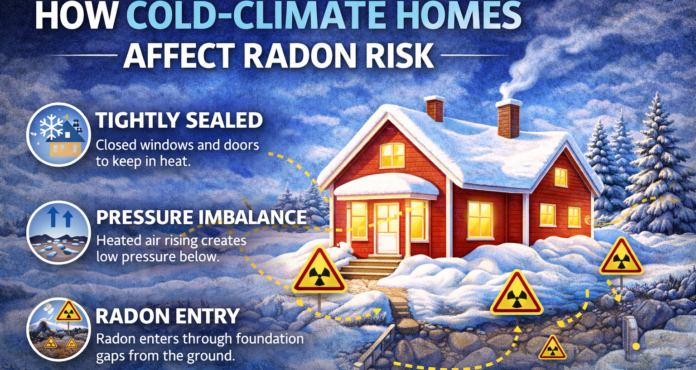
How Cold-Climate Homes Affect Radon Risk
Cold weather does not create radon. The gas still comes from the ground, and sometimes from building materials or water. But cold-climate homes can change the way radon behaves once it is trying to enter a building. That is why colder regions often pay closer attention to radon, and why winter or heating-season measurements are so common in official radon guidance.
The basic idea is simple. In cold climates, homes are usually built and operated to hold heat. Windows stay closed more often. Buildings may be tighter. Warm indoor air rises and escapes through upper parts of the house, which can help pull replacement air in through the lower parts. If the lower part of the house is connected to the soil through cracks, joints, gaps, sump openings, or service penetrations, some of that incoming air can be radon-bearing soil gas.
That does not mean every cold-climate house has high radon, and it does not mean cold weather is always the main cause of a radon problem. Geology still matters most. But cold-climate housing can make an existing radon risk more important by helping the gas enter and build up indoors. Official Nordic radon guidance says exactly that, noting that the high radon levels seen in Finland, Sweden, and Norway are linked not only to uranium-rich bedrock and soils, but also to a low air exchange rate due to cold climate.
So when people ask whether cold-climate homes affect radon risk, the honest answer is yes, but in a specific way. Cold climate usually affects how much radon gets drawn in, how long it stays indoors, and how much indoor levels can rise during sealed-up periods. This article explains why that happens and what homeowners should do about it.
Table of Contents
- Quick Answer
- Cold Weather Does Not Create Radon
- Why Cold-Climate Homes Can Change Radon Risk
- Pressure Differences and the Stack Effect
- Why Sealed-Up Houses Often See Higher Winter Levels
- Ventilation Matters More Than Many Homeowners Realize
- Basements, Slabs, and Ground Contact in Cold Climates
- Can Energy-Efficiency Upgrades Make Radon Worse?
- Why Cold-Climate Homes Still Need Proper Long-Term Testing
- What Homeowners in Cold Climates Can Do
- Final Thoughts
- Sources
Quick Answer
Cold-climate homes can increase radon concern because they often have lower natural air exchange during the heating season and stronger pressure differences between the house and the soil. In practical terms, that can make it easier for radon-bearing soil gas to be pulled into the lower parts of the home and harder for that radon to dilute once it is inside. Official Nordic guidance says this is one reason Finland, Sweden, and Norway often see higher radon concern, and official testing guidance in countries such as Finland, Norway, and Canada all emphasize long-term measurements during colder months or the heating season because indoor radon often runs higher when houses are more closed up.
Cold climate is not the only factor. The underlying geology still matters most, and some cold-climate homes test low while some milder-climate homes test high. But when a house sits on radon-prone ground, cold-weather operation can make the indoor radon problem worse. That is why radon policy in colder countries often focuses on heating-season testing, good ventilation design, tight but well-managed construction, and mitigation methods that reduce soil-gas entry instead of relying on window-opening alone.
Cold Weather Does Not Create Radon
The first thing to get straight is that cold weather itself does not create radon. Radon is a radioactive gas formed from the natural decay of uranium and radium in soil, rock, and sometimes groundwater. The World Health Organization explains that the concentration of radon in a home depends on the amount of uranium in the underlying rocks and soils, the construction of the house, and the ventilation habits of the inhabitants. That is a useful summary because it places climate in the right context. Climate is part of the story, but not the source of the gas.
That matters because many homeowners in colder regions assume high radon is “just a winter problem.” It is not. If a home has elevated radon, the source is still the ground below and around the building, or less commonly building materials or water. Cold-climate housing conditions can make that underlying problem easier to notice and more severe indoors, but they are not the original cause.
This is also why two neighboring homes in the same cold town can test very differently. One may have better sub-slab sealing, better ventilation balance, fewer leakage routes, or less direct communication with radon-bearing soil gas. The cold climate affects both homes, but the building details decide how much that climate influence actually matters.
Why Cold-Climate Homes Can Change Radon Risk
Cold-climate homes change radon risk mostly by changing the way air moves. The Nordic recommendations on radon in dwellings say that the high radon levels found in Finland, Sweden, and Norway are linked to high uranium concentrations in bedrock and soil formations, and that a low air exchange rate due to cold climate is an important contributing factor. That sentence is one of the clearest official explanations of the issue anywhere.
When the weather is cold, people are less likely to leave windows open for long periods. The building envelope may also be tighter because the home is designed to keep heated air inside and cold outdoor air outside. That makes sense for comfort and energy savings, but it also means any radon that enters may remain concentrated for longer if ventilation is limited or poorly balanced.
Cold weather can also increase the temperature difference between indoors and outdoors, and that matters because indoor radon is affected by the difference between outdoor and indoor temperatures. STUK says indoor radon levels are affected by ventilation rates and the difference between outdoor and indoor air temperatures. So even when the source of radon remains the same, the way the building behaves in winter can still raise or lower the indoor result.
Pressure Differences and the Stack Effect
One of the biggest reasons cold-climate homes can see higher radon is the way pressure differences develop in winter. Warm air inside a house rises and leaks out through upper parts of the building. As that happens, replacement air is pulled in through lower parts of the home. In radon discussions, this is often called the stack effect.
The U.S. EPA explains the radon-entry principle clearly: if the air pressure of a house is lower than the surrounding soil, the house can act like a vacuum and pull radon gas inside through cracks or openings in the foundation. That pressure relationship is not unique to cold climates, but cold weather often strengthens it because the indoor-outdoor temperature gap is larger.
Finland’s radon mitigation guidance says the airflow that carries radon indoors is created by the underpressure in the building, which in turn is created by mechanical ventilation and the temperature difference between the outdoor and indoor air. That is exactly why cold-climate homes deserve more attention. In winter, the temperature difference is usually larger, and the lower levels of the house can be more prone to pulling in soil gas if there are entry routes available.
This also helps explain why the lowest occupied parts of a home, such as basements, lower-ground rooms, and slab-on-grade first floors, often show higher radon than upper floors. They sit closest to the soil and closest to the pressure-driven entry routes.
Why Sealed-Up Houses Often See Higher Winter Levels
Another piece of the puzzle is simple occupant behavior. During cold weather, homes are often closed up for comfort and energy reasons. That does not just affect airflow in an abstract way. It changes the real indoor conditions under which radon accumulates.
Health Canada’s residential radon measurement guide says that higher radon levels are usually observed during winter months when houses are sealed up. That is one reason Health Canada recommends long-term testing, ideally during the heating season. Nordic countries use a similar logic. Norway recommends home measurements between mid-October and mid-April, and Finland recommends measurement during its main season from the beginning of September to the end of May. DSA: Norway home measurements | STUK: Measuring radon
This seasonal pattern does not mean a home is only risky in winter. It means winter often reveals the problem more clearly because indoor concentrations are more likely to build up. That is why short-term summer testing can be misleading if it is used to make major decisions about remediation or long-term exposure.
It also explains why homeowners sometimes get confused. They may notice the house feels comfortable, tight, and energy efficient in winter and assume that must mean indoor air is better. For radon, tighter winter operation can sometimes mean the opposite if the house is drawing in soil gas and not diluting it well.
Ventilation Matters More Than Many Homeowners Realize
Ventilation is one of the most important moving parts in a cold-climate radon problem. WHO says radon levels in existing homes can be reduced by improving the ventilation of the building, especially in the context of energy conservation. That wording is important because it acknowledges the real tension many cold-climate homeowners face. They want to conserve heat, but they also need enough effective air exchange to avoid trapping indoor pollutants, including radon.
Finland’s radon mitigation guidance makes the point even more bluntly. It says that before starting mitigation, it is important to check that ventilation is working well enough, as poorly functioning ventilation increases the radon concentration. That is a practical reminder that radon is not always just a foundation issue. It is often a whole-house air-movement issue.
At the same time, homeowners should be careful not to oversimplify this into “just ventilate more.” Random window-opening is not a dependable radon mitigation strategy in cold weather, and CDC notes that natural ventilation is only a temporary way to reduce radon. CDC: Reducing radon levels in your home What matters is whether the building has balanced, reliable ventilation that lowers indoor radon rather than accidentally worsening pressure-driven entry from the soil.
In other words, ventilation matters, but it has to be the right ventilation. A poorly designed change can sometimes make pressure conditions worse, while a well-designed system can help reduce indoor radon and improve overall indoor air quality.
Basements, Slabs, and Ground Contact in Cold Climates
Cold-climate homes often have design features that increase the importance of the lower part of the building. Basements are common in many colder regions. Even where full basements are less common, slab-on-grade floors, crawl spaces, utility penetrations, and insulated lower levels create important ground-contact zones.
The EPA says radon can enter through cracks or openings in the foundation, and STUK says one of the most common leakage routes is the gap between the ground-supported floor slab and the footing or wall, created as concrete dries and shrinks. These are exactly the kinds of entry routes that become more important when indoor air pressure is lower than soil-gas pressure around the foundation.
In cold climates, lower levels may also be occupied more often. A basement that serves as a family room, office, bedroom, or playroom matters much more for exposure than an unfinished storage space that people visit only briefly. That is one reason official guidance often tells people to test frequently used lower rooms rather than treating the house as one uniform box.
The combination of ground contact, lower indoor pressure, and reduced winter ventilation is why cold-climate radon risk is often most visible in basements and lowest occupied floors. It is not just that these rooms are closer to the soil. They are also where the building’s winter pressure and ventilation behavior can matter most.
Can Energy-Efficiency Upgrades Make Radon Worse?
This is one of the most practical questions for cold-climate homeowners. The honest answer is that energy-efficiency work can be very good for comfort and heating costs, but it can also change indoor radon behavior if the home becomes tighter without adequate radon planning or ventilation balance.
The WHO radon fact sheet specifically mentions improving ventilation especially in the context of energy conservation, which is a strong hint that energy upgrades and radon should be considered together, not separately. The EU radon framework says national radon action plans should consider related programs such as energy saving and indoor air quality. That is not an accident. Tighter homes can save energy, but if radon entry routes remain and ventilation is not handled properly, indoor radon may increase.
This does not mean homeowners should avoid weatherization, insulation, or air sealing. It means radon should be part of the conversation when major cold-climate upgrades are planned. If the home is in a radon-prone area or has never been tested, it is wise to measure before and after major work so you know whether the indoor radon profile changed.
In practical terms, the safest approach is not “never tighten the house.” It is “tighten the house intelligently, and make sure radon and ventilation are considered at the same time.”
Why Cold-Climate Homes Still Need Proper Long-Term Testing
Because cold-climate homes can show stronger seasonal patterns, proper testing matters even more. Finland says radon levels can vary with outdoor temperature, weather conditions, ventilation rates, and the difference between outdoor and indoor temperatures. It also says the year-to-year variation for indoor radon measurements is typically in the order of plus or minus 30%. STUK: Measuring radon
That is exactly why official guidance tends to favor long-term measurements. Norway recommends at least two months during the heating season. Health Canada recommends long-term testing, ideally during the heating season, and says short-term tests are not acceptable for deciding the initial need for remedial action. The UK uses a standard three-month test for homes. DSA: Norway home measurements | Health Canada guide | UK Radon: Measuring radon
For cold-climate homeowners, the takeaway is straightforward. Do not rely too heavily on a quick reading taken under unusual conditions. A proper long-term measurement, done when the house is being lived in normally during colder months, will tell you much more about real exposure.
What Homeowners in Cold Climates Can Do
The first step is to test the home properly. That remains true whether you live in Finland, Minnesota, northern England, Alberta, or a mountain town anywhere else. The only way to know whether the building has a meaningful radon problem is to measure it.
The second step is to understand that comfort and energy efficiency do not automatically equal low radon. A warm, well-sealed home can still have elevated radon if soil gas is being pulled in through the lower part of the building. So if you are planning major insulation, air-sealing, or ventilation work, it is smart to include radon in the plan rather than treating it as an unrelated issue.
The third step is to focus on durable mitigation if the result is high. WHO lists common methods such as increasing under-floor ventilation, installing a sump system, avoiding the passage of radon from the basement into living spaces, sealing floors and walls, and improving building ventilation. WHO: Radon and health In Finland, STUK says the most effective mitigation methods are sub-slab suction and a radon well. These are examples of the broader rule that permanent radon reduction works best when it addresses how soil gas enters and how pressure behaves around the building.
The final step is to remember that cold climate raises the importance of good design, but it does not make a radon problem hopeless. Official guidance from WHO, STUK, EPA, and other agencies is consistent on this point. Radon can usually be reduced effectively with the right approach.
Final Thoughts
Cold-climate homes affect radon risk because they often combine several conditions that help indoor radon build up. They may be tighter, more closed up during winter, and more affected by indoor-outdoor temperature differences that increase pressure-driven soil-gas entry. In houses with radon-prone ground below them, those conditions can turn a moderate underlying risk into a more significant indoor air problem.
But cold climate is not destiny. The gas still has to come from somewhere, and the building still has to give it a path inside. That is why geology, foundation details, ventilation performance, and room usage all still matter. A cold-climate home on low-radon ground may test low. A home in a milder area with poor foundation details may test high. The climate changes the odds and the way the house behaves, but it does not write the final result on its own.
If there is one practical lesson to keep, it is this: in colder climates, radon deserves a little more respect because the way homes are built and operated can make indoor levels worse. Testing during the proper season, understanding how your home handles air and pressure, and acting on a high result are the best ways to stay ahead of the problem.
Sources
- Recommendations for Radon in Dwellings in the Nordic Countries
- STUK: Measuring Radon
- STUK: Radon Mitigation
- World Health Organization: Radon
- World Health Organization: Radon and Health
- Norwegian Radiation and Nuclear Safety Authority: Radon Measurements in Residential Dwellings
- U.S. EPA: How to Address Radon When Building a New Home
- Health Canada: Guide for Radon Measurements in Residential Dwellings
- CDC: Reducing Radon Levels in Your Home
- UK Radon: Measuring Radon
- EUR-Lex: Council Directive 2013/59/Euratom