
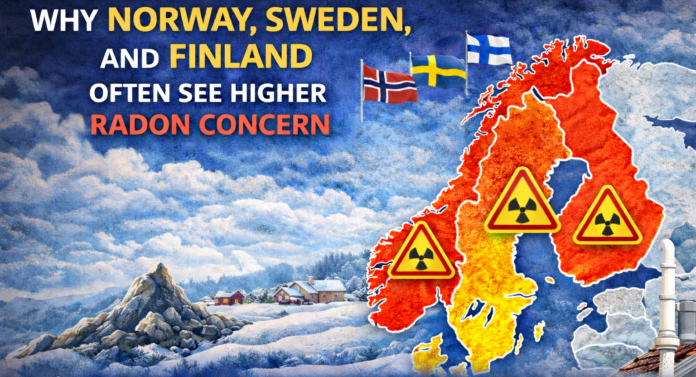
Why Norway, Sweden, and Finland Often See Higher Radon Concern
If you spend much time reading about radon in Europe, the same three countries keep coming up again and again: Norway, Sweden, and Finland. That is not an accident. These countries are not the only places in Europe with important radon issues, but official Nordic and national sources consistently treat them as part of Europe’s strongest radon-concern cluster.
That does not mean every home in Norway, Sweden, or Finland has high radon. It also does not mean the problem is spread evenly across each country. Radon is still highly local and building-specific. But when experts and public agencies talk about countries where radon deserves special attention, these three Nordic countries show up for good reason.
A joint Nordic recommendation from radiation authorities and experts says that radon levels in dwellings in the Nordic countries, except Iceland, are high, and that Finland, Norway, and Sweden are among the highest in the world. The same document also points to two of the main reasons: high uranium concentrations in bedrock and soil formations, and a cool climate with often lower air exchange. That is the short version of why these countries stand out, but it is only the beginning of the story. Nordic radon recommendations
To really understand why Norway, Sweden, and Finland often see higher radon concern, you have to look at several things at once: geology, climate, housing design, building materials, water in some areas, and the simple fact that these countries have spent decades measuring and documenting radon carefully. In other words, the higher concern is not caused by one single factor. It is the result of several radon-friendly conditions stacking on top of one another.
Table of Contents
- Quick Answer
- Why These Three Countries Keep Appearing in Radon Discussions
- The Biggest Reason: Geology and Soil Conditions
- Climate and Air Exchange Also Matter
- Sweden’s Extra Factor: Building Materials Such as Blue Concrete
- Water Can Add to the Picture in Some Areas
- How the Concern Differs in Norway, Sweden, and Finland
- Why These Countries Also Have Stronger Radon Systems
- Why This Still Does Not Mean Every Nordic Home Is High
- What Homeowners Should Take from This
- Final Thoughts
- Sources
Quick Answer
Norway, Sweden, and Finland often see higher radon concern because they combine several risk factors that work together. Official Nordic and national sources point most consistently to radon-prone geology, cold-climate building conditions that can reduce air exchange, and in some places additional sources such as building materials or water. A Nordic expert recommendation says that radon levels in dwellings in Finland, Norway, and Sweden are among the highest in the world. Nordic radon recommendations
That higher concern also shows up in how these countries talk about radon. Finland’s radiation authority says the average radon concentration in Finnish homes is about 94 Bq/m³ and that radon in breathing air is usually the most significant source of radiation exposure for Finns. Sweden’s radiation authority estimates radon in dwellings causes about 500 lung cancer cases per year. Norway’s radiation authority estimates radon in homes causes around 300 lung cancer deaths per year. Those are not the numbers of countries treating radon as a minor side issue. STUK: Radon in Finland | SSM: Radon | DSA: Radon and health risks
Why These Three Countries Keep Appearing in Radon Discussions
The simplest reason these three countries keep appearing is that official radon authorities in the Nordic region say so directly. The joint Nordic recommendations on radon in dwellings state that Finland, Norway, and Sweden are among the highest in the world for radon in dwellings. That single statement helps explain why these countries appear so often in European radon comparisons and why they are often treated as a core high-concern group. Nordic radon recommendations
But that does not mean all three countries are identical. Their radon burdens are shaped by slightly different mixes of factors. Norway’s official explanations emphasize permeable soil and radium-rich rocks such as alum shale, granites, and pegmatites. Sweden’s public guidance says radon can enter buildings from the ground, building materials, or household water, and Swedish research reports continue to flag blue concrete, uranium in the ground, soil type, region, and ventilation as important background factors. Finland’s national action plan says radon can enter indoor air from the soil and bedrock below and around the building, from construction products, or from borehole water. DSA: What is radon? | SSM: Radon | STUK: National action plan
So the higher concern comes from a broad pattern, not one single explanation. The official picture is more like this: these countries tend to have favorable ground conditions for radon generation and movement, housing conditions that can trap it indoors, and long-established radon programs that have measured enough homes to prove the issue is real.
The Biggest Reason: Geology and Soil Conditions
The first and biggest reason is geology. Radon is produced through the decay of uranium and radium in the ground, so the geology beneath buildings matters enormously. The Nordic recommendations say the high Nordic radon problem is linked to high uranium concentrations in bedrock and soil formations. That is the starting point for understanding why the Nordic region often stands out. Nordic radon recommendations
In Norway, the official explanation is especially direct. The Norwegian Radiation and Nuclear Safety Authority says that one of the major causes of high radon levels in Norway is the country’s geology, and that areas of permeable soil and bedrock containing radium-rich rocks such as alum shale, granites and pegmatites can lead to very high indoor radon levels. That is a strong official statement because it connects not only the uranium-bearing rock itself, but also the ability of the soil to move radon-bearing air upward into buildings. DSA: What is radon?
In Finland, STUK explains that radon is produced from uranium through the decay chain and that indoor radon can enter from the soil and bedrock below and around the building. STUK also notes that the concentration of radium-226 in Finnish soil and bedrock varies considerably, and that radium produces radon when it decays. That is one reason Finland’s radon maps and measurement advice remain so broad. STUK even says it recommends radon measurements in all areas in Finland because high concentrations have been measured in all types of areas. STUK: Radon in Finland | STUK: Radioactivity of building materials and ash | STUK: Maps of radon in Finland
In Sweden, the official consumer-facing radon page is a little broader and says radon can come from the ground, building materials, or household water. But Swedish research reports still highlight factors such as uranium level in the ground and type of soil when trying to understand why some dwellings exceed the reference level. In other words, Sweden’s geology still matters greatly, even if Swedish public messaging also gives more attention than some other countries to building materials. SSM: Radon | SSM report 2021:28
This is why geology remains the central explanation. If the ground under and around buildings can generate a lot of radon and also allow it to migrate indoors, the country starts with a higher baseline concern before you even talk about ventilation or construction details.
Climate and Air Exchange Also Matter
Geology alone does not fully explain the Nordic pattern. Climate matters too. The Nordic radon recommendations say the problem is also linked to the region’s cool climate and often lower air exchange. That is important because radon only becomes a serious indoor problem if it both enters the building and remains there long enough to build up. Nordic radon recommendations
In colder climates, homes are often built and operated in ways that conserve heat. That is sensible and necessary, but it can also reduce natural air exchange if the building is not well designed for radon control. Lower air exchange does not create radon, but it can allow indoor concentrations to remain higher once radon is entering from the ground.
Norway’s earlier national strategy also states this plainly, saying that geological conditions and the cool climate pose a big challenge. That line is useful because it captures the way the Nordic problem works in real life. It is not just that the rocks can generate radon. It is that the building and climate context can help trap it indoors. Norway radon strategy
This also helps explain why the Nordic countries often emphasize long-term winter-season measurements. Finland recommends measurement during the main measurement season from the beginning of September to the end of May, and Norway recommends measurement between mid-October and mid-April. These are not random seasonal windows. They reflect the fact that a cool-climate housing environment can strongly influence indoor radon behaviour. STUK: Measuring radon | DSA: Radon measurements in homes
Sweden’s Extra Factor: Building Materials Such as Blue Concrete
Sweden has one especially notable feature that makes its radon story slightly different from Norway’s and Finland’s. Swedish official sources repeatedly point to certain building materials, especially blue concrete, as an important background factor in elevated indoor radon.
The Swedish Radiation Safety Authority says radon can enter buildings from the ground, building materials, or household water. More specifically, its 2021 analysis of radon levels in Swedish dwellings and workplaces says that important factors to analyse include building material (blue concrete), region, uranium level in the ground, type of soil, building year, and ventilation type. The same report also notes that large databases of Swedish detached-house measurements include many homes in areas with well-known radon problems and homes containing blue concrete. SSM: Radon | SSM report 2021:28
This matters because it means Sweden’s radon burden is not only a ground-gas problem. It is also partly a housing-stock problem in some older buildings. That makes Swedish radon concern more layered. Some homes are dealing mostly with radon from the ground. Others may also be affected by the materials used to build them.
That is one reason Sweden can be a little misleading if you only look at a simple national average. The issue is not spread uniformly. Certain building types and periods of construction matter more than others, which is one reason Swedish radon policy still pays attention to the details of housing stock rather than only to geology.
Water Can Add to the Picture in Some Areas
Another reason the Nordic countries sometimes see higher concern is that, in some locations, water adds to the overall radon picture. This is usually not the main reason a home has elevated indoor radon, but it can matter more in some Nordic settings than people expect.
In Finland, STUK says radon can enter indoor air not only from soil and bedrock but also from borehole water. STUK also says radon is the radioactive substance contributing most to the radiation dose received from drinking water in Finland, and that radon readily evaporates into indoor air when water is heated or used in showers and baths. That means private well and borehole water can become an additional exposure route in some Finnish homes. STUK: National action plan | STUK: Sources of radon
Sweden’s public radon page also says radon can come from household water, although the Swedish system generally gives more public attention to ground sources and building materials. SSM: Radon
Norway’s major official consumer explanations focus more strongly on geology and indoor air from the ground, but Norway’s broader radon and radiation strategy has long recognized that different environmental and housing conditions can interact. So even where water is not the main national story, it is part of the reason Nordic radon policy often looks more comprehensive than people expect.
How the Concern Differs in Norway, Sweden, and Finland
Although the three countries are often grouped together, the concern is not identical in all of them.
In Finland, the issue looks especially strong from the perspective of population exposure. STUK says the average radon concentration in Finnish homes is about 94 Bq/m³ and that radon in breathing air is usually the most significant source of radiation exposure for Finns. STUK also estimates that radon exposure causes around 150 to 270 cases of lung cancer each year in Finland. Those facts help explain why Finland treats radon as a major national radiation issue, not just a small environmental problem. STUK: Radon in Finland | STUK: Radon causes lung cancer
In Sweden, the concern is strongly visible in the housing stock and health burden. The Swedish Radiation Safety Authority says radon in dwellings causes around 500 lung cancer cases per year in Sweden. Its 2021 report also estimated that around 16% of Sweden’s single-family houses, about 330,000 homes, still had radon levels above 200 Bq/m³. That is a huge number of homes above the Swedish reference level and one reason Sweden remains a major radon country in Europe. SSM: Radon | SSM report 2021:28
In Norway, the concern is perhaps most visible in the way the national authority talks about the issue. DSA says it is estimated that radon in homes causes around 300 lung cancer deaths each year in Norway, and it recommends homeowners take measures above 100 Bq/m³ while keeping levels below the home limit value of 200 Bq/m³. Norway’s public guidance also strongly emphasizes that measurement is the only way to know whether a dwelling has a radon problem. DSA: Radon and health risks | DSA: Radon | DSA: Radon measurements in homes
So the overall pattern is shared, but each country has its own emphasis. Finland is especially notable for national average exposure and the role of soil, bedrock, and borehole water. Sweden is especially notable for the combination of ground radon, building materials such as blue concrete, and a very large number of single-family homes above the national level. Norway is especially notable for geology, cool-climate housing conditions, and a very direct national focus on early action and home measurement.
Why These Countries Also Have Stronger Radon Systems
Another reason these countries often look like “higher concern” countries is that they have built stronger radon systems around the problem. That is partly a response to the high burden, but it also makes the burden more visible because they measure and document it well.
Finland, for example, has a national action plan, broad national measurement advice, radon maps, separate rules for homes and new buildings, and active regulation of workplace radon. STUK even says it recommends measurements in all areas because high concentrations have been found everywhere in Finland. STUK: Maps of radon in Finland | STUK: National action plan
Sweden has detailed dwelling analysis, ongoing radon mapping and supervision priorities, and a strong official focus on how building age, ventilation, ground uranium, soil type, and blue concrete relate to elevated levels. That is not the behaviour of a country still trying to decide whether radon matters. It is the behaviour of a country managing a long-standing national issue. SSM report 2021:28
Norway’s system is also strong and very practical. DSA says homeowners should measure, gives a clear action level and limit value, and has separate radon guidance for dwellings, schools, kindergartens, and mitigation. That stronger policy framework is not separate from the higher concern. It is one of the consequences of it. DSA: Radon
So when people say these countries “see higher radon concern,” they are partly talking about indoor concentrations and health burden, but they are also talking about the visibility of the issue in public policy. Countries that measure more, publish more, and regulate more will naturally look more radon-aware than countries that treat the issue more quietly.
Why This Still Does Not Mean Every Nordic Home Is High
This point is important enough to state clearly. Even though Norway, Sweden, and Finland often see higher radon concern, it does not mean every home there has a high radon level. Radon is still highly variable from one building to another.
STUK says you cannot conclude your home’s radon concentration from the results measured in a neighboring dwelling. Sweden’s and Norway’s public guidance also emphasize that measurement is the only way to know what is happening in a specific building. That is why these countries do not rely only on maps or regional reputation. They still point people back to actual testing. STUK: Neighboring dwelling results do not determine yours | SSM: Radon | DSA: Radon measurements in homes
So the better way to understand the headline is this: these three countries often see higher national concern because the conditions for elevated indoor radon are more common and better documented there. But the only way to know whether a particular home is high is still to measure that home.
What Homeowners Should Take from This
If you live in Norway, Sweden, or Finland, the practical lesson is not to panic. It is to take radon seriously and assume measurement is worthwhile, especially if you live in a detached home, ground-contact dwelling, or known higher-risk area. Official sources in all three countries consistently point toward testing as the only reliable way to know where a specific building stands. STUK: Measuring radon | SSM: Radon | DSA: Radon measurements in homes
If you live elsewhere in Europe, the lesson is slightly different. Do not assume the Nordic countries are the only places where radon matters. They are simply some of the clearest examples of countries where geology, climate, and housing conditions combine to create a stronger overall radon burden. Other European countries can still have serious local hot spots or strong national concerns of their own.
And if you are trying to understand why Nordic countries get singled out so often, the answer is now fairly clear: they are not being singled out because of a stereotype. They are being singled out because official data and official authorities keep pointing to the same mix of conditions that make higher radon concern more likely there.
Final Thoughts
Norway, Sweden, and Finland often see higher radon concern because several important factors line up in the same direction. Their geology can generate and release a lot of radon. Their cool climates and housing conditions can help indoor concentrations build up. Sweden also has an added historical building-material factor in some homes. Finland can see added contribution from borehole water. And all three countries have measured, studied, and regulated radon seriously enough to show the scale of the issue clearly.
That is why these countries keep appearing in radon discussions across Europe. They are not the only places with radon problems, but they are among the most consistently documented and officially acknowledged high-concern countries. In the end, that is really what the phrase “higher radon concern” means here: not that every home is dangerous, but that the conditions for elevated indoor radon are common enough, and the health burden real enough, that national authorities have had to build strong radon systems around them.
Sources
- Recommendations for Radon in Dwellings in the Nordic Countries
- STUK: Radon in Finland
- STUK: National Action Plan to Prevent Radon Risks
- STUK: Maps of Radon in Finland
- STUK: Sources of Radon
- STUK: Radon Causes Lung Cancer
- STUK: Measuring Radon
- STUK: You Cannot Conclude Your Home’s Radon Concentration from the Neighboring Dwelling
- Swedish Radiation Safety Authority: Radon
- Swedish Radiation Safety Authority: Analysis of Radon Levels in Swedish Dwellings and Workplaces
- Norwegian Radiation and Nuclear Safety Authority: Radon
- Norwegian Radiation and Nuclear Safety Authority: What Is Radon?
- Norwegian Radiation and Nuclear Safety Authority: Radon and Health Risks
- Norwegian Radiation and Nuclear Safety Authority: Radon Measurements in Residential Dwellings
- Strategy for the Reduction of Radon Exposure in Norway