
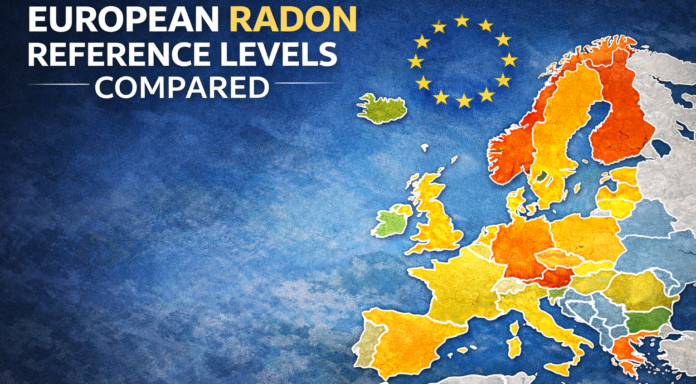
European Radon Reference Levels Compared
One of the fastest ways to get confused about radon in Europe is to assume every country uses the same number. They do not. Europe shares a lot of radon science, and within the EU there is a shared legal framework through the Basic Safety Standards Directive, but national radon reference levels still differ in visible ways. Some countries are built around 100 Bq/m³. Some around 200 Bq/m³. Many use 300 Bq/m³. And a few do not rely on one simple reference level at all, instead combining an action level with a separate maximum or limit value.
That does not mean Europe is disorganized. It means countries have made different policy choices within a broad shared framework. The World Health Organization recommends a national residential reference level of 100 Bq/m³ where possible, and says it should not exceed 300 Bq/m³ if country-specific conditions make 100 impractical. The EU Basic Safety Standards Directive then requires Member States to set national reference levels for indoor radon in dwellings that are not higher than 300 Bq/m³. Inside that envelope, countries still have room to be stricter, more layered, or more targeted.
This is why a homeowner in Denmark may hear that 100 Bq/m³ is the key number, while a homeowner in Ireland or Sweden is more likely to hear 200 Bq/m³, and someone in Germany, Austria, France, Switzerland, Finland, or the Czech Republic may encounter a 300 Bq/m³ reference framework. Meanwhile, the UK still uses an older but very clear Action Level of 200 Bq/m³ and a Target Level of 100 Bq/m³, while Norway uses an action level of 100 Bq/m³ and a limit value of 200 Bq/m³ for homes.
So if you want to compare European radon reference levels properly, the first thing to understand is that you are not really comparing one single system. You are comparing a family of national systems that use related but not identical radon thresholds. This article explains how those systems group together, why they differ, and what those differences actually mean in practice.
Table of Contents
- Quick Answer
- The Big Picture: Europe Does Not Use One Number
- Why European Reference Levels Differ
- A Quick Country-by-Country Comparison
- The 100 Bq/m³ End of the Spectrum
- The 200 Bq/m³ Group
- The 300 Bq/m³ Group
- Why These Numbers Are Not Always Directly Comparable
- Homes, Workplaces, and New Buildings Often Use Different Levels
- What Homeowners Should Actually Take from This
- Final Thoughts
- Sources
Quick Answer
European radon reference levels are not fully harmonized. The most common national patterns today are:
- 100 Bq/m³ systems or strongly 100-based approaches, especially Denmark and the WHO benchmark.
- 200 Bq/m³ systems, including Sweden, Ireland, and the UK’s Action Level, with Norway also using 200 Bq/m³ as a home limit value alongside a lower action level.
- 300 Bq/m³ systems, including Germany, Austria, Switzerland, France, the Czech Republic, and Finland for existing dwellings.
The WHO recommends 100 Bq/m³ where possible and says the national level should not exceed 300 Bq/m³ if country conditions make 100 impractical. The EU directive caps national residential reference levels at 300 Bq/m³, but it still allows countries to be stricter. So the answer to “what counts as high radon in Europe?” depends partly on which country you mean and whether you are talking about homes, workplaces, or new buildings.
The Big Picture: Europe Does Not Use One Number
It is tempting to think Europe has settled on one official indoor radon number. That is not really true. Europe has converged on the idea that radon is a serious health issue and that countries should set formal national levels, but it has not converged on one single value for every national system.
The reason many people assume Europe uses 300 Bq/m³ is that this number appears in the EU Basic Safety Standards Directive. For dwellings, the directive says the national reference level for the annual average indoor radon concentration must not be higher than 300 Bq/m³. That is extremely important, but it is a ceiling, not a command that every country must choose exactly 300.
At the same time, the WHO still recommends a lower benchmark of 100 Bq/m³ where possible. That leaves countries with a range of plausible policy choices. Some lean closer to the WHO ideal. Some adopt the EU ceiling. Some choose something in between. Some use more than one number depending on whether the building is an existing home, a workplace, a school, or a new building.
This is why comparing European radon reference levels is useful, but it has to be done carefully. Otherwise you end up comparing unlike with unlike.
Why European Reference Levels Differ
There are a few reasons these numbers differ. The first is policy philosophy. Some countries want a stricter benchmark that triggers earlier attention, even if that means more buildings fall above the official number. Others are more comfortable using a higher formal reference level while still encouraging reduction below it where possible.
The second reason is building and geology context. Countries with widespread radon-prone geology, colder climates, or tighter buildings may choose a structure that balances health goals against the practical reality of how many homes might exceed a strict value. A country with a large radon burden may still choose 300 Bq/m³ as its formal level while strongly encouraging lower results in practice.
The third reason is that reference level is not always the only concept in play. The UK, for example, does not primarily frame residential radon around a single “reference level” on its consumer pages. It uses an Action Level of 200 Bq/m³ and a Target Level of 100 Bq/m³. Norway likewise uses an action level of 100 Bq/m³ and a limit value of 200 Bq/m³. These are not less serious systems. They are just structured differently.
The final reason is that many countries separate existing buildings from new construction. Finland is a clear example. STUK says Finland uses 300 Bq/m³ for existing dwellings and other premises used by people, but 200 Bq/m³ for the design and construction of new buildings. So even within one country, “the radon reference level” may not be just one number.
A Quick Country-by-Country Comparison
The table below is a practical snapshot of the main residential or consumer-facing radon levels in selected European systems. It is not a complete list of every country in Europe, and it does not try to collapse workplace or new-building rules into one number. It is simply a homeowner-friendly comparison of the main national frameworks.
| Country / Framework | Main Residential Level | Notes |
|---|---|---|
| WHO recommendation | 100 Bq/m³ | WHO says use 100 where possible, and not above 300 if 100 is impractical. |
| EU Basic Safety Standards Directive | Up to 300 Bq/m³ | National residential reference levels must not be higher than 300 Bq/m³. |
| Denmark | 100 Bq/m³ | One of the stricter Nordic and European frameworks. |
| Norway | 100 / 200 Bq/m³ | 100 is the action level and 200 is the limit value for homes. |
| Sweden | 200 Bq/m³ | Reference level used for existing buildings, including dwellings and workplaces. |
| Ireland | 200 Bq/m³ | Homes use 200 Bq/m³, while workplaces use 300 Bq/m³. |
| United Kingdom | 200 Bq/m³ Action Level | UK also uses a 100 Bq/m³ Target Level. |
| Finland | 300 Bq/m³ | Existing dwellings use 300; new buildings use 200. |
| Germany | 300 Bq/m³ | Reference value in the Radiation Protection Act. |
| Austria | 300 Bq/m³ | Reference value applies to residential buildings and workplaces. |
| Switzerland | 300 Bq/m³ | Reference level for premises where people stay regularly for several hours a day. |
| France | 300 Bq/m³ | France uses 300 Bq/m³ as the annual-average reference value for homes. |
| Czech Republic | 300 Bq/m³ | The national radon action plan describes a legally set reference level of 300 Bq/m³. |
The 100 Bq/m³ End of the Spectrum
If you start from the strictest end of the European spectrum, the most important reference point is still the WHO recommendation of 100 Bq/m³. WHO presents this as the preferred national annual-average residential reference level and says that if country-specific conditions make this impractical, the level should not exceed 300 Bq/m³. In other words, 100 is the ideal policy benchmark even though many countries have chosen a higher formal level.
Denmark stands out because official Nordic comparison material says Denmark uses 100 Bq/m³ as its reference value. A recent STUK comparison of Nordic radon management says exactly that. Danish official material also uses 100 Bq/m³ as the level at which homes are treated as high on the national radon map and as the workplace reference level in Danish radiation regulations. That gives Denmark one of the stricter public radon postures in Europe.
It is worth noting that a 100 Bq/m³ system does not mean a country has solved radon. It means the country has chosen to formalize a lower benchmark for action or concern. From a homeowner perspective, this makes the Danish approach more precautionary than many 200 or 300 systems. More homes are likely to fall above the official number, which pushes the conversation toward earlier attention.
The 200 Bq/m³ Group
The next major European cluster is the 200 Bq/m³ group. This includes some of the best-known public radon systems in Europe, but not all of them express the number in exactly the same way.
Sweden uses 200 Bq/m³ as the national reference level for radon activity concentration in indoor air in existing buildings, including dwellings, workplaces, and public premises, according to the official Nordic overview published through the Swedish Radiation Safety Authority. That makes Sweden one of the clearest examples of a country that has chosen a mid-range, but still fairly strict, national value.
Ireland also uses 200 Bq/m³ for homes. The Irish EPA says the national reference level for long-term exposure to radon in a house is 200 Bq/m³, while workplaces use a separate reference level of 300 Bq/m³. This split is important because it shows how one country can apply one number to homes and another to workplaces without treating that as a contradiction.
The UK is a little different because it does not present the homeowner framework mainly as a “reference level” on its public pages. Instead, UK Radon says the Action Level is 200 Bq/m³ and the Target Level is 100 Bq/m³. That means 200 is the point where reduction is recommended, while 100 is the ideal outcome for remediation work and preventive measures in new buildings. Functionally, the UK’s public residential system still sits in the 200-style family, but with an added lower target built into it.
Norway is another special case. The Norwegian Radiation and Nuclear Safety Authority says homeowners should take steps to reduce radon above 100 Bq/m³, and that the radon level should not exceed the limit value of 200 Bq/m³. That puts Norway partly in the 100 group and partly in the 200 group. In practice, it is one of the stricter systems in Europe because it combines early action at 100 with a hard upper residential value at 200.
The 300 Bq/m³ Group
The largest single cluster in Europe is the 300 Bq/m³ group. These are the countries whose formal residential or general indoor reference framework aligns more closely with the top end allowed by EU law.
Germany is a straightforward example. The Federal Office for Radiation Protection, BfS, says the reference value in the German Radiation Protection Act is 300 Bq/m³. Germany then uses radon precautionary areas and workplace rules to determine where additional duties apply.
Austria also uses 300 Bq/m³. The official Austrian radon portal says the national reference value is 300 Bq/m³ for indoor areas in residential buildings and workplaces and that it refers to the annual average radon concentration. Austria is therefore a clear example of a country using the EU-maximum-style reference level while still maintaining a strong radon program around measurement, precautionary areas, and remediation.
Switzerland likewise uses a 300 Bq/m³ reference level. The Swiss Federal Office of Public Health says that from 2018 onward the earlier limit value of 1000 Bq/m³ was replaced by a reference level of 300 Bq/m³ for the annual average radon concentration in premises where people stay regularly for several hours a day. Switzerland still keeps a separate workplace threshold structure for certain radon-exposed workplaces, which shows again that one number rarely tells the whole story.
France is also in this group. Official French radon guidance from IRSN says that France uses 300 Bq/m³ as the annual-average reference value for homes and that concentrations above that level should be reduced. France’s consumer-facing language therefore aligns clearly with the 300 model.
The Czech Republic is another 300-based country. The Czech national radon action plan says the legally set reference level is 300 Bq/m³ for radon activity concentration. Given the Czech Republic’s long-established radon program and geology-driven radon-prone areas, this is an important part of the broader European picture.
Finland is slightly more layered. STUK says the radon level in existing dwellings and other premises used by people uses a reference value of 300 Bq/m³, while new buildings use 200 Bq/m³. So Finland belongs in the 300 group for existing homes, but not for all building contexts.
From a policy perspective, a 300 Bq/m³ country is not necessarily saying radon below 300 is ideal. In fact, several official sources make clear that the reference level does not divide safe from unsafe conditions with scientific precision. It marks the level where national policy gives special priority to action.
Why These Numbers Are Not Always Directly Comparable
This is probably the most important section in the whole article. A simple list of national radon numbers is useful, but it can also be misleading if you do not understand what is sitting behind those numbers.
First, not every country uses the same terminology. Some speak mainly of a reference level. Others use an action level, a target level, a limit value, or some combination. A British Action Level of 200 Bq/m³ plus a Target Level of 100 Bq/m³ does not mean exactly the same thing as a German reference value of 300 Bq/m³, even though both are serious radon systems.
Second, some countries apply one number to existing dwellings and another to new buildings or workplaces. Finland is a good example with 300 for existing buildings and 200 for new construction. Ireland separates homes at 200 from workplaces at 300. Switzerland uses 300 as the general reference level but retains a separate 1000 Bq/m³ threshold value for certain radon-exposed workplaces. So if you compare countries without asking “for which type of building?” you can get the wrong impression.
Third, countries differ in how strongly they encourage action below the formal number. The WHO, UK, and several national authorities emphasize that radon risk is continuous and that lower is generally better. So a country using 300 may still promote remediation well below that level in some circumstances, especially when smoking risk or new construction is involved.
Finally, measurement practices differ. Some countries compare the annual-average residential concentration directly against the formal number. Others use seasonal correction or particular test windows. That means the same raw test result may enter national decision-making in slightly different ways depending on the country.
Homes, Workplaces, and New Buildings Often Use Different Levels
One reason people get tangled up in European radon comparisons is that they often assume one country has one number for everything. That is rarely true.
In Ireland, the home reference level is 200 Bq/m³, while workplaces use 300 Bq/m³. In Finland, existing dwellings use 300 Bq/m³, new buildings use 200 Bq/m³, and workplaces also use 300 Bq/m³. In Norway, homes use 100 as the action level and 200 as the limit value, and schools, kindergartens, and rented accommodation are also structured around those levels. In Switzerland, 300 Bq/m³ is the general reference level, but certain workplaces exposed to radon also carry a separate threshold value of 1000 Bq/m³.
This tells you something very useful. European radon policy is not really about choosing one magic number and applying it everywhere. It is about choosing numbers that fit different building contexts and legal responsibilities. Homes, schools, offices, rental housing, and new construction do not always sit under the same radon rules, even inside one country.
What Homeowners Should Actually Take from This
The first practical takeaway is that a national reference level is not the same thing as a promise that everything below it is harmless. The WHO says radon risk increases with exposure and recommends 100 Bq/m³ where possible. Countries using 200 or 300 are not claiming that 199 or 299 is perfectly safe. They are setting a policy trigger.
The second takeaway is that if you are reading about another country’s radon policy, do not assume it translates neatly to your own. A homeowner in Ireland, the UK, Norway, and Germany may all be told something different about what number matters most, even though each country is using an official system.
The third takeaway is that for practical decision-making, the national number is only one part of the picture. You also need to know whether your country uses maps or risk areas, whether your building has a basement or cellar, whether it is a newer or older home, and whether there are smokers in the household. Those details often matter just as much as the formal national level.
The final takeaway is the simplest one. If you do not know the radon level in your own home, the only number that finally matters is the one measured there. Country frameworks help decide when action is encouraged or required, but they do not replace testing the building itself.
Final Thoughts
European radon reference levels are best understood as a spectrum, not a single continental standard. At the strict end sits the WHO recommendation of 100 Bq/m³, with Denmark close to that benchmark in practice. In the middle sit the strong 200 Bq/m³ systems of Sweden and Ireland, along with the UK’s 200 Bq/m³ Action Level and Norway’s 200 Bq/m³ home limit value. At the upper end of the formal European framework sit the many 300 Bq/m³ systems, including Germany, Austria, Switzerland, France, the Czech Republic, and Finland for existing dwellings.
That does not mean some countries care and others do not. It means they have made different decisions about where to place the main policy trigger, how to separate homes from workplaces, and how strongly to distinguish existing buildings from new ones.
So if you want the clearest answer possible to the title of this article, it is this: Europe does not use one radon reference level. It uses a family of national systems that cluster around 100, 200, and 300 Bq/m³, with additional action levels, target levels, and limit values layered on top depending on the country. Understanding that makes European radon policy much easier to read and much less confusing.
Sources
- World Health Organization: Radon and Health
- EUR-Lex: Council Directive 2013/59/Euratom
- UK Radon: Action Level and Target Level
- Ireland EPA: Radon
- Ireland EPA: Measurement Protocol for Homes and Workplaces
- STUK: National Action Plan to Prevent Radon Risks
- STUK: The Nordic Countries Use Slightly Different Methods to Prevent Radon Harm
- Swedish Radiation Safety Authority: Overview of Radon Management in the Nordic Countries
- Norwegian Radiation and Nuclear Safety Authority: Radon
- German Federal Office for Radiation Protection: Reference Value
- Austria Radon Competence Center: How Can I Measure Radon?
- Swiss Federal Office of Public Health: Legal Dispositions Concerning Radon
- IRSN / ASNR: Le risque radon en 10 questions
- Czech State Office for Nuclear Safety: National Action Plan for Control of Public Exposure to Radon
- Danish Health Authority: Executive Order on Ionising Radiation and Radiation Protection
- Danish Health Authority: Radon Map of Denmark