
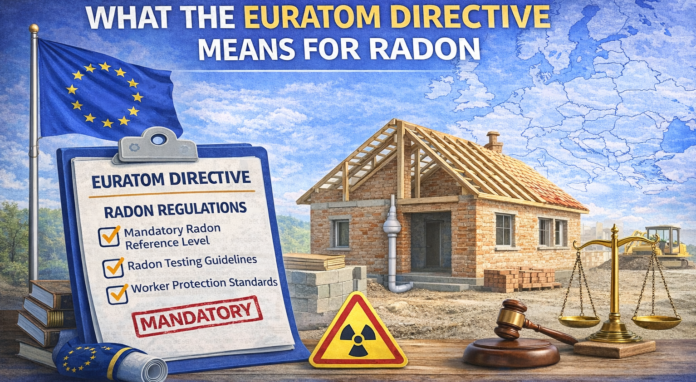
What the Euratom Directive Means for Radon
When people read about radon in Europe, they often come across the phrase Euratom Directive and are left wondering what it actually means in real life. Is it a law that tells every homeowner in Europe to test? Is it just a broad recommendation? Does it set one single radon limit for every country? The answer is more structured than that.
The key legal text is Council Directive 2013/59/Euratom, usually called the Basic Safety Standards Directive. It is the main EU radiation-protection directive and it covers natural radiation sources as well as artificial ones. The European Commission describes it as the key radiation-protection legal instrument adopted under the Euratom Treaty, and the Joint Research Centre explains that the directive introduced legally binding requirements on protection from exposure to radon for the first time.
That last point is the heart of the issue. Before this framework, radon was often treated more as guidance, mapping, or public-health advice. The Euratom directive did not magically solve radon, but it changed radon from something many countries could address loosely into something EU Member States had to build real systems around. Those systems now include national radon action plans, indoor reference levels, radon-priority areas, workplace rules, public information duties, and measures to stop radon entering new buildings.
So what does the Euratom directive mean for radon? In simple terms, it means radon is no longer just a geology problem or a homeowner awareness issue. It is a regulated radiation-protection issue. The directive does not run one giant EU radon program for every home, but it does require each Member State to create a national radon framework with real legal responsibilities behind it.
Table of Contents
- Quick Answer
- What the Euratom Directive Actually Is
- Why This Directive Mattered So Much for Radon
- Reference Levels: The Core Number Most People Notice
- What It Means for Homes
- What It Means for Workplaces
- The National Radon Action Plan Requirement
- Radon Priority Areas and National Maps
- What It Means for New Buildings and Building Codes
- Public Information, Awareness, and Technical Guidance
- Enforcement: Why This Is More Than Advice
- What the Directive Does Not Do
- What It Means in Practical Terms for Homeowners, Buyers, and Employers
- Final Thoughts
- Sources
Quick Answer
The Euratom directive means that radon is treated as a formal radiation-protection issue across the European Union, not just a matter of local guidance. Under Directive 2013/59/Euratom, Member States have to set national indoor radon reference levels, create a national radon action plan, identify areas where many buildings are expected to exceed the national level, require radon measurements in certain workplaces, provide public information, and put measures in place to prevent radon from entering new buildings.
For homes, the directive says the national reference level for the annual average indoor radon concentration must not be higher than 300 Bq/m³. For workplaces, the annual-average reference level must also generally stay at or below 300 Bq/m³, although the workplace article contains a narrow allowance where national prevailing circumstances justify otherwise. The directive also requires action plans to cover dwellings, buildings with public access, and workplaces, and to address radon from soil, building materials, or water.
In practical terms, this means the EU does not tell each homeowner exactly what to do, but it does force Member States to have a serious radon system in place. That is why so many European countries now have official radon maps, reference levels, testing guidance, workplace obligations, and construction rules that did not exist in the same structured way before.
What the Euratom Directive Actually Is
The Euratom directive people mean in radon discussions is usually the Basic Safety Standards Directive, formally Council Directive 2013/59/Euratom. The European Commission says this directive is the key radiation-protection legal instrument under the Euratom Treaty. It lays down basic safety standards for protection against ionising radiation and replaced several earlier Euratom directives when Member States had to transpose it into national law by 6 February 2018.
That transposition point matters because a directive is not the same thing as a consumer leaflet. It is a legal instrument addressed to Member States. In other words, the EU set the framework and each Member State had to build the national laws, regulations, administrative systems, and enforcement tools needed to comply with it. That is why the actual radon system you experience in Finland, Ireland, France, Germany, Sweden, or Austria can look different while still growing out of the same legal backbone.
The directive also matters because of its scope. The Commission says it covers all relevant radiation sources, including natural radiation sources, and it distinguishes between planned, existing, and emergency exposure situations. The JRC explains that indoor radon exposure of both workers and members of the public is now explicitly brought within the directive’s scope, and that this was the first time legally binding requirements for radon protection were introduced at EU level.
That is the first real answer to the headline question. The Euratom directive means radon moved from a patchwork of recommendations into the core of European radiation law.
Why This Directive Mattered So Much for Radon
The reason this directive mattered so much is not only that it mentioned radon. It is that it turned radon into something that Member States had to organize, regulate, and plan for. The JRC explains that earlier European guidance on indoor radon was effectively incorporated into a legally binding structure. That changed the whole posture of radon policy across Europe.
Before that shift, a country could treat radon mainly as a public-awareness topic and still say it was taking the issue seriously. After the directive, that became much harder. The directive requires national reference levels, action plans, priority-area identification, workplace measurement triggers, building-code prevention, public information, and enforcement systems. That is a much more demanding standard than simply telling people radon exists.
It also mattered because radon was no longer treated as a narrow homeowner issue. The directive reaches across homes, workplaces, buildings with public access, and new construction. That means radon policy is not only about the person who owns a detached house. It also affects employers, school operators, public authorities, planners, building inspectors, and the construction sector.
Another important change is that the directive frames radon as part of existing exposure situations. Annex XVII includes indoor exposure to radon and thoron in workplaces, dwellings, and other buildings as a type of existing exposure situation. In practical terms, that means radon is treated as a real environmental exposure that governments are expected to manage over the long term, rather than as a rare or purely theoretical issue.
Reference Levels: The Core Number Most People Notice
The number most people associate with the Euratom directive is 300 Bq/m³. But it is important to understand what that number really is. The directive uses the language of reference levels, not a simple universal “safe line” where everything below is harmless and everything above is automatically unlawful.
Under Article 7, Member States must establish reference levels for emergency and existing exposure situations. The same article says optimisation of protection should give priority to exposures above the reference level, while still continuing below it. That is a more realistic public-health approach than pretending radon risk suddenly begins at one exact number.
For dwellings, Article 74 says Member States must establish national reference levels for indoor radon concentrations and that the annual-average level in air must not be higher than 300 Bq/m³. In other words, 300 Bq/m³ is the EU ceiling for a residential national reference level, not a mandatory one-size-fits-all target that every country must use.
For workplaces, Article 54 uses a very similar structure. It says the annual-average workplace reference level must also not be higher than 300 Bq/m³, unless national prevailing circumstances justify otherwise. So the directive strongly centers the radon framework around 300 Bq/m³, but still leaves room for countries to make stricter or differently structured choices in national law.
The JRC makes this explicit by noting that Member States can choose more challenging reference levels and can define different reference levels for existing and newly built buildings. That is why the directive can be the common legal foundation for countries that still end up with visibly different national radon policies.
What It Means for Homes
For ordinary people, the most important radon article is usually Article 74. This is the article on indoor exposure to radon in homes. It does three big things.
First, it requires each Member State to establish a national indoor radon reference level for dwellings, with the annual-average concentration not higher than 300 Bq/m³. Second, under the national radon action plan, Member States must promote action to identify dwellings that exceed the national reference level and encourage radon-reducing measures in those homes. Third, Member States must make local and national information available on indoor radon exposure, the health risks, the importance of measurement, and the technical means available for reducing radon.
This is important because it shows the directive is not trying to micromanage each individual household from Brussels. It does not say every homeowner in Europe must test by a certain date. It also does not prescribe one universal remediation system for every house. What it does instead is require Member States to create a functioning national system that can find elevated homes, inform the public, and encourage actual reduction work where needed.
That is why the directive matters even if you never read it yourself. If your country has an official radon map, home-testing advice, public educational pages, a reference level for homes, and guidance on mitigation systems, those tools are exactly the sort of national infrastructure the Euratom framework was designed to force into existence.
What It Means for Workplaces
The directive is even more concrete on workplaces. Under Article 54, Member States must require radon measurements in two main situations. The first is workplaces located on the ground floor or in basements within areas identified under the national radon framework. The second is specific types of workplaces identified in the national action plan.
That is a major shift from radon being treated as a vague environmental issue. It means workplace radon is not just something employers may think about if they happen to be interested. In many situations, the directive expects national law to make radon measurement a real workplace duty.
The directive also sets up an escalation path. Article 54 says that where radon concentrations in workplace areas continue to exceed the national reference level despite optimisation measures, the situation must be notified. Then Article 35 becomes relevant. It says that if worker exposure is liable to exceed an effective dose of 6 mSv per year, or the corresponding time-integrated radon exposure value set nationally, the workplace must be managed as a planned exposure situation. If exposure stays at or below that level, the competent authority must still require that exposures are kept under review.
This is one of the clearest examples of what the Euratom directive means in practice. For homes, the framework is about identification, public information, and encouraging reduction. For workplaces, the framework can turn into a formal occupational-radiation regime with measurement, notification, continuing review, and stronger regulatory controls.
The National Radon Action Plan Requirement
If Article 74 and Article 54 are the most visible radon rules, Article 103 is the article that makes the whole system possible. It says Member States must establish a national radon action plan addressing long-term risks from radon in dwellings, buildings with public access, and workplaces, for any source of ingress, whether from soil, building materials, or water. It also says the plan must take account of the issues listed in Annex XVIII and be updated regularly.
This is the part of the directive that turned radon policy into a real national governance issue. A country could no longer just set a number and stop there. It had to think through how it would survey radon, manage measurement data, communicate with the public, identify radon-priority areas, support remediation, define responsibilities, coordinate public and private actors, and integrate radon into building codes and technical guidance.
Annex XVIII shows just how wide that planning duty is. It says national radon action plans should consider things such as strategies for surveys, the data and criteria used to define higher-radon areas, identification of workplaces and public-access buildings where measurement is required, the basis for reference levels, responsibility and coordination mechanisms, strategies for reducing radon in dwellings, strategies for facilitating post-construction remediation, strategies for preventing radon ingress into new buildings, review schedules, public-awareness communication, and guidance on measurements and remedial measures.
This is why the directive means more than “the EU picked 300 Bq/m³.” The action-plan article shows that the Euratom framework is really about building a national radon system, not just setting a number.
Radon Priority Areas and National Maps
One of the most practical consequences of the directive is the requirement to identify the places where radon is more likely to be a serious issue. Under Article 103, Member States must identify areas where the annual-average radon concentration is expected to exceed the relevant national reference level in a significant number of buildings.
This is why so many countries now have radon maps, address-based radon tools, or officially defined radon-priority areas. The directive does not prescribe one exact map style. It does not say whether a country must use postcode zones, geological categories, probability grids, municipal lists, or any other single model. What it does say is that countries must identify the areas where radon is expected to be a significant problem.
That flexibility is deliberate. Radon does not behave uniformly across national borders, counties, or even neighborhoods. It follows geology, building characteristics, and ventilation patterns. So the directive leaves room for each Member State to create a mapping system that fits its own conditions while still meeting the legal requirement to identify higher-risk areas.
For the public, that means national radon maps are not just informational extras. In many cases, they exist because the Euratom directive pushed governments to build them.
What It Means for New Buildings and Building Codes
Another major piece of the directive is its effect on new buildings. Under Article 103, Member States must ensure that appropriate measures are in place to prevent radon ingress into new buildings. The article even says these measures may include specific requirements in national building codes.
This is one of the strongest signs that the Euratom directive treats radon as a building-policy issue as well as a health issue. The logic is simple. It is often easier and cheaper to prevent radon during construction than to retrofit a home after it is occupied. That can mean radon barriers, sub-floor measures, activation-ready sumps, airtight treatment of service penetrations, or other national code solutions depending on the country.
Annex XVIII reinforces this by saying national action plans should include a strategy, methods, and tools for preventing radon ingress in new buildings, including attention to building materials with significant radon exhalation. In other words, the directive does not only care about homes that already have a radon problem. It also cares about preventing future buildings from developing one in the first place.
This is a major part of what the directive means in practical terms. If your country has radon provisions in national building regulations, especially in mapped higher-risk areas, those rules are not random. They are exactly the kind of prevention framework Article 103 was designed to produce.
Public Information, Awareness, and Technical Guidance
The directive also means that radon policy is supposed to be visible to the public, not hidden away inside technical law. Article 74 requires Member States to make information available on indoor radon exposure, the associated health risks, the importance of performing measurements, and the technical means available for reducing existing radon concentrations.
Annex XVIII expands this further by saying national action plans should include a communication strategy to raise public awareness and inform local decision-makers, employers, and employees about radon risks, including the relationship between radon and smoking. It also says the plans should include guidance on methods and tools for measurements and remedial measures, and should consider criteria for accrediting measurement and remediation services.
This part of the directive matters because a legal number alone does not help the public very much. Most homeowners do not need to read Article 74. They need to know whether they should test, where to get reliable measurement devices, how long a measurement should last, what the result means, and what kinds of building measures are usually used if the level is high. The directive therefore pushes countries not just to regulate radon, but also to explain it.
Enforcement: Why This Is More Than Advice
One reason the Euratom directive matters so much is that it is not just an awareness framework. It also has an enforcement side. Under Article 104, Member States must establish inspection systems to enforce the provisions adopted pursuant to the directive and to initiate surveillance and corrective action where needed. The directive also says the competent authority must have inspection programs and that the outlines of those programs and the main findings from their implementation should be available to the public.
Then Article 105 says competent authorities must have the power to require people or legal entities to remedy deficiencies and prevent their recurrence, or where appropriate to withdraw authorization if the exposure situation is not compliant with the national provisions adopted under the directive.
This does not mean an EU inspector is going to appear at every house with a basement. What it does mean is that the radon framework was not intended as a purely voluntary educational campaign. In areas like workplaces, public buildings, and regulated national systems, the directive expects competent authorities to have real legal tools.
What the Directive Does Not Do
Understanding the Euratom directive also means understanding its limits. First, it does not create one identical radon policy for every country. It sets a framework, but it leaves national implementation to Member States. That is why different countries can still use different public-facing thresholds, test durations, map systems, and building-code details while staying inside the same EU structure.
Second, it does not tell every homeowner in the EU that they personally must test their home by law. Instead, it tells Member States to establish reference levels, build action plans, identify high-risk areas, provide public information, and promote action to identify and reduce elevated dwellings.
Third, it does not prescribe one single technical fix for radon. The directive does not say every building above the reference level must get the same membrane, sump, fan, or ventilation system. It expects national authorities and technical guidance systems to develop those practical tools.
Fourth, the directive does not mean that 300 Bq/m³ is the only important number in Europe. It is the EU ceiling for national residential reference levels, but countries are allowed to choose more challenging levels and even define different reference levels for existing and newly built buildings. That is one reason national radon systems across Europe still look different in practice.
Finally, the directive is mainly about indoor radon in buildings. Radon in water has its own separate Euratom legal track through Council Directive 2013/51/Euratom. That is useful to know because some people assume all radon law sits inside one single legal text. It does not.
What It Means in Practical Terms for Homeowners, Buyers, and Employers
For homeowners, the Euratom directive means your country should have a serious radon system in place. You should be able to find a national radon reference level, some form of official guidance on measurement, public information on radon risks, and usually a way to identify whether your property is in a higher-risk area. The directive does not tell you exactly what to do on your own property, but it is the reason your government is expected to provide more than vague warnings.
For homebuyers, it means radon is not just a local rumor or an internet talking point. It is a recognized radiation-protection issue with a formal legal framework behind it. If a national map, address search, or local rule indicates your target property is in a higher-risk area, that should be taken seriously as part of due diligence.
For employers, the directive means radon can become a real compliance issue, especially for ground-floor or basement workplaces in identified radon areas and for specific workplace types flagged under national action plans. In that context, radon is no longer just a building-maintenance matter. It can become part of occupational radiation protection.
For builders, planners, and regulators, the directive means new construction should not ignore radon. National building rules are expected to include radon-prevention thinking, especially in higher-risk areas. That can influence the design of slabs, membranes, penetrations, basements, sub-floor spaces, and future mitigation options.
In short, the Euratom directive means radon now has legal consequences across the full chain, from public information to measurement, from planning to new construction, and from private homes to workplaces and public-access buildings.
Final Thoughts
The Euratom directive means radon is no longer just a scientific concern or a local public-health campaign. It is part of the EU’s legally binding radiation-protection framework. The directive requires Member States to treat radon seriously through reference levels, national action plans, higher-risk area identification, workplace measurement duties, public information, and prevention measures for new buildings.
The most important thing to understand is that the directive works through national systems. It does not create one single Europe-wide homeowner rulebook. Instead, it makes sure every Member State has to build the machinery needed to manage radon in a real and lasting way. That is why the details still differ by country, even though the legal foundation is shared.
So if you want the clearest summary possible, it is this: the Euratom directive means radon became a formal EU-level legal issue, and that change is the reason modern European radon policy is far more structured, visible, and enforceable than it used to be.