
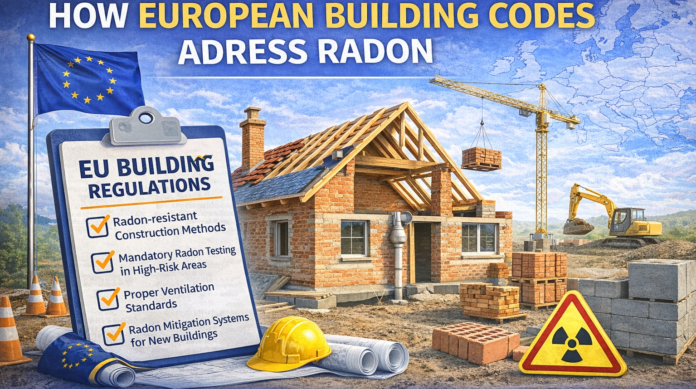
How European Building Codes Address Radon
When people think about radon, they usually think about test kits, maps, and lung cancer risk. But one of the most important parts of radon control in Europe happens much earlier, at the construction stage. Long before a homeowner orders a detector, building codes and technical rules may already have decided whether the home should include a radon barrier, a standby sump, a ventilated sub-floor space, sealed ground-contact penetrations, or some other protective feature.
That matters because radon is usually easier and cheaper to prevent during construction than to fix after the building is finished. Once a house is occupied, retrofitting can involve opening floors, adding fans, modifying sub-floor spaces, or solving air leakage paths that should have been addressed before the slab was poured. European policymakers understand that. Across the continent, radon is increasingly treated not just as an environmental health issue, but as a building-design issue.
There is not one single European building code for radon. What Europe has instead is a shared legal direction and a range of national code systems. At EU level, Directive 2013/59/Euratom requires Member States to ensure that appropriate measures are in place to prevent radon ingress into new buildings. It also requires national radon action plans to include a strategy, methods, and tools for preventing radon in new buildings. From there, each country turns that obligation into its own rules, maps, construction details, and enforcement system.
That is why European radon codes can look so different. Some countries build their rules around mapped radon-priority or radon-precautionary areas. Some use a national performance target for new homes. Some specify a radon barrier plus a standby system that can be activated later. Others focus more on airtight design of all ground-contact components. Some countries make radon protection nearly universal in new housing, while others concentrate requirements in higher-risk zones.
This article explains how those systems work in practice. Instead of treating Europe as though it has one uniform answer, it looks at the main code ideas that repeat across the continent and the key ways countries differ in translating those ideas into construction rules.
Table of Contents
- Quick Answer
- The EU Framework Behind National Building Rules
- What Radon Building Codes Are Actually Trying to Do
- The Main Radon-Proofing Tools Used in European Codes
- The UK and Ireland: Barriers, Sumps, and Zone-Based Protection
- The Nordic Approach: Performance Targets Plus Construction Readiness
- Germany and Austria: Precautionary Areas and Structural Measures
- Switzerland: Strong Strategic Focus on Protecting New Buildings
- Performance-Based vs Prescriptive Code Styles
- What Building Codes Cannot Guarantee on Their Own
- What Homeowners, Builders, and Buyers Should Take from This
- Final Thoughts
- Sources
Quick Answer
European building codes address radon mainly by doing three things. First, they try to stop soil gas from entering the building through the ground floor, basement walls, joints, and service penetrations. Second, they often require or encourage activation-ready features, such as standby sumps, sub-slab pipework, or ventilated sub-floor spaces, so radon can be reduced later if a test comes back high. Third, many countries connect code requirements to mapped high-radon areas, meaning the stricter construction measures apply where geology suggests higher risk.
The shared European legal foundation is the EU Basic Safety Standards Directive, which says appropriate measures must be in place to prevent radon ingress into new buildings. But the way countries apply that is very different. The UK uses basic and full protection depending on radon probability. Ireland requires a radon membrane in High Radon Areas and a standby sump in all buildings built since July 1998. Norway requires a radon barrier plus measures in the building land that can be activated if needed. Germany requires private new buildings to largely prevent radon ingress, with additional structural measures in radon precautionary areas. Austria and Finland both lean strongly toward designing radon protection into the building from the start.
The EU Framework Behind National Building Rules
The starting point for radon in European construction is not a national membrane detail or a local inspector. It is EU radiation law. Under Directive 2013/59/Euratom, Member States must ensure that appropriate measures are in place to prevent radon ingress into new buildings. The same directive also says national radon action plans must include a strategy, methods, and tools for preventing radon in new buildings, including attention to building materials with significant radon exhalation.
That is an important distinction. The EU does not tell every builder in Europe to use the exact same membrane brand or the exact same pipe detail. What it does is require every Member State to have a radon-prevention system for new buildings. That system can be embedded in national building regulations, technical guidance documents, foundation standards, radon action plans, or a combination of all of them.
Once you understand that, the rest of Europe’s code landscape makes much more sense. Countries are not improvising from scratch. They are translating a shared prevention duty into their own legal and construction language.
What Radon Building Codes Are Actually Trying to Do
At the building-science level, radon codes across Europe are all trying to solve the same problem. Radon comes mainly from the ground and enters buildings through gaps, cracks, joints, penetrations, service ducts, floor-wall junctions, and other imperfections in the ground-contact envelope. So radon-aware construction is really about controlling the interface between the building and the soil.
That usually leads to two broad code strategies. One strategy is barrier-based. The code tries to prevent soil gas entry by making the slab and ground-contact elements tighter, more continuous, and better sealed. The second strategy is relief-based. The code assumes some radon may still get in, so it requires or enables a way to depressurize or vent the ground beneath the building later. Many national codes use a blend of both.
This is why radon code language often sounds more like foundation design than public health. You see phrases such as radon barriers, airtight or convection-tight penetrations, sub-floor depressurisation, standby sumps, ventilated sub-floor voids, and activation-ready pipework. The health reason is lung cancer risk, but the code response is overwhelmingly about ground-contact construction details.
The Main Radon-Proofing Tools Used in European Codes
Even though countries differ, the same basic technical tools show up again and again. The first is the radon barrier or membrane. In practice, this is often a modified damp-proof membrane or equivalent barrier that is extended and sealed so it helps resist radon movement from the soil into the building. The UK’s guidance on basic radon protection describes exactly that approach, using a damp-proof membrane modified and extended to form a radon-proof barrier across the ground floor.
The second common tool is some form of sub-slab or sub-floor system that can be activated later. This may be called a standby sump, radon drainage, sub-floor depressurisation provision, or a similar term depending on the country. The idea is simple but powerful. Even if the barrier helps, the building is also given a built-in path for later mitigation if a post-occupancy radon test still comes back high.
The third recurring tool is careful treatment of joints, penetrations, and connections. Austria’s radon construction guidance is especially clear on this point. It says new buildings should be planned so the annual average radon concentration in occupied rooms stays below 300 Bq/m³, and that a convection-tight design of components, connections, and penetrations in contact with the ground is essential. That is not very glamorous language, but it gets to the heart of radon-proof design.
The fourth common tool is site- and area-based escalation. Many countries do not impose the same level of radon construction everywhere. Instead, they tie stronger measures to mapped radon areas, precautionary areas, or higher-probability zones. That is a major reason European building codes differ so much in public appearance. Often, the underlying toolbox is similar, but the trigger for using it is different.
The UK and Ireland: Barriers, Sumps, and Zone-Based Protection
The UK and Ireland are two of the clearest examples of radon entering building control through mapped risk areas. Both countries connect construction requirements to radon-prone geography, but they do it in slightly different ways.
In the UK, radon protective measures for new buildings are tied to the probability of high radon at the site. Depending on the level of radon probability, building regulations may require no protective measures, basic protection, or full protection. UK guidance explains that basic protection is a radon-proof barrier across the ground floor, while full protection adds provision for sub-floor depressurisation through a standby sump or ventilation through a ventilated sub-floor void. The UK approach is a good example of a code system that escalates from one layer of defence to two.
The UK system is also realistic about limits. Official guidance says building regulations do not require a pre-occupation radon test for the new dwelling, so the homeowner should test after moving in. It also notes that even if a home has radon protection, that does not guarantee a radon level below 200 Bq/m³. That is an important point. The code is trying to reduce risk, not promise perfect performance under all site conditions and installation quality levels.
Ireland is more prescriptive in some respects. The EPA says that for buildings built since 1 July 1998 in High Radon Areas, a radon membrane is required. It also says that the Building Regulations require all buildings built since 1 July 1998 to have a standby radon sump. That is a notably strong design choice. Ireland is essentially baking future activation potential into the building stock as a baseline, rather than requiring it only in the very highest-risk sites.
Ireland’s official guidance also makes an important practical point that applies everywhere in Europe. A standby sump that has not been activated with a fan does not reduce radon levels on its own. In other words, readiness is not the same as active mitigation. The construction code is giving the building a tool, but that tool may need to be turned into a working radon-reduction system later if the measured level is high.
The Nordic Approach: Performance Targets Plus Construction Readiness
The Nordic countries are especially interesting because they combine strong radon awareness with somewhat different code styles. Norway and Finland are two of the clearest examples.
In Norway, the technical building regulations are unusually explicit. The English version of TEK17 says buildings shall be designed and constructed with radon-prevention measures to limit inflow from the ground, and that indoor radon concentrations shall not exceed 200 Bq/m³. It then adds two minimum requirements for buildings designed for constant occupancy: they must have a radon barrier toward the ground, and they must be designed with suitable measures in the building land that can be activated if needed. That combination is striking because it captures both common code strategies at once. Norway requires a barrier, but it also requires built-in mitigation readiness.
That makes Norwegian code one of the clearest examples of a “do both” philosophy. Do not just try to seal the building. Also make sure the site and foundation design leave room for active intervention later. It is an elegant response to the fact that radon control is never purely about one layer of plastic or one perfect joint.
Finland takes a somewhat different but still strongly prevention-oriented approach. STUK states that the reference level for the design and construction of new buildings is 200 Bq/m³, even though the reference level for existing dwellings is 300 Bq/m³. That alone tells you something important. Finland expects more from new buildings than from the existing stock.
STUK’s new-building guidance also says radon-safe building methods are justifiable anywhere in Finland and that radon prevention during construction is easier and less expensive than later mitigation. It explains that the key issue is blocking or reducing radon-bearing airflow from the soil. This is more of a broad construction philosophy than a single mandatory detail, but it is still very clear: Finnish construction is expected to think about radon at the design stage, not after the house is already occupied.
Germany and Austria: Precautionary Areas and Structural Measures
Germany and Austria show another common European pattern, the use of precautionary areas or similar mapped zones to trigger stronger code expectations.
Germany’s Federal Office for Radiation Protection, BfS, says that for new private buildings, owners are required to largely prevent radon from entering by taking special structural measures. It also says that in areas where a high radon concentration can be expected in buildings, additional structural measures are obligatory. Germany is therefore a good example of a country where the national rule is already performance-oriented, but the mapped radon precautionary areas increase the code burden further.
Austria is even more explicit about the construction side. Its radon portal says that in radon precautionary areas, preventive radon protection measures must be provided for all new buildings under the relevant provincial regulations. The same guidance explains that the required protection depends on area designation, building type, the design of components in contact with the ground, and whether habitable basement rooms are planned.
Austria’s examples are some of the most concrete in official European radon guidance. It highlights convection-tight ground-contact construction, gives examples such as white-tank style design and watertight designs, and even notes that a continuous foundation slab of at least 20 cm combined with convection-tight pipe and cable penetrations can be sufficiently tight against radon convection. This is a very construction-oriented way of addressing radon. It treats radon not as an abstract threshold problem, but as a question of whether the ground-contact shell of the building has been executed correctly.
Austria also shows another mature feature of some European code systems: public support and follow-up. Its portal points people toward free radon measurement after moving into the building. That matters because a strong code culture does not assume that a good detail drawing automatically solves everything. It still checks performance in the real building.
Switzerland: Strong Strategic Focus on Protecting New Buildings
Switzerland is not in the EU, but it is still an important European comparison because it has a well-developed radon strategy. The Swiss Federal Office of Public Health says in its Radon Action Plan 2021-2030 that Switzerland is particularly affected by radon because of its geology. The action plan is also very direct that not enough has yet been achieved in measurement campaigns, remediation, building regulations, and cooperation with other programs, and that too many new buildings are still being built without appropriate preventative radon protection.
That self-assessment is useful because it shows how radon codes evolve. A country can already have a radon system and still decide it needs to strengthen how builders, planners, architects, and specialists handle radon in practice. Switzerland’s action plan explicitly says the country seeks to protect the population by systematically protecting new buildings against radon and by improving expertise among builders, planners, and architects. That is a slightly different emphasis from the more prescriptive public-facing details in Ireland or Austria, but it points in the same direction.
In other words, Switzerland shows that radon code policy is not only about what the law says on paper. It is also about whether the construction sector has enough knowledge and capacity to apply it correctly.
Performance-Based vs Prescriptive Code Styles
One of the most interesting differences across Europe is the difference between prescriptive and performance-based radon code styles.
A prescriptive system tells you more directly what features to install. Ireland is a strong example. In High Radon Areas, the new building needs a membrane, and buildings built since July 1998 also need a standby sump. Norway is also partly prescriptive because it explicitly requires a radon barrier and suitable activation-ready measures in the building land.
A more performance-based system focuses first on the outcome. Germany’s language about largely preventing ingress through special structural measures is closer to this style. Austria combines both, because it gives specific examples of acceptable approaches while still emphasizing the required performance of keeping occupied rooms below the reference value through convection-tight design and appropriate protection linked to map zones.
The UK sits somewhere in the middle. It has clear protective categories, basic and full, but those categories are still built around a performance logic related to site radon probability and the need for additional means of reducing levels if testing later shows a problem.
This difference matters because it affects how easy a code is for builders and homeowners to understand. A prescriptive system is often easier to describe, but a performance system can be more adaptable across different foundation types, climates, and construction traditions.
What Building Codes Cannot Guarantee on Their Own
For all their importance, radon codes have limits. A membrane can be damaged, badly lapped, or poorly sealed. Pipe penetrations can be left imperfect. A standby sump can exist but never be activated. A building can technically comply with the code and still produce a high radon reading if workmanship is weak or site conditions are more difficult than expected.
Official sources across Europe acknowledge this, even when they do not all use the same wording. The UK says protective measures do not guarantee the final level will be below 200 Bq/m³. Ireland says a membrane alone cannot guarantee that an individual building will be below the reference level and that installation quality is critical. Switzerland’s action plan says new buildings are still being constructed without appropriate preventative protection and that builder expertise must improve. All of that points to the same truth: radon code is only as good as design, installation, and follow-up.
That is why many European systems still point back to post-occupancy measurement. The code reduces the chance of a problem. The measurement tells you whether the building actually performed as intended.
What Homeowners, Builders, and Buyers Should Take from This
If you are a homeowner, the most practical lesson is not to assume that “built to code” means “radon proof.” It means the building may have some level of preventive design, but you still need to understand what was actually installed and whether post-occupancy testing is recommended.
If you are buying a newer home, it is worth asking a few direct questions. Was the home built in a mapped radon area? Did the code require basic or full protection, or a membrane and standby sump? Is there a visible capped pipe exit, a ventilated sub-floor void, or documentation for radon measures? Has the home ever been tested after occupancy? Those questions are often more useful than simply asking whether the property “has radon protection.”
If you are building or renovating, the lesson is even simpler. Radon prevention belongs in the design phase, especially where the building has ground-contact rooms, a slab-on-ground design, or habitable basement areas. It is usually much easier to detail airtight penetrations, build in radon drainage, and make the foundation shell convection-tight during construction than to correct those issues once finishes are complete.
If you are a builder or designer, the wider European lesson is that radon is increasingly no longer treated as a niche extra. It is part of healthy-building design, especially in mapped risk areas. Across Europe, the direction of travel is clear: more radon awareness in code, more prevention in new buildings, and more emphasis on measuring performance rather than assuming compliance alone is enough.
Final Thoughts
European building codes address radon in different ways, but they are all moving toward the same basic idea: prevent the problem before the house is occupied. Some countries do that through radon membranes and standby sumps. Some through barriers plus activation-ready measures under the building. Some through convection-tight ground-contact design. Some through zone-based escalation tied to radon maps. Most do it through a blend of several approaches.
The EU framework helped push this shift by requiring Member States to have measures for preventing radon ingress in new buildings. But the national responses are where the real detail lives. The UK and Ireland show strong map-linked building control. Norway and Finland show how performance targets and construction readiness can work together. Germany and Austria show how precautionary areas can trigger stronger structural obligations. Switzerland shows the importance of construction-sector expertise and systematic new-build protection.
So if you want the clearest takeaway, it is this: European radon codes are not really about one magic membrane or one universal threshold. They are about designing the building-ground interface intelligently, building in mitigation readiness, and recognizing that a healthy home starts with what happens under and around the floor long before anyone moves in.
Sources
- EUR-Lex: Council Directive 2013/59/Euratom
- UK Radon: Radon and Building Regulations
- UK Radon: Recently Built Homes and Radon Protection
- Ireland EPA: Builders
- Ireland EPA: Radon Map
- Norway: Regulations on Technical Requirements for Building Works
- Norwegian Radiation and Nuclear Safety Authority: Radon Measurements in Residential Dwellings
- Germany BfS: Legal Regulations for the Protection Against Radon
- Germany BfS: Protection Measures
- Austria Radon Competence Center: Precautions for New Buildings
- Austria Radon Competence Center: Precautionary Measures
- STUK: Radon in Finland
- STUK: Radon in New Buildings
- Swiss Federal Office of Public Health: Radon Action Plan 2021-2030