
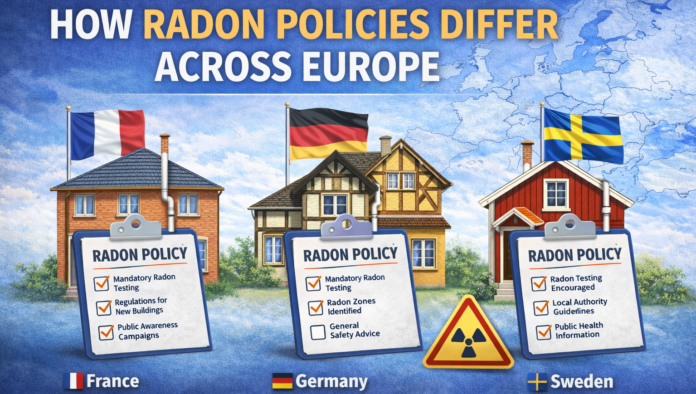
How Radon Policies Differ Across Europe
Radon is one of the few indoor air problems that almost every European country recognises, but that does not mean every country handles it in the same way. Europe has a shared scientific understanding of radon and, inside the European Union, a shared legal framework through the Basic Safety Standards Directive. Even so, the policy you actually encounter as a homeowner, landlord, employer, school operator, or homebuyer can look very different depending on where you are.
That difference is not just bureaucratic clutter. It reflects a deeper truth about radon. The problem varies by geology, climate, housing stock, building habits, legal culture, and public health priorities. Countries with widespread granite, uranium-rich bedrock, and cold climates often have stronger or stricter radon systems. Countries with large mapped hot spots may build their policy around priority zones. Others may use a lower national reference level or a more aggressive testing message even if the legal structure is different.
So when people ask how radon policies differ across Europe, they are really asking several questions at once. What number counts as too high? Who is expected to test? Is testing aimed at everyone or mainly at high-risk areas? Are schools and workplaces treated more strictly than homes? Are new buildings required to include radon protection? And how much responsibility falls on homeowners versus public authorities or employers?
The short answer is that Europe does not have one single radon policy. It has a shared framework and a collection of national systems that interpret and apply that framework in different ways. Some countries are stricter on the number. Some are stricter on who must test. Some build their whole system around mapping. Some focus heavily on workplaces and public buildings. Some offer free household testing. Some use long six-month measurements, while others use two or three months as standard.
This article explains those differences in plain language. Instead of pretending Europe can be summarised by one number or one map, it looks at the main policy fault lines that separate one national radon system from another. That gives homeowners and buyers something much more useful than a generic overview. It shows how the systems differ and what those differences actually mean in practice.
Table of Contents
- Quick Answer
- Europe Has a Shared Framework, Not One Single Policy
- The Biggest Difference: Countries Use Different Radon Numbers
- Who Is Expected to Test? This Varies a Lot
- Testing Rules and Measurement Traditions Are Not Identical
- Workplaces, Schools, and Rentals Often Have Stricter Rules
- New-Build and Construction Policies Differ Too
- Europe Uses Very Different Mapping Systems
- What These Differences Look Like in Real Countries
- What Homeowners and Buyers Should Take from This
- Final Thoughts
- Sources
Quick Answer
Radon policies differ across Europe mainly in five ways. First, countries use different residential reference or action levels. Some systems are built around 100 Bq/m³, some around 200 Bq/m³, and many around 300 Bq/m³. Second, countries differ on who is expected to test. Norway takes a broad, almost universal testing approach for homes, while the UK leans much more heavily on radon Affected Areas and occupied basements. Third, the standard test length is not identical from one country to another. Fourth, many countries regulate workplaces, schools, and rented buildings more tightly than owner-occupied homes. Fifth, new-build requirements and radon mapping systems vary significantly.
The result is that two countries can both be “following European radon law” while still handling the issue very differently on the ground. Denmark is notably strict at 100 Bq/m³ in its national framework, Sweden and Ireland use 200 Bq/m³ for homes, the UK uses a 200 Bq/m³ Action Level plus a 100 Bq/m³ Target Level, while countries such as Finland, Germany, Austria, Switzerland, and France are built more visibly around 300 Bq/m³ reference-level systems for many existing buildings. That does not mean one country cares and another does not. It means they have made different policy choices about how to structure action, prevention, and enforcement.
Europe Has a Shared Framework, Not One Single Policy
The best place to start is with the difference between European framework law and national implementation. Inside the EU, the core legal structure comes from Directive 2013/59/Euratom, often called the Basic Safety Standards Directive. That directive requires Member States to set national indoor radon reference levels, establish national radon action plans, identify areas where a significant number of buildings are expected to exceed the relevant national level, require radon measurements in certain workplaces, and ensure measures are in place to prevent radon ingress into new buildings.
That might sound like Europe already has one uniform radon policy. In reality, it does not. The EU framework tells countries what must exist, but it often leaves room for countries to decide how to do it. A country can choose a lower reference level than the EU ceiling. It can structure its maps differently. It can set more aggressive testing advice. It can design its building-code response in a way that fits local geology and construction traditions. That is why France, Germany, Ireland, Finland, and Austria can all comply with the same EU legal backbone while still looking different to the public.
It is also worth remembering that “Europe” is broader than the European Union. Countries such as Norway, the United Kingdom, and Switzerland are outside the EU but still have mature radon systems of their own. In practice, this means a Europe-wide comparison is not really an EU-only comparison. It is a comparison between a shared EU model plus several strong non-EU national models that often resemble the EU approach in broad principle while differing in important details.
That is the key idea for the rest of this article. Europe has converged on the idea that radon is a serious indoor air and lung cancer issue. It has not converged on a single identical way of handling it.
The Biggest Difference: Countries Use Different Radon Numbers
The easiest policy difference to notice is the number itself. When homeowners ask, “What level is too high?” the answer depends partly on the country. This is where European radon policy starts to split into several camps.
One camp is the 100 Bq/m³ style approach. Denmark is the clearest example. A 2024 Nordic overview published through the Swedish Radiation Safety Authority noted that the reference level for existing dwellings and public-access premises across the Nordic countries varies between 100 and 300 Bq/m³, and specifically stated that Denmark uses 100 Bq/m³. Denmark’s executive order on ionising radiation and radiation protection also uses 100 Bq/m³ as the workplace radon reference level that triggers optimisation measures. That is a relatively strict policy posture by European standards.
A second camp is the 200 Bq/m³ system. This includes countries like Sweden and Ireland, and it also broadly resembles the current UK homeowner framework. The Swedish Radiation Safety Authority describes 200 Bq/m³ as the reference level that matters for dwellings. In Ireland, the EPA states that the reference level for homes is 200 Bq/m³. In the UK, UK Radon uses a 200 Bq/m³ Action Level for homes, while also maintaining a lower Target Level of 100 Bq/m³ as the ideal outcome for remediation and new-build protection.
Then there is the broad 300 Bq/m³ camp. This includes a number of countries that align more visibly with the ceiling built into EU law for existing indoor environments. In Finland, STUK states that the reference level for radon in existing dwellings and other premises used by people is 300 Bq/m³, while the design and construction reference for new buildings is 200 Bq/m³. Germany’s Federal Office for Radiation Protection, BfS, says the reference value is 300 Bq/m³. Switzerland’s Federal Office of Public Health says its current radon framework uses a 300 Bq/m³ reference level. Austria’s radon portal also uses a 300 Bq/m³ reference value for remediation decisions in existing buildings.
Norway is a special case because it uses a two-part system that feels stricter than a simple 200-or-300 reference value. The Norwegian Radiation and Nuclear Safety Authority, DSA, says that if you have measured radon levels above 100 Bq/m³, you should take steps to reduce them, and that the level should not exceed the limit value of 200 Bq/m³. In other words, Norway formally separates an action level from a maximum or limit level.
This numerical variation changes the tone of policy. A country centered on 100 Bq/m³ is implicitly telling the public that much lower concentrations still deserve formal attention. A country centered on 300 Bq/m³ may still care deeply about radon, but it is choosing to put the main reference point higher. That can affect how many homes fall above the policy threshold, how much remediation gets promoted, and how the public perceives the urgency of the problem.
Who Is Expected to Test? This Varies a Lot
The next big difference is not the number itself, but who is expected to measure. Some countries take a broad approach and essentially tell most households to test. Others use a more targeted system built around priority areas or particular building types.
Norway is one of the clearest examples of the broad approach. DSA’s residential guidance says that it is impossible to predict whether radon is a problem in a dwelling and that radon measurements are the only means of determining this. Its public-facing radon page is even more direct about the need to measure in order to know whether there is radon in your home. That gives Norwegian policy a more universal tone.
Finland also leans quite broad. In its national radon action plan, STUK says residents of detached houses and owners or occupiers of apartments on the lowest floor should take measurements throughout the country. That is not exactly the same as “every home must test,” but it is far broader than a narrow hotspot-only strategy.
The UK is more targeted. UK Radon strongly recommends testing if you live or work in a radon Affected Area, and it treats an occupied basement or cellar as worth testing regardless of the general area status. Affected Areas in the UK are tied to a probability threshold, generally where at least 1% of homes are estimated to be above the Action Level. This is a distinctly map-driven system rather than a countrywide “everyone should test” message.
Ireland also uses a risk-area model, but with a different threshold and public framing. The Irish EPA defines a High Radon Area as an area where it is predicted that more than 10% of homes will exceed the national reference level. At the same time, the EPA also makes clear that a high radon level can be found in any home in any part of the country. So Ireland is mapped and targeted, but not in a way that suggests other areas are automatically irrelevant.
Germany uses yet another model. Under German law, the federal states designate radon precautionary areas where a high concentration is expected in many buildings, and these areas are then subject to special rules that go beyond the nationwide baseline. That gives Germany a more administrative, state-designated priority-area structure.
France uses a geologically oriented zoning system rather than a single probability message like Ireland or the UK. The official IRSN radon map divides communes into categories 1, 2, and 3, with category 3 representing communes where part of the area contains geological formations with higher estimated uranium content and therefore greater radon potential. This is another example of how countries can share the same scientific concern while expressing it through quite different map logic.
Austria adds another variation by combining zoned policy with practical testing support. The Austrian radon portal offers a free household radon measurement program using two detectors. That does not make Austria’s system universal in the Norwegian sense, but it lowers the practical barrier to testing in a way many countries do not.
Testing Rules and Measurement Traditions Are Not Identical
Another policy difference that matters more than most people realise is the test protocol itself. Europe does not use one universal homeowner test length or one universal seasonal method.
In the UK, a standard home test is usually a three-month measurement using two detectors, usually one in the living area and one in an occupied bedroom. UK Radon is also clear that shorter test periods are less reliable and that results are less dependable if the test is not run under normal occupancy conditions.
Finland uses a minimum of two months between the beginning of September and the end of May, preferably three months or more. Finland also explicitly estimates the annual average from the long-term measurement, which reflects the strong role of seasonal correction in its system.
Norway uses a very similar seasonal long-term approach. DSA says home measurements should be carried out between mid-October and mid-April and should last at least two months. Measurements should be performed in at least two frequently occupied rooms, and if the dwelling has several floors, DSA recommends measuring at least one frequently occupied room on each floor in contact with the ground.
Austria is notably longer. Its radon portal explains that household long-term measurement takes about six months, typically in the first or second half of the year, and that short-term measurements are not recommended for meaningful comparison with the reference value. This is a striking contrast with the two- and three-month models used elsewhere.
These differences matter because they affect how the public experiences radon policy. In one country, the answer might be, “Order a kit and run it this winter for two months.” In another, it might be, “Use two detectors over three months.” In Austria, it may mean committing to a six-month measurement. That changes convenience, perceived urgency, and how likely people are to complete the process.
It also affects how results are interpreted. A recent STUK comparison of Nordic radon management notes that Finland and Norway use the measurement result to estimate annual average radon levels, while in other countries the comparison may be made more directly against the measured result or the average of the measurements in the dwelling. These are not cosmetic differences. They influence how policy is translated into practical decision-making.
Workplaces, Schools, and Rentals Often Have Stricter Rules
If you only read homeowner radon pages, it is easy to miss how much stronger radon policy can become once workplaces, schools, kindergartens, and rented properties are involved. This is one of the clearest areas where European countries diverge in visible ways.
Ireland is a good example of a country that separates residential and workplace thresholds. The EPA says the national reference level for indoor radon in workplaces is 300 Bq/m³, and where the result exceeds that level, remedial measures must be taken.
Germany also has a more structured workplace system. BfS states that the annual-average radon concentration at workplaces should be below 300 Bq/m³, and workplaces in radon precautionary areas are subject to specific measurement obligations. This shows how the same country that may not order every private homeowner to test can still impose clearer duties once employment law and occupational safety enter the picture.
Norway is even more explicit in some public-access settings. DSA says all schools and kindergartens should keep radon as low as reasonably achievable and that the annual average should be below 200 Bq/m³ in frequently occupied rooms. The current regulations also use 100 Bq/m³ as the action level for kindergartens, schools, and rented dwellings, with 200 Bq/m³ as the limit value. That is far more operational than a simple awareness message.
Switzerland provides another interesting variation. The Federal Office of Public Health says that, from 2018 onward, the country shifted to a 300 Bq/m³ reference level for premises where people stay regularly for several hours a day, while also keeping a separate threshold value of 1000 Bq/m³ for workplaces exposed to radon. That creates a two-layer structure that looks different from both Norway’s 100/200 system and Germany’s more unified 300 framework.
France also stands out on the public-building side. The French nuclear safety authority, ASN, describes a system in which 300 Bq/m³ is the workplace reference level, corrective action is expected if that level is exceeded, and the response becomes more demanding if levels reach or exceed 1000 Bq/m³. ASN also reports on radon screening in educational and healthcare institutions, showing how much of French radon policy is now tied to managed public environments rather than just private homes.
This is one of the most consistent patterns across Europe. Even where homeowner policy feels advisory, workplace and public-access building policy often feels much more formal.
New-Build and Construction Policies Differ Too
One of the clearest signs of policy maturity is what a country does about new buildings. Testing and remediation in existing homes matters, but from a long-term public health perspective, prevention during construction is often the better bargain. European countries agree on that in principle, but they do not all structure it in the same way.
In Finland, STUK states that the radon concentration reference value for the design and construction of a new building is 200 Bq/m³, lower than the 300 Bq/m³ reference for existing dwellings. That alone shows a policy difference between existing-stock tolerance and new-build expectations.
Germany also places clear responsibility on new construction. BfS explains that for new private buildings, owners are required to largely prevent radon ingress through structural measures. Radon precautionary areas then add further special protections beyond the nationwide baseline.
Austria uses a zoned approach that links construction requirements to radon geography. Its radon portal explains that the country has radon protection areas and radon precautionary areas, and its legal guidance says the national radon action plan and the Radiation Protection Act 2020 are the basis for both home and workplace radon protection. Austria’s system is especially notable because it combines mapping, construction prevention, and public testing in a fairly integrated way.
The UK, although no longer in the EU, is still useful as a European comparison point because it explicitly links radon maps to building regulation requirements. In higher-risk areas, building regulations may call for basic or full radon protective measures in new homes and some extensions. UK policy is also unusual in retaining the language of a Target Level of 100 Bq/m³ alongside the 200 Bq/m³ Action Level.
The broad lesson is that Europe has not settled on one single construction standard. But it has clearly moved toward the same strategic idea: where radon risk is known, new buildings should not simply be left to chance.
Europe Uses Very Different Mapping Systems
Maps are where national radon policy becomes visible to the public, and here too Europe shows major variation. Even when countries are trying to answer the same question, “where is radon more likely to be a problem?”, they often do it in very different ways.
The UK uses radon Affected Areas, defined around the probability of homes exceeding the Action Level. In broad terms, an Affected Area is one where at least 1% of properties are estimated to be above the Action Level. This is a relatively sensitive threshold, which means the UK map functions as an early-warning style system.
Ireland uses a narrower, more selective definition for its public “high-risk” label. The EPA says a High Radon Area is one where more than 10% of homes are predicted to exceed the reference level. This does not mean Ireland ignores lower-risk areas. It just means the official map category is set at a much higher threshold than the UK’s Affected Area concept.
Germany uses radon precautionary areas designated by the federal states. This is more of an administrative zoning model than a consumer-facing probability banding system.
France uses commune categories rooted heavily in geology. The IRSN map labels communes as category 1, 2, or 3, with category 3 corresponding to communes where geological formations with higher estimated uranium content are present over at least part of the area. This is less about a neat predicted-percentage number and more about a radon-potential classification tied to the underlying ground.
Switzerland uses a probability-style map, but not identical to the UK or Ireland. The Swiss radon map shows the probability of exceeding 300 Bq/m³ in a building. That makes it a risk-probability system, but centered directly on the Swiss reference value.
These mapping differences matter because they shape public understanding. A homeowner looking at a British “Affected Area” map, an Irish “High Radon Area” map, and a French category map may think they are looking at equivalent tools. They are not. Each map reflects different policy assumptions and thresholds.
What These Differences Look Like in Real Countries
Sometimes the best way to see policy differences is to step back and look at a few countries side by side.
Norway looks relatively strict and broad. It encourages measurement widely, uses an action level at 100 Bq/m³, a limit value at 200 Bq/m³, and has particularly clear rules for schools, kindergartens, and rented accommodation. It is a good example of a country where radon policy feels active rather than merely advisory.
The UK looks more layered. It combines mapping through Affected Areas, a 200 Bq/m³ Action Level, a 100 Bq/m³ Target Level, a standard three-month two-detector home test, and clear building-regulation links in higher-risk zones. The UK system is not the strictest by number, but it is one of the most structured in how it ties maps, testing, remediation, and new building control together.
Ireland looks simple at first, but it has a very clear division between home and workplace levels, a public-facing High Radon Area map, and strong messaging that any home can still have high radon even outside mapped high-risk zones. That makes it a very practical public-health system.
Finland looks more technical and nationally integrated. It uses 300 Bq/m³ for existing dwellings, 200 Bq/m³ for new construction, long winter measurements of at least two months, and a national action plan that reaches well beyond a few isolated hotspots. Finland’s system reflects a country that treats radon as a large-scale national radiation issue.
Austria stands out because it couples one of the strongest geological radon profiles in Europe with public support for testing, six-month measurement practice, and a clear legal structure around radon protection and action planning. Austria’s policy style feels preventative and infrastructure-based.
Germany is distinctive because of its federal structure. The nationwide reference value is 300 Bq/m³, but the designation of radon precautionary areas sits with the states. That means German radon policy has a strong administrative and regional flavour.
France looks different again because its zoning language is less consumer-friendly at first glance but very geologically grounded. Category 3 communes matter, public-access buildings have an important role, and the workplace side of radon policy is clearly formalised.
Switzerland combines a 300 Bq/m³ reference-value model with a probability map and an additional workplace threshold concept. That makes it a useful example of a country that sits close to the broader EU-style 300 Bq/m³ framework while still keeping its own distinct legal structure.
Denmark is a good reminder that strictness is not only about having a famous radon map or a large public campaign. A country can be comparatively strict simply by choosing a lower reference level, and Denmark’s use of 100 Bq/m³ gives it a different policy posture from many of its neighbours.
What Homeowners and Buyers Should Take from This
The first takeaway is that a radon policy number does not tell the whole story. A country using 300 Bq/m³ is not necessarily relaxed about radon, and a country using 100 Bq/m³ is not automatically better at getting homes tested. You have to look at the whole system: maps, testing advice, schools, workplaces, construction rules, and how easy it is for the public to get a measurement done.
The second takeaway is that you should not assume a policy in one country means the same thing in another. A British Affected Area is not the same thing as an Irish High Radon Area. A German precautionary area is not the same thing as a French category 3 commune. A Swiss probability map is not using exactly the same public logic as a UK address search. The words can sound similar while the underlying policy model differs.
The third takeaway is that workplace and public-building rules often matter more than people expect. Many countries allow homeowner action to remain partly advisory while imposing firmer requirements on employers, schools, kindergartens, rented housing, or public buildings. So if you are comparing radon policy strength, do not look only at the home threshold.
The fourth takeaway is that new-build policy is one of the clearest signs of seriousness. Countries that force radon into building regulations, especially in mapped higher-risk areas, are trying to reduce the future burden rather than just react to existing homes after the fact.
The final takeaway is the most practical one. Whatever country you live in, the map and the policy structure are only part of the story. Radon still has to be measured in the building itself. Policy differences matter, but they do not replace the basic fact that one home can test very differently from the one next door.
Final Thoughts
Radon policies differ across Europe because Europe is trying to solve the same health problem in countries with different geology, climates, legal systems, housing stock, and public health traditions. The EU has pushed national systems toward a common structure, especially through action plans, reference levels, workplace rules, and radon-priority areas. But the way those ideas are translated into homeowner policy is still very much national.
That is why Europe contains everything from Denmark’s lower 100 Bq/m³ reference posture to the UK’s Action Level and Target Level system, Norway’s 100-and-200 two-step approach, Ireland’s High Radon Area model, Germany’s state-designated precautionary areas, Finland’s separate values for existing and new buildings, Austria’s six-month free household testing, and Switzerland’s probability map tied to 300 Bq/m³.
So the honest answer to the headline is not that Europe has wildly contradictory radon policies. It is that Europe has related but clearly different radon systems. They share the same basic science and, in many cases, the same broad legal principles. But they make different choices about thresholds, testing, zoning, enforcement, and prevention. For homeowners and buyers, understanding those differences makes the radon conversation much clearer and much more practical.
Sources
- EUR-Lex: Council Directive 2013/59/Euratom
- UK Radon: Action Level and Target Level
- UK Radon: Measuring Radon
- UK Radon: Address Search
- UK Radon: Radon and Building Regulations
- Ireland EPA: Radon
- Ireland EPA: Radon Map
- Ireland EPA: Householders
- Ireland EPA: Employers
- STUK: National Action Plan to Prevent Radon Risks
- STUK: Measuring Radon
- STUK: The Nordic Countries Use Slightly Different Methods to Prevent Radon Harm
- Swedish Radiation Safety Authority: Analysis of Radon Levels in Swedish Dwellings and Workplaces
- Norwegian Radiation and Nuclear Safety Authority: Radon
- Norwegian Radiation and Nuclear Safety Authority: Radon Measurements in Residential Dwellings
- Norwegian Radiation and Nuclear Safety Authority: Radon in Schools and Kindergartens
- Norway: Regulations on Radiation Protection and Use of Radiation
- Austria Radon Portal: Where Does Radon Occur?
- Austria Radon Portal: Free Radon Measurement in Private Households
- Austria Radon Portal: Radon Measurement
- Austria Radon Portal: Legal Matters
- Swiss Federal Office of Public Health: Radon Map of Switzerland
- Swiss Federal Office of Public Health: Legal Dispositions Concerning Radon
- Germany BfS: Reference Value
- Germany BfS: Radon Precautionary Areas
- Germany BfS: Radon at the Workplace
- Germany BfS: Legal Regulations for Protection Against Radon
- France IRSN: Radon Map by Commune
- France ASN: 2023 Annual Report, Radon
- Denmark: Executive Order on Ionising Radiation and Radiation Protection