What Is a Radon Affected Area in the UK?
If you have been researching radon in the UK, you have probably come across the phrase radon Affected Area. It sounds technical, and many homeowners are not quite sure what it actually means. Some assume it means a house definitely has dangerous radon levels. Others assume it is just a vague warning with little real value. The truth sits in the middle.
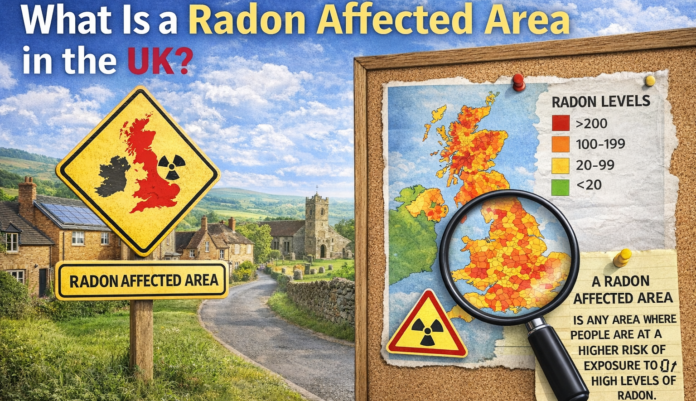
In the UK, a radon Affected Area is not a label that says a particular house has high radon. It is a way of identifying areas where there is a meaningful enough chance of elevated indoor radon that testing is advised. In plain English, it is a risk-based map category, not a diagnosis for an individual property. That distinction matters a lot, because one of the biggest mistakes people make is confusing area risk with an actual test result.
Understanding what a radon Affected Area means can help you make better decisions about testing, buying a house, planning renovations, and interpreting online radon maps. It can also save you from false confidence. A home outside an Affected Area is generally lower risk, but that is not the same thing as a guarantee. A home inside an Affected Area is worth checking, but that does not mean it will automatically test high. The real value of the term is that it tells you when radon testing should move higher on your list.
Table of Contents
- Quick Answer
- What a Radon Affected Area Actually Means
- Why It Does Not Mean Your Home Definitely Has High Radon
- How Radon Affected Areas Are Identified
- Free Maps vs Address Searches
- What It Means If You Live in One
- What If Your Home Is Not in a Radon Affected Area?
- Why Basements and Cellars Need Extra Attention
- Why Radon Affected Areas Matter in House Sales
- Why They Matter for New-Build Homes and Extensions
- Common Misunderstandings
- Final Thoughts
- Sources
Quick Answer
In the UK, a radon Affected Area is an area where there is at least a 1% chance that a home will have a radon level at or above the Action Level of 200 Bq/m³. That is the official threshold used to define an Affected Area. It does not mean every home in that area has high radon. It means the area has enough radon potential that testing is recommended.
The practical takeaway is simple. If your property is in a radon Affected Area, UK Radon recommends testing. If it is not in a radon Affected Area, there is generally no formal advice to test, because the chance of a high level is less than 1%. But even then, the only way to know the actual radon level in a specific building is to measure it.
What a Radon Affected Area Actually Means
The clearest way to understand the term is to think of it as a probability category. According to the current Great Britain radon potential dataset, UKHSA defines radon Affected Areas as places where there is a 1% chance or more that a house will have a radon concentration at or above the Action Level of 200 Bq/m³.
That definition is more precise than many homeowners expect. It does not say “high-radon counties” or “dangerous districts.” It says there is at least a 1 in 100 chance that a home in that mapped area may be at or above the level where UKHSA recommends taking action. Once you understand that, the term makes much more sense. It is about identifying where testing is sensible, not about declaring that every home there has a problem.
The Action Level in UK homes is 200 Bq/m³. That is the point where UKHSA recommends reducing radon levels. So when an area is classed as “affected,” it means that based on available evidence, the probability of homes exceeding that benchmark is high enough to justify formal attention.
Why It Does Not Mean Your Home Definitely Has High Radon
This is the most important distinction in the whole topic. A radon Affected Area is an area-based risk flag. It is not an actual radon result for your home. UK Radon says this very plainly in its address search guidance. A radon address report tells you the risk of the chosen address having a high radon level, not the level of radon at that address.
That means two nearby homes can behave very differently. One might test low and the other might test high, even if both sit in the same mapped zone. Construction style, floor type, the condition of the building, ventilation, whether there is a basement, and the exact connection to the ground can all affect indoor radon. Radon mapping gets you to the right question, but it does not replace measurement.
This is why UK Radon says the only way to know whether a building has a high level is to have it tested. The map tells you whether you should care enough to test. The test tells you what is actually happening in your home.
How Radon Affected Areas Are Identified
Radon Affected Areas are not guessed at randomly. UKHSA and the British Geological Survey work together to identify where elevated radon is more likely. The UKHSA announcement on the updated map for Great Britain explains that the mapping combines the latest geological mapping with one of the largest databases of in-home measurements ever compiled.
The logic behind that is straightforward. Radon comes from the ground, so geology matters. Some rocks and soils produce more radon than others, and some ground conditions make it easier for radon to move into buildings. But geology alone is not enough. The maps are also informed by actual indoor measurements, which helps turn raw geology into something much more useful for real buildings.
The HSE’s radon guidance puts it simply: the map was created by combining the results of measurements in houses with maps of the underlying geology. In other words, radon Affected Areas are evidence-based, not just theoretical.
Free Maps vs Address Searches
One part of the UK system that often confuses homeowners is that there is more than one way to look up radon risk. There are free maps, and there are also definitive address searches. These are not the same thing.
The free maps on UK Radon’s map pages are useful for getting a broad overview. They show where high levels are more likely and use colour shading to represent different levels of probability. UK Radon explains that in the white areas the chance is less than one home in a hundred, while in the darkest areas the chance is greater than one in three. That is helpful for general awareness, but it is still only a map view.
For a more precise answer, UK Radon offers a paid individual address search. UK Radon’s search guidance explains that these definitive searches use the full radon dataset of 25 metre by 25 metre squares. That is much more precise than just looking at a broad atlas or a free overview map.
This distinction matters because a free map may show the worst-case radon potential for a wider grid area, while an individual address search is designed to estimate the probability for the actual address. If you are just learning about radon, the free map is a good starting point. If you are buying a home, dealing with solicitors, or trying to answer the question properly for a specific property, the address search is the stronger tool.
What It Means If You Live in One
If your home is in a radon Affected Area, the basic implication is simple: test the property. UK Radon’s main homeowner guidance says that if you live or work in a radon Affected Area, a radon test is recommended.
That recommendation exists because area status alone is not enough. Affected Areas tell you the risk is meaningful, but only a test tells you whether your particular home is above or below the Action Level. In practice, this means the best response to learning your home is in an Affected Area is not panic. It is measurement.
The normal domestic measurement in the UK is a three-month test using two detectors, usually placed in the living area and an occupied bedroom. That result is used to estimate the home’s annual average radon concentration and decide whether any action is needed.
What If Your Home Is Not in a Radon Affected Area?
If your home is not in a radon Affected Area, that is generally reassuring, but it is not the same thing as a guarantee of zero radon risk. UK Radon’s guidance for buying or selling property says that if a property is not in a radon Affected Area, there is no formal advice to test, and this means there is less than a 1% chance of having a high level of radon in that area.
That wording is important. “Less than 1% chance” is not the same as “impossible.” It simply means the area does not meet the threshold that triggers formal testing advice. Some homeowners outside Affected Areas still choose to test for peace of mind, especially if the home has unusual ground contact, known local geology concerns, or a room below ground level.
So if your property is outside an Affected Area, the reasonable conclusion is usually “lower concern,” not “radon can be ignored forever.”
Why Basements and Cellars Need Extra Attention
One of the most useful homeowner details in UK guidance is that below-ground rooms deserve special attention. UK Radon’s address search guidance says that if any occupied room is below ground, a radon test is recommended regardless of the radon Affected Area status, because basement and cellar areas are considered to be at additional risk from high radon levels.
This is important because many homeowners assume the map is the whole story. It is not. A house outside a mapped Affected Area may still have a basement or cellar that behaves differently from the rest of the property. Because those spaces sit closer to the ground source and are often less ventilated, they can present a higher risk.
So if you use a basement as a bedroom, office, study, or any other occupied room, do not let a low-risk postcode lull you into skipping the question entirely. The UK guidance specifically calls out below-ground rooms for a reason.
Why Radon Affected Areas Matter in House Sales
Radon Affected Areas matter quite a bit during property transactions because radon is a standard issue in conveyancing. UK Radon’s homeowner information explains that one of the key questions in a property sale is whether the property is in a radon Affected Area, and its address search report is designed to answer one of the standard legal enquiries used in England and Wales.
If a property is in a radon Affected Area and has not been tested, UK Radon’s house sale guidance recommends that it be tested. If there is not enough time to complete the normal three-month measurement before the sale finishes, solicitors may use a retention arrangement to account for possible remediation costs after move-in.
This is one of the reasons the phrase matters beyond simple homeowner curiosity. It can directly affect questions raised during a purchase, how risk is discussed between buyer and seller, and whether a radon test becomes part of the overall due diligence.
Why They Matter for New-Build Homes and Extensions
Radon Affected Areas are also important in construction and renovation. UK Radon’s building regulations guidance says that when new buildings are constructed in high radon areas, or when extensions are made to existing buildings in those areas, protective measures against radon may be required.
The same page explains that depending on the probability of buildings having high radon levels, the regulations may require no protective measures, basic protective measures, or full protective measures. So an Affected Area is not just a public-information label. It can also influence how a building is designed or upgraded.
UK Radon’s new-build guidance adds that homes in radon Affected Areas may be built with either basic or full radon protection depending on the level of radon potential. It also says homeowners should still do a three-month radon test during the first year of occupation, because even a new home with protective measures is not guaranteed to be below the Action Level.
Common Misunderstandings
The first common misunderstanding is thinking that a radon Affected Area means your house definitely has high radon. It does not. It means your area has enough probability of elevated radon that testing is recommended.
The second misunderstanding is thinking that if your property is not in an Affected Area, radon cannot be a problem. Again, that is not quite right. It means the area has less than a 1% chance of homes being above the Action Level, not that every individual building is automatically safe under all conditions.
The third misunderstanding is treating the free map as though it gives the final answer for a specific address. It does not. The free map is useful for broad awareness, while the definitive search is more precise for individual addresses.
The final misunderstanding is assuming that a radon Affected Area label tells you what to do next beyond “worry.” In reality, the next step is very practical. If your home is in an Affected Area, test it. If it tests high, look at remediation. If it does not, keep the report with your property documents.
Final Thoughts
A radon Affected Area in the UK is best understood as a risk category, not a verdict on your house. It means there is enough probability of homes being at or above the 200 Bq/m³ Action Level that official guidance says testing is worth doing. That is all, but it is also important.
For homeowners, this makes the term much less mysterious. It is not a red sticker saying your home is dangerous. It is a signal that the area has enough radon potential to justify checking properly. If you live in one, the sensible response is to test. If you do not, you are generally in a lower-risk category, but special cases such as basements can still deserve attention.
In the end, radon Affected Areas are useful because they help answer a simple question: should this property be checked more carefully? The map helps you know when to ask. The test is what gives you the real answer.
Sources
- UK Radon: Everything You Need to Know About Radon
- UK Radon: Measuring Radon
- UK Radon: Radon Action Level and Target Level
- UK Radon: UK Maps of Radon
- UK Radon: Radon Searches
- UK Radon: Order a Radon Address Search
- UK Radon: Buying or Selling in a Radon Affected Area
- UK Radon: Radon and House Sales
- UK Radon: Radon and Building Regulations
- GOV.UK: UKHSA and BGS Publish Updated Radon Map for Great Britain
- HSE: Radon in the Workplace
- Data.gov.uk: Radon Potential for Great Britain Version 3