UK Radon Levels: When Should You Take Action?
Radon is one of those home health issues that is easy to ignore because you cannot see it, smell it, or taste it. But in the UK, radon is taken seriously for a reason. It is a radioactive gas that comes from the ground, can build up indoors, and increases the risk of lung cancer over time. The risk is especially important for smokers and ex-smokers, which is why UK guidance does not just focus on whether radon is present. It focuses on when the level is high enough that action is worth taking.
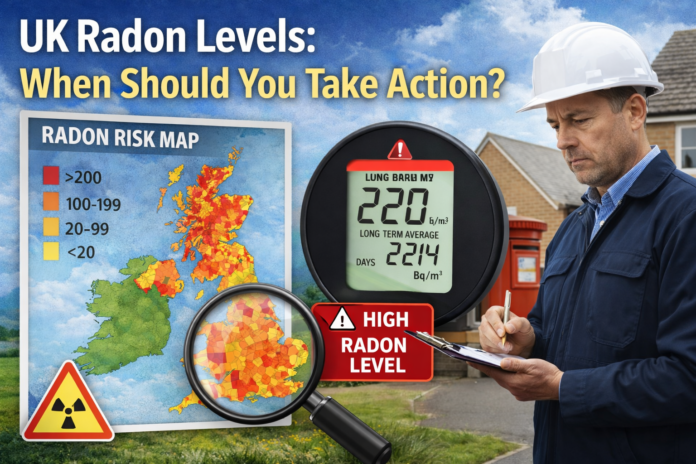
If you are trying to understand what a radon test result means in practical terms, the short answer is this: in the UK, 200 Bq/m³ is the Action Level for homes, and 100 Bq/m³ is the Target Level. That does not mean everything below 200 is automatically fine and everything above 200 is a crisis. It means 200 Bq/m³ is the point where UKHSA formally recommends reducing radon, while 100 Bq/m³ is the level remediation work ideally aims to get you below. If your result falls between 100 and 200 Bq/m³, you should still think carefully about taking action, particularly if anyone in the home smokes or used to smoke.
Table of Contents
- Quick Answer
- What UK Radon Levels Actually Mean
- The UK Action Level and Target Level
- When Should You Take Action?
- Why a Single Short Reading Is Not Enough
- When You Should Test Your Home in the UK
- What to Do If Your Result Is High
- Why Smoking Changes the Conversation
- Common Mistakes Homeowners Make
- Final Thoughts
- Sources
Quick Answer
In the UK, you should take radon seriously as soon as you know your long-term result. If your home tests at 200 Bq/m³ or more, UK guidance says you should reduce the level. If your result is between 100 and 200 Bq/m³, action should still be considered, especially if a smoker or ex-smoker lives in the property. If your result is below 100 Bq/m³, that is generally where you want to be, although you may still choose to improve the property if you are already carrying out building work or want extra peace of mind.
The most important point is that you should not judge radon by guesswork, postcode reputation, or a quick spot reading. In the UK, the standard domestic approach is a three-month test using two detectors, usually placed in the living area and an occupied bedroom. That long-term average is what matters when deciding whether you need to act.
What UK Radon Levels Actually Mean
Radon is measured in becquerels per cubic metre, written as Bq/m³. That number tells you how much radioactive decay is happening in a cubic metre of air. For homeowners, the science matters less than the practical meaning. The higher the number, the greater the long-term exposure, and the greater the potential health risk. UKHSA explains that radon risk rises with both concentration and duration of exposure, so a modestly elevated level over many years matters more than a brief spike on a temporary reading.
That is why UK radon advice is built around annual average exposure rather than one-off measurements. Radon levels can fluctuate from day to day and from room to room. Weather, ventilation, building use, and how the home connects to the ground can all affect readings. A result only becomes useful when it reflects the way the home is actually lived in over time. That is also why UK Radon home tests are designed to estimate a yearly average, not just capture what happened on a particular afternoon.
The UK Action Level and Target Level
The two key numbers in UK homeowner guidance are the Action Level and the Target Level. The Action Level is 200 Bq/m³. If your home is above that, UKHSA recommends reducing the radon level. This recommendation has been endorsed by the government and is the main line homeowners should remember.
The Target Level is 100 Bq/m³. This is not the same thing as a legal limit for homeowners. Instead, it is the ideal outcome for remediation work in existing homes and for radon protective measures in new buildings. In simple terms, if you are paying to fix a radon problem, the goal is not merely to dip below 200 Bq/m³. The goal is ideally to get below 100 Bq/m³.
This two-level system is useful because it reflects real life. Some homes are clearly low. Some are clearly high. But many sit in the middle ground. A result of 120, 140, or 180 Bq/m³ is not above the formal Action Level, yet it is still above the level the UK considers preferable. That is why UK guidance says levels between 100 and 200 Bq/m³ should not be dismissed automatically.
When Should You Take Action?
The easiest way to think about this is in bands rather than as one single cutoff.
Below 100 Bq/m³
If your home is below 100 Bq/m³, that is generally a reassuring result. It means you are below both the Target Level and the Action Level, which is where most homeowners want to be. In most cases, there is no immediate reason to pay for remediation. You may still decide to improve ventilation or incorporate radon-resistant details if you are renovating anyway, but from a UK guidance perspective, this is usually a low-concern result.
100 to 200 Bq/m³
This is the range many homeowners misunderstand. Because it is below the Action Level, people often assume it means, “do nothing.” That is too simplistic. UKHSA states that if your result is between the Target Level and the Action Level, action to reduce the level should be considered, especially if there is a smoker or ex-smoker in the home. The dedicated UK Radon decision guidance also points people in this band toward considering reduction rather than simply forgetting about it.
In practical terms, a result in this range is often the point where you should stop asking, “Is this an emergency?” and start asking, “Would it be sensible to improve this now?” If mitigation is straightforward, if you are already doing building work, or if someone in the home has an elevated risk profile, there is a good case for action.
200 to 500 Bq/m³
Once your home is at or above 200 Bq/m³, the answer becomes much clearer. This is the UK Action Level, and it is the point at which the official recommendation is to reduce radon. At that stage, you are not simply in a grey area. You have crossed the threshold where remediation is advised. Homeowners should move from awareness to action and begin looking at practical reduction methods such as a radon sump, under-floor ventilation improvements, or other building-specific fixes described on the UK Radon reduction guidance.
Above 500 Bq/m³
A result well above the Action Level should prompt faster movement. UK Radon guidance separates results below 500 Bq/m³ from results above 500 Bq/m³ in its decision tools, which reflects the fact that a very high reading deserves more urgency. It does not mean you need to panic, but it does mean this is not something to leave on a to-do list for next year. The level is substantially above the threshold for action, and you should start arranging remediation and follow-up testing.
Why a Single Short Reading Is Not Enough
One of the most common mistakes with radon is treating it like temperature or carbon monoxide, where a quick reading tells you most of what you need to know. Radon does not work like that. UK guidance is built around long-term measurement because radon levels rise and fall naturally. The same room can produce different readings on different days, and even within the same season the pattern can shift depending on weather and ventilation.
That is why UKHSA recommends a three-month test. In a standard domestic test, two detectors are used, usually one in the living area and one in an occupied bedroom. The reason is straightforward. Those are the rooms where people typically spend the most time, so they give a more realistic estimate of exposure. The result is then used to estimate the home’s annual average radon concentration, which is what the UK Action Level refers to.
A quick test or digital monitor can still be useful for curiosity, screening, or post-mitigation tracking, but it should not replace a proper long-term interpretation when you are deciding whether to spend money on remediation or whether a home falls above or below UK guidance levels.
When You Should Test Your Home in the UK
Even before you get a number, there are some situations where testing makes particular sense in the UK. The first is if your property is in a radon Affected Area. UK Radon offers an address-based search that tells you the estimated probability that a property is above the Action Level. It is important to understand what that means. The report tells you the risk of a high level at that address. It does not tell you the actual radon level in your home. The only way to know that is to measure.
If your home is not in an Affected Area, UK guidance says there is no formal advice to test, and that generally means the area has less than a 1% chance of homes being above the Action Level. Even so, that is not the same as zero risk. If you want peace of mind, have unusual building features, or spend time in a below-ground room, testing can still be worthwhile.
Basements and cellars deserve special attention. UK Radon states that all occupied basements, meaning those used for more than about 50 hours per year, should be monitored regardless of radon potential. That is an important detail many people miss. A postcode that looks low risk above ground does not erase the fact that below-ground spaces are more vulnerable to radon entry and buildup.
Testing also matters during property transactions. If you are buying in an Affected Area and the home has not been tested, UK Radon recommends that it be tested. If there has already been a high result, you should ask whether remediation was installed and whether the property was retested afterward. A high radon result is not automatically a reason to walk away from a purchase, but it is absolutely a reason to understand the details.
New-build homes are another situation where people make bad assumptions. Some buyers think that because a home is modern, it cannot have a radon problem. That is not what UK guidance says. In radon areas, Building Regulations may require basic or full protective measures in new buildings and some extensions, but those measures do not guarantee the finished home will be below the Action Level. In fact, UK Radon recommends a three-month test during the first year of occupation for a new-build home.
What to Do If Your Result Is High
If your result is at or above 200 Bq/m³, the next step is not to panic. It is to move methodically. Start by reading the result carefully and making sure it came from a proper long-term measurement. Then look at the building type and the likely reduction options. Different homes respond to different fixes.
For homes with solid floors, a radon sump is often one of the most effective solutions. This works by drawing radon from beneath the building and venting it safely outside before it enters the living space. Homes with suspended timber floors may respond well to improving under-floor ventilation. In some cases, positive ventilation systems are used. If a newer home already has full radon protection built in, it may have a capped sump that can simply be activated if the test result comes back high.
Once remediation has been completed, test again. This part matters just as much as the original test. Radon mitigation is not something you assume worked. It is something you confirm with a follow-up measurement. UK Radon notes that in some circumstances a free re-measurement may be available after remedial work, which makes it easier to verify whether the level has actually been brought down.
It is also worth remembering that the goal is ideally to get below 100 Bq/m³, not merely to scrape under 200 Bq/m³. If your contractor or chosen mitigation approach can realistically do better, that is usually the better long-term outcome.
Why Smoking Changes the Conversation
Smoking is one of the biggest reasons homeowners should not think about radon as a simple pass-or-fail issue. UKHSA and NHS information both make the same general point: radon increases lung cancer risk, and the risk is worse for smokers. UK Radon states that the risk is higher for ex-smokers and significantly greater for current smokers, while the NHS notes that radon can damage the lungs, particularly if you smoke.
This is exactly why the 100 to 200 Bq/m³ range matters more than many people think. In a household of lifelong non-smokers, a reading in that band may lead to a calmer discussion about timing, cost, and practicality. In a household with a smoker or ex-smoker, that same result deserves a more proactive approach. The threshold has not changed, but the urgency has.
For some homeowners, the right decision is not only to reduce radon but also to use the result as a reason to tackle smoking cessation at the same time. From a risk-reduction standpoint, those two steps reinforce each other.
Common Mistakes Homeowners Make
The first common mistake is relying only on a map or postcode search. A radon risk report is useful, but it is not a measurement. It estimates the probability of a high level at that address. It does not tell you what your indoor air is doing right now. Homes close together can still test differently.
The second mistake is assuming a new home cannot have radon because it was built recently. That is not how UK guidance works. New homes in radon areas may have protective measures, but UK Radon still recommends testing in the first year of occupation because those measures are not an iron-clad guarantee.
The third mistake is ignoring basements. If a room is below ground and actually used, it deserves serious attention. UK guidance specifically highlights occupied basements as needing monitoring regardless of the general area status.
The fourth mistake is thinking that anything below 200 Bq/m³ means there is no reason to act. The existence of the 100 Bq/m³ Target Level tells you otherwise. The UK system clearly recognizes that lower-than-ideal radon levels still matter, particularly for higher-risk households.
The final mistake is failing to retest after mitigation. A radon fan, sump, or ventilation change is not the finish line. The finish line is a follow-up result that shows the level has come down to where you want it.
Final Thoughts
So when should you take action on UK radon levels? The formal answer is at 200 Bq/m³ and above. The smarter homeowner answer is a little broader. You should pay close attention as soon as your result moves above 100 Bq/m³, and you should be especially proactive if anyone in the home smokes, used to smoke, or spends time in a basement or cellar. The longer you live with an elevated level, the more the long-term risk matters.
If you have not tested yet, start there. If your address is in an Affected Area, arrange a proper measurement. If you have an occupied basement, test regardless. If you are buying a home in a radon area, ask for the evidence. And if your result is high, treat it as a fixable building problem, not a mystery. In most cases, radon can be reduced. The real mistake is not knowing where you stand.
Sources
- UK Radon: Radon Action Level and Target Level
- UK Radon: Measuring Radon
- UK Radon: Order a Radon Address Search
- UK Radon: Buying or Selling in a Radon Affected Area
- UK Radon: Radon and House Sales
- UK Radon: How to Reduce Radon Levels
- UK Radon: Radon and Building Regulations
- UK Radon: The Risks to Your Health from Radon
- GOV.UK: UKHSA and BGS Publish Updated Radon Map for Great Britain
- NHS: Lung Cancer Causes