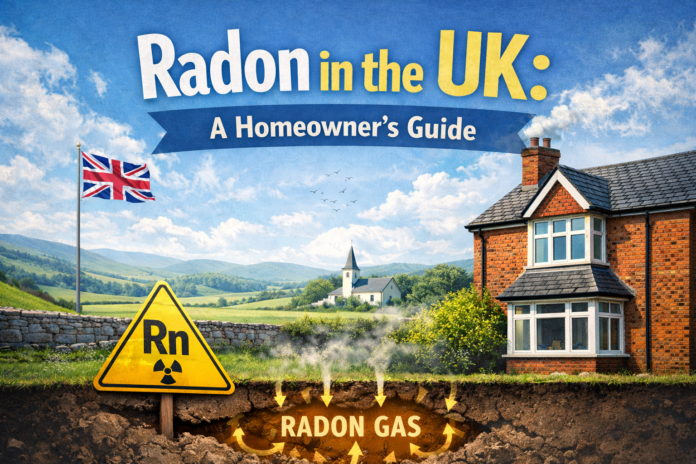
Radon in the UK: A Homeowner’s Guide
Radon is one of the stranger home hazards in the UK because most people never notice it until they deliberately go looking for it. You cannot see it, smell it, or taste it. It does not stain the walls, trip an alarm, or make a house feel different. A perfectly ordinary home can have a radon problem for years without the owner having any idea.
That is part of what makes radon so easy to ignore. The other part is that many homeowners assume it must only affect a few unusual places, perhaps deep rural cottages, old mining areas, or homes in one or two famous counties. In reality, radon is found across the UK. What changes is the chance that indoor levels will be high enough to matter.
UK radon guidance is also a little different from the American advice many people find online. In the United States, much of the public conversation revolves around EPA action levels, pCi/L measurements, and real-estate testing. In the UK, the homeowner framework is built around Bq/m³, a three-month measurement, a 200 Bq/m³ Action Level, a 100 Bq/m³ Target Level, address searches, radon maps, and building-regulation protections in higher-risk areas.
This guide brings those UK pieces together in one place. It explains what radon is, why it matters, how the UK system works, how to check whether your property may be affected, how to test properly, what the results mean, what to do if the level is high, and what homeowners should know about buying, selling, extensions, new-build homes, landlords, and basements.
Table of Contents
- What radon is and why it matters
- Why UK homeowners should care
- Where radon occurs in the UK
- How to check whether your property may be affected
- How to test your home properly in the UK
- Action Level and Target Level explained
- How to read your radon result
- What to do if your radon level is high
- Extensions, refurbishments, and new-build homes
- Buying or selling a home in a radon area
- Landlords, tenants, and buy-to-let homes
- Basements and cellars
- Common UK radon myths
- Bottom line for homeowners
- Sources
What radon is and why it matters
Radon is a naturally occurring radioactive gas formed by the decay of small amounts of uranium in rocks and soils. In the open air, radon levels are usually very low. Indoors, the gas can build up if it enters a building from the ground and has nowhere to disperse easily.
UKHSA’s UKradon information hub describes radon as a radioactive gas that comes from the rocks and soil found everywhere in the UK. The level in the air outdoors is usually low, but it can be higher inside buildings. The gas enters through cracks and gaps in floors and foundations, then accumulates depending on the ground, the building, and how it is ventilated.
That is why radon is mainly treated as an indoor air issue. It is not the fact that radon exists in the environment that matters most. It is whether it accumulates inside places where people spend years breathing the air.
The health concern is lung cancer. UKradon explains that radon produces tiny radioactive particles in the air we breathe. Radiation from these particles damages lung tissue, and over a long period that damage may cause lung cancer. The higher the level and the longer the period of exposure, the greater the risk.
Why UK homeowners should care
Homeowners sometimes assume radon is a specialist issue for scientists, regulators, or employers. But UK public-health agencies describe it in much more practical terms.
The Health and Safety Executive says breathing in radon is the second largest cause of lung cancer in the UK and results in over 1,000 fatal cancers each year. The NHS says radon can damage your lungs, particularly if you smoke. UKradon also highlights that high levels are especially concerning for smokers and ex-smokers.
That makes radon important in a way many homeowners do not expect. It is not just a building defect. It is a long-term health exposure issue.
It is also not limited to visibly old or neglected homes. New homes can have radon problems. Well-kept homes can have radon problems. Two very similar houses in the same village can have different results. That is why the UK system is built around testing rather than guesswork.
Where radon occurs in the UK
Radon occurs across the UK, but some places are more likely than others to have high indoor levels. The key phrase UKHSA uses is radon Affected Area. This does not mean every building there is dangerous. It means the probability of a building exceeding the Action Level is high enough that extra attention is justified.
The easiest official starting point is the UKradon map page. UKHSA says every building contains radon, but levels are usually low, and the chances of a higher level depend on the type of ground. Its interactive map shows where higher levels are more likely. UKHSA explains that the chance is less than one home in a hundred in the white areas and greater than one in three in the darkest areas.
That is an important point. The map is about probability, not certainty. A home in a pale area can still test high. A home in a dark area can still test low. The map tells you what is more likely, not what your individual home will definitely do.
UKHSA also says the map should not be used for basements, cellars, or underground sites because all of these should be considered as having an increased chance of high radon levels regardless of location. That is a very useful homeowner nuance, especially in older UK housing with cellars or lower-ground spaces.
If you want the most precise property-specific answer, the map is only the starting point. The better next step is an address search.
How to check whether your property may be affected
The UK system gives homeowners two main ways to check radon potential before they test the home itself.
The first is the free interactive UK radon map. This is useful for getting a broad sense of local radon potential. It is an indicative tool and is good for quick screening.
The second is the UKradon address search. UKHSA explains that this uses the full radon data set at 25 metre by 25 metre resolution and is suitable for individual homes and small workplaces. It gives a more definitive property-level result than the free map.
For most homeowners, the practical approach is simple. Use the free map first if you are just exploring. Use the address search if you want the better property-specific answer, especially if you are buying, selling, planning an extension, or deciding whether a measurement should move higher on your to-do list.
UKradon’s homeowner message is also very direct on testing. If you live or work in a radon Affected Area, UKHSA recommends arranging a radon test.
How to test your home properly in the UK
This is the part many homeowners care about most, because once the property looks like it might be in an affected area, the next question is obvious: how do you actually test it?
UKHSA’s Measuring Radon page lays out the homeowner method clearly. For a typical domestic measurement, UKHSA sends out two detectors, one for the living area and one for an occupied bedroom. The detectors are left in place for three months, then posted back for analysis.
UKHSA says the three-month period is important because radon levels vary over time and from room to room. The test is designed to determine your exposure, which is why the living area and bedroom are used. A shorter test has greater uncertainty and is more likely to lead to ambiguous or inconclusive results.
This is one of the big differences between UK homeowner practice and the more flexible short-term testing culture many people see in U.S. articles. In the UK, the homeowner benchmark is explicitly based on an annual average concentration, and the standard three-month method is meant to smooth out short-term fluctuations.
UKHSA also notes a few situations that reduce result reliability, such as change of occupier during the test period, significant building works, long vacancy during the test, or detectors being set up late. So if you are about to renovate heavily, leave the property empty, or move in and out during the measurement period, it is better to plan around that if possible.
Another important basement-related detail appears on the same page: all occupied basements, meaning those used for more than 50 hours per year, should be monitored regardless of radon potential. That matters because a basement can behave differently from the mapped risk for the surrounding area.
If you are not using UKHSA directly, UKHSA also advises homeowners to use a validated laboratory. That is the safest route if you want a result that lines up with the UKradon framework.
Action Level and Target Level explained
The UK system uses two numbers, not just one. This is one of the most useful things to understand because it helps explain why “below the Action Level” does not always mean “stop thinking about radon altogether.”
According to UKHSA’s Action Level and Target Level page, the Action Level is 200 Bq/m³. UKHSA recommends that radon levels should be reduced in homes where the annual average is more than 200 Bq/m³, and that recommendation is endorsed by the Government.
The Target Level is 100 Bq/m³. UKHSA says this is the ideal outcome for remedial works in existing buildings and protective measures in new buildings. It also says that if the result lies between the Target and Action Levels, action to reduce the level should be considered, especially if there is a smoker or ex-smoker in the home.
This dual-level system is helpful because it gives homeowners two ways to think about their result.
If the home is above 200 Bq/m³, UK guidance is very clear that you should reduce it.
If the home is between 100 and 200 Bq/m³, you are below the formal Action Level, but not at the ideal outcome. That is why UKradon says reduction should still be considered in that range, particularly if smoking is part of the picture.
That makes the UK framework more nuanced than a simple pass-fail threshold.
How to read your radon result
Once the result arrives, the next question is what the number actually means.
Below 100 Bq/m³
This is below both the Target Level and the Action Level. For most homeowners, this is reassuring. It does not mean radon has disappeared entirely, but it does mean the home is already under the UK’s preferred target outcome.
100 to 199 Bq/m³
This is below the Action Level but above the Target Level. In this range, UKHSA says action should be considered, especially if there is a smoker or ex-smoker in the home. Many homeowners in this band will not rush into remediation, but it is not a range to dismiss casually either.
200 Bq/m³ and above
This is at or above the UK Action Level. In practical terms, this is where the result moves from “consider reduction” to “you should reduce it.”
Very high results
UKHSA’s radon reduction page notes that if levels exceed 1000 Bq/m³, householders may wish to contact UKHSA for advice. That does not mean you should wait passively at lower levels. It simply shows that very high readings may justify especially direct advice.
UKHSA’s How to reduce radon levels page is the main official homeowner page for what happens after a high result.
What to do if your radon level is high
If your home is at or above the Action Level, the next step is not panic. It is remediation.
UKradon says the aim of remedial work is to reduce radon levels as low as possible. It also makes an important point that many homeowners need to hear: simple actions such as sealing around loft hatches, sealing large openings in floors, or adding extra ventilation do not reliably reduce radon levels on their own. They may help when combined with more effective measures, but they are not usually the whole answer.
In other words, radon remediation is usually more technical than “caulk a few cracks and hope for the best.”
The right remedy depends on the type of floor and the construction of the building. UKHSA’s radon pages and BRE guidance are set up around that principle. In many homes, the solution involves pressure control beneath the building or targeted ventilation strategies rather than superficial sealing alone.
UKradon also offers a decision tool to help householders think through whether they need to reduce the level and how. That is a good next click for homeowners who already have a result.
If you remediate, UKHSA notes that a free remeasurement may sometimes be available to check the work, depending on the original measurement provider and circumstances. Either way, the key point is that you should retest after remedial work so you know whether the fix actually worked.
Extensions, refurbishments, and new-build homes
Radon matters not just when you live in a house, but also when you build, extend, or substantially alter one.
UKradon’s Building Regulations page says that when extensions are made to existing buildings in high-radon areas, or when new buildings are constructed in these areas, the Building Regulations require protective measures against radon entering the building.
UKHSA says the regulations may require one of three levels of response depending on the probability of buildings having high radon levels:
no protective measures,
basic protective measures,
or full protective measures.
That matters because radon prevention is usually easier and cheaper during construction than after the home is finished and occupied.
New-build buyers should also avoid a very common assumption: that a new home in a radon area is automatically “solved” forever just because protective measures were included. UKradon’s house sales page says that when you move into a new-build home in a radon Affected Area, UKHSA recommends doing a 3-month radon test during the first year of occupation because it is not guaranteed that the radon level will be below the Action Level.
That is a very important UK homeowner detail. Even where full protection has been built in, the sump is often capped when the house is built and only activated later if testing shows it is needed. In other words, radon-resistant construction reduces risk, but it does not remove the value of testing after occupation.
Buying or selling a home in a radon area
Radon often enters the conversation during conveyancing, and UKradon has a dedicated house sales page for this reason.
UKHSA says anyone can find out whether a property is in a radon Affected Area by completing an online search. If you are buying in an affected area, UKradon says you should ask whether the current owners have completed a three-month radon test and ask for a copy of the report if they have.
If they have not tested, UKradon says buyers may wish to discuss a retention with their solicitor and test once they move in. A retention is essentially money held back from the sale to help cover remedial costs if the measurement comes back high.
For sellers, the same page says that if you have previously tested the property, you should locate the result. If you have not tested, the new owner will usually be advised to do so when they move in, and you should be prepared to be asked about retention.
This is one area where UK radon practice is very practical and property-focused. The system does not assume every property in an affected area will already have a radon result on file, but it does build radon into the decision-making process for buyers and sellers.
Landlords, tenants, and buy-to-let homes
Radon is not only a question for owner-occupiers. It matters for landlords too.
UKradon’s landlord and tenant guidance says radon is identified as a potential hazard in dwellings under the Housing Act 2004. The Housing Health and Safety Rating System uses the measured annual average radon level to assess risk, and if the risk exceeds certain trigger points, the local housing authority is obliged to act.
That is an important point for buy-to-let owners. In a rental context, radon is not just an interesting environmental fact. It can become part of housing safety enforcement and tenant welfare.
UKradon recommends measurements for properties in radon Affected Areas and says action to reduce radon should be taken if the annual average concentration is at or above the Action Level of 200 Bq/m³.
For ordinary homeowners this matters in two ways. First, if you are a landlord, you should take it seriously as part of your duty of care. Second, if you are a tenant and suspect the issue has been ignored, there is a formal safety framework behind the topic.
Basements and cellars
Basements and cellars deserve special mention because they do not fit neatly into the map-and-average approach many people use for ordinary above-ground rooms.
UKHSA says that all occupied basements should be monitored regardless of the mapped radon potential. Its map page also says the radon map should not be used for basements, cellars, or underground sites because all such spaces should be considered as having an increased chance of high radon levels, wherever they are located.
This makes intuitive sense. Basements and cellars are closer to the ground, often less ventilated, and sometimes structurally more vulnerable to soil-gas ingress. In older UK homes with cellars or lower-ground rooms, this can become one of the most important parts of the radon story.
For homeowners, the practical message is simple. If you have a cellar, basement office, lower-ground flat, or any basement space used regularly, do not rely on a broad map colour alone. Treat the space as worth direct radon consideration.
Common UK radon myths
“If I am not in a famous radon county, I do not need to think about it.”
Not true. Radon occurs throughout the UK. Maps show probability, not certainty, and any individual home can differ from nearby homes.
“My new-build home will already be protected, so I am done.”
Not necessarily. UKradon says new-build owners in affected areas should still do a three-month test in the first year because the level is not guaranteed to be below the Action Level.
“Below 200 Bq/m³ means radon is irrelevant.”
Too simplistic. The UK also uses a Target Level of 100 Bq/m³, and UKHSA says reduction should be considered between 100 and 200, especially if a smoker or ex-smoker lives there.
“I can fix high radon just by sealing cracks.”
Usually not. UKHSA says sealing and extra ventilation on their own do not generally reduce levels enough by themselves.
“If the map looks low-risk, the basement does not matter.”
Wrong. UKHSA says occupied basements should be monitored regardless of mapped radon potential.
“Radon is mainly a workplace issue or a mining issue.”
No. UK guidance is very clear that homes matter too, and that the health risk comes from long-term breathing exposure indoors.
Bottom line for homeowners
Radon in the UK is a practical homeowner issue, not just a technical one.
The UK system is fairly straightforward once you understand its structure. Start by checking the radon potential of your property using the UKradon map or address search. If the property is in a radon Affected Area, or if you have an occupied basement, arrange a proper measurement. Use the standard UK three-month approach with two detectors, one in a bedroom and one in a living area. Compare the result against the Action Level of 200 Bq/m³ and the Target Level of 100 Bq/m³. If the result is high, reduce it. If it is between target and action, consider reduction, especially if someone in the home smokes or used to smoke.
And if you are buying, selling, building, extending, or renting out a home, radon is something to factor into those decisions as well. UK guidance already treats it as part of the wider housing and public-health picture.
The biggest mistake is not necessarily having a high radon level. The biggest mistake is assuming you could not possibly have one and never checking.
Sources
- UKradon: Everything You Need to Know About Radon
- UKradon: Radon Action Level and Target Level
- UKradon: Measuring Radon
- UKradon: UK Maps of Radon
- UKradon: Radon Searches
- UKradon: How to Reduce Radon Levels
- UKradon: Radon and Building Regulations
- UKradon: Radon and House Sales
- UKradon: Landlord’s Responsibilities with Regard to Radon
- HSE: Radon in the Workplace
- NHS: Lung Cancer Causes
- GOV.UK: UK National Radon Action Plan
- GOV.UK: Radon Collection
- GOV.UK: UKHSA and BGS Publish Updated Radon Map for Great Britain