Radon Levels in Canadian Homes: What Counts as High?
If you test your home for radon in Canada, the result usually comes back as a number in Bq/m3, or becquerels per cubic metre. That is the number most Canadian homeowners are looking for, but it is also where a lot of confusion starts.
Is 80 Bq/m3 low? Is 150 Bq/m3 a problem? Is 200 Bq/m3 dangerous? Is 400 Bq/m3 an emergency? And what exactly does Health Canada mean when it says a home is “high” in radon?
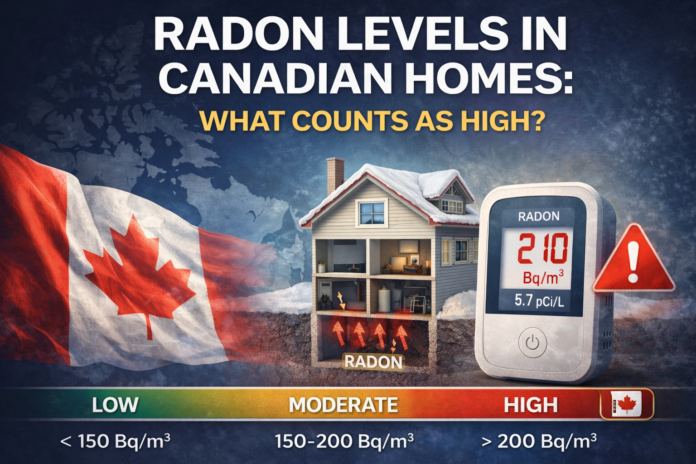
The short answer is this: in Canada, a radon level counts as high when it is above the Canadian guideline of 200 Bq/m3. That is the official national benchmark. If your long-term radon result is above 200 Bq/m3, Health Canada recommends taking corrective action to reduce it.
But that does not mean everything below 200 is harmless, and it does not mean every result above 200 should be interpreted in exactly the same way. Radon risk works on a spectrum. The official Canadian action point is 200 Bq/m3, but homeowners benefit from understanding the ranges around that number too.
This guide explains what “high” means in Canada, how Health Canada wants homeowners to interpret their results, what levels are clearly above guideline, and where people often get tripped up when reading a radon test.
Table of Contents
- The short answer
- What counts as high under the official Canadian guideline?
- Why 200 Bq/m3 is not a magic safety line
- How to think about radon ranges in a practical way
- Below 100 Bq/m3
- 100 to 199 Bq/m3
- 200 Bq/m3 and above
- When a result is much higher than the guideline
- What this looks like in pCi/L
- How common are high radon levels in Canada?
- What to do if your result is high
- Common mistakes homeowners make
- Bottom line for homeowners
- Sources
The short answer
If you want the clearest possible answer, here it is: Health Canada considers a home to have a high radon level when the long-term result is over 200 Bq/m3.
That number is not just a suggestion floating around the internet. It is the official Canadian radon guideline. Health Canada says homeowners should take corrective action if the average annual radon level exceeds 200 Bq/m3 in the normal occupancy area of a building.
So if you are asking, “What counts as high in Canada?” the official answer is straightforward: above 200 Bq/m3.
What counts as high under the official Canadian guideline?
Health Canada’s official radon guideline page says the Canadian guideline is 200 Bq/m3 and recommends that:
you take corrective action if the average annual radon level exceeds 200 Bq/m3 in the normal occupancy area of a building,
you take corrective action sooner, the higher the radon level is,
and the corrective action should reduce the radon concentration as much as is practicable.
That is the official foundation. It means the word high has a real Canadian public-health meaning. It does not just mean “higher than average” or “higher than I expected.” It means the home is above the level where Canada says action is recommended.
Health Canada’s own action guides reinforce this same idea even more directly. For example, its municipal action guide describes “high radon levels” as levels over the Canadian radon guideline of 200 Bq/m3.
So from an official Canadian standpoint, the answer is not ambiguous. Over 200 Bq/m3 counts as high.
Why 200 Bq/m3 is not a magic safety line
Even though 200 Bq/m3 is the official Canadian guideline, it should not be misunderstood as a hard line between safe and dangerous.
Health Canada is very clear on this point. It says that while the health risk below the Canadian guideline is small, there is no level that is considered risk free. That means a result below 200 is better than a result above 200, but it does not mean radon has stopped mattering.
This is one of the most important ideas for homeowners to understand. A result of 180 Bq/m3 is below the official action level, but it is still a higher exposure than 40 Bq/m3. The guideline is a practical public-health threshold for action. It is not a guarantee that lower levels are harmless.
That is why Health Canada also says that any action that reduces radon exposure reduces health risk. In other words, lower is still better, even below the guideline.
How to think about radon ranges in a practical way
While the official Canadian answer is simple, homeowners often benefit from a more practical way of thinking about their result.
The best way to do that is to use two layers at once.
The first layer is the official one: over 200 Bq/m3 is high and should be fixed.
The second layer is the practical one: some below-guideline results are still meaningfully elevated, and some above-guideline results are much more urgent than others.
So while Canada does not publish a long public ranking system with labels like low, medium, high, and very high, homeowners can still think about radon in a sensible range-based way without losing sight of the official guideline.
Below 100 Bq/m3
For most Canadian homeowners, a long-term result below 100 Bq/m3 would generally be seen as relatively low by Canadian residential standards.
That does not mean it is risk free. Health Canada says no radon level is considered risk free. But a result well below the national guideline is obviously better than one approaching or exceeding it.
If your home tests below 100 Bq/m3, the practical next step is usually simple: keep the result on file, re-test after major renovations or ventilation changes, and test again if the lowest lived-in level changes. For example, if you later finish a basement or start using a lower level as an office or bedroom, a new test makes sense.
A below-100 result is the kind of reading most homeowners would view as reassuring, even though it does not eliminate radon entirely.
100 to 199 Bq/m3
This is the range that often causes the most homeowner confusion.
A result in this range is below the official Canadian guideline, so it does not count as high in the formal Health Canada sense. But it also is not the same thing as a very low result.
If your home is in this range, the best way to think about it is as elevated but below the current Canadian action threshold. Health Canada would not tell you that the home is officially above guideline, but it also would not tell you the level is risk free.
This range matters even more if someone in the home smokes, if the lower level is used heavily, or if you expect to live in the home for a long time. It is also the range where homeowners sometimes choose to reduce exposure anyway, especially if mitigation is easy, if the home is already being renovated, or if they simply want a larger margin of comfort.
So 100 to 199 Bq/m3 is not “high” under the official Canadian definition, but it is also not a range that should be dismissed as meaningless.
200 Bq/m3 and above
This is the key Canadian threshold.
Once a long-term result goes above 200 Bq/m3, the home is above the Canadian guideline and counts as having a high radon level in the way Health Canada uses the term.
At that point, the question is no longer “Should I worry about this?” It becomes “When and how should I fix this?”
Health Canada’s current Reduction Guide for Canadians says that if the radon level is above 200 Bq/m3, homeowners should take action to lower it within 1 year. It also says the higher the concentration, the sooner action should be taken to reduce levels to as low as practically possible.
So in the Canadian system, 200 Bq/m3 is the point where “elevated” becomes “officially high and should be addressed.”
When a result is much higher than the guideline
Not every above-guideline result carries the same urgency.
Health Canada’s current guidance keeps the message simple: above 200 Bq/m3 should be fixed within 1 year, and the higher the level, the sooner action should be taken. That means a result of 220 Bq/m3 and a result of 1200 Bq/m3 are both officially high, but they are not equally concerning in practical terms.
This is where homeowner judgment and professional advice matter. If your result is only modestly above the guideline, you should still plan mitigation, but you are not looking at the same exposure burden as someone whose reading is several times over the action level.
In plain English, the farther above 200 Bq/m3 the reading goes, the more clearly it falls into the category of “do not delay this.”
That does not mean panic. Radon is a long-term exposure issue, not a house-fire emergency. But it does mean you should move from awareness to action.
What this looks like in pCi/L
Canadian homeowners often run into U.S. articles or radon monitors that report results in pCi/L instead of Bq/m3. That can make a Canadian result harder to interpret at first glance.
Health Canada’s technical guidance notes that 37 Bq/m3 is equal to 1 pCi/L. That means the Canadian guideline of 200 Bq/m3 is equal to about 5.4 pCi/L.
So if you see a U.S.-style reading in pCi/L, here is the rough Canadian comparison:
5.4 pCi/L = 200 Bq/m3
That is helpful because many American articles focus on the EPA action level of 4.0 pCi/L, which is about 148 Bq/m3. That is lower than Canada’s formal guideline, but the important point for a Canadian homeowner is to interpret your result first through Health Canada’s own guidance.
How common are high radon levels in Canada?
Health Canada estimates that about 7% of homes in Canada have a high radon level, meaning a level above the national guideline. That is a useful number because it helps homeowners understand that high radon is not rare, but it is also not something every home will have.
At the same time, that national figure can be misleading if you read it too casually. Radon varies a lot by region, local geology, and individual building characteristics. Health Canada’s guidance also says the percentage varies significantly across Canada.
So a 7% national estimate does not mean your area has a 7% chance or that your neighbour’s result predicts yours. It simply means high radon is common enough that every Canadian homeowner should take testing seriously.
The same national guidance also says there are no radon-free areas in Canada. That is why the only way to know what counts as high in your home is to test it properly.
What to do if your result is high
If your long-term radon result is above 200 Bq/m3, the next step is not more guessing. It is planning mitigation.
Health Canada says homes above the guideline should be reduced within 1 year, and sooner if levels are higher. It also says mitigation should reduce the radon concentration as much as is practicable.
For most homes, that means contacting a C-NRPP-certified radon professional and getting an assessment of the best mitigation approach. In many homes, that will involve some form of active soil depressurization or sub-slab depressurization.
Health Canada’s guidance also notes that radon in most homes can be reduced very effectively. So a high result is serious, but it is also fixable.
If your home tests high, the most sensible sequence is:
keep your test result and dates,
contact a certified professional,
plan mitigation,
and re-test after the work is complete to confirm that the level has been reduced.
Common mistakes homeowners make
Thinking 199 Bq/m3 is “safe” and 201 Bq/m3 is “dangerous.”
That is too simplistic. The guideline is an action threshold, not a magic safety line.
Assuming anything below 200 can be ignored forever.
Also too simplistic. Health Canada says no level is risk free, and re-testing still makes sense after major changes to the home.
Thinking “high” means only extreme numbers.
In Canada, a result above 200 Bq/m3 already counts as high in the official sense.
Using a short-term test to decide whether the home counts as high.
Health Canada’s homeowner system is built around long-term testing, generally at least 3 months, because the guideline refers to average annual exposure.
Comparing Canadian and U.S. numbers without converting units.
A result in Bq/m3 and a result in pCi/L may describe the same exposure, but only after conversion.
Assuming the national average predicts the home.
It does not. Radon can vary dramatically from one house to another, even on the same street.
Bottom line for homeowners
If you want the clearest Canadian answer to the question “What counts as high?”, it is this: over 200 Bq/m3 counts as high in a Canadian home.
That is the official Health Canada guideline. A long-term result above that level means corrective action is recommended.
But the smarter homeowner interpretation is slightly more nuanced than that. A result below 200 is better, but not risk free. A result close to 200 is not the same as a very low result. And a result far above 200 should be treated with greater urgency than a result just over the line.
So the practical rule is simple. Test your home properly, use a long-term Canadian-style measurement, compare the result to the 200 Bq/m3 guideline, and if the result is above it, plan to reduce it. That is what “high” really means in the Canadian radon system.