
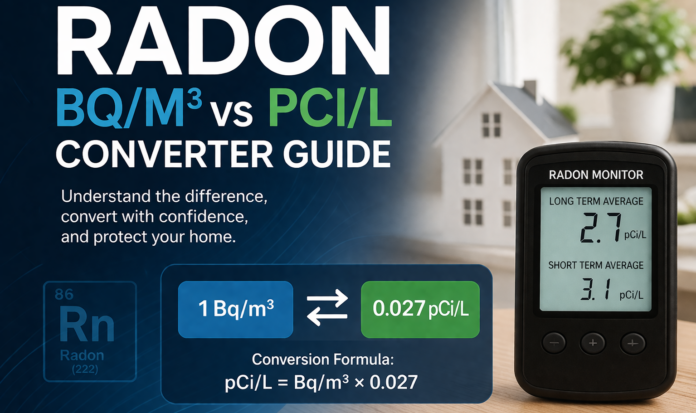
Radon Bq/m³ vs pCi/L Converter Guide
If you read radon articles long enough, you eventually run into the same frustrating problem: one page says 200 Bq/m³, another says 5.4 pCi/L, another says 4.0 pCi/L, and another says 100 Bq/m³. It can feel like everyone is using different numbers for the same issue.
In reality, they often are talking about the same radon level, just in two different unit systems.
That is what this guide is for. It explains what Bq/m³ and pCi/L mean, why Canada and the United States usually use different units, how to convert between them, and how to quickly make sense of the most common radon numbers homeowners see in articles, test-kit packaging, inspection reports, and government guidance.
The good news is that the conversion itself is simple. There is no advanced math here. Once you know the formula, you can convert almost any radon reading in a few seconds.
Table of Contents
- Why radon has two different units
- What Bq/m³ means
- What pCi/L means
- The exact conversion formula
- How to convert Bq/m³ to pCi/L
- How to convert pCi/L to Bq/m³
- Quick radon conversion table
- The most common radon levels homeowners see
- Why some official numbers look slightly different
- Canada vs. U.S. radon numbers at a glance
- Common conversion mistakes to avoid
- Bottom line for homeowners
- Sources
Why radon has two different units
Radon is usually reported in one of two units: becquerels per cubic metre, written as Bq/m³, or picocuries per litre, written as pCi/L.
Canada and most of the world generally use Bq/m³. The United States usually uses pCi/L. That is why Canadian homeowners often see one unit on a Health Canada page and another unit on an EPA article, an American radon detector, or a U.S.-based real estate website.
Neither unit is “more correct” in a health sense. They are simply different measurement systems describing the same thing: how much radon is in the air.
If you want the official Canadian baseline, start with Health Canada’s radon guideline page. If you want the U.S. version, EPA’s main action-level page is here.
What Bq/m³ means
Bq/m³ stands for becquerels per cubic metre. This is the unit most commonly used in Canada and in many international radon resources.
A becquerel is a unit that measures radioactive decay. In simple terms, it tells you how much radioactive disintegration is happening. When you see radon reported in Bq/m³, it means the reading is showing how much radon activity is present in one cubic metre of air.
For homeowners, the practical point is not the physics. The practical point is that a higher Bq/m³ number means more radon in the air.
Health Canada’s technical measurement guide explains this unit directly and is a useful source if you want the Canadian terminology in official form: Guide for Radon Measurements in Homes.
What pCi/L means
pCi/L stands for picocuries per litre. This is the unit most commonly used in the United States.
A curie is an older unit of radioactivity, and a picocurie is a very small fraction of that. When you see a radon result in pCi/L, it is measuring the same basic thing as Bq/m³, just in a different unit system and a different air volume reference.
Again, the homeowner takeaway is simple: a higher pCi/L number means more radon in the air.
This is the unit you will usually see on EPA guidance, many U.S. test kits, and a lot of American radon articles. EPA’s homeowner action-level page is here: What Is EPA’s Action Level for Radon and What Does It Mean?.
The exact conversion formula
This is the key formula that makes the whole topic easy.
1 pCi/L = 37 Bq/m³
That is the conversion Health Canada uses in its technical measurement guide, and it is the foundation for nearly every homeowner radon conversion you will ever need.
From that one relationship, you can convert either direction:
To convert pCi/L to Bq/m³:
Multiply by 37
To convert Bq/m³ to pCi/L:
Divide by 37
That is it. No special calculator is required.
How to convert Bq/m³ to pCi/L
If your result is in Bq/m³ and you want to convert it to pCi/L, divide by 37.
Here is the formula:
pCi/L = Bq/m³ ÷ 37
Examples:
100 Bq/m³ ÷ 37 = 2.7 pCi/L
200 Bq/m³ ÷ 37 = 5.4 pCi/L
300 Bq/m³ ÷ 37 = 8.1 pCi/L
This is the direction many Canadian homeowners need when they read U.S. articles or compare a Canadian test result with EPA guidance they found online.
For example, if your Canadian radon result is 200 Bq/m³, that is about 5.4 pCi/L.
How to convert pCi/L to Bq/m³
If your result is in pCi/L and you want to convert it to Bq/m³, multiply by 37.
Here is the formula:
Bq/m³ = pCi/L × 37
Examples:
2.0 pCi/L × 37 = 74 Bq/m³
4.0 pCi/L × 37 = 148 Bq/m³
5.4 pCi/L × 37 = 199.8 Bq/m³
This is the direction many Canadian homeowners need when they buy an American detector or read a U.S.-based radon report.
For example, if a U.S. article says the EPA action level is 4.0 pCi/L, that is mathematically 148 Bq/m³.
Quick radon conversion table
Below is a practical reference table for the numbers homeowners see most often.
| Bq/m³ | Approximate pCi/L | Why homeowners see it |
|---|---|---|
| 37 | 1.0 | Basic conversion point |
| 74 | 2.0 | Lower end of EPA “consider fixing” range |
| 100 | 2.7 | WHO reference level if possible |
| 148 | 4.0 | Exact math for EPA action level |
| 150 | 4.1 | Common rounded EPA equivalent |
| 200 | 5.4 | Health Canada guideline |
| 300 | 8.1 | WHO upper ceiling if 100 Bq/m³ is not achievable |
| 400 | 10.8 | Common high-result reference point |
| 600 | 16.2 | Useful for older Canadian remediation timing references |
| 800 | 21.6 | Useful when reading older Canadian material |
| 1000 | 27.0 | Very elevated level |
The most common radon levels homeowners see
Once you know the formula, the next useful step is learning the few numbers that show up again and again.
Health Canada guideline:
Health Canada’s current radon guideline is 200 Bq/m³, which equals about 5.4 pCi/L. If you are in Canada, this is one of the most important conversions to remember.
EPA action level:
EPA recommends fixing homes at 4.0 pCi/L, which converts mathematically to 148 Bq/m³. EPA often rounds this and presents it as about 150 Bq/m³.
EPA “consider fixing” range:
EPA also says homeowners should consider fixing between 2.0 and 4.0 pCi/L, which is about 74 to 148 Bq/m³. In EPA materials, that range is often rounded to 75 to 150 Bq/m³.
WHO reference level:
WHO proposes 100 Bq/m³ as a reference level if possible, which converts to about 2.7 pCi/L. WHO also says the chosen level should not exceed 300 Bq/m³ if 100 cannot reasonably be achieved, which is about 8.1 pCi/L.
These are the numbers that cause most of the cross-border confusion. Once converted, they make much more sense.
Why some official numbers look slightly different
This is where homeowners sometimes think different agencies are contradicting one another when they are really just rounding.
Because 1 pCi/L = 37 Bq/m³, some conversions produce decimals that are not especially neat.
For example:
4.0 pCi/L × 37 = 148 Bq/m³
That is the exact math. But EPA often rounds that and presents it as about 150 Bq/m³. That is not a different standard. It is just a rounded presentation.
The same thing happens the other way:
200 Bq/m³ ÷ 37 = 5.405…
Health Canada and other Canadian resources commonly round that to 5.4 pCi/L.
So when you see 148 in one source and 150 in another, or 5.4 in one source and 5.41 in another, do not assume the rules changed. It is usually just rounding.
Canada vs. U.S. radon numbers at a glance
This is the comparison that confuses homeowners most often.
In Canada, the official homeowner benchmark is 200 Bq/m³. In the United States, the best-known EPA action level is 4.0 pCi/L.
Once converted, that means:
Canada: 200 Bq/m³ = 5.4 pCi/L
United States: 4.0 pCi/L = 148 Bq/m³, usually shown by EPA as about 150 Bq/m³
That is why Canadian and U.S. radon articles can look different even when they are discussing similar decisions. The units differ, the numbers differ, and the policy frameworks differ, but the conversion itself is still simple.
If you live in Canada, the safest rule is to interpret your result first through Health Canada’s guidance. If you live in the U.S., use EPA’s guidance. Use conversion mainly to compare systems or understand articles from outside your country.
Common conversion mistakes to avoid
Mistake 1: Comparing raw numbers without converting them.
A homeowner sees 200 Bq/m³ and 4.0 pCi/L and assumes they are unrelated. They are related, but only after conversion.
Mistake 2: Forgetting which direction to go.
If you have Bq/m³ and want pCi/L, divide by 37. If you have pCi/L and want Bq/m³, multiply by 37.
Mistake 3: Treating rounded numbers as contradictions.
EPA may show 4.0 pCi/L as about 150 Bq/m³, while exact math gives 148 Bq/m³. That is a rounding difference, not a policy difference.
Mistake 4: Using too much false precision.
For homeowner use, you usually do not need six decimal places. Rounding to one decimal place for pCi/L is usually more than enough.
Mistake 5: Forgetting which country’s guidance applies.
A Canadian result should be interpreted against Canadian guidance first, even if you convert it into pCi/L to understand an American article.
Bottom line for homeowners
The Bq/m³ vs pCi/L issue sounds more confusing than it really is.
The core rule is simple:
1 pCi/L = 37 Bq/m³
From there:
Bq/m³ to pCi/L: divide by 37
pCi/L to Bq/m³: multiply by 37
If you remember only a few practical conversions, remember these:
100 Bq/m³ = 2.7 pCi/L
148 Bq/m³ = 4.0 pCi/L
200 Bq/m³ = 5.4 pCi/L
300 Bq/m³ = 8.1 pCi/L
That alone will help you make sense of most radon articles, test reports, and government pages you are likely to see.
Once the unit confusion is gone, the real question becomes much simpler: what is your home’s radon level, and what does the guidance in your country recommend you do about it?