
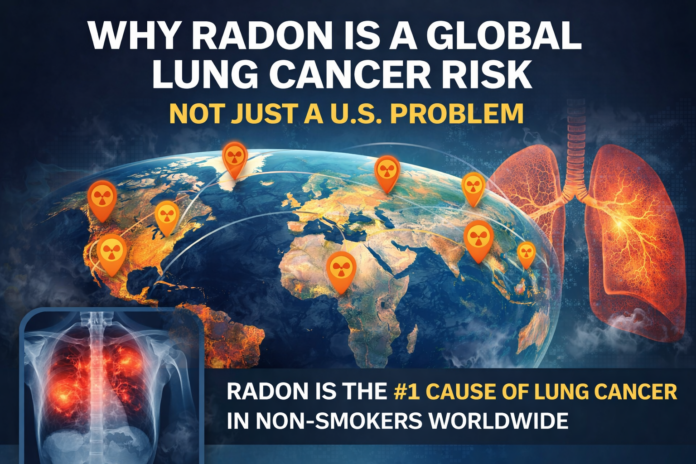
Why Radon Is a Global Lung Cancer Risk, Not Just a U.S. Problem
If you spend enough time reading about radon online, it is easy to come away with the impression that radon is mostly an American issue. A lot of the most visible radon content on the internet is written around U.S. home sales, EPA action levels, pCi/L measurements, and American testing products. That can make radon feel like a topic that belongs mainly to U.S. basements, U.S. real estate agents, and U.S. environmental agencies.
That impression is wrong.
Radon is not a U.S. problem with a few international side notes. It is a global indoor air and lung cancer issue. It has been recognized by major international health and radiation authorities for years. It affects homes, workplaces, schools, and public buildings in many parts of the world. It is studied in Europe, North America, Asia, and Africa. And countries far beyond the United States already have radon reference levels, action plans, testing campaigns, public maps, and mitigation guidance.
The reason is simple. Radon does not care about borders. It comes from geology, soil gas movement, building design, ventilation, and long-term exposure patterns. Those conditions exist in many countries, not just in one.
This article explains why radon should be understood as a global lung cancer risk, how international health agencies frame the problem, what the worldwide evidence actually says, and why homeowners outside the United States should take the topic just as seriously.
Table of Contents
- Why people think radon is mostly a U.S. issue
- WHO treats radon as a global public-health risk
- Radon is classified as carcinogenic to humans
- The evidence does not come from the U.S. alone
- Radon is not just a mining problem
- Countries around the world already regulate and respond to radon
- What global radon policy looks like in real life
- Why radon matters so much for never-smokers
- Why this matters for homeowners outside the U.S.
- Bottom line
- Sources
Why people think radon is mostly a U.S. issue
The misunderstanding is easy to explain. The United States has produced a huge amount of public-facing radon content. EPA guidance is widely quoted. American home inspection culture talks about radon often. U.S. radon test kits are sold everywhere online. Real-estate websites, contractors, and state radon programs have generated a large volume of content over many years.
That visibility creates a false impression. It makes radon feel unusually American even though the underlying risk is not. In reality, the internet is heavily weighted toward English-language U.S. content, and that distorts how people perceive the issue.
The result is that homeowners in Canada, Europe, Australia, and elsewhere may read about radon through a U.S. lens and assume they are looking at a foreign problem. But when you step back and look at what international health agencies and national governments are doing, a very different picture appears.
WHO treats radon as a global public-health risk
The clearest way to see that radon is not just a U.S. problem is to start with the World Health Organization’s radon fact sheet.
WHO does not describe radon as a U.S.-specific concern. It describes radon as a major cause of lung cancer and says it is estimated to cause between 3% and 14% of all lung cancers in a country, depending on that country’s average radon level and smoking prevalence. WHO also states that the risk of lung cancer increases by about 16% for every 100 Bq/m³ increase in long-term average radon concentration.
That language is global by design. WHO is talking about countries, not one country. It is talking about worldwide public health, not a single national program. It is also very clear that the risk is not limited to extremely high exposures. WHO says studies in Europe, North America, and China have confirmed that even lower concentrations commonly found in homes contribute to lung cancer.
WHO’s broader indoor-air guidance is just as explicit. Its air-quality and health material says radon-attributable lung cancers in Europe, North America, and Asia range from 3% to 14%, and identifies radon as the leading cause of lung cancer among non-smokers. You can read that here: WHO air quality, energy and health: types of pollutants.
In other words, the world’s leading public-health body does not frame radon as a U.S. environmental niche. It frames radon as an international lung-cancer issue.
Radon is classified as carcinogenic to humans
The next important global point is that radon is not just “suspected” of being dangerous. It has been formally classified as a human carcinogen.
The International Agency for Research on Cancer, or IARC, which is part of WHO, classifies agents according to carcinogenic hazard. IARC’s current classifications identify Group 1 agents as carcinogenic to humans. More specific IARC radon materials and the latest European Code Against Cancer radon brief state that radon is classified as carcinogenic to humans because of its causal link with lung cancer.
This matters because it moves radon out of the category of “possible concern” and into the category of a well-established cancer hazard. From a public-health perspective, that is one reason radon has become part of national cancer-prevention policy in multiple countries rather than remaining a narrow radiation topic.
For homeowners, the practical takeaway is simple. Radon is not controversial in the scientific sense. It is a recognized lung-cancer hazard.
The evidence does not come from the U.S. alone
Another reason people sometimes think radon is mainly an American problem is that they assume the strongest evidence comes from American homes. That is also not true.
WHO specifically says that studies in Europe, North America, and China confirm radon’s role in residential lung cancer. That is a very important sentence because it shows the evidence base is international and replicated across regions with different housing stocks, climates, and geology.
The most important modern radon message is not that extremely high exposures are dangerous. We have known that from miner studies for a long time. The more important message is that ordinary residential exposure, spread across millions of homes in multiple parts of the world, can also raise lung-cancer risk.
That is why WHO says radon levels in homes, schools, offices, and workplaces can vary widely and that people may unknowingly spend years in buildings with elevated levels. It is also why public-health agencies no longer treat radon as a strange specialty issue confined to a few occupational settings.
The scientific and policy logic is global. The gas occurs naturally in soil and rock. Buildings all over the world sit on soil and rock. Some buildings draw soil gas in more readily than others. That mechanism is not uniquely American.
Radon is not just a mining problem
One of the oldest misconceptions about radon is that it belongs mainly to mines and underground work. That was once a major part of the story, because higher rates of lung cancer were first observed among miners exposed to very high radon concentrations.
But WHO now makes clear that the risk extends far beyond mining. Its radon fact sheet says most people receive their greatest radon exposure at home, where they spend much of their time. Indoor workplaces may also be important, but the residential setting is central.
The International Atomic Energy Agency says the same thing in plainer terms. High radon concentrations can build up in enclosed spaces such as buildings, and long-term exposure can increase the risk of lung cancer. In its feature Radon in the Home: Confronting a Global Challenge, the IAEA explicitly states that the risk is not exclusive to any one geographic region or income level and that radon can be dangerous around the world when it accumulates indoors.
That shift matters. Radon is no longer mainly a story about miners. It is a story about homes, schools, public buildings, basements, ground-contact floors, and long-term indoor exposure in everyday life.
Countries around the world already regulate and respond to radon
One of the strongest arguments against the idea that radon is “just a U.S. problem” is the simple fact that many countries already have radon reference levels, testing systems, action plans, and public maps.
That is not what governments do for a niche American issue. It is what governments do for an international public-health problem that shows up in their own housing stock.
For example, Health Canada says radon exposure is the number one cause of lung cancer in non-smokers and links radon to more than 3,000 lung-cancer deaths a year in Canada. Canada’s national residential guideline is 200 Bq/m³.
In the United Kingdom, UKradon says the Action Level is 200 Bq/m³ and the Target Level is 100 Bq/m³, with action to reduce radon considered even between those two levels, especially where there is a smoker or ex-smoker in the home.
In Ireland, the Environmental Protection Agency says radon causes about 350 cases of lung cancer each year, uses a home reference level of 200 Bq/m³, and maintains a radon risk map that identifies High Radon Areas. It also requires testing in certain workplaces and schools in those areas.
In Australia, ARPANSA recommends action be considered if household radon levels are above 200 Bq/m³, even though average Australian residential radon levels are lower than in many other countries.
In Finland, STUK says the reference level for indoor radon concentration in dwellings is 300 Bq/m³, with 200 Bq/m³ used for the design and construction of new buildings. Finland also publishes radon maps and notes that its geology contributes to elevated risk in certain regions.
In Switzerland, the Federal Office of Public Health says that since 2018 a radon reference level of 300 Bq/m³ applies to average annual concentration in premises where people stay regularly for several hours a day.
In Germany, the Federal Ministry for the Environment describes a national radon action plan and says that in radon-prone areas, measurements and protective measures are mandatory in certain basement- and ground-floor workplaces when the reference level of 300 Bq/m³ may be exceeded.
At the European Union level, the Joint Research Centre’s European Atlas of Natural Radiation explains that EU Member States must establish national radon action plans and set national indoor radon reference levels that are not higher than 300 Bq/m³ for annual average indoor air.
All of that exists because radon is not confined to one national housing market. It is a shared international problem that different countries are addressing in slightly different ways.
What global radon policy looks like in real life
It helps to pause here and notice what the global pattern actually looks like.
Countries do not all use the exact same number. Some use 200 Bq/m³. Others use 300 Bq/m³. The United Kingdom layers a 100 Bq/m³ Target Level under a 200 Bq/m³ Action Level. WHO recommends a national reference level of 100 Bq/m³ if possible and says it should not exceed 300 Bq/m³ if that lower level cannot reasonably be achieved.
But the differences in numbers do not change the overall story. Across countries, the pattern is remarkably consistent. Governments are measuring radon, mapping radon-prone areas, requiring action in high-risk settings, pushing long-term testing, and encouraging mitigation in homes above national reference levels.
That is exactly what you would expect for a global health risk. Countries localize the rules, but the core public-health logic remains the same.
The scale of the issue in Europe alone reinforces the point. The latest European Code Against Cancer radon policy brief says radon is responsible for about 19,000 deaths per year in Europe. That is not a small or local burden. It is a continent-wide cancer-prevention issue.
Why radon matters so much for never-smokers
One reason radon deserves global attention is that it does not fit the usual public picture of lung cancer. Many people still associate lung cancer almost entirely with smoking. Smoking remains the dominant risk factor, of course, but radon matters because it is one of the few major lung-cancer hazards that affects people in their own homes regardless of whether they smoke.
WHO’s air-quality material says radon is the leading cause of lung cancer among non-smokers. Health Canada says the same basic thing in national public-health language. The IAEA also repeats it in its public radon education materials.
That does not mean smokers are less relevant to the story. Quite the opposite. WHO says the lung-cancer risk from radon is much higher for smokers because the effects are synergistic. In fact, WHO estimates smokers are about 25 times more at risk from radon than non-smokers.
So radon matters globally for two reasons at once. It is a major hazard in never-smokers, and it is an even larger hazard when it combines with smoking. That makes it a public-health issue in countries with very different smoking patterns and very different housing conditions.
Why this matters for homeowners outside the U.S.
If you live outside the United States, the global nature of radon matters for a very practical reason: you should not dismiss the topic just because most of the online conversation sounds American.
A Canadian homeowner should not assume radon is mainly a U.S. basement problem when Health Canada attributes more than 3,000 lung-cancer deaths a year to radon exposure in Canada.
An Irish homeowner should not assume the issue is foreign when Ireland’s EPA says radon causes about 350 lung-cancer cases per year and maintains a national radon map.
A Finnish homeowner should not treat radon as an imported concern when STUK says average radon concentration in Finnish homes is about 94 Bq/m³ and has built a country-specific measurement and reference-level system around that reality.
Even countries where average residential radon is lower still maintain official guidance. Australia is a good example. ARPANSA notes that average radon in Australian homes is relatively low, but it still has action guidance, public FAQs, and household reference levels because the risk does not disappear just because national averages are lower.
And the issue is not confined to North America, Europe, and Australia. The IAEA’s report on Cameroon describes a large African radon survey of 3,000 dwellings and notes that nearly half exceeded WHO’s more conservative 100 Bq/m³ level, with some areas showing especially elevated concentrations. That kind of work matters because it reminds people that radon is also being mapped and managed in parts of the world that are often underrepresented in online radon discussions.
So the homeowner lesson is simple. If your country has official radon guidance, that is not a courtesy copy of EPA policy. It is evidence that your own country has recognized radon as a real domestic risk.
Why radon crosses borders so easily as a health risk
Radon crosses borders as a health issue because its main drivers are universal.
It comes from the natural decay of uranium in soil and rock. Those are found around the world. It moves into buildings through pressure differences, cracks, joints, drains, service penetrations, and other ground-contact routes. Those conditions also exist around the world. It becomes more important where buildings are enclosed, where lower levels are occupied, where ventilation is limited, and where the underlying geology supports higher radon release. Again, those are not uniquely American conditions.
That is why radon can show up in detached houses, apartment buildings, schools, offices, childcare centres, hospitals, waterworks, caves, mines, and certain industrial settings across different countries. The details vary, but the underlying mechanism is global.
The IAEA’s public radon material makes this point especially well when it says the risk is not exclusive to any particular geography or income level. That is exactly right. A country can be wealthy or not, large or small, cold or warm, and still face radon risk if the right geological and building conditions come together.
Bottom line
Radon is not just a U.S. problem with international footnotes. It is a global lung-cancer risk.
WHO treats it that way. IARC classifies it that way. The evidence base spans Europe, North America, and China. Europe has continent-wide radon action planning and an estimated 19,000 radon-related deaths per year. Canada links radon to more than 3,000 lung-cancer deaths annually. Ireland, the UK, Australia, Germany, Switzerland, Finland, and many other countries have official radon reference levels, public guidance, maps, or action plans. Countries in Africa are also building radon measurement and control programs.
So if radon content online sometimes sounds overly American, that is mostly a visibility problem, not a science problem.
The real message is broader. Radon is wherever geology, buildings, and long-term indoor exposure allow it to become a risk. That means it belongs in the global conversation about lung-cancer prevention, indoor air quality, and healthier housing.
For homeowners, the takeaway is straightforward. Do not let the U.S.-heavy internet conversation fool you into thinking radon is someone else’s issue. If your country has official radon guidance, it has that guidance for a reason.
Sources
- World Health Organization: Radon and Health
- World Health Organization: Air Quality, Energy and Health, Types of Pollutants
- World Health Organization: WHO Handbook on Indoor Radon
- IARC Monographs: Agents Classified by the IARC Monographs
- European Code Against Cancer: Indoor Radon Gas Policy Brief
- IAEA: Radon
- IAEA: Radon in the Home, Confronting a Global Challenge
- IAEA: Pioneering Radon Research in Cameroon Decreases Risks of Lung Cancer
- Health Canada: Radon, What You Need to Know
- Health Canada: Government of Canada Radon Guideline
- UKradon: Radon Action Level and Target Level
- Ireland EPA: Radon Map
- ARPANSA: Radon Frequently Asked Questions
- STUK Finland: Radon in Finland
- Swiss Federal Office of Public Health: Legal Dispositions Concerning Radon
- German Federal Ministry for the Environment: Radon
- European Commission Joint Research Centre: European Atlas of Natural Radiation, Chapter I