
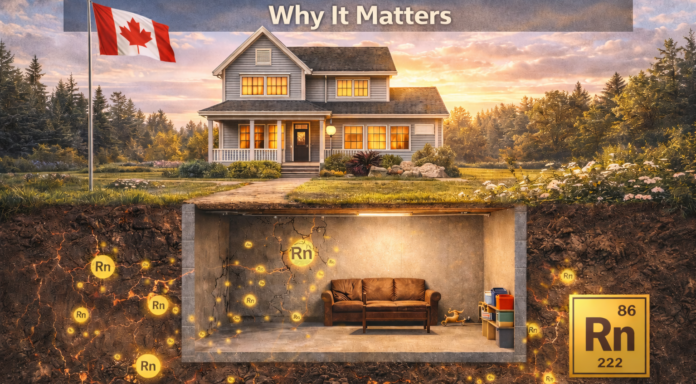
Radon in Canadian Basements: Why It Matters
When Canadian homeowners think about radon, they usually think about the basement first. That instinct is not wrong. In many homes, the basement is where radon is highest, where radon enters most directly, and where the most important testing and mitigation decisions often begin.
But basement radon is also one of the most misunderstood parts of the topic. Some people assume an unfinished basement does not matter because nobody sleeps there. Others assume that if the basement is finished and comfortable, radon must not be a problem. Some think sealing a crack or opening a window is enough. Others hear that basements tend to have the highest radon and conclude that every Canadian homeowner should automatically test only in the basement, even if the basement is barely used.
The truth is more specific than that.
Basements matter because they are usually the part of the house closest to the soil, which is where radon comes from. They also tend to have more contact points with the ground, more entry routes, and less natural ventilation. But in Canada, the testing decision is not based only on where radon is highest. It is based on where people actually spend time.
This article explains why basements matter so much in Canadian radon discussions, how radon gets into basement spaces, why finished basements deserve extra attention, how Health Canada wants homeowners to test, and what to do if the level comes back high.
Table of Contents
- Why basements matter so much for radon
- Why radon is usually higher in basements
- How radon gets into a basement
- Finished vs. unfinished basements
- How Canadian homeowners should test basement radon
- What “lowest lived-in level” really means
- Basement bedrooms, offices, and rec rooms
- What to do if basement radon is high
- Common basement radon myths
- Bottom line for homeowners
- Sources
Why basements matter so much for radon
Basements matter because radon starts in the ground. It forms naturally as uranium in soil and rock breaks down, then moves through the soil as a gas. Once that gas reaches a building, it can seep inside anywhere the house is in contact with the ground. In most Canadian homes, the basement is the part of the house with the most direct relationship to that ground contact.
Health Canada explains this clearly in its homeowner materials. It notes that radon levels are generally highest in basements and crawl spaces because those areas are closest to the source and are often the least well ventilated. Its more technical residential testing guide says higher radon levels are typical in basements and crawl spaces, while also noting that elevated levels can be found throughout a home.
That last point matters. A basement is often the starting point of the radon problem, but radon does not always stay there. Air moves through a house. If radon builds up in lower levels, it can affect the rest of the home as well, especially over time.
This is why Canadian radon discussions so often begin with basements. Not because radon is only a basement issue, but because the basement is usually the first place where the problem starts and the first place where it becomes obvious on a test.
Why radon is usually higher in basements
There are two main reasons basement radon is often higher than radon elsewhere in the home.
The first is simple proximity. The basement sits closest to the soil, rock, and foundation contact points where radon enters. The gas does not need to travel as far to reach the basement as it does to reach the upper floors.
The second reason is ventilation. Basement and crawl-space areas are often more enclosed and less well ventilated than upper levels. Health Canada says this directly on its What You Need to Know page and again in its residential testing guide. When radon enters a closed or poorly ventilated lower level, it can accumulate instead of dispersing.
Pressure differences also matter. In many homes, the pressure inside the house is lower than the pressure in the surrounding soil. That difference helps pull soil gas into the building. The basement is usually where that pressure-driven movement matters most because it is the part of the home closest to the source and most connected to the foundation system.
So when people say “radon is a basement problem,” what they usually mean is that basements are where radon most often enters and collects first. That is generally true. But it still needs to be interpreted correctly in the context of how the home is actually used.
How radon gets into a basement
Many homeowners imagine radon entering through one obvious crack in the basement floor. Sometimes it does enter through visible cracks, but the real picture is usually broader than that.
Health Canada says soil gas is the largest source of indoor radon and that radon can enter a home anywhere the building is in contact with the ground. Typical entry points include cracks in foundation walls and floor slabs, construction joints, gaps around service pipes, support posts, floor drains, and sumps. Its plain-language homeowner page also lists openings around water connections, support poles, empty spaces in walls, and parts of the water supply network as possible entry routes in some homes.
In basement terms, that means the obvious crack in the concrete is only one possibility. Radon can also move through the wall-floor joint, around plumbing penetrations, through a sump pit, through a floor drain, through utility penetrations, or through other less obvious weak points in the foundation system.
This is one reason basement radon can be so deceptive. A basement can look dry, clean, solid, and structurally fine while still allowing radon in. The absence of a dramatic visible defect does not mean the basement is not a radon entry zone.
Finished vs. unfinished basements
This is where homeowners often get tripped up.
A finished basement can feel like normal living space, and that is exactly why it matters. A comfortable basement bedroom, office, family room, rec room, or guest suite may put people in the area of the home where radon levels are often highest for many hours at a time. If that space is occupied regularly, radon in the basement becomes much more than a structural issue. It becomes a direct exposure issue.
An unfinished basement is different, but not irrelevant. If it is used only occasionally for laundry, storage, or utilities, Health Canada does not automatically tell homeowners to test there just because it is physically the lowest level. On its homeowner page Radon Gas: It’s in Your Home, Health Canada says the test should be placed in the lowest lived-in level, meaning the lowest level used or occupied for more than four hours per day. It even gives a practical example: if the basement is only used once a week for laundry, there is no need to test on that level.
That does not mean the unfinished basement “does not matter.” It means the testing decision is based on exposure, not just the concrete slab. Physically, the unfinished basement may still be where radon enters and where mitigation work eventually needs to focus. But from a health-risk and testing standpoint, Health Canada wants the measurement to reflect where people actually live.
How Canadian homeowners should test basement radon
In Canada, the testing approach is more specific than many homeowners realize.
Health Canada says homeowners should do a long-term test for at least three months, ideally during the fall or winter. Its technical guide for radon measurements in homes says the test should run no less than 91 days and should be placed in the normal occupancy area of the lowest lived-in level.
That means Canadian basement radon testing is not just “put a detector in the basement and see what happens.” It is more accurate to say, “put the detector in the lowest basement or lower-level area where people regularly spend time.”
If that level is a basement office where someone works every weekday, test there. If it is a basement bedroom or family room, test there. If the basement is unfinished and only used briefly, the main floor may actually be the correct test location, even though the basement itself is physically closer to the source.
For homeowners who want extra confidence, Health Canada says testing can be done with a do-it-yourself long-term kit or by hiring a professional certified under C-NRPP. The key is not whether the test is DIY or professional. The key is that it is long-term and placed in the right lived-in area.
What “lowest lived-in level” really means
This phrase causes a lot of confusion, so it is worth slowing down and unpacking it.
Health Canada says the test should be placed in the lowest level of the home that is used or occupied for more than four hours per day. In some houses, that means the basement. In others, it means the ground floor. The answer depends on how the home is actually used.
For example, if a home has a finished basement with a rec room where the family spends evenings, then the basement is likely the right testing level. If someone works from a basement office all day, that basement office matters even more. If there is a basement bedroom, guest suite, or teen bedroom, that lower level becomes especially important because of the long time spent there.
On the other hand, if the basement is just a utility zone visited occasionally for laundry or storage, Health Canada’s guidance points away from that area as the primary testing location. The basement still matters structurally and diagnostically, but it may not be the right place for the initial health-exposure measurement.
This is one of the most important distinctions in basement radon discussions. The basement often matters the most physically, but the lowest lived-in level matters the most for the first homeowner test.
Basement bedrooms, offices, and rec rooms
If there is one basement scenario Canadian homeowners should take especially seriously, it is the finished lower level that people spend real time in.
A basement bedroom matters because someone may be breathing that air for seven to nine hours a night. A basement office matters because someone may be working there all week. A basement rec room, homeschool room, or playroom matters because repeated daily use adds up over time.
This is where the idea of basement radon becomes less theoretical. Once the basement becomes real living space, the health question becomes more direct. Health Canada’s testing logic is built around this exact issue. The goal is not merely to see where radon is highest in the structure. The goal is to estimate radon exposure where people are actually spending time.
That is also why finished basements can create a false sense of security. Carpet, drywall, lighting, furniture, and a comfortable temperature can make the space feel healthy and normal. None of those things tells you what the radon level is. The only way to know is to test.
What to do if basement radon is high
If the test result is above the Canadian guideline of 200 Bq/m3, Health Canada recommends taking corrective action. It also says action should be taken sooner when the radon level is higher and that the goal should be to reduce the concentration as much as is practicable.
For most basement-driven radon problems, the solution is not guesswork or cosmetic patching. Health Canada’s Reducing Radon Levels in Your Home page says the most common method is sub-slab depressurization. In that system, a pipe is installed through the foundation floor and connected to the outside, with a fan that draws radon from beneath the house before it can enter the home.
Health Canada says a mitigation system can usually be installed in less than a day and, in most homes, can reduce radon by more than 80%. It also recommends hiring a mitigation professional certified under C-NRPP.
That matters because basement radon mitigation is usually about pressure control below the slab or foundation, not just surface sealing. Sealing large entry routes can help, but Health Canada notes that sealing and added ventilation alone often have limited effectiveness depending on the house and the starting level. The most reliable fix is usually an actual mitigation system designed around how radon is entering from below.
Common basement radon myths
“If my basement is unfinished, radon there does not matter.”
Not exactly. It may not be the right first test location if nobody uses it much, but it can still be the main entry zone and the place where mitigation work needs to focus.
“If the basement looks clean and dry, it probably does not have radon.”
False. Radon is invisible, odourless, and tasteless. A neat basement can still have elevated radon.
“A finished basement is safer because it is more comfortable.”
Also false. Finishing a basement can increase how much time people spend there, which can make exposure more important, not less.
“I should always test on the lowest concrete level no matter what.”
Not according to Health Canada. The recommended location is the lowest lived-in level, meaning the lowest level occupied more than four hours per day.
“If radon starts in the basement, the upstairs does not matter.”
Not true. Elevated radon can be found throughout a home even though basements and crawl spaces are often highest.
“Opening a basement window once in a while solves the problem.”
Usually not. Temporary ventilation may change conditions briefly, but it is not a dependable long-term radon solution for a high reading.
Bottom line for homeowners
Radon in Canadian basements matters because the basement is usually where the house meets the ground, where radon most often enters, and where levels are often highest. That makes the basement central to the radon issue even when nobody sleeps there.
But the smartest homeowner takeaway is a little more precise than “test the basement.” In Canada, the real rule is to test the lowest lived-in level. If that level is the basement, then the basement is your test zone. If the basement is rarely used, the correct test area may actually be the main floor, even though the basement still matters as the source area.
So if your basement is finished, used as living space, or contains bedrooms, offices, or rec rooms, it deserves serious attention. If your basement is unfinished and lightly used, it still matters structurally, but your first test should reflect actual exposure. Either way, radon is not something to guess at. Health Canada says every home should be tested, and the only way to know what is happening in your basement or lower levels is to measure it.
Sources
- Health Canada: Radon, What You Need to Know
- Health Canada: Guide for Radon Measurements in Homes
- Health Canada: Radon Gas, It’s in Your Home
- Health Canada: Testing Your Home for Radon
- Health Canada: Radon Guideline
- Health Canada: Reducing Radon Levels in Your Home
- C-NRPP: Find a Professional
- Canadian Cancer Society: Radon