
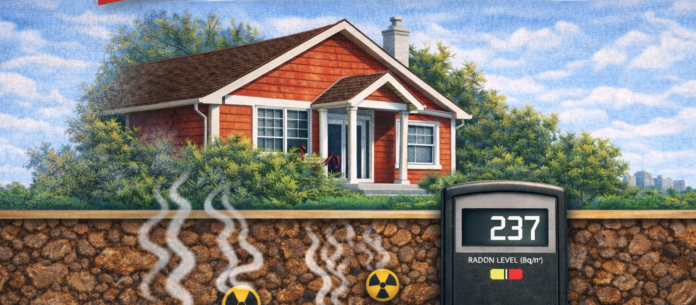
Health Canada Radon Guideline Explained
If you have been reading about radon in Canada, you have probably seen the same number over and over again: 200 Bq/m3. That is the Health Canada radon guideline. But many homeowners still come away confused about what that number actually means, how they are supposed to use it, and what should happen if their test result is above or below it.
That confusion is understandable. A guideline is not the same thing as a guarantee of safety. It is not the same thing as a building code rule. It is not the same thing as a home inspection pass-or-fail threshold. It is a public-health benchmark. Once you understand that, the entire Canadian radon system starts to make much more sense.
This article explains the Health Canada radon guideline in plain English. It covers the exact number, what kind of number it is, how Health Canada expects homeowners to test against it, what “average annual radon level” and “normal occupancy area” mean, how quickly people should act if their result is high, and where homeowners often misunderstand the guideline.
The short version is simple. Health Canada says homeowners should take corrective action if the average annual radon level is above 200 Bq/m3 in the normal occupancy area of a building. But there is more to it than that, and knowing the details helps homeowners make better decisions.
Table of Contents
- What is the Health Canada radon guideline?
- The exact Health Canada wording, in plain English
- Why the guideline exists
- Why 200 Bq/m3 is not a magic safety line
- What “average annual radon level” means
- What “normal occupancy area” means
- How Health Canada says to test against the guideline
- How to read your result against the guideline
- How quickly should homeowners act?
- How the guideline connects to mitigation
- What the guideline says about new buildings
- Common misunderstandings about the guideline
- Bottom line for homeowners
- Sources
What is the Health Canada radon guideline?
The current Health Canada radon guideline is 200 Bq/m3. More specifically, Health Canada says homeowners should take corrective action if the average annual radon level exceeds 200 Bq/m3 in the normal occupancy area of a building.
If that sounds technical, here is the homeowner version. Health Canada is saying that if long-term radon exposure in the part of the home where people actually spend time is above 200 Bq/m3, the home should be fixed.
The unit itself, Bq/m3, stands for becquerels per cubic metre. It measures radioactive decay in a volume of air. Most homeowners do not need to understand the physics in detail. What matters is that a higher number means more radon in the air and greater long-term health risk.
If you want to read the official wording directly, Health Canada’s main guideline page is here: Government of Canada Radon Guideline.
The exact Health Canada wording, in plain English
Health Canada’s guideline page says four especially important things.
First, it says you should take corrective action if the average annual radon level exceeds 200 Bq/m3 in the normal occupancy area of a building.
Second, it says you should take corrective action sooner when the radon level is higher. In other words, the guideline is not meant to treat 210 Bq/m3 and 1200 Bq/m3 as having the same urgency, even though both are above the benchmark.
Third, it says corrective action should reduce the radon concentration as much as is practicable. That matters because the goal is not merely to squeak just below the number if it is reasonable to go lower.
Fourth, it says new buildings should be built with techniques that minimize radon entry and make it easier to remove radon later if needed. So the guideline is not only about testing old homes. It also has a prevention side.
You can read those recommendations directly on Health Canada’s official guideline page: Health Canada Radon Guideline.
Why the guideline exists
The guideline exists because radon is a real and significant public-health issue in Canada. Health Canada says radon is found in every building in Canada at some level and that long-term exposure increases the risk of lung cancer. Its current public-health messaging says radon exposure is the leading cause of lung cancer in non-smokers and is associated with about 16% of lung cancers in Canada.
That is why the guideline matters. It gives homeowners, builders, public-health agencies, and mitigation professionals one shared national benchmark for when exposure is high enough that corrective action is recommended.
It also gives Canada a practical standard for public education, technical guidance, building practices, and policy. Without a guideline, every homeowner would be left trying to decide on their own what number should matter and when to act.
If you want broader Health Canada background on the health side, these pages are helpful starting points: Radon, What You Need to Know and Radon Causes Lung Cancer.
Why 200 Bq/m3 is not a magic safety line
This may be the most important part of the whole article.
Many homeowners read the Health Canada guideline as though it creates a hard line between safe and dangerous. That is not how Health Canada itself describes it. Health Canada says that while the health risk below the Canadian guideline is smaller, no level is considered risk free.
That means a home at 180 Bq/m3 is below the guideline, which is good, but not because radon suddenly stops mattering at 199. The guideline is a benchmark for recommending corrective action. It is not a declaration that everything below it is harmless.
This is why Health Canada also says mitigation should reduce levels as much as is practicable. The broader direction is always the same: lower radon is better.
The clearest plain-language explanation of this point appears on Health Canada’s Radon Reduction Guide for Canadians.
What “average annual radon level” means
When Health Canada says the guideline applies to the average annual radon level, it is telling homeowners something very important about how radon should be measured.
Radon changes over time. It rises and falls from hour to hour, day to day, and season to season. Weather, ventilation, pressure differences, home use, and the heating season all affect indoor levels. A quick reading does not tell the full story.
That is why Health Canada recommends long-term testing. It wants homeowners comparing the guideline to a result that reasonably reflects long-term exposure, not just a brief snapshot from one weekend or one weather pattern.
This is also why Health Canada’s testing guidance says homeowners should do a long-term radon test for at least three months, ideally during the fall or winter. The point is to estimate long-term exposure in a way that is actually meaningful when compared with the national guideline.
The clearest official page for this is Testing Your Home for Radon, and the deeper technical explanation is in the Guide for Radon Measurements in Homes.
What “normal occupancy area” means
This phrase also trips people up.
Health Canada does not simply say “test the lowest concrete level in the house.” Instead, it focuses on the normal occupancy area of the lowest lived-in level. In practical terms, that means the part of the home where people actually spend time, usually defined in Health Canada guidance as an area used more than four hours per day.
For example, if a finished basement contains a family room, office, or bedroom used regularly, that basement area is likely the right place to test. But if the unfinished basement is used only occasionally for storage or laundry, the test may belong on the main floor instead.
This detail matters because the guideline is about human exposure, not just structural curiosity. Health Canada wants the measurement to reflect where people actually breathe the air.
Health Canada’s step-by-step placement guidance is especially clear on this page: How to Use an Electronic Radon Monitor or a Long-Term Detector.
How Health Canada says to test against the guideline
If you want to use the guideline correctly, testing method matters.
Health Canada recommends that homeowners do a long-term test for a minimum of 3 months, generally during the fall or winter. The detector should be placed in the lowest level of the home where homeowners spend at least 4 hours per day.
Health Canada’s technical measurement guide goes further and says long-term testing in homes should run no less than 91 days. That is because longer tests do a better job of reflecting average exposure over time.
Short-term measurements can have limited uses, but they are not the preferred basis for deciding whether a home exceeds the Canadian guideline. Canada’s homeowner guidance is built much more heavily around long-term testing than quick screening.
The best pages to read for this are Testing Your Home for Radon, Radon Reduction Guide for Canadians, and the technical Guide for Radon Measurements in Homes.
How to read your result against the guideline
Once you have a proper long-term result, the guideline becomes much easier to use.
If your result is below 200 Bq/m3
Your home is below the level where Health Canada recommends corrective action. That is positive. But it does not mean radon is risk free or that future retesting is unnecessary. Health Canada makes it clear that no radon level is considered risk free.
If your home is below the guideline, keep the result on file and consider re-testing after major renovations, ventilation changes, foundation work, or major changes in how lower levels of the home are used.
If your result is above 200 Bq/m3
Your home is above the Health Canada guideline, and corrective action is recommended. At that point, the sensible next step is to plan mitigation with a certified radon professional.
If your result is much higher than 200 Bq/m3
The higher the number, the sooner action should be taken. That is built directly into the wording of the Health Canada guideline itself.
Health Canada’s current homeowner guidance says homes above the guideline should generally be reduced within 1 year, and sooner if levels are higher. Older Canadian technical documents sometimes used a two-tier timeline, with 200 to 600 Bq/m3 addressed within 2 years and above 600 Bq/m3 within 1 year. That older wording is one reason homeowners sometimes see mixed timing advice online. For homeowners today, the safest interpretation is simple: if you are above the guideline, start planning mitigation, and move faster if the level is substantially higher.
The current consumer-facing version is on Health Canada’s Reduction Guide for Canadians. The technical version appears in the Guide for Radon Measurements in Homes.
How quickly should homeowners act?
In practical terms, homeowners should not treat a result above 200 Bq/m3 as something to think about “someday.” Health Canada says the higher the concentration, the sooner corrective action should happen. Its current public-facing reduction guide says homeowners should lower radon above the guideline within one year.
That does not mean you need to panic. Radon is a long-term exposure issue, not an instant crisis like a gas leak or a fire. But it does mean the correct response is to move into solution mode rather than indefinite delay mode.
So if your home is over the guideline, the right mindset is not panic. It is planning.
How the guideline connects to mitigation
The Health Canada guideline is not just a number on a page. It is meant to trigger action.
If a home tests above 200 Bq/m3, Health Canada says homeowners should hire a mitigation professional certified under the Canadian National Radon Proficiency Program (C-NRPP) to determine the best and most cost-effective way to reduce radon in the home.
Health Canada also says radon mitigation systems can often be installed in less than a day and will reduce radon levels by more than 80% in most homes. The most common method is active soil depressurization or sub-slab depressurization, which draws radon from beneath the house and vents it outdoors before it can enter living space.
For homeowners, that means a high result is not the end of the story. It is usually the start of a fairly standard home-repair process with proven solutions.
Health Canada’s homeowner mitigation page is here: Reducing Radon Levels in Your Home.
What the guideline says about new buildings
Many homeowners think of the guideline only as a rule for existing homes, but Health Canada’s wording also points toward prevention in new construction.
The guideline says new buildings should be built with techniques that minimize radon entry and allow removal after construction if needed. That reflects a simple idea: it is often easier and cheaper to build radon resistance in from the start than to retrofit it later.
So if you are building a home, buying a new build, or comparing builders, the Health Canada guideline still matters to you. It is part of why radon-ready features, membranes, rough-ins, and other preventive measures are worth asking about.
Common misunderstandings about the guideline
“Below 200 means safe.”
No. Health Canada says no radon level is considered risk free.
“The guideline is just a suggestion, so it does not matter much.”
It is a guideline, but it is Canada’s official public-health benchmark for when corrective action is recommended. It is meant to be taken seriously.
“A quick test is enough to compare against the guideline.”
Not really. Health Canada’s system is built around long-term testing because the guideline refers to average annual exposure.
“The guideline only applies to old or damaged homes.”
False. New homes can also have elevated radon. Health Canada’s guideline explicitly includes recommendations for new construction techniques that reduce radon risk.
“If I get just under 200, I never need to think about radon again.”
That is too simplistic. Re-testing still makes sense after renovations, major changes in home use, or years passing since the original test.
“If I am above 200, I should panic.”
No. The correct response is action, not panic. Radon can usually be reduced effectively with established mitigation methods.
Bottom line for homeowners
The Health Canada radon guideline is 200 Bq/m3, and it means homeowners should take corrective action if the average annual radon level in the normal occupancy area of the home is above that number.
But the more useful explanation is slightly fuller than that. The guideline is not a promise that lower levels are harmless. It is not a replacement for proper long-term testing. It is not a reason to delay if you are over the threshold. It is Canada’s main decision point for when radon exposure is high enough that homeowners should stop wondering and start fixing.
If you want to use the Health Canada guideline correctly, the process is simple. Test for at least three months, ideally in fall or winter. Place the detector in the lowest lived-in level. Compare the result to 200 Bq/m3. If the level is above that, start planning mitigation with a certified professional. If it is below that, keep the result on file and re-test when circumstances change.
That is what the Health Canada guideline is really for. It turns an invisible risk into a manageable homeowner decision.
Sources
- Health Canada: Radon Guideline
- Health Canada: Testing Your Home for Radon
- Health Canada: Radon Reduction Guide for Canadians
- Health Canada: Guide for Radon Measurements in Homes
- Health Canada: Reducing Radon Levels in Your Home
- Health Canada: How to Use an Electronic Radon Monitor or a Long-Term Detector
- Health Canada: Radon Causes Lung Cancer
- Health Canada: Justifications and Policy Rationales for Radon Action
- C-NRPP: Find a Professional