Radon Addendum Explained: What It Means for Buyers and Sellers
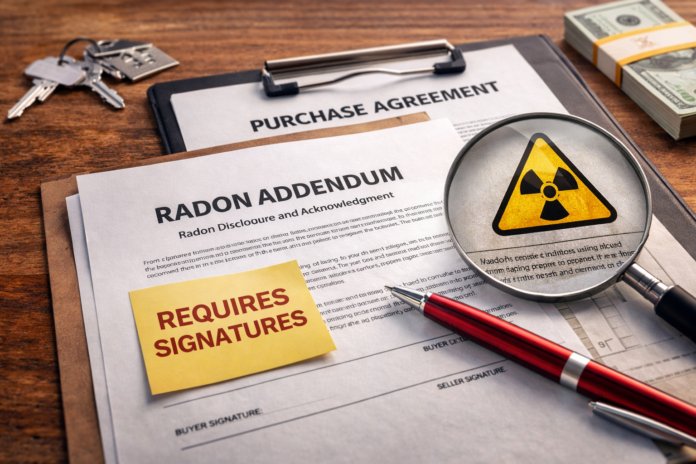
A “radon addendum” is a short contract attachment that turns radon from a vague concern into a clear, time-bound process. It typically answers the questions that cause the most friction in real estate deals: Will the home be tested, how will it be tested, what number matters, who pays for what, and what happens if the result is high.
Radon can feel intimidating because it is invisible and because people are unsure what is “normal.” The good news is that radon is usually one of the most solvable issues in a transaction because the workflow is standardized: test using a credible method, interpret the result using public guidance, negotiate a resolution if needed, and verify after mitigation.
Key benchmark: EPA recommends fixing a home if the radon level is 4.0 pCi/L or higher, and also recommends considering action between 2.0 and 4.0 pCi/L. EPA action level guidance.
Important note: This article is educational and not legal advice. Addendum language and requirements vary by state, local association forms, and contract structure. NAR notes that transaction forms are typically state-specific because laws vary significantly. NAR forms guidance.
Table of Contents
- What a radon addendum is
- Why radon addendums exist in real estate
- Radon addendum vs radon disclosure
- What a radon addendum usually covers
- Testing terms explained in plain English
- Closed-house conditions and why they matter
- Why consumer radon monitors can cause disputes
- The threshold number and how it is used
- Common remedy options: repair, credit, price reduction, escrow
- Verification: post-mitigation testing and paperwork
- Buyer guide: how to read a radon addendum before you sign
- Seller guide: how to avoid delays and retests
- Agent notes: wording pitfalls and best practices
- A quick checklist you can copy into your workflow
- Sources
What a radon addendum is
A radon addendum is a contract attachment that sets rules around radon testing and what happens if the radon level is above a defined threshold. It often acts like a mini-contingency or a mini-resolution plan. In many markets, it is signed at the time the offer is accepted or during the inspection period.
The addendum matters because radon decisions are time-sensitive in real estate. A test takes time to run, a report takes time to deliver, mitigation may take time to schedule, and closing deadlines do not wait. A good addendum prevents confusion by putting the plan in writing.
Why radon addendums exist in real estate
Radon is a measurable health risk, and testing is the only way to know a home’s level. EPA created resources specifically for real estate to help buyers and sellers test and fix radon in a transaction setting. EPA radon and real estate resources and EPA resources for the real estate community.
A radon addendum exists because without one, each side tends to assume different rules. Buyers assume the seller will fix high radon. Sellers assume buyers can handle it after closing. Agents assume the test will be done “like normal,” but “normal” differs by state and local practice. The addendum is the simplest tool to align expectations.
National Radon Program Services (Kansas State University) describes the most common real estate workflow as the buyer requesting radon testing as part of the overall home inspection, noting that radon testing is generally a separate service and must be requested. NRPS radon during real estate transactions.
Radon addendum vs radon disclosure
People often mix up “addendum” and “disclosure.” They are related, but they do different jobs.
A disclosure is typically a statement about known information. For example, a seller may disclose that a prior radon test was performed and provide the result, or disclose that a mitigation system is installed. Disclosure rules vary by state and locality. NAR notes that radon notification and disclosure laws differ by state and local jurisdiction, and that some ordinances may require testing at point of sale. NAR radon key messages.
An addendum is typically a plan. It defines what will be done now, within this transaction, including timelines and responsibilities. In other words, the addendum is where “who does what by when” lives.
Some transactions include both. A seller may disclose prior results, and the buyer may still use an addendum to require a new test under transaction conditions.
What a radon addendum usually covers
Most radon addendums are built from the same set of ingredients. Your specific form will vary by state, but the meaning is usually familiar across markets.
| Clause topic | What it usually means | Why it matters |
|---|---|---|
| Testing right and deadline | Buyer may perform a radon test by a certain date | Prevents last-minute testing that breaks closing timelines |
| Who performs the test | A qualified professional or a specified credential requirement | Creates credibility and reduces disputes |
| Test type and duration | Often a short-term test with a minimum time requirement | Ensures the test is meaningful and comparable |
| Closed-house conditions | Windows and outside doors remain closed except normal entry and exit | Reduces variability and avoids invalid tests |
| Threshold | A number that triggers action, often 4.0 pCi/L | Turns disagreement into a yes or no decision |
| Remedy | Seller installs mitigation, gives a credit, price reduction, or escrow holdback | Defines who pays and how the deal stays on track |
| Verification | Post-mitigation test requirement and documentation | Confirms the fix worked and reduces future conflict |
EPA’s Home Buyer’s and Seller’s Guide to Radon is the best public reference for how radon testing is typically handled in a transaction and includes a transaction-focused checklist. EPA Home Buyer’s and Seller’s Guide (PDF).
Testing terms explained in plain English
Radon addendums often use technical language that feels heavier than it is. Here is what the most common testing language usually means in real life.
“Radon inspection period” or “radon testing deadline” means there is a defined window during which the buyer can perform the radon test and respond. Some local forms explicitly state that the buyer conducts testing at the buyer’s expense, by a certified radon professional, by a specific deadline. (Example of this style of wording appears in common regional addendums.) Example radon testing contingency addendum (PDF).
“Short-term test” in transactions often means a test that runs at least 48 hours. EPA’s real estate guide discusses short-term testing in transaction contexts and emphasizes controlled conditions. EPA transaction guide (PDF).
“Qualified professional” can mean a credentialed radon measurement professional, but the definition varies. EPA provides guidance on finding qualified radon service providers and points consumers toward credentialing programs. EPA guidance on qualified providers.
“Test location” often means the lowest level that could be used regularly. EPA’s real estate guide emphasizes testing a level that could be used by the buyer, not only the level currently used by the seller. EPA transaction guide (PDF).
“Non-interference”</strong means no one should move the device or intentionally change conditions during the test. This is often reinforced with a signed agreement in professional practice. NRPP provides a non-interference agreement template. NRPP non-interference agreement (PDF).
Closed-house conditions and why they matter
Closed-house conditions exist because a short-term radon test is sensitive to ventilation changes. Wide-open windows can lower indoor radon during the test, while unusual pressure or ventilation patterns can affect readings in other directions. The point is not to create an unrealistic situation. The point is to prevent big, avoidable swings that make the test questionable.
EPA’s Home Buyer’s and Seller’s Guide includes a radon testing checklist and warns that disturbing the device or interfering with closed-house conditions may invalidate results and may be illegal in some states. It also notes that if the tester cannot confirm conditions were maintained, another test may be needed. EPA checklist and interference warning (PDF).
In transaction terms, closed-house conditions are a deal-protection tool. They reduce the chance that one party will dispute the result, and they reduce the chance that you will pay for a retest that costs time you do not have.
Why consumer radon monitors can cause disputes
Many homeowners now own consumer digital radon monitors. They are useful for long-term awareness. In a transaction, they often create arguments because the other party may not accept the method or trust the number.
CRCPD issued an advisory stating that Consumer Digital Radon Monitors are not for testing during real estate transactions and that results should be verified using an approved method. CRCPD advisory (PDF).
The practical takeaway is simple: if a consumer monitor suggests elevated radon, confirm with a transaction-appropriate test that both parties will accept. This is faster than debating screenshots.
The threshold number and how it is used
Many radon addendums use a single trigger number. The most common is 4.0 pCi/L because it aligns with EPA’s recommended action level. EPA action level guidance.
Some addendums use language like “if the result is equal to or greater than X, seller will do Y.” Some define a range. Some require only that the parties negotiate in good faith. The most useful addendums are specific, because specificity reduces conflict.
It is also important to understand what a short-term result is and is not. A short-term test is a decision tool designed to fit transaction timelines. EPA’s real estate guide exists because transaction testing has unique constraints and provides follow-up guidance when needed. EPA transaction guide (PDF).
Common remedy options: repair, credit, price reduction, escrow
When a radon addendum triggers action, it usually routes the deal into a small set of resolution paths. Most transactions use one of these because they solve the same problem: how to address elevated radon without destroying the closing schedule.
Seller installs mitigation before closing is the cleanest for buyer confidence, but it depends on contractor availability and timing. Seller credit is often the fastest when time is tight, because the deal can close and the buyer installs later. Price reduction can work when parties want minimal repair paperwork. Escrow holdback is a hybrid that protects the buyer and keeps closing on track by holding funds until the work is completed.
EPA provides real estate radon resources that include guidance and tools for the real estate community. EPA radon and real estate resources. NRPS also describes the typical point-of-sale testing workflow and how elevated results are commonly addressed in transactions. NRPS real estate testing overview.
Verification: post-mitigation testing and paperwork
A radon addendum is strongest when it defines what “fixed” means. Many addendums require a post-mitigation test and a maximum acceptable number. Some require that a qualified professional perform the post-mitigation test. Some require that documentation be provided to the buyer.
Verification matters because the transaction is not only about installing a system. It is about confidence that the system worked. A buyer who receives an invoice and a post-mitigation test result is far less likely to worry about the problem after closing.
EPA provides guidance for finding qualified radon service providers, which can be used to select a mitigator or measurement professional. EPA qualified provider guidance.
Buyer guide: how to read a radon addendum before you sign
Buyers should read a radon addendum the same way they read any contingency: focus on deadlines, definitions, and remedies. A radon addendum is not just “radon will be tested.” It is “radon will be tested in this way, by this date, and here is what happens if the number is above this threshold.”
Start with the deadline. If the addendum gives you only a few days, confirm you can schedule a tester fast enough. Then look at who pays for the test. In many markets the buyer pays because it is an inspection add-on, and NRPS describes this as the most common real estate pattern. NRPS real estate testing.
Next, look at the method. If it allows a consumer monitor or a vague method, you risk disputes. CRCPD advises that consumer digital monitors are not for real estate transaction testing. CRCPD advisory (PDF). If you want leverage, use a method that the seller cannot reasonably dispute.
Finally, look at remedies. If the addendum says “parties will negotiate,” that sounds fair but can become messy. If it defines a seller obligation, a credit amount or cap, or a clear pathway, the deal stays cleaner.
Seller guide: how to avoid delays and retests
Sellers should treat the radon addendum as a schedule and behavior agreement. Most transaction headaches come from invalid tests and late scheduling. The easiest seller win is cooperating with the tester’s instructions and maintaining closed-house conditions. EPA warns that interfering with test conditions may invalidate results and may be illegal in some states. EPA checklist and interference warning (PDF).
If a seller is worried about disruption during a test, ask the tester for a clear written instruction sheet and consider using a non-interference agreement. NRPP provides a template that many professionals use as a model. NRPP non-interference agreement (PDF).
Sellers also benefit from clarity on remedies. If you want to avoid last-minute contractor scheduling, consider negotiating for a credit or escrow holdback instead of promising installation before closing. The right structure depends on market leverage and timelines, but clarity always helps.
Agent notes: wording pitfalls and best practices
Agents often act as translators. Buyers and sellers may not know what “closed-house conditions” means, why a test must run for a minimum time, or why a consumer device screenshot is not enough for a transaction dispute. EPA maintains radon resources for the real estate community specifically to support these conversations. EPA real estate radon resources.
A practical agent best practice is to avoid overpromising legal interpretations. NAR emphasizes that laws and forms are state-specific and that disclosure rules vary. NAR forms guidance. The safest approach is procedural: define a credible test, define deadlines, define remedies, and keep documentation clean.
Another key best practice is preventing interference disputes. EPA’s transaction guide emphasizes that improper testing can require another test and warns about device interference. EPA transaction guide (PDF). Setting expectations early reduces conflict later.
A quick checklist you can copy into your workflow
Before signing the addendum: Confirm the radon testing deadline fits your inspection window. Confirm who pays for the test. Confirm the method is transaction-appropriate and credible.
During testing: Maintain closed-house conditions as required. Do not move the device. Document any unusual events that could impact validity.
If the result is above the threshold: Choose a resolution structure quickly. Seller installs, seller credit, price reduction, or escrow holdback. Define whether post-mitigation testing is required and what result is acceptable.
At closing: Ensure documentation is delivered. Test report, mitigation invoice if applicable, warranty information, and post-mitigation test result if required.
After moving in: Retest periodically, and retest after major renovations or changes in how you use the lowest level. EPA retesting guidance.
Sources
- EPA: What is EPA’s Action Level for Radon and What Does it Mean?
- EPA: Radon and Real Estate Resources
- EPA: Radon Resources for Real Estate Community
- EPA: Home Buyer’s and Seller’s Guide to Radon (PDF)
- National Radon Program Services (Kansas State University): Radon During Real Estate Transactions
- CRCPD: Radon Testing with Consumer Digital Radon Monitors (Publication 25-4) (PDF)
- National Association of Realtors: Radon Key Messages and Resources
- National Association of Realtors: Forms for REALTORS (state-specific forms note)
- NRPP: Radon Test Authorization and Non-Interference Agreement (PDF)
- Example: Home Inspection and Radon Testing Contingency Addendum (PDF)