How Much Does Radon Mitigation Cost?
Radon mitigation is one of those home upgrades that is hard to price from a distance. Many homeowners see one number online, then get a quote that feels higher than expected. The reason is simple: radon systems are custom to your foundation type, your home layout, and how difficult it is to move soil gas from under the slab or crawl space to a safe outdoor discharge point.
This guide gives you a realistic cost range, explains what is included in a proper system, breaks down the biggest cost drivers, and shows you how to compare quotes without getting lost in details. The goal is not to chase the cheapest number. The goal is to pay for a system that actually lowers radon and keeps it low over time.
Typical cost range in the U.S.
A widely cited national average for a contractor-installed radon mitigation system is about $1,200. A common overall range is roughly $800 to $2,500, depending on the home and the system design. Some markets and some homes will be lower or higher, but this range is a practical starting point for planning. Costs vary based on the size and design of the home and which radon reduction method is needed.
Two important clarifications:
- Online averages are not quotes. Your cost depends on the route, the foundation, and how many suction points are required.
- Higher radon does not always mean higher cost. System difficulty is more about foundation conditions than the number on your test.
What you are paying for
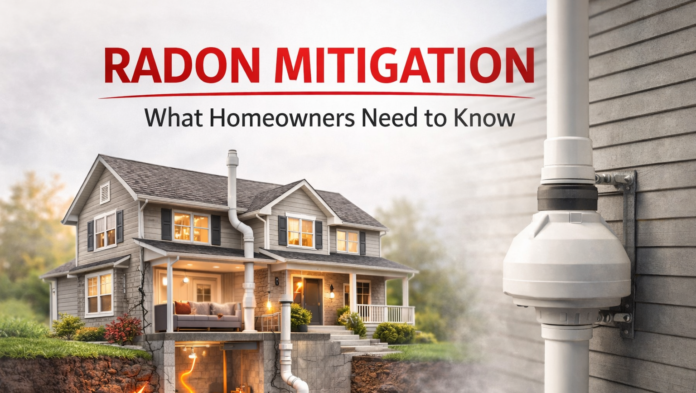
Most residential mitigation is a fan-based soil depressurization system. It uses a suction point and piping to pull radon-laden soil gas from beneath the home and exhaust it outdoors. A proper installation usually includes more than a fan and a pipe.
When a quote is legitimate, you are generally paying for:
- System design matched to the foundation type and sub-slab or crawl space conditions
- Labor to create the suction point, route piping, mount and wire the fan, and seal the system
- Materials including piping, fittings, fan, supports, and roof or exterior discharge components
- Safety and standards details like correct fan placement, correct discharge location, labeling, and a warning device
- Verification guidance including post-mitigation testing recommendations
If a quote is extremely low, it is often missing one of those elements.
Cost breakdown: install, testing, and ownership
A helpful way to think about cost is in three layers: installation cost, verification cost, and ownership cost.
1) Installation cost
This is the number most homeowners focus on. It typically covers the physical system installation and the labor needed to get it running.
| Cost item | What it covers | Why it changes |
|---|---|---|
| Base mitigation system install | Suction point, piping route, radon fan, discharge termination, basic sealing, labeling, warning device | Foundation type, routing difficulty, number of suction points, finished vs unfinished areas |
| Electrical work | Outlet installation, wiring, dedicated circuit if needed | Fan location, existing electrical access, local code requirements |
| Permits and inspections | Any required permits and inspections | Varies by location and scope |
| Crawl space membrane work | Membrane, seam sealing, wall attachment, suction under membrane | Crawl space size, access, need for full encapsulation details |
| Multiple suction points or multiple systems | Additional suction points, extra piping, sometimes additional fans | Complex slabs, low permeability sub-slab materials, split foundations |
2) Verification cost
After installation, the system has to be proven by testing. Guidance commonly recommends a post-mitigation test within 30 days of installation, no sooner than 24 hours after the system is operating. Many homeowners use a short-term test for confirmation and then consider a longer-term test later for a better average.
Verification usually includes:
- Post-mitigation radon testing
- Keeping the results as part of your home record
- Retesting periodically, often every two years, and after major remodeling
3) Ownership cost
Once installed, the system runs continuously. Long-term ownership costs typically come from:
- Electricity for the fan
- Possible heating and cooling impact if the system draws some conditioned air from the home, which can be minimized by effective sealing
- Fan replacement at some point in the future
- Periodic retesting
A simple electricity estimate looks like this:
(Fan watts ÷ 1000) × 24 × 365 × your electricity rate per kWh
Example: a 70-watt fan at $0.15 per kWh is roughly (0.07 × 8760 × 0.15) = about $92 per year. Many sources describe radon fan power use as similar to running a 60 to 90 watt light bulb continuously.
Fan lifespan varies. Guidance notes fans may last five years or more and warranties often do not exceed five years. National Radon Program Services also notes that fan warranties are typically five years and lifespans are often in the 10 to 15 year range depending on conditions. Plan for eventual replacement as normal home maintenance.
The biggest cost drivers
When quotes differ, the difference is usually explained by one or more of these factors.
Foundation type
- Basement and slab homes often use sub-slab suction and are the most common “standard” systems.
- Crawl spaces often require a sealed membrane and sub-membrane suction, which adds materials and labor.
- Mixed foundations (basement plus slab addition) can require more complex design.
Number of suction points needed
Some homes are easy to influence with one suction point. Others are not. Low permeability soils, thicker slabs, interior footings, and complicated slab layouts can limit pressure field extension. More suction points means more coring, more piping, and more labor.
Piping route and aesthetics
Routing is a major price lever. An exterior pipe run is often simpler and can be cheaper. An interior route through closets or finished spaces can look cleaner but can increase labor. Some homeowners choose to pay more to hide the pipe. Others choose an exterior route to reduce cost.
Finished basement versus unfinished basement
Finished basements can increase cost because access is restricted and installers need to protect finishes. Routing options can also be limited, which can force a longer path or more complex concealment.
Electrical access and code requirements
Fans need reliable power. If there is no nearby outlet, electrical work can add cost. Some jurisdictions require permits for certain electrical changes.
Accessibility
Tight crawl spaces, difficult attic access, steep roofs, and complicated roof penetrations add labor time. Labor time is one of the largest parts of the quote.
Local market factors
Labor costs vary by region. Demand varies seasonally and by local radon awareness. Your local market will affect the final number even if two homes are identical.
Costs by foundation type and common scenarios
Instead of trying to guess your price from a single national average, it helps to map your home to a scenario.
Scenario A: Standard unfinished basement or slab home
This is the most common case. A single suction point system with a straightforward piping route often falls near the national averages.
Scenario B: Finished basement with limited routing options
Costs often increase because installers must route piping carefully and may need to run exterior piping or build a more complex interior route. The system itself may be similar, but the labor time is higher.
Scenario C: Crawl space home requiring a membrane system
Crawl space systems often cost more because they add membrane material, sealing, and additional labor working in a tight space. If a full encapsulation-style install is required, costs can increase further.
Scenario D: Mixed foundation or split-level home
Mixed foundation homes can require multiple suction points or a more complex design to influence all foundation sections. This can push costs above the standard range.
Scenario E: High radon plus complex sub-slab conditions
High radon combined with low permeability sub-slab material can require more diagnostic work, additional suction points, or changes in system design. This is one of the more common reasons quotes climb above the typical range.
How to compare mitigation quotes
Do not compare quotes by total price alone. Compare the system design and the safety details. Use this checklist.
| Quote item | What you want to see | Why it matters |
|---|---|---|
| System type | Sub-slab suction, drain tile suction, sump suction, or crawl space membrane system clearly described | Wrong method can underperform or create avoidable issues |
| Fan location | Fan placed outside occupied space (attic, appropriate garage space, or exterior) | Reduces risk of soil gas leaks affecting indoor air |
| Discharge termination | Discharge routed to a location that minimizes re-entry risk, often above the roofline | Prevents exhaust from being pulled back into the home |
| Warning device | A visible or audible indicator that the system is operating | Fans can fail silently without monitoring |
| Sealing scope | Basic sealing included where appropriate, especially around the suction point and sump cover if used | Improves system efficiency and reduces energy loss |
| Post-mitigation testing plan | Clear guidance for confirmation testing after installation | Mitigation is only proven by a lower test result |
| Warranty | Workmanship warranty and clear fan warranty terms | Reduces risk if adjustments are needed |
EPA and other guidance commonly recommend getting estimates from one or more qualified contractors. If possible, get at least two bids so you can compare system approaches and routing decisions.
How to lower cost without cutting corners
There are reasonable ways to reduce cost without sacrificing performance.
- Be flexible on the piping route. If you are comfortable with an exterior route, it can reduce labor in some homes.
- Bundle work when it makes sense. If you are already remodeling the basement, it might be easier to route piping during that work.
- Ask the contractor to explain suction coverage. If one bid proposes multiple suction points, ask why. It may be necessary, or it may be overly conservative.
- Do not pay extra for cosmetic upgrades that do not affect performance. Some add-ons are purely aesthetic.
- Do not skip the warning device or the confirmation test. Skipping these creates false savings and higher risk.
Can you get help paying for mitigation?
Sometimes. The reality is mixed.
- National Radon Program Services notes that some federal programs might be used to help fund radon reduction in affordable housing contexts, but these programs typically fund local agencies or groups rather than providing direct payments to individual homeowners.
- EPA notes that State Indoor Radon Grant funds support state and tribal programs, but by law these funds are not available to individuals or homeowners.
The practical best step is to contact your state radon office and ask whether your state, county, or local health or housing programs offer any assistance, loan programs, or community-funded projects for mitigation.
New construction: what it costs to build radon resistance in
If you are building a new home, it is often cheaper to include radon-resistant features during construction than to retrofit later. EPA states that radon-resistant new construction typically costs a builder between $250 and $750, and can be less than $250 if the builder already uses similar moisture control techniques.
Even with radon-resistant features, the home should still be tested after occupancy. The value is that if radon is elevated, upgrading from passive to active can be simpler and cheaper than building a full system from scratch.
Bottom line
Most homeowners can plan around a national average near $1,200, with many installs falling somewhere in the $800 to $2,500 range. Your true price depends more on foundation type, routing difficulty, and suction coverage than on the radon number itself.
When evaluating cost, prioritize a complete system: proper fan placement, proper discharge location, a warning device, and post-mitigation testing. Those items are not optional if you want a result you can trust.
Sources
- National Radon Program Services (Kansas State University) – Intro to Mitigation (average cost and range)
- National Radon Program Services (Kansas State University) – Reducing Radon In Your Home (cost factors, fan power, fan lifespan)
- U.S. Environmental Protection Agency (EPA) – How much can a radon mitigation system cost?
- Centers for Disease Control and Prevention (CDC) – Reducing Radon Levels in Your Home (cost context, retesting guidance)
- Kansas Radon Program – Mitigation (example cost range and post-mitigation retesting guidance)
- U.S. EPA – Radon-Resistant New Construction for Home Buyers (RRNC cost range)
- National Radon Program Services – Are there funds to help with mitigation?
- U.S. EPA – State and Tribal Indoor Radon Grants (SIRG) Program and Resources (grant limitations for homeowners)