
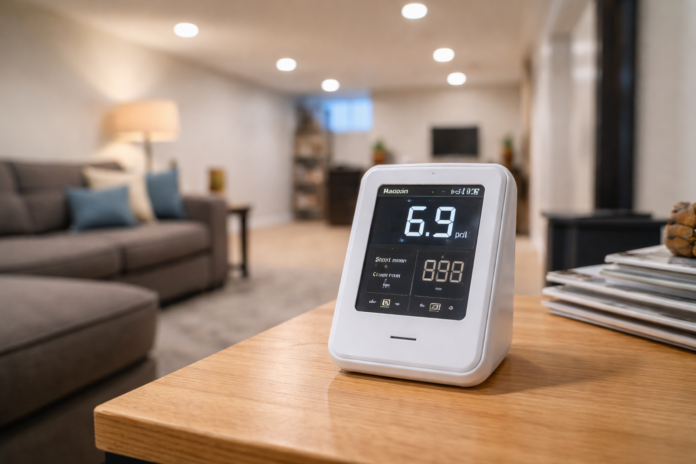
What to Do If Your Digital Radon Detector Reads High
Seeing a high number on a digital radon detector can be unsettling, especially because radon is invisible and you cannot “sense” it. The good news is that a high reading is something you can act on. Your next steps are not complicated, but they do need to be structured. Most mistakes happen when people either panic over a short spike or dismiss a sustained high average because “the number changes a lot.”
This deep dive guide gives you a calm, step-by-step plan. You will learn how to interpret what your device is actually showing, how to rule out common setup and placement issues, how to confirm the result properly, and when it is time to move forward with mitigation.
First, do not panic: high does not always mean urgent
Radon risk is driven by long-term exposure. A digital detector can show you hour-by-hour variation, which makes the situation feel more dramatic than it usually is. A single high number is not the same as a sustained high average.
Your goal is to answer two questions:
- Is the high reading a short-term spike or a sustained average?
- If it is sustained, what is the best next action: confirm, mitigate, or both?
Step 1: Identify which number is “high”
Digital radon detectors typically display multiple averages. Before you do anything else, write down exactly what the device is showing:
- Units: pCi/L (common in the U.S.) or Bq/m³
- Which average is high: 1-day, 2-day, 7-day, 30-day, or a “current” value
- How long the device has been running in its current location
- Where the device is located (level and room)
This matters because a high “today” number can be noise, while a high 30-day number is a meaningful signal. If your device only shows one number, find out whether that number is a short rolling average or a long rolling average. Many monitors update frequently but base their displayed value on a specific time window.
Step 2: How high is high?
In the U.S., the EPA action level is 4.0 pCi/L. EPA also recommends considering action between 2.0 and 4.0 pCi/L because there is no known safe level and lower is better.
For context, 4.0 pCi/L is commonly shown as about 150 Bq/m³.
When evaluating “how high,” use the longest average your device provides. If your longest average is clearly above 4.0 pCi/L, you are likely looking at a real issue, not a spike.
Quick decision table: what to do by reading
Use this table as an immediate triage tool. It assumes you are looking at your device’s longest available average.
| Longest Average Reading | What it Usually Means | What to Do Next |
|---|---|---|
| Below 2.0 pCi/L | Generally lower long-term exposure | Keep monitoring, retest periodically, retest after major remodeling |
| 2.0 to 3.9 pCi/L | Moderate range, not “safe,” but below EPA action level | Consider a long-term lab test for a true average. Consider mitigation based on time spent in the lowest level and household risk factors |
| 4.0 to 9.9 pCi/L | Elevated, at or above action level | Confirm appropriately, then plan mitigation. Many homeowners move straight to mitigation if the reading is clearly sustained |
| 10.0 pCi/L or higher | High, sustained exposure is a strong reason to act | Move toward mitigation as soon as practical. Use confirmation testing if needed, but do not delay action for long if the high level persists |
If your longest average is not available yet (for example, the device has been running only a day), skip the table and move to the stabilization steps below.
Step 3: Check the device basics
Before you assume the home has a high radon problem, confirm you are not dealing with something simple.
Confirm the units
If your device is set to Bq/m³ and you are thinking in pCi/L, you can misread the severity. Make sure you know which unit you are viewing.
Confirm the location has not changed
If you recently moved the device, the averages may reflect a blend of old and new conditions. Treat a moved device as a new test.
Check for error codes or warnings
If your monitor indicates sensor error, unusual humidity, or calibration warnings, address that first. A failing sensor can produce nonsense values.
Do a simple consistency check
Without changing anything, note the reading today and again in 24 hours. If it is wildly erratic and the device is new to the location, you may be seeing stabilization behavior. If it is consistently elevated, you may be seeing the real baseline.
Step 4: Fix placement problems first
Bad placement is one of the most common reasons people get confusing readings. Placement issues can produce false lows and false highs, but the most important thing is that poor placement can make the reading non-representative of real exposure.
Place the device on the lowest lived-in level
CDC guidance emphasizes testing in the basement or lowest level of the home. The basic idea is to measure where radon is most likely to be elevated and where people actually spend time.
Choose a room people use
Good rooms include a family room, bedroom, office, or finished basement living area. If you work in a basement office daily, that room matters more than a storage room upstairs.
Avoid “bad rooms” and “bad spots”
National Radon Program Services provides clear guidance on avoiding kitchens, bathrooms, laundry rooms, and hallways, and it also notes that high humidity and drafty conditions can bias results from some test devices.
Avoid placing the detector:
- Next to windows or exterior doors
- Directly in airflow from HVAC supply or return vents
- Right beside a sump pit, floor drain, or crawl space opening (unless you are intentionally diagnosing entry points)
- In direct sunlight or near strong heat sources
Keep it at a reasonable height
CDC instructions for home testing describe placing the device raised off the floor and positioned in a way that reflects the room air, not the boundary layer on the floor.
Practical rule: put it on a shelf or table in the breathing-zone range, and leave it there.
Step 5: Give it enough time to stabilize
This step is where many people go wrong. Digital devices can show a number quickly, but a quick number is not the best decision number.
Use this timeline:
- First 48 hours: treat the reading as an early estimate. Do not make a major decision based on this alone.
- After 7 days: you start seeing meaningful patterns. Weekly averages are useful for trend direction.
- After 30 days: you usually have a much more stable baseline. If your 30-day average is elevated, the issue is likely real.
Radon levels naturally fluctuate. A longer average is more representative of exposure risk. This is why CDC describes long-term kits as better for reflecting year-round average levels. The same concept applies to a digital device’s longer averaging windows.
Step 6: Check your house conditions that can create false signals
Even with perfect placement, your home conditions can make readings look higher or lower than you expect. Some of this is normal. Some of it is avoidable.
Ventilation habits
Opening windows and increasing airflow can temporarily reduce radon. If your “high” reading happened during a period of very closed conditions, and you normally ventilate heavily, your long-term average might be lower than a short snapshot suggests.
On the other hand, if you usually keep windows closed for much of the year (very common in hot or cold seasons), then the closed condition reading is relevant to real exposure.
Basement door position and stack effect
Many homes pull air upward. Warm air rises, and that can draw soil gas into lower levels. If your basement is the main radon zone, changes in door position and airflow patterns can shift readings.
Exhaust appliances and fans
Bath fans, dryers, range hoods, and fireplaces can change pressure relationships. If your reading climbs during heavy exhaust use, it may be showing a real behavior in your home.
Storms and pressure changes
Weather can legitimately shift radon entry. If your high reading lines up with a storm period, look at the longer average rather than treating the storm spike as your “true level.”
Step 7: Confirm the result the right way
If your digital detector’s longer averages remain elevated, the next move is confirmation. Confirmation gives you confidence and documentation, and it prevents mistakes like spending money based on a device placed in a bad location.
There are two strong confirmation paths:
Option A: Long-term lab test (best estimate of true average)
If your digital detector suggests a moderate or borderline elevation, a long-term test (90+ days) is often the cleanest way to estimate true average exposure. CDC describes long-term testing as better for reflecting your year-round average radon level.
Option B: Repeat measurement under controlled conditions
If your reading is clearly elevated and you want a faster confirmation, a second measurement can help. This might be a second device in the same placement or a short-term test kit placed correctly.
Important: do not “confirm” by moving the digital monitor to a different room and comparing numbers. That creates a new measurement, not confirmation.
How to confirm without confusing yourself
- Keep the digital monitor in place.
- Run a separate test (short-term or long-term) in the same general area.
- Compare time windows as fairly as possible. A 2-day test can differ from a 30-day average, even if both are valid.
Step 8: What to do if elevated levels are confirmed
If confirmation supports elevated radon, the plan becomes straightforward.
If the sustained level is at or above 4.0 pCi/L
EPA recommends fixing the home at or above 4.0 pCi/L. CDC also states that EPA recommends installing a radon reduction system if your radon level is at or above 4.0 pCi/L.
The most commonly used method is a vent pipe system with a fan (soil depressurization), which pulls radon from beneath the house and vents it outside.
If the sustained level is between 2.0 and 4.0 pCi/L
EPA recommends considering action in this range. CDC also notes the 2.0 to 4.0 pCi/L range as a place where action to reduce radon may be appropriate.
Many homeowners choose a long-term test here to estimate the true average before committing to mitigation, especially if cost is a concern. Others choose to mitigate anyway, particularly if they spend a lot of time on the lowest level or there is smoking history in the household.
How to choose a contractor wisely
If you move to mitigation, get more than one quote when possible and compare on design, not only price. Ask:
- What mitigation method are you recommending for my foundation type?
- Where will the fan be placed?
- Where will the system discharge terminate?
- What warning device or system indicator will be installed?
- What is your plan for post-mitigation testing?
EPA’s guidance on finding a radon test kit or professional is a good starting point for locating qualified help through your state radon program resources.
Step 9: Temporary steps to reduce exposure while you plan
Temporary steps are not mitigation, but they can be reasonable while you schedule confirmation testing or installation.
Reduce time in the highest zone
If the high readings are in a basement and you spend many hours there, consider shifting work or sleep to an upper level temporarily. This reduces exposure without changing the home.
Increase ventilation carefully
CDC notes that natural ventilation should not be considered mitigation because it is temporary. Still, temporary ventilation can reduce levels during the period you are planning a permanent fix. Think of it as a short-term tactic, not a solution.
Do not turn this into a long-term routine
Living with windows open year-round is not realistic for most households. The goal is to get a durable system in place if sustained levels are elevated.
Step 10: Using a digital detector after mitigation
Digital detectors are excellent after mitigation. They can show you that the system is working and can help you notice changes that might indicate fan failure or system problems.
A strong post-mitigation approach:
- Keep the monitor in the same location so comparisons are meaningful.
- Watch the longer averages for at least 30 days after installation.
- Do a formal post-mitigation test to document the improvement.
- Continue periodic retesting. CDC suggests retesting about every two years and after remodeling.
Common mistakes that cause bad decisions
- Reacting to a spike: a one-day spike can happen. Use the longest average for decisions.
- Moving the device repeatedly: you lose comparability and create confusion.
- Testing in a bad room: kitchens, bathrooms, laundry rooms, and drafty areas can bias results.
- Using the wrong level: testing upstairs when you live in the basement can underestimate exposure.
- Skipping confirmation: if your situation is borderline or confusing, a long-term test gives clarity.
- Skipping post-mitigation testing: the system is only proven by a lower measured result.
Bottom line
If your digital radon detector reads high, the correct response is structured, not emotional. Identify which average is high, confirm placement, give the device enough time to stabilize, and focus on the longest average for decisions. If the longer average remains elevated, confirm with an appropriate test and move toward mitigation when levels are sustained at or above the EPA action level.
Radon is invisible, but it is measurable. A high reading is not the end of the story. It is the start of a clear action plan.
Sources
- U.S. Environmental Protection Agency (EPA) – What is EPA’s action level for radon and what does it mean?
- U.S. Environmental Protection Agency (EPA) – Are radon measurements accurate and reliable?
- U.S. Environmental Protection Agency (EPA) – Find a radon test kit or measurement and mitigation professional
- Centers for Disease Control and Prevention (CDC) – Testing for Radon in Your Home
- Centers for Disease Control and Prevention (CDC) – Reducing Radon Levels in Your Home
- National Radon Program Services (Kansas State University) – Testing protocols and placement guidance