Radon Mitigation Costs: What Homeowners Should Expect
After a radon test comes back elevated, the next question is usually about cost. How much will it take to fix? What drives the price up or down? And what costs show up later after the system is installed?
This guide breaks down radon mitigation costs in a practical way. You will learn typical price ranges, what is included, which home features increase cost, and how to compare quotes so you are paying for performance and safety, not just a fan and a pipe.
Quick answer: typical radon mitigation cost range
Most single-family homes can be mitigated for a price similar to other common home repairs. A widely cited national range for contractor-installed radon reduction is about $800 to $2,500, with an average around $1,200 in many markets.
That range assumes a typical soil suction system (pipe plus fan) for a standard home. Crawl spaces, complex foundations, finished basements, or difficult routing can push costs higher.
Radon mitigation cost chart
| Cost Item | Typical Range | What it Usually Includes |
|---|---|---|
| Standard radon mitigation system (most homes) | $800 to $2,500 (average about $1,200) | Active soil depressurization system: suction point, PVC piping, radon fan, roof discharge routing, basic sealing, system labeling, startup check |
| Crawl space mitigation (sub-membrane system) | Often higher than standard | Sealed membrane, sealing/taping, suction connection under membrane, fan and venting, additional labor due to crawl space access |
| Post-mitigation confirmation test | Varies | A radon test after installation to confirm the system reduced levels |
| Fan replacement later | About $200 to $350 installed | Replacement of the radon fan (parts and labor), depending on access and local labor rates |
Use this table as a planning tool, not as a quote. The correct number for your home depends on your foundation type, layout, and how hard it is to create suction under the slab or membrane.
What drives the cost of radon mitigation?
Radon mitigation pricing is not random. It usually comes down to the home’s design and how difficult it is to create a pressure field under the foundation. Here are the biggest cost drivers.
1) Foundation type
- Basement and slab homes: Most commonly use sub-slab suction (soil depressurization). These are often the “standard” systems people think of.
- Crawl spaces: Often need a sealed membrane and sub-membrane suction. This adds materials and labor.
- Mixed foundations: Homes with a basement plus slab addition can require special design, multiple suction points, or more complicated routing.
2) Number of suction points needed
Some slabs are easy to influence with one suction point. Others are not. Soil type, sub-slab material, footings, and slab layout can limit how far suction reaches. When suction does not extend far enough, the system may need additional suction points, additional piping, or a different collection strategy.
3) Piping route and aesthetics
A straight pipe run is cheaper and often quieter. A route that hides piping inside closets, walls, or finished areas can look better, but it can increase labor and complexity. Some homeowners choose exterior routing to reduce cost, while others pay more for a concealed interior route.
4) Sump pit and drain tile details
If the home has a sump pit or perimeter drain tile, a mitigation system may connect to it as part of the suction strategy. This can be a benefit, but it often requires a properly sealed sump cover and careful workmanship so water management still functions correctly.
5) Electrical work and permits
Radon fans run continuously and need reliable power. Some installations require adding an outlet, running a dedicated circuit, or pulling a permit depending on local rules. These items can add cost, especially when the fan location is in an attic or other difficult-to-access area.
6) Access and difficulty
Two homes can have the same radon level and very different installation costs because one is easy to work on and the other is not. Tight crawl spaces, limited attic access, complex roof penetrations, or finished lower levels can increase labor and price.
What is usually included in a “standard” mitigation quote?
Most contractor quotes for a typical soil suction system include these components:
- A suction point through the slab (or connection to an approved collection method)
- PVC piping from the suction point to the discharge point
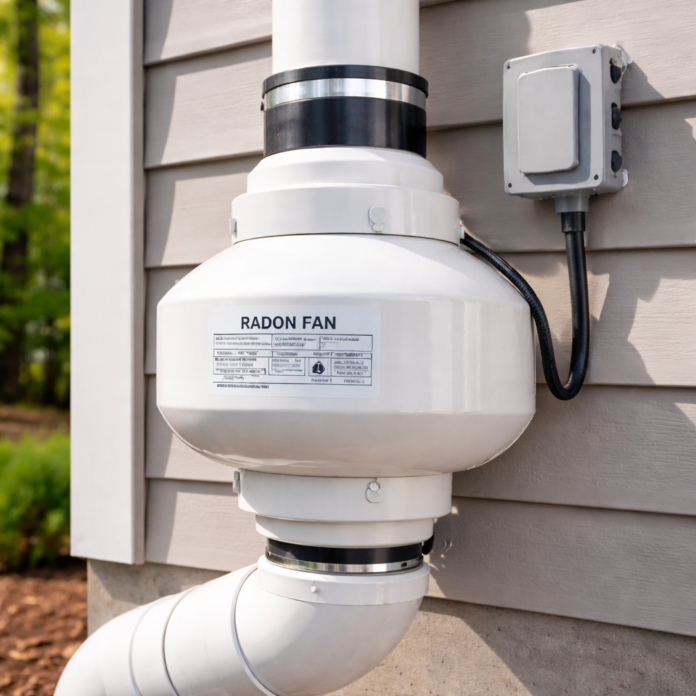
- A continuously operating radon fan
- Exhaust discharge routed to a safe location (often above the roofline)
- Basic sealing at key openings used for the system
- A system performance indicator or warning device
- Labeling of system components
If your quote is missing key items like a warning device, clear discharge routing, or post-installation testing guidance, that is a red flag. A radon system is not just a fan and a pipe. It is a safety system.
Ongoing costs after installation
Most homeowners think only about installation price, but there are a few ongoing costs to keep in mind.
1) Electricity to run the fan
Radon fans run continuously. Most are low power, so operating cost is usually modest. If you want to estimate your cost, use this simple math:
(Fan watts ÷ 1000) × 24 × 365 × your electricity rate per kWh
Example: A 70-watt fan at $0.15 per kWh would be about $92 per year. Your actual cost depends on fan wattage, system resistance, and local electric rates.
2) Fan replacement
Fans do not last forever. EPA notes that fans may last five years or more and may eventually need repair or replacement. EPA also provides a typical fan replacement cost around $200 to $350 including parts and labor.
3) Retesting
After a system is installed, you should test again to confirm the system worked. Retesting periodically (for example, every two years) is also recommended to make sure levels remain low, and to catch issues like fan failure early.
How to compare mitigation quotes
When you get multiple bids, it helps to compare quotes on a consistent checklist instead of comparing only the total number.
- What system type is proposed? Sub-slab suction, drain tile suction, sump suction, crawl space membrane, or a combination.
- Where will the fan be located? It should not be in or below livable space.
- Where will the discharge terminate? The discharge should be located to minimize re-entry risk.
- Is a warning device included? You should have a visible or audible way to tell the system is operating.
- What is the warranty? Ask about fan warranty and workmanship warranty.
- Will the contractor provide post-install guidance? You should be told how to monitor the system and when to retest.
If one quote is far cheaper than the others, ask what is being omitted. Low cost often means shortcuts: poor routing, weak sealing, no warning device, or a design that is not matched to the foundation.
Ways homeowners accidentally waste money
Here are common cost mistakes that lead to extra spending later:
- Skipping the confirmation test and assuming the system worked without measuring.
- Choosing the lowest quote with unclear design and then paying to fix underperformance later.
- Turning off the fan to save electricity, which can allow radon levels to rise again.
- Not checking the warning device and missing a fan failure for months.
Bottom line
Most homes can be mitigated with a fan-based soil suction system for a price comparable to other common home repairs. A practical national planning range is about $800 to $2,500, with many homes around $1,200, but your foundation type, system routing, and number of suction points can shift the total.
When evaluating cost, do not focus only on the install price. Think in terms of total ownership: a properly designed system, correct discharge location, a warning device you will actually notice, confirmation testing, and periodic retesting. That is how you pay once and stay protected long-term.
Sources
- National Radon Program Services (Kansas State University) – Intro to Mitigation (cost range and averages)
- National Radon Program Services (Kansas State University) – Reducing Radon in Your Home (cost factors, power use, retesting)
- Centers for Disease Control and Prevention (CDC) – Reducing Radon Levels in Your Home (cost context and retesting)
- U.S. Environmental Protection Agency (EPA) – How much can a radon mitigation system cost?
- U.S. Environmental Protection Agency (EPA) – How do I know if my radon mitigation system is working properly?
- U.S. Environmental Protection Agency (EPA) – Consumer’s Guide to Radon Reduction (PDF)
- Kansas Radon Program – Mitigation overview (local range example)