
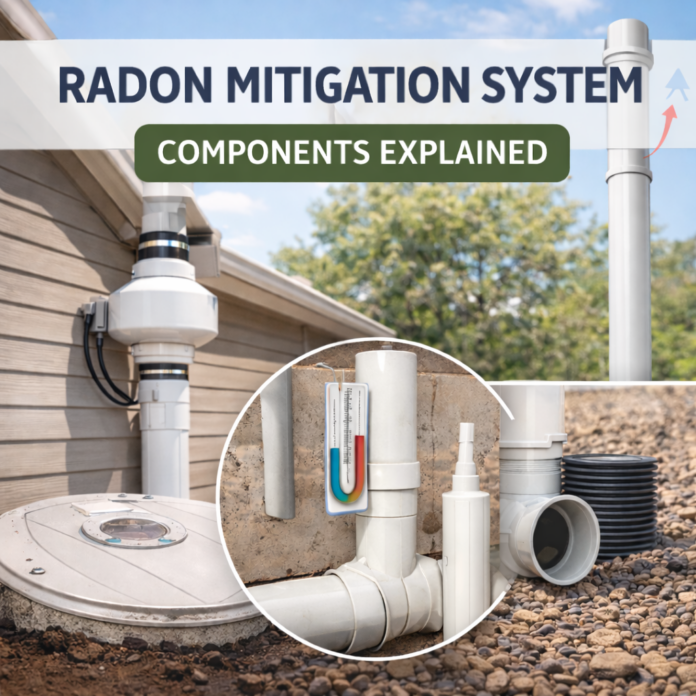
Radon Mitigation System Components Explained
A radon mitigation system is not one single device. It is a set of components that work together to reduce radon entering a building and to safely vent radon outdoors. In most homes, the most common approach is a vent pipe system with a continuously running fan that pulls radon from beneath the house and vents it outside. This is often referred to as a soil depressurization system.
Homeowners usually notice the fan first, but the fan is only one part of the system. A high quality installation depends on the collection point under the home, the piping layout, how the exhaust is discharged, how the system is sealed, and how the system is monitored over time. This guide breaks down each major component, explains what it does, and highlights the most common design and installation mistakes that impact performance.
What a radon mitigation system is
A radon mitigation system is any set of steps designed to reduce radon concentrations in the indoor air of a building. In many homes, the most common and proven method is a vent pipe system and fan that pulls radon from beneath the house and vents it outside. Sealing foundation openings can make this approach more effective, but sealing by itself is rarely the complete solution when radon is elevated.
The system is successful only if post-installation testing shows that indoor radon levels dropped and remain low over time.
Common mitigation system types
Most residential radon systems fall into a few common categories. The components are similar, but the collection point and airflow path differ.
- Sub-slab depressurization: A suction point is created through the slab, and soil gas is pulled from beneath the slab into the piping.
- Drain tile suction: The system connects to a perimeter drain tile network to draw soil gas from around the foundation.
- Sump pit suction: A sealed sump lid becomes part of the collection point, allowing suction to extend into sub-slab areas and drain pathways.
- Block wall suction (in some homes): Suction is applied to hollow block walls, sometimes combined with sub-slab suction.
- Sub-membrane depressurization for crawl spaces: A sealed membrane covers the crawl space floor, and soil gas is pulled from beneath the membrane and vented outdoors.
Homes can also require combinations of these approaches, especially when the home has more than one foundation type.
Core components in most radon systems
Collection point and suction location
The collection point is where the system gathers radon-laden soil gas before it enters the pipe. This is the foundation of the system. If the collection point is poorly chosen or too small for the home’s sub-slab conditions, the fan may run constantly but the system may still struggle to reduce radon effectively.
Common collection approaches include:
- Suction pit under the slab: A small cavity is created beneath the slab where the pipe enters. This can improve airflow under the slab and extend the pressure field.
- Connection to drain tile: If the home has a perimeter drain tile system, it can provide a pathway for air movement that allows suction to reach more areas.
- Sealed sump pit connection: A sump pit can be an effective collection point when sealed properly. The seal matters because an unsealed sump can act as a direct radon entry pathway.
- Block wall connection: Hollow block walls can hold soil gas. A system may draw from the wall cavities in certain designs.
What “good” looks like:
- The collection point is located where it can influence a wide area under the foundation.
- The entry into the pipe is airtight and durable.
- The system avoids creating new entry paths for radon into the living space.
Piping and fittings
The piping is the transport system. It carries soil gas from the collection point to the discharge location. Even though the pipe looks simple, layout decisions affect performance, noise, and long-term reliability.
Key piping concepts:
- Airflow resistance: Long pipe runs, many elbows, and restrictive fittings increase resistance. Higher resistance can reduce airflow and weaken the pressure field under the slab unless the fan is appropriately matched.
- Leak control: Leaks on the suction side of the fan can pull radon into the building if the fan is installed in or below occupied space. Good systems seal joints and route piping through appropriate areas.
- Support and stability: Pipes should be supported to prevent sagging, vibration, and movement over time. Poor support can lead to noise and joint stress.
Common pipe and fitting components include couplings, elbows, reducers, unions, and cleanouts. Not every system uses all of these, but most systems use enough fittings that layout efficiency matters.
Radon fan
The fan is what turns a passive vent into an active mitigation system. It runs continuously and creates suction in the pipe, pulling soil gas from beneath the foundation and exhausting it outside.
Key fan concepts:
- Continuous duty: Mitigation fans are designed to run 24/7.
- Fan matching: The best fan is the one that matches the home’s resistance and suction needs. Bigger is not always better. A fan that is oversized can create more noise and energy use without improving pressure field extension.
- Fan placement safety: Fans are typically installed outside of occupied spaces so that any leak on the suction side does not pull radon into living areas.
Exhaust discharge and termination
The system does not remove radon from existence. It moves it from beneath the house to the outdoor air where it can dilute quickly. This is why discharge location matters.
General principles:
- Discharge above the roofline: Many standard approaches vent above the roof to reduce the chance of radon being pulled back into the home.
- Avoid re-entry pathways: The exhaust point should not be near windows, doors, soffit vents, or other openings where exhaust could re-enter.
- Avoid ground-level discharge: Ground-level discharge is discouraged due to re-entrainment risk and concerns about higher concentrations near the discharge point.
In a well-designed system, the exhaust path is clear, properly routed, and terminates where dilution is rapid and re-entry risk is low.
Sealing, covers, and entry-point controls
Sealing is not usually the primary mitigation method, but it is an important supporting component. Sealing reduces easy entry pathways and can make a soil depressurization system more effective and cost-efficient.
Common sealing and entry control components include:
- Foundation crack sealing: Sealing visible cracks and slab openings can reduce direct radon entry and reduce system air loss.
- Penetration sealing: Gaps around plumbing penetrations, floor drains, and utility entries can be sealed to reduce soil gas entry.
- Sealed sump covers: A sealed sump cover can both prevent radon entry and allow the sump pit to function as a suction point when designed that way.
- Backer rod and sealant details: Used to create durable seals in gaps and joints.
Sealing tends to provide the most value when it supports a fan-driven soil depressurization system, rather than being used as the only strategy for elevated radon.
System monitoring and warning devices
A radon system should include a way to tell if it is running. This is where monitoring components matter.
Common monitoring components include:
- Manometer (pressure gauge): Often a U-tube gauge that shows pressure difference and provides a visual signal that the fan is operating.
- Fan failure alarm: Audible or visual alarms that alert homeowners to a loss of pressure or fan operation.
- Other indicators: Some systems use light indicators or digital pressure gauges.
Homeowners should check the warning device regularly. A warning device helps you notice issues early, especially since the fan often runs in an attic, garage, or exterior location where you may not notice a failure immediately.
Electrical and power considerations
Radon fans require continuous power. Electrical details vary by home and local code requirements, but the practical goals are consistent:
- The fan should have reliable power and should not be plugged into an outlet likely to be switched off.
- The wiring and receptacle should be installed according to local electrical codes.
- The fan should be accessible for service without unsafe workarounds.
From a homeowner perspective, the main takeaway is simple: do not unplug the fan or switch it off. If the fan stops, radon levels can rise again.
Labels and documentation
Good systems are labeled and documented. The goal is to prevent accidental disconnection and to make future service easier.
Common documentation and labeling includes:
- Labels on the system piping identifying it as part of a radon reduction system
- System information provided to the homeowner, including basic operating guidance
- Post-mitigation test results kept as part of home records
This also helps during resale. A home with clear documentation and retest history is easier to evaluate and easier to maintain.
Crawl space system components
Crawl space mitigation systems often share the same fan and discharge concepts, but they include additional components focused on sealing the crawl space ground surface.
Key crawl space components include:
- Membrane (vapor barrier): A durable plastic membrane that covers the crawl space floor.
- Seam tape and sealing materials: Used to seal overlaps, seams, and edges to reduce leakage.
- Wall attachment methods: Methods to secure and seal the membrane at the perimeter.
- Suction connection under the membrane: A pipe connection designed to pull soil gas from beneath the sealed layer.
In crawl spaces, sealing quality can make or break system performance. If the membrane leaks heavily, suction may short-circuit and fail to control soil gas effectively.
Diagnostics and performance checks
Professionals often use diagnostics to design a system and confirm it is performing as intended. This is especially important in complex homes or when initial designs do not reduce radon enough.
Common diagnostic concepts include:
- Pressure field extension testing: Checks how far suction influence extends under the slab.
- System pressure checks: Confirms expected pressure levels within the piping.
- Smoke testing and leak checks: Helps identify suction-side leaks and airflow pathways.
You do not need to become a mitigation technician to benefit from this. The key homeowner takeaway is that system design is not guesswork in a strong installation. It is measured, adjusted, and verified.
After installation: testing and verification
A radon mitigation system is not “done” when the fan turns on. It is done when testing confirms reduced radon levels.
A practical verification sequence looks like this:
- Post-mitigation test: Test again after installation to confirm the system is working.
- Document the result: Keep the test result and the install details for your records.
- Consider a long-term test: In many homes, a long-term test provides the best picture of average exposure after the system has settled into normal operation.
Retesting is also recommended periodically and after remodeling. This is especially important if you finish a basement, change HVAC systems, or alter the building envelope.
Maintenance, fan lifespan, and replacement
Radon systems are low-maintenance, but they are not no-maintenance. The fan is a mechanical device running continuously, so it can eventually fail. Guidance commonly notes that fans may last five years or more, and that warranties tend not to exceed five years. Replacing a fan has a typical cost range referenced by EPA and can vary by region and accessibility.
Practical maintenance habits include:
- Check the warning device regularly.
- Listen for major changes in fan noise if the fan is in a location where it can be safely observed.
- Retest periodically to confirm radon remains low.
Common component-related problems
When systems underperform or become annoying, the cause is often component-related.
- Noisy system: Often caused by vibration transfer, poor pipe supports, or fan wear. Noise can frequently be reduced by better mounting and support.
- Weak performance: Often caused by insufficient suction coverage, wrong fan match, leaks, or an ineffective collection point.
- Condensation problems: Moisture can condense in piping. Poor routing can allow pooling or freezing in cold climates, restricting airflow.
- Fan failure: Can be electrical, mechanical, or moisture-related. Warning devices help detect this quickly.
- Exhaust re-entry risk: Can occur if discharge is routed too close to openings or terminated improperly. Proper discharge location reduces this risk.
If your system is not performing or seems compromised, the fastest path is to confirm with a radon test and contact a qualified radon professional to diagnose the system.
Bottom line
A radon mitigation system is a chain. The collection point, piping, fan, exhaust discharge, sealing, and monitoring components all matter. The best systems are designed to control soil gas entry, vent it safely outdoors, and provide a clear indicator of continued operation. The system is validated by post-installation testing and maintained through periodic retesting and basic monitoring.
If you want a single simple principle, it is this: the presence of a fan is not proof. A working radon system is proven by a lower radon test result that stays low over time.
Sources
- CDC – Reducing Radon Levels in Your Home
- EPA – Consumer’s Guide to Radon Reduction: How to Fix Your Home (PDF)
- EPA – Why must radon be vented into the air above my home’s roof?
- EPA – How do I know if my radon mitigation system is working properly?
- Kansas Radon Program – Mitigation overview
- National Radon Program Services (Kansas State University) – Reducing Radon in Your Home
- ANSI/AARST Standards (SGM-SF and related radon mitigation standards)