
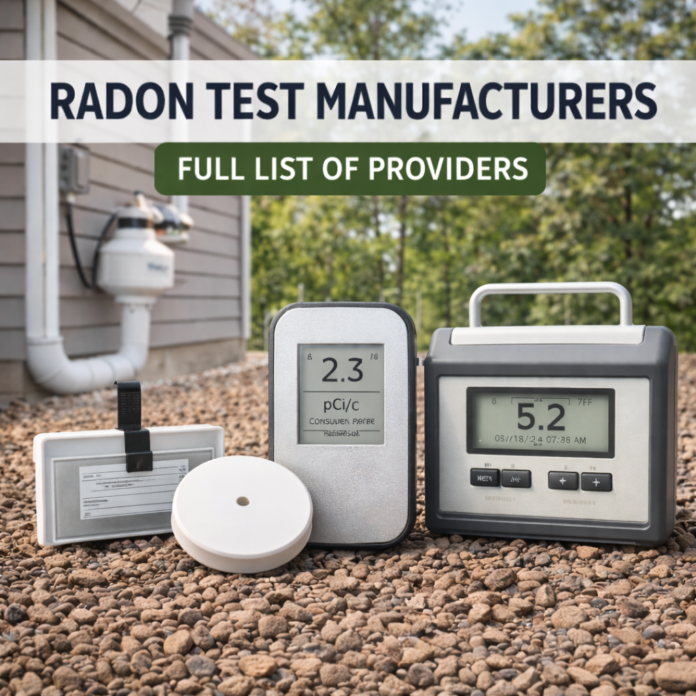
Radon Test Manufacturers: A Deep Dive Directory of Test Kit and Monitor Companies
When people say they need a “radon test,” they might mean very different things. A mail-in charcoal kit from a hardware store. A long-term alpha track test. A digital home monitor that updates daily. Or a professional continuous radon monitor used for real estate and inspection work.
All of those are radon tests, but they come from different kinds of companies. Some companies manufacture devices. Some run accredited labs and sell test kits that they analyze. Others do both, or sell under multiple brand names.
This pillar guide does three things:
- Explains the different categories of radon tests and who makes them.
- Lists major radon test manufacturers and lab-based test providers with direct links to each company.
- Shows you how to verify whether a device is considered “professional grade” using industry listings.
What “radon test manufacturer” actually means
In radon testing, the word “manufacturer” can mean a few different things:
- Device manufacturer: designs and builds the detector or monitor (for example, a professional continuous radon monitor or a consumer digital monitor).
- Passive device maker: produces passive detectors like charcoal canisters, alpha track detectors, or liquid scintillation components.
- Laboratory provider: sells test kits and performs the lab analysis. Many “radon test kits” are really a detector plus the lab analysis service.
- Private label brand: sells a kit under their brand name, but the lab or detector may be provided by another company.
This matters because you might buy a kit branded one way, but the analysis and reporting may be performed by a different laboratory. If you are comparing accuracy, quality control, or turnaround time, the analysis provider is often the key piece.
The main categories of radon tests
Passive test kits (lab analyzed)
Passive kits do not plug in. You deploy them, then ship them to a lab for analysis. The most common types include:
- Charcoal tests (often 2 to 7 days): fast screening, widely available.
- Alpha track tests (often 90 days to 1 year): long-term average, usually the best picture of true exposure.
- Liquid scintillation based tests: common in professional workflows and certain kit types.
Passive tests can be very good, but they are sensitive to following instructions. For example, charcoal tests are time-sensitive and should be mailed promptly after the test ends.
Consumer digital radon monitors (homeowner devices)
Consumer digital monitors (sometimes called CDRMs) are designed for homeowners who want ongoing monitoring without mailing a kit to a lab. You place the device and it reports averages over time.
The upside is convenience and trend visibility. The downside is that consumer devices vary widely, and a single spike should not be treated as your “true” level. Longer averages are what matter.
Professional continuous radon monitors (CRM)
Professional CRMs are used by inspectors and radon professionals, especially in real estate transactions and formal testing protocols. They typically collect time-series data and are commonly used under standards-based procedures.
If you are a homeowner, you do not usually need a professional CRM to make a radon decision. But understanding the pro market is useful because many “accuracy” conversations online are really about professional-grade devices, calibration requirements, and QA expectations.
Electret ion chamber systems
Electret systems are a hybrid category. They use an electret inside an ion chamber to integrate exposure over time. Electret systems are popular in professional settings because they can support short-term and long-term measurements and may be used in structured QA programs.
How to verify device credibility (NRPP, NRSB, standards)
Before buying or recommending a device, it helps to know where the industry looks for “accepted” equipment lists.
- NRPP Approved Devices list: A widely referenced list that includes passive devices and professional electronic monitors, along with device categories and update dates.
- NRSB Approved Devices list: A published list of devices approved for use by NRSB-certified professionals.
- ANSI/AARST measurement standards: Measurement protocols (like MAH) explain how tests should be conducted and documented.
Important nuance: a device listing is not the same as a guarantee. Accuracy still depends on correct deployment, proper calibration (where required), and following testing protocols. Still, these listings are one of the best ways to separate professional-grade equipment from random “radon fan” style inline products that are not meant for radon measurement.
Directory: major radon test manufacturers and lab providers
The directory below focuses on established manufacturers and lab-based test providers that appear frequently in real-world radon testing: homeowners, inspectors, and professional radon programs.
Consumer digital monitor manufacturers
Airthings
Airthings is a major manufacturer of consumer radon and indoor air quality monitors, including products in the Corentium and Wave families. They also offer a professional-focused product line.
Ecosense
Ecosense produces consumer and professional radon monitors, with both display-based models and app-connected models. Their product pages are also useful as educational references for how to interpret averages (hourly, daily, weekly).
SunRADON (consumer and professional monitors)
SunRADON is best known in the professional world for continuous radon monitors used by inspectors and radon professionals, but they also offer consumer-facing long-term monitoring devices.
Professional instrument manufacturers
SunRADON (XP Family of professional continuous radon monitors)
The SunRADON XP family is widely used for professional radon measurements and reporting workflows. If you see “1028 XP” referenced in professional discussions, it is tied to this product family.
DURRIDGE
DURRIDGE manufactures professional radon detection instruments used by universities, governments, and professional testers. Their RAD7 is widely recognized as a professional electronic radon detector.
femto-TECH
femto-TECH manufactures professional continuous radon monitors used in measurement workflows that emphasize instrument performance and formal QA requirements.
Bertin Technologies (AlphaGUARD)
AlphaGUARD is often described as a benchmark instrument for professional radon monitoring in air and related applications.
SARAD
SARAD manufactures radon and thoron monitors used in professional and environmental measurement contexts. Their product pages can be useful if you are comparing professional instrument types.
Pylon Electronics (Radon division)
Pylon’s radon division produces instruments and components used for radon, thoron, and progeny measurement. This brand shows up frequently in professional device lists.
BREEZE (continuous radon monitor system)
BREEZE markets a cloud-managed radon monitoring workflow and continuous radon monitor products aimed at professional testing operations that want automated data handling.
Rad Elec (electret systems and related measurement products)
Rad Elec manufactures the E-PERM electret ion chamber system and related tools used in professional radon measurement workflows.
Lab-based radon test kit providers
These companies sell test kits and also provide the analysis and reporting service, or they operate as major laboratories that support other test kit brands.
AccuStar Labs
AccuStar is a major laboratory and test kit provider. They also reference professional training and device support in their ecosystem.
Air Chek
Air Chek is widely known for mail-in radon test kits and lab analysis services. Their kits are commonly used in state programs and consumer testing.
Radonova
Radonova sells short-term and long-term radon test kits (including alpha track options) and provides lab analysis and reporting services.
Alpha Energy Laboratories (Eurofins Environment Testing Radon)
Alpha Energy Laboratories is a long-running radon lab brand and is associated with Eurofins in the U.S. market.
RTCA (Radon Testing Corporation of America)
RTCA sells test kits and provides radon analysis services, supporting both consumer and professional testing workflows.
PRO-LAB
PRO-LAB is a long-standing environmental test kit brand that sells radon test kits, including short-term and long-term options, with lab analysis as part of the service.
First Alert (test kit brand)
First Alert sells a charcoal-based radon test kit that includes lab fees and a results workflow. This is a common retail brand consumers will recognize.
Radon.com (consumer kits and resources)
Radon.com is a consumer-facing storefront and educational hub that sells radon tests and provides radon resources. This site is closely associated with the “Air Chek” ecosystem that many consumers run into first.
Passive device and canister manufacturers
F&J Specialty Products (radon canisters and related products)
F&J Specialty Products manufactures radon-related sampling products, including radon canisters and related items used in some professional and program workflows.
How to choose the right test type and vendor
Most confusion about “best brand” comes from comparing different test categories. Here is a practical way to choose.
Scenario 1: You want a quick yes or no answer
Use a short-term passive kit from a reputable lab provider, follow placement instructions carefully, and mail it promptly. If the result is close to a decision threshold, confirm with a long-term test or follow a recognized standard for follow-up.
Scenario 2: You want the most representative average exposure
Use a long-term alpha track test (often 90 days or longer). This averages out short-term swings and is often the best single number for “what do we live with most of the time?”
Scenario 3: You want ongoing tracking after mitigation
A consumer digital monitor can be helpful here because you can see trend direction and quickly notice changes. Just focus on longer averages, not hourly spikes.
Scenario 4: You are buying or selling a home
Real estate testing often uses short-term tests under closed-house conditions and may require professional devices or specific protocols depending on the state and the parties involved. In those cases, equipment listings and standards matter more than the brand name on the box.
Scenario 5: You want professional-grade equipment
If you are an inspector or radon professional, the simplest filter is: start with recognized device lists, then decide based on workflow, calibration process, reporting needs, and service support.
How to keep your manufacturer list current
The radon device market changes. Models get renamed. Companies rebrand. New monitors appear. Instead of trusting one static list forever, use these resources to refresh your view:
- NRPP Approved Devices list: a living list of many common devices, including passive devices and professional electronic monitors.
- NRSB Approved Devices PDF: another widely referenced list used in professional certification contexts.
- EPA guidance: good for consumer-friendly framing, including how to obtain a kit and how to interpret reliability in broad terms.
- ANSI/AARST measurement standards: helpful for understanding what “good testing” means beyond the device itself.
If you want your own “complete list,” the NRPP list is the best starting point. It contains many manufacturers that do not market directly to homeowners and may not appear in typical consumer searches.
Sources
- NRPP – Approved Devices
- NRSB – Approved Radon Measurement Devices (PDF)
- ANSI/AARST MAH-2019 – Measurement of Radon in Homes
- U.S. EPA – Find a Radon Test Kit or Measurement and Mitigation Professional
- U.S. EPA – Are radon measurements accurate and reliable?
- Airthings (manufacturer)
- Ecosense (manufacturer)
- SunRADON (manufacturer)
- DURRIDGE (manufacturer)
- femto-TECH (manufacturer)
- Bertin Technologies – AlphaGUARD
- SARAD – Radon products
- Pylon Electronics – Radon measurement
- Discover Breeze (manufacturer)
- Rad Elec (manufacturer)
- AccuStar Labs (lab and kit provider)
- Radonova (lab and kit provider)
- Alpha Energy Laboratories (lab and kit provider)
- RTCA (lab and kit provider)
- PRO-LAB (kit provider)
- First Alert – Home Radon Test Kit
- F&J Specialty Products (manufacturer)
- Radon.com (kits and resources)