
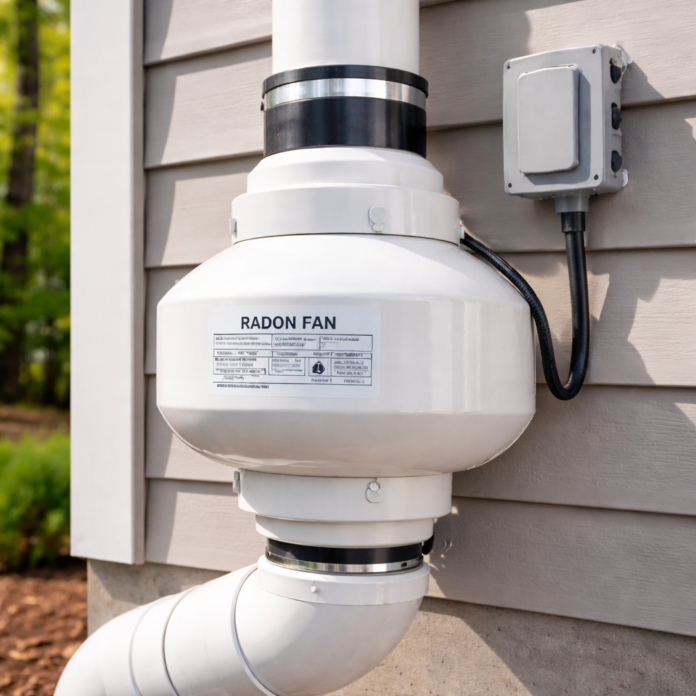
Radon Fans: A Deep Dive Guide
A radon fan is the engine that makes most radon mitigation systems work. When you hear someone say they have a “radon system,” they usually mean an active soil depressurization system, which is a pipe-and-fan setup that pulls radon-laden soil gas from beneath the home and vents it safely outside.
Radon fans are simple in concept, but the details matter. The wrong fan, installed in the wrong place, connected to the wrong piping layout, can lead to noisy operation, poor performance, or even radon re-entering the home. This guide explains what radon fans do, how they fit into mitigation systems, how professionals select and install them, how to monitor them, and what to do when they fail.
What is a radon fan?
A radon fan is a continuously operating inline fan designed to move soil gas. Its job is to create suction (negative pressure) in a mitigation pipe so that soil gas is pulled from beneath the foundation and exhausted outdoors.
In most homes, this fan runs 24/7. It is not like a bathroom fan that turns on occasionally. It is designed for continuous duty so it can maintain a pressure field under the slab or under a crawl space membrane and keep radon from entering living space.
Where radon fans are used in a mitigation system
Radon fans are used in multiple mitigation methods, but the principle stays the same: collect soil gas from below the building, then vent it outside.
Basement and slab homes
In basement and slab-on-grade homes, the most common approach is soil suction. A pipe (or pipes) connects through the slab to the crushed rock or soil beneath it. The fan pulls radon-laden soil gas into the pipe and exhausts it outdoors.
Depending on the home, suction can be applied through:
- A dedicated suction pit under the slab
- A connection to a drain tile system
- A sealed sump lid connection
- In some cases, a block wall suction approach combined with sub-slab suction
Crawl space homes
In crawl spaces, a common method is sub-membrane suction. A high-density plastic sheet covers the crawl space floor, edges and seams are sealed, and a vent pipe plus fan draws soil gas from under the sheet and exhausts it outdoors.
How radon fans work
To understand radon fans, it helps to separate two things the fan is doing at the same time:
- Creating suction (negative pressure) to influence how soil gas moves under the foundation
- Moving air (flow) through the piping and out the exhaust point
This is why “fan strength” is not one simple number. A radon fan is selected based on how much suction and flow are needed for a specific home’s foundation and piping layout.
Static pressure and airflow
Every radon mitigation system creates resistance to airflow: long pipe runs, multiple elbows, small pipe diameter, restrictive suction points, and certain foundation conditions can all increase resistance. As resistance increases, airflow decreases for a given fan.
Professionals think in terms of a fan curve: the relationship between airflow and pressure. The correct fan is the one that can deliver enough suction and flow for your system’s resistance.
Pressure field extension matters more than “big airflow”
A major goal of the fan is to create an effective pressure field under the slab or under the crawl space membrane. That pressure field is what prevents radon from migrating into the home through cracks and openings. In practical terms, you want suction to reach the areas of the slab where radon enters.
In some homes, soil and sub-slab materials allow air movement easily, so one suction point and a modest fan can influence a large area. In other homes with low permeability soil, multiple suction points or different system designs may be needed.
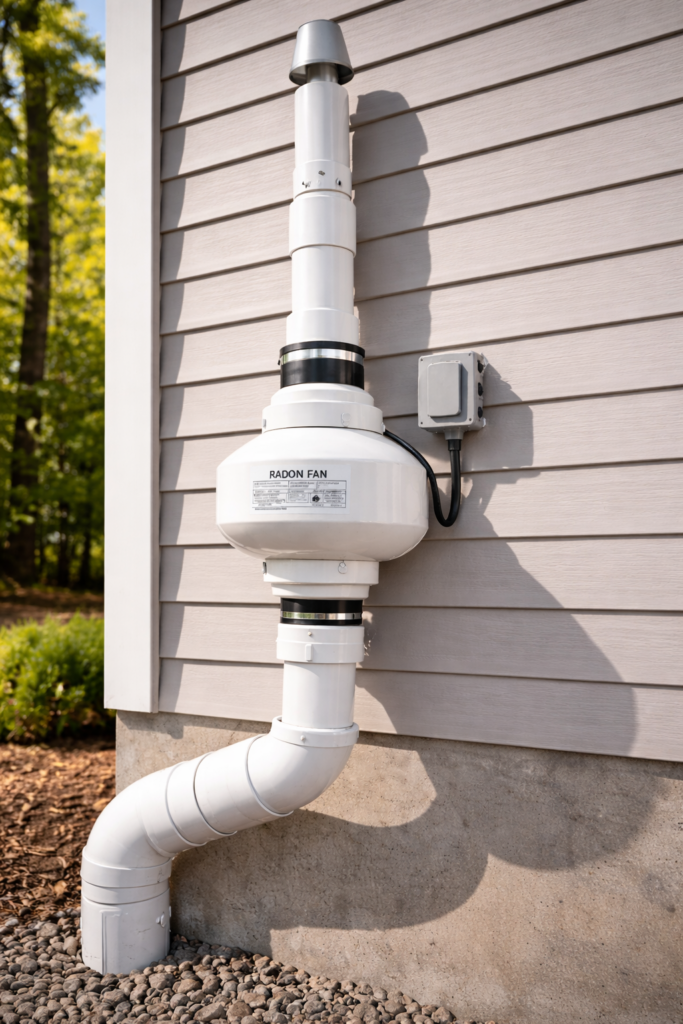
Where a radon fan should be installed, and why
Fan location is not just a preference. It is a safety rule.
General rule
The fan must not be located in or below a livable area. It should be installed in unconditioned space, such as an attic, certain garage spaces, or outside, depending on the home and local code requirements.
Why this matters: the piping on the suction side of the fan is under negative pressure. If there is a leak in that piping and the fan is located in or under livable space, radon-laden soil gas could be pulled into the building. Placing the fan outside of livable space reduces this risk.
Typical fan locations
- Attic (common in many homes)
- Garage (often acceptable if there is no living space above, depending on local requirements)
- Outside (mounted on an exterior pipe run, using equipment rated for outdoor use)
Even when the fan is installed outside, the system must still be built to prevent radon from re-entering the home through leaks or poor exhaust placement.
Exhaust discharge: where the air must go
A radon fan does not “destroy” radon. It moves it. So the exhaust location matters.
Vent above the roof
EPA guidance indicates that exhaust pipes for soil suction systems must vent above the roof and specifies separation distances and height requirements designed to prevent radon from re-entering the home through windows, doors, or other openings.
Why not discharge at ground level?
EPA explains that ground-level discharge was disallowed primarily due to the potential for radon to be pulled back into the home (re-entrainment) and because of the possibility of children being exposed to higher concentrations near the discharge point.
In short: the fan should discharge where the radon can dilute quickly and where it is least likely to return to the building.
How pros choose the right radon fan
Homeowners often search “best radon fan,” but a more useful question is: “Which radon fan is best for my system?” A correct fan selection is based on the home’s foundation, sub-slab conditions, and pipe layout, not on a single brand name.
1) Foundation type and collection method
Fan needs vary depending on whether the system is pulling from:
- A suction pit under a slab
- A drain tile or perimeter drain system
- A sealed sump pit
- A crawl space membrane system
For example, a drain tile system can behave differently than a small suction pit. Crawl space membrane systems can involve higher moisture and unique piping routes.
2) Soil and sub-slab permeability
How easily air moves under the slab changes everything. If air moves easily, you may get strong pressure field extension with one suction point and a moderate fan. If air movement is restricted, the fan may need to overcome more resistance, or the system may need additional suction points.
3) Piping layout
Longer pipe runs, smaller pipe diameter, and many elbows increase resistance. This reduces airflow and can reduce performance if the fan is not matched correctly.
A well-designed pipe run is typically straight where possible, uses appropriate diameter, and avoids unnecessary restrictions. The goal is not “maximum airflow at any cost.” The goal is enough suction and flow to control radon entry while remaining quiet, efficient, and durable.
4) Multiple foundations and complex homes
Homes with more than one foundation type, such as part basement and part slab, can be harder. A single suction point may not influence all sections. Some systems use multiple suction points or even multiple fans, depending on the design. A trained mitigation professional may connect multiple collection points into one fan system when feasible, but this depends on the home.
Noise and vibration: what causes it and how to reduce it
Most radon fans produce a steady low hum. When systems get noisy, the cause is often installation-related.
Common noise causes include:
- Vibration transfer into framing or ductwork due to poor mounting
- Pipe contact with joists or walls that transmit vibration
- Improper supports allowing the pipe to rattle
- Fan wear as bearings age, leading to new sounds over time
Practical noise reduction usually includes solid mounting, vibration isolation, correct pipe supports, and selecting a fan that is properly matched to the system. Oversized fans can sometimes create more noise than needed while not improving performance in a meaningful way.
Condensation, moisture, and freezing in radon piping
Soil gas can carry moisture vapor. When warm moist air moves through cooler pipe sections, condensation can form. If condensation pools in the pipe, it can reduce airflow and system performance. In cold climates, pooled condensation can freeze and block the pipe.
This is why proper system design and installation practices matter. The mitigation system should be configured to prevent moisture from pooling where it can cause restrictions. In many cases, routing and slope decisions are used to manage condensation drainage.
Moisture management is not just about comfort. It is about protecting the fan and preserving long-term performance.
Monitoring a radon fan: manometers, alarms, and what to check
A radon fan should not be a mystery box. You should be able to tell whether the system is operating.
Warning devices and system indicators
EPA guidance indicates that a warning device must be installed to alert the homeowner if an active system stops working properly, and it gives examples such as a liquid gauge, sound alarm, light indicator, or dial/needle display gauge. The warning device should be placed where it can be seen or heard easily.
Minnesota’s health department describes the U-tube manometer as a device that visually indicates if the fan is working and also notes that systems can include an active notification monitor that alarms if the fan is not working properly.
What you should check
- Look at the system indicator regularly so you notice changes early.
- Listen for changes in fan sound if your fan is in a place where you can hear it safely.
- Make sure the fan has power and has not been unplugged or switched off.
If the system indicator suggests the fan is not operating, contact a qualified radon contractor. Do not ignore an alarm or a manometer reading that indicates failure.
Fan lifespan, replacement cost, and operating cost
Radon fans are designed for continuous operation, but they still wear out.
Lifespan and warranties
EPA notes that radon fans may last five years or more and that manufacturer warranties tend not to exceed five years. At the same time, long-term mitigation experience suggests that many fans run longer than the warranty period when installed correctly and not exposed to harsh moisture conditions.
National Radon Program Services notes that fan warranties are typically five years and that lifespans are often in the 10 to 15 year range, depending on conditions.
Replacement cost
EPA estimates that replacing a radon fan may cost around $200 to $350 including parts and labor. Costs vary by region, fan accessibility, and whether electrical or piping changes are needed.
Operating cost
National Radon Program Services notes that operating costs are generally minor due to low fan power consumption, and it gives a typical reference of less than 90 watts per fan in many cases. It also compares the electric draw to continuously running a roughly 60 to 90 watt light bulb.
Energy impact is not only the fan’s wattage. Some systems can also draw some conditioned air from the home, which can slightly increase heating and cooling demand. Good sealing and good system design can help minimize unnecessary air loss.
Common failure signs and what to do
Radon fans usually fail in predictable ways. The biggest mistake is noticing a warning sign and ignoring it.
Common signs
- The warning device indicates failure or abnormal operation
- A manometer reading changes dramatically from its normal position
- The fan makes a new loud noise, grinding, or intermittent sounds
- The fan loses power due to a tripped breaker or unplugged cord
What to do
- Confirm power: check the outlet, breaker, and any switch controlling the fan circuit.
- Check the warning device: if it indicates failure, treat it seriously.
- Call a qualified radon contractor: fan replacement is usually straightforward, but correct fan selection and correct sealing are important.
- Retest after repair: the only way to confirm the system is back to reducing radon is to measure again.
Do not leave a failed fan offline for long periods. A mitigation system without an operating fan may allow radon levels to return toward pre-mitigation conditions.
Maintenance and retesting schedule
Maintaining a radon fan system is mostly about two habits: monitoring the system indicator and retesting periodically.
- Check the warning device regularly to confirm the system is operating.
- Retest your home at least every two years to confirm radon levels remain low.
- Retest after remodeling, especially when remodeling affects basements, foundations, or ventilation patterns.
EPA and CDC both emphasize retesting after installing a radon reduction system to ensure it is working, and they discuss periodic retesting as an ongoing best practice. EPA also recommends timing for post-mitigation testing and notes that an independent follow-up measurement can reduce conflict-of-interest concerns.
FAQ about radon fans
Do radon fans need to run all the time?
Yes in most systems. These fans are designed for continuous operation to maintain a pressure field under the slab or membrane and keep radon from entering.
Can I turn my radon fan off to save electricity?
Turning the fan off can allow radon levels to rise again. The power cost is usually modest compared to the value of consistent radon control. If you suspect your fan is using unusually high power or running unusually loud, that is a maintenance issue, not a reason to shut it off.
Can I install a radon fan myself?
Some homeowners attempt DIY mitigation, but improper design can make performance worse or create re-entrainment risks. If you do not have diagnostic tools and mitigation experience, hiring a qualified radon contractor is the safer approach, especially for homes with complex foundations or high radon levels.
Will a bigger fan always reduce radon more?
Not always. Performance depends on the pressure field under the slab and the system’s resistance. Oversizing can add noise and energy use without improving pressure field extension. Correct matching is the goal.
Do radon fans work in crawl space homes?
Yes. In crawl spaces, sub-membrane suction systems use a fan to draw soil gas from beneath a sealed plastic membrane and exhaust it outdoors.
Bottom line
Radon fans are the heart of most radon mitigation systems. They create suction that pulls radon-laden soil gas from beneath your home and vents it outdoors. For the system to be safe and effective, the fan must be installed in the right location (not in or below livable space), the exhaust must discharge in a way that prevents re-entry, the piping must be designed to avoid unnecessary restrictions, and the system must include a visible or audible warning device.
If you remember one principle, remember this: radon mitigation is not proven by the presence of a fan. It is proven by follow-up radon testing and ongoing monitoring over time.
Sources
- U.S. Environmental Protection Agency (EPA) – Consumer’s Guide to Radon Reduction: How to Fix Your Home (PDF)
- U.S. Environmental Protection Agency (EPA) – How do I know if my radon mitigation system is working properly?
- U.S. Environmental Protection Agency (EPA) – Why must radon be vented into the air above my home’s roof?
- Centers for Disease Control and Prevention (CDC) – Reducing Radon Levels in Your Home
- Minnesota Department of Health – Radon Mitigation Systems (components and fan location)
- HUD Exchange – Summary of Radon Standards of Practice (PDF)
- National Radon Program Services (Kansas State University) – Reducing Radon in Your Home (fan power, costs, lifespan)
- ANSI/AARST – SGM 2023 Technical Bulletin (PDF)