
Continuous Radon Monitoring: What It Is, When It Makes Sense, and How to Use It Correctly
Most homeowners learn about radon through a one time test kit. You place a device, wait a few days or a few months, then you get a number. That approach works well for many situations.
Continuous radon monitoring is different. Instead of one final number, you get a stream of data over time. This can be extremely useful, but only if you understand what the data means and how to use it without overreacting to short-term fluctuations.
This guide explains what continuous monitoring is, how it differs from standard test kits, the difference between consumer monitors and professional continuous radon monitors, and a practical method for using continuous monitoring to make better decisions.
What “continuous radon monitoring” means
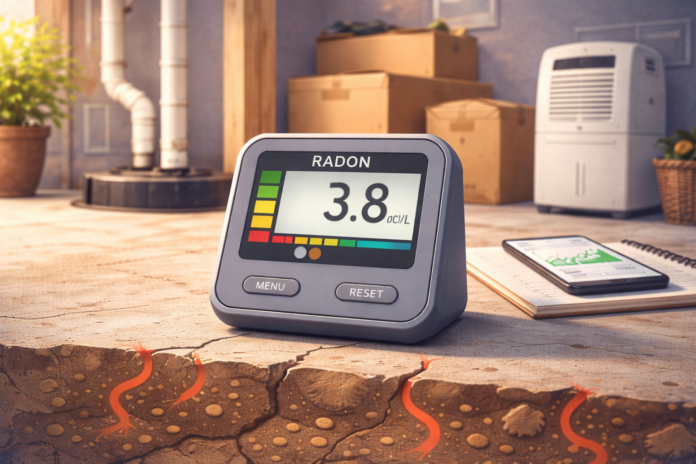
In everyday language, continuous radon monitoring usually means keeping an electronic radon monitor running in your home so you can see levels over time. Many devices show hourly readings and rolling averages (such as 1-day, 7-day, and 30-day averages).
In professional testing standards, a Continuous Radon Monitor (CRM) is defined more specifically as an electronic device capable of automatically recording a retrievable time series of radon measurements, typically averaged over time intervals of one hour or less. This definition matters because it is tied to how professional radon measurements are documented and quality-controlled.
Both uses are valuable. The key is knowing which goal you have.
Why continuous monitoring can be valuable
Radon levels change. They can rise and fall due to:
- Weather and barometric pressure changes
- Season and soil moisture
- HVAC schedules and ventilation
- Exhaust fans, fireplaces, and dryer operation
- Opening windows and doors
- How much time is spent in lower levels like basements
A short-term test captures a small slice of time. A long-term test captures a broader average. Continuous monitoring adds a different benefit: it shows patterns. It helps you answer questions like:
- Is radon consistently elevated or only occasionally elevated?
- Do levels spike overnight, during storms, or when the HVAC runs?
- Did mitigation reduce levels and keep them low during different conditions?
- Is the basement behaving differently than the first floor?
Continuous monitoring is especially useful after mitigation, during renovations, or when you are trying to understand how your home behaves across seasons.
Consumer digital monitors vs professional continuous radon monitors
Many people use the term “continuous radon monitor” to describe any digital device that shows radon levels. In practice, there are two broad categories.
Consumer digital radon monitors
These are designed for homeowners. They typically show rolling averages and sometimes provide app dashboards and trend charts. They are great for awareness and ongoing tracking. They are not usually used for formal measurement protocols in real estate or compliance testing.
Best use cases:
- Learning how radon behaves in your home
- Tracking trends over weeks and months
- Monitoring after mitigation as a day-to-day dashboard
Professional CRMs used for time-sensitive measurements
Professional CRMs are often used by radon measurement professionals and home inspectors, especially for short-term real estate tests. These devices typically support detailed reporting, time-stamped hourly results, and quality assurance requirements.
Best use cases:
- Real estate transactions under defined protocols
- Professional measurement projects that require documentation and QA
- Schools and large buildings when CRMs are used as part of a broader protocol
Professional standards also emphasize quality assurance practices for CRMs, including instrument checks, comparison checks, and calibrations. This is one reason professional testing can look different than homeowner monitoring.
What continuous data can teach you, and what it cannot
Continuous monitoring can teach you patterns. It can show you how radon responds to weather, HVAC operation, and changes in home use. It can also give you confidence that a mitigation system is staying effective.
What it cannot do is change the core truth about radon risk: health risk is linked to long-term exposure. A single spike does not define your risk. A single low day does not guarantee safety. You should make decisions based on longer averages and repeatable trends.
How to set up continuous radon monitoring in a home
If you are using a consumer digital monitor, treat setup like you would treat a proper test placement.
Step 1: Choose the right level
Place the monitor on the lowest level of the home that is used regularly. If you have a finished basement that you use as living space, start there. If the basement is not used and you live on the first floor, start on the first floor.
Step 2: Choose a representative room
Pick a room where people spend time. Good examples are a family room, office, or bedroom. Avoid kitchens, bathrooms, laundry rooms, and closets.
Step 3: Avoid airflow distortions
Keep the monitor away from windows, exterior doors, direct drafts, and HVAC supply or return vents. Do not place it directly against an exterior wall or on the floor unless the manufacturer instructs it.
Step 4: Leave it in one place
Many people move the monitor around every day and then feel confused. A monitor needs time to build meaningful averages. Leave it in place for at least a few weeks before drawing conclusions.
How long it takes for continuous monitoring to become meaningful
Most monitors provide early readings quickly, but early readings can swing. Use a simple timeline mindset:
- First 48 hours: useful for a rough sense of direction, but not for decisions.
- After 7 days: useful for learning weekly behavior.
- After 30 days: more stable and far more useful for decision-making.
If your device provides a longer average than 30 days, use that as the main decision metric.
How to interpret continuous monitoring results
In the United States, the most widely used benchmark is the EPA action level of 4.0 pCi/L. EPA also notes you may want to consider reducing radon levels between 2.0 and 4.0 pCi/L because there is no known safe level and lower is better.
With continuous monitoring, use this approach:
- Ignore single-hour spikes unless they are extreme and persistent.
- Focus on the longest average your monitor provides.
- Look for sustained patterns, not one-time events.
A practical interpretation framework:
- Longest average below 2.0 pCi/L: generally lower exposure, continue monitoring as desired.
- Longest average 2.0 to 3.9 pCi/L: moderate exposure, consider confirmation with a long-term lab test and consider mitigation depending on your situation.
- Longest average at or above 4.0 pCi/L: elevated exposure, plan mitigation or confirm using a recognized method if needed before action.
Using continuous monitoring to confirm mitigation performance
One of the best uses of continuous monitoring is after a mitigation system is installed. You can see whether radon stays low across weather events and across seasonal changes.
A practical post-mitigation method:
- Run the monitor in the same location for at least 30 days after the system is installed.
- Compare your longest average to your pre-mitigation longest average.
- Watch for sustained increases that could indicate a fan failure, disconnected pipe, or another issue.
- Still perform a formal post-mitigation test to document the result, then keep the monitor as your ongoing dashboard.
Quality assurance and why professional CRMs are treated differently
For professional measurement work, especially in real estate, schools, and larger projects, quality assurance matters. Standards and QA documents describe practices such as:
- Maintaining current calibration
- Instrument checks before use
- Comparison checks and cross-check measurements
- Documenting hourly data and project reporting
This is part of why professional CRM testing has more structure than consumer monitoring. The goal is defensible, repeatable results.
Common mistakes with continuous monitoring
- Making decisions based on the first day of readings
- Panicking over spikes instead of evaluating longer averages
- Placing the monitor near vents, windows, or drafty areas
- Moving the monitor often and comparing inconsistent locations
- Assuming low readings in one room represent the whole home
- Using continuous monitoring as a substitute for mitigation when levels are consistently elevated
Bottom line
Continuous radon monitoring is a powerful tool for understanding patterns and maintaining confidence over time. It is especially helpful after mitigation, during major home use changes, and for homeowners who want ongoing awareness rather than a one time snapshot.
To use it well, place the monitor correctly, leave it in one location long enough to build meaningful averages, focus on the longest averaging window, and confirm major decisions with recognized test methods when appropriate. Continuous data is most valuable when it leads to clear, calm decisions based on trends, not fear based reactions to short spikes.
Sources
- U.S. Environmental Protection Agency (EPA) – How to test your home for radon
- U.S. Environmental Protection Agency (EPA) – EPA action level for radon and what it means
- U.S. Environmental Protection Agency (EPA) – Find a radon test kit or measurement professional
- U.S. Environmental Protection Agency (EPA) – Are radon measurements accurate and reliable?
- Centers for Disease Control and Prevention (CDC) – Testing for radon
- ANSI/AARST MALB – Definition and use of Continuous Radon Monitors (CRM) in schools and large buildings
- ANSI/AARST MAH – Protocol for conducting measurements of radon in homes
- ANSI/AARST MS-QA – Quality assurance for Continuous Radon Monitors (CRM)
- National Radon Program Services (Kansas State University) – Testing devices overview