
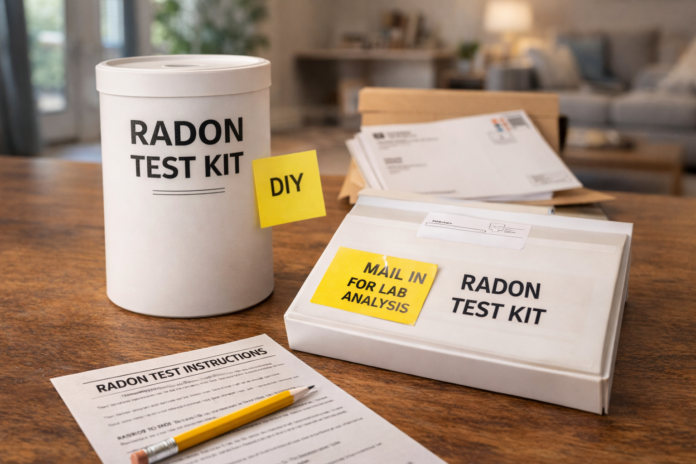
DIY Radon Test Kits: How They Work, Which One to Choose, and How to Get Accurate Results
Radon is a radioactive gas that can build up indoors, and you cannot see it, smell it, or taste it. Because of that, testing is the only way to know your radon level. The good news is that you do not need a contractor just to test. A simple DIY radon test kit can give you a reliable measurement if you choose the right kit and follow the instructions closely.
This guide explains the main types of DIY radon test kits, how to pick one, how to place it correctly, how to avoid common mistakes, and what to do with your results.
What a DIY radon test kit actually measures
DIY radon kits measure the amount of radon in the air over a specific period of time. In the United States, results are usually reported in pCi/L (picocuries per liter). Radon risk is tied to long-term exposure, so the most useful number is your long-term average level, not a single momentary reading.
Radon levels can change day to day based on weather, ventilation, and how the building operates. That is why the type of kit you choose matters. Some kits measure a short snapshot, and some measure a longer average that better reflects typical exposure.
Short-term vs long-term DIY kits
Short-term kits
Short-term kits are designed for quick screening. Many short-term tests run for a few days, and they are commonly used when you want results quickly, such as during a home purchase or when you are deciding whether radon might be a concern.
Common short-term DIY kit types include:
- Charcoal canisters (very common and inexpensive)
- Charcoal liquid scintillation kits (a charcoal method that is analyzed at a lab)
- Short-duration electret ion chambers (less common for consumer kits)
Short-term kits can be very useful, but remember they are a snapshot. A single short-term result can be influenced by unusual conditions.
Long-term kits
Long-term kits measure radon over a longer period, often several months, to estimate your average exposure more accurately. This is especially useful when your short-term results are moderate or near decision thresholds and you want a clearer answer.
Common long-term DIY kit types include:
- Alpha track detectors (very common for long-term testing)
- Long-duration electret ion chambers (less common for consumer kits)
Long-term tests take longer to complete, but they often provide the most meaningful picture of your true radon exposure in a home where you plan to live for years.
Which DIY kit should you choose?
The best kit depends on your goal. Use this simple decision framework:
- You want a fast answer: start with a short-term kit.
- You want your best estimate of average exposure: use a long-term kit.
- You got a moderate or borderline short-term result: follow up with a long-term kit to refine the decision.
- You are buying a home: a short-term test is common, then consider a long-term test after moving in for a better average.
Many homeowners do both. They start with a short-term test to see where they stand, then use a long-term test for confirmation if the result is not clearly low or clearly high.
Where to buy DIY radon test kits
In general, a reliable DIY kit is one that is analyzed by a qualified lab and comes with clear instructions, a sealed container, and a mail-back process. Many state radon programs provide recommendations for where to buy kits, and some states offer low-cost kits to residents.
If you want a simple rule: choose a kit from a reputable source and confirm that the analysis is done by a recognized radon measurement lab or program. The kit should provide clear documentation, chain of custody information, and a way to register the device.
How to place a DIY radon test kit for accurate results
Placement is one of the most important factors for a useful result. Follow the kit instructions first, but these general principles apply to most DIY tests.
Test the lowest lived-in level
Place the test on the lowest level of the home that is used regularly. If you have a finished basement that you use as living space, test there. If the basement is not used and you live on the first floor, test on the first floor.
Choose a normal, lived-in room
Good locations include a family room, bedroom, office, or finished basement living area. You want the test in a place that represents typical breathing-zone air.
Avoid bad locations
Do not place the kit in kitchens, bathrooms, laundry rooms, closets, or near drafts, vents, windows, exterior doors, sump pits, or direct sunlight. Avoid high humidity areas unless the kit instructions explicitly allow it.
Keep it off the floor and away from disturbances
Many instructions recommend placing the device in the breathing zone range, not on the floor. Keep it where pets or kids will not move it.
Closed-house conditions for short-term tests
Many short-term test instructions use “closed-house conditions.” This generally means keeping windows and exterior doors closed as much as possible during the test period, except for normal entry and exit. The goal is to reduce ventilation swings that can artificially lower the reading.
If you run a short-term test with windows open much of the day, you may get a result that looks lower than what you experience under typical closed conditions. Long-term tests are less sensitive to a single day of open windows, but you should still follow the kit instructions.
How to run the test step by step
- Read the kit instructions fully before opening anything.
- Choose the test location on the lowest lived-in level.
- Start the test exactly when instructed and note the date and time.
- Leave the kit undisturbed for the full duration.
- End the test exactly when instructed and seal it properly.
- Mail it promptly if it is a mail-back kit, especially for charcoal tests.
- Save your results for your home records.
Charcoal tests are especially time-sensitive after the test ends. Delays in mailing can affect results. Follow the instructions closely.
How to interpret your DIY radon result
In the U.S., the EPA action level is 4.0 pCi/L. Many guidance materials also encourage considering action in the 2.0 to 4.0 pCi/L range because radon risk is cumulative and lower is better.
A practical interpretation approach looks like this:
- Below 2.0 pCi/L: generally lower risk, retest in the future or after major home changes.
- 2.0 to 4.0 pCi/L: consider a long-term test to understand average exposure and consider mitigation depending on your situation.
- At or above 4.0 pCi/L: follow guidance for confirmation and mitigation planning.
- Well above 4.0 pCi/L: take it seriously and move toward follow-up testing or mitigation sooner.
Do not treat the number as a verdict based on a single day. Radon is a long-term exposure issue, which is why follow-up and averages matter.
When to retest or follow up
Follow-up depends on your result and the type of test used.
- If your short-term result is high: follow the recommended follow-up process. Many homeowners either run another short-term test or switch to a long-term test for a better average.
- If your result is near a decision threshold: a long-term test is often the most informative next step.
- If you mitigate: retest after mitigation to confirm that levels dropped.
- If you remodel, finish a basement, or change HVAC: retest because building changes can affect radon.
DIY kits vs digital radon monitors
Many homeowners now use digital radon monitors because they provide continuous readings. These can be helpful for learning patterns, but they can also cause confusion if you focus on day-to-day fluctuations.
A lab-analyzed DIY kit gives you a clear result for a defined period. A digital monitor provides rolling averages that change over time. If you use a monitor, pay attention to longer averages such as weekly or monthly readings, and consider confirming with a long-term lab test if you want a solid baseline.
Common DIY testing mistakes
- Testing in the wrong level of the home
- Placing the kit near a window, vent, or exterior door
- Running a short-term test with windows open
- Ending the test early or leaving it out too long
- Forgetting to seal the kit properly
- Waiting too long to mail a charcoal kit
- Disturbing the kit during the test period
A well-run DIY test is simple. Most mistakes come from placement and timing.
When to hire a professional instead
DIY kits are great for initial testing, but there are situations where professional help can be useful:
- You need testing for a real estate transaction with specific protocols.
- You want a multi-room diagnostic approach in a complex home.
- You are testing a school, daycare, or large building.
- You have consistently high results and want a mitigation plan.
In many cases, DIY testing is still the right first step, and professional involvement becomes relevant after you confirm elevated levels.
Bottom line
DIY radon test kits are one of the easiest ways to make an invisible risk measurable. Short-term kits are great for fast screening. Long-term kits are best for understanding average exposure. The most important success factors are choosing a reputable kit, placing it on the lowest lived-in level, following closed-house guidance for short-term tests, and taking follow-up steps if your results are elevated.
If you want the simplest plan, start with a short-term kit. If the result is moderate or near a decision point, follow up with a long-term kit. If the result is at or above 4.0 pCi/L, move toward confirmation and mitigation planning.
Sources
- U.S. Environmental Protection Agency (EPA) – How do I get a radon test kit?
- U.S. Environmental Protection Agency (EPA) – How to test your home for radon
- U.S. Environmental Protection Agency (EPA) – EPA action level for radon and what it means
- U.S. Environmental Protection Agency (EPA) – A Citizen’s Guide to Radon (PDF)
- Centers for Disease Control and Prevention (CDC) – Testing for radon
- National Radon Program Services (Kansas State University) – Radon education and guidance
- ANSI and AARST – Radon standards and guidance
- National Institute of Environmental Health Sciences (NIEHS) – Radon