
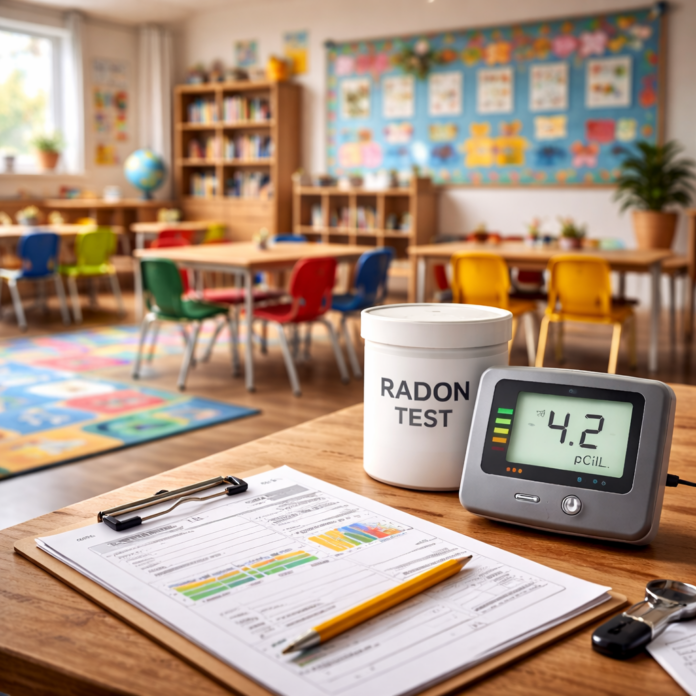
Radon in Schools and Daycares: Testing, Risk, and What to Do if Levels Are High
Radon is a naturally occurring radioactive gas that can build up indoors. It is colorless, odorless, and tasteless, which means the only way to know whether a building has elevated radon is to test. Public health agencies focus on radon because long-term exposure increases the risk of lung cancer, and many people spend thousands of hours over their lifetime inside schools, childcare centers, and other public buildings.
Schools and daycares add a practical challenge: these are shared spaces with many occupants, many rooms, and complex heating and ventilation systems. Radon can vary widely from room to room, even within the same building. A single test in a hallway or one classroom is not enough to describe the whole facility. A good radon plan is less about a one time test and more about building a repeatable process: measure, act, confirm, and retest over time.
Why radon matters in schools and daycares
Radon risk is driven by two factors: level and time. A higher level over a longer period creates greater exposure. Children and staff may spend many hours per week in the same rooms for months at a time. For many students and employees, school is the second largest place-based exposure after the home.
Daycares and early childhood programs can be even more exposure-intensive because children may attend year-round and spend long days inside. Some programs operate in buildings with basements or ground-contact rooms used for play, naps, or storage. These lower-level spaces are often where radon levels are highest.
It is also important to keep expectations realistic. Radon does not usually cause short-term symptoms. The purpose of radon testing in schools and childcare is not to explain immediate coughing or headaches. The goal is to reduce long-term cancer risk by identifying and fixing elevated levels.
How radon gets into school and childcare buildings
Radon comes from the breakdown of uranium in soil and rock. It moves through soil gas and can enter buildings through cracks and openings in foundations. Schools and childcare facilities can have many radon entry pathways, including slab joints, expansion joints, utility penetrations, crawl spaces, basements, and tunnels. Heating, ventilation, and air-conditioning systems can also influence indoor radon levels by changing pressure relationships and air movement inside the building.
This is why two schools in the same neighborhood can have very different results. It is also why one classroom can test low while a nearby room tests higher. You cannot reliably predict radon levels from building age, appearance, or zip code alone.
Which rooms should be tested?
EPA guidance for schools emphasizes testing all frequently occupied rooms that are in contact with the ground. This matters because radon levels can vary significantly from room to room, and a measurement in one space should not be used as a proxy for adjacent rooms.
In a school, frequently occupied rooms typically include:
- Classrooms
- Offices and staff rooms
- Libraries and media centers
- Gymnasiums and multipurpose rooms that are used regularly
- Laboratories and workshops
- Cafeterias if they are regularly occupied for extended periods
Areas that usually do not need initial testing include restrooms, hallways, stairwells, and storage rooms. However, those spaces can become important during diagnostic work if elevated radon is found and you are trying to identify entry pathways and pressure drivers.
For daycares and childcare centers, the practical rule is similar: test rooms where children and staff spend time, especially any space on the lowest occupied level. If a daycare operates in a home, treat it like a residence with an added emphasis on any basement playroom, nap area, or ground-level classroom.
When should testing be done?
Timing matters because radon levels change with seasons, weather, and building operation. EPA school guidance commonly recommends testing during cooler months and under closed-building conditions, meaning windows and exterior doors are kept closed except for normal entry and exit. The goal is to capture conditions when radon is more likely to be elevated and when the building is operating in a typical enclosed mode.
For schools, testing during the school year is usually preferred since occupancy patterns and HVAC schedules during the year are part of real exposure. For childcare centers that operate year-round, select a period when the building is in normal operation and try to avoid unusual events that change ventilation patterns.
Short-term vs long-term tests in schools and daycares
Most school and childcare radon programs begin with short-term testing to quickly identify whether elevated radon may be present. EPA school guidance describes an initial short-term measurement phase in all frequently occupied ground-contact rooms, often done simultaneously. If a room tests at or above the action level, a follow-up measurement is used to confirm the result before making major decisions.
Long-term tests can be useful for estimating the average exposure over a longer period, particularly when you want a better picture of typical conditions across seasons. In many real-world programs, long-term testing is used as a follow-up in rooms where the initial results suggest a potential issue, or as part of an ongoing monitoring plan.
Interpreting results and deciding when to act
In the United States, the EPA action level is 4.0 pCi/L. In school guidance, EPA describes confirming an initial short-term result of 4.0 pCi/L or higher with another test. If the follow-up measurement is also at or above 4.0 pCi/L, the recommendation is to take action to reduce levels.
It is also worth understanding the broader principle: radon is a carcinogen, and no level is considered completely risk-free. This is why some facilities choose to reduce radon even when levels are below 4.0 pCi/L, especially in high-occupancy rooms or spaces used by very young children. That choice often depends on feasibility, cost, and the ease of mitigation in a particular building.
What mitigation looks like in schools and large buildings
Mitigating radon in a school is not always the same as mitigating a single-family home. Large buildings can have multiple foundations, wings, or slabs, and HVAC systems can strongly influence pressure differences. Effective mitigation typically requires a building-specific plan based on measurements, diagnostics, and the layout of the facility.
Common mitigation approaches for schools and large buildings can include:
- Sub-slab depressurization or sub-membrane systems where appropriate
- Sealing and repairs as a supporting step, not as a stand-alone solution
- HVAC adjustments or ventilation improvements when they reduce radon without creating other indoor air problems
- Targeted approaches for specific wings or pods where elevated readings are concentrated
EPA and professional standards groups emphasize that mitigation should be followed by retesting to confirm that radon levels were actually reduced. A mitigation system is only successful if measurements show that it is working under normal building conditions.
Retesting and ongoing management
Radon management should not stop after the first test cycle. EPA school guidance recommends retesting at some point in the future and especially after significant changes to the building structure or HVAC system. Renovations, additions, foundation repairs, and ventilation upgrades can change pressure dynamics and radon entry in ways that increase or decrease levels.
A practical school or daycare radon plan usually includes:
- Initial baseline testing in all frequently occupied ground-contact rooms
- Follow-up confirmation testing for rooms with elevated results
- Mitigation in confirmed elevated areas
- Post-mitigation testing to verify results
- Periodic retesting, plus retesting after major renovations or HVAC changes
This approach aligns with the broader indoor air quality mindset: document the baseline, fix what needs fixing, and verify performance over time.
Communication and transparency: what parents and staff should expect
Because schools and daycares involve many families, communication matters. A good radon program is not only technical, it is also administrative. Facilities should be prepared to explain:
- Which rooms were tested and why
- What test method was used and when testing occurred
- How results were interpreted and what threshold triggered follow-up or action
- What mitigation steps were taken and the timeline
- How post-mitigation testing confirmed the outcome
- When retesting will occur in the future
For daycares, licensing and oversight expectations vary by state. Some states have specific requirements or programs related to radon testing in childcare settings. The most reliable next step for facility operators and parents is to contact the state radon office and the childcare licensing agency to understand local expectations.
A practical checklist for school administrators and childcare operators
- Build a simple written radon plan with roles, rooms, timing, and documentation.
- Test all frequently occupied rooms on and below the ground level.
- Use follow-up testing to confirm elevated results before major decisions.
- Prioritize mitigation in the highest readings and highest occupancy rooms.
- Retest after mitigation to verify results.
- Retest after major renovations or HVAC changes.
- Communicate results and actions clearly to staff and families.
Bottom line
Radon in schools and daycares is not a theoretical concern. It is a measurable indoor air hazard that can vary room to room and can persist for years if not addressed. The good news is that schools and childcare programs can manage it with a structured approach: test the right rooms, confirm elevated results, mitigate when needed, and retest over time. That process protects students, staff, and families with clear, evidence-based steps.
Sources
- U.S. Environmental Protection Agency (EPA) – Radon in Schools
- U.S. Environmental Protection Agency (EPA) – Managing Radon in Schools
- U.S. Environmental Protection Agency (EPA) – Radon Measurement in Schools (Revised Edition PDF)
- U.S. Environmental Protection Agency (EPA) – A Citizen’s Guide to Radon (PDF)
- Centers for Disease Control and Prevention (CDC) – Radon and Your Health
- ANSI and AARST – Radon Mitigation Standards for Schools and Large Buildings (RMS-LB)
- AARST – Protocol for Conducting Measurements of Radon and Radon Decay Products in Schools and Large Buildings (MALB)
- National Radon Program Services (Kansas State University) – Radon in Schools