
Radon and Pets: Can Radon Harm Dogs and Cats?
If you care about radon because of your family’s health, it is natural to wonder about your pets too. Dogs and cats share the same indoor air you do, and in many homes they spend even more time inside. Since radon is a leading cause of lung cancer in people, the question becomes simple: can long-term radon exposure also affect pets?
The short answer is that the strongest, most established radon risk is still lung cancer in humans. For pets, the research base is smaller, but there is credible evidence suggesting radon may be associated with certain lung cancers in dogs and cats. Even when the science is still developing, the practical guidance is straightforward because the solution is the same: test the home, and reduce radon if it is elevated.
Quick refresher: what radon is and why it is a long-term risk
Radon is a naturally occurring radioactive gas that forms as uranium breaks down in soil and rock. Outdoors it usually disperses quickly. Indoors it can enter through tiny openings in foundations and build up, especially in basements, crawl spaces, and other lower areas.
The main health concern comes from radon’s decay products, sometimes called radon progeny. These are radioactive particles that can be inhaled and lodge in the lungs. Over time, the radiation released by these particles can damage cells and DNA, increasing cancer risk. This is why radon is treated as a long-term exposure issue. You typically do not notice short-term symptoms that point to radon.
Why pets might be more exposed than you think
Even though you and your pets live in the same building, pets can have exposure patterns that make radon more relevant:
- They are closer to the floor. Radon can be higher in lower levels and near the ground, especially in basements or rooms with slab foundations and entry pathways.
- They often spend more hours indoors. Many pets are home all day, every day.
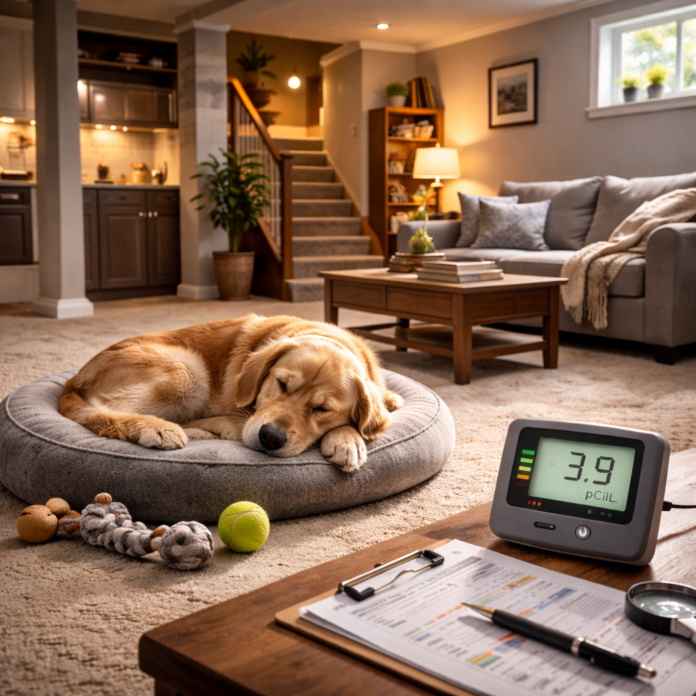
- They may sleep in basements or lower rooms. If your dog bed is in the basement family room or your cat sleeps downstairs, that can increase cumulative exposure.
- They have smaller lungs and faster breathing rates. Some public health materials note that, like children, pets can receive a higher dose relative to body size because of breathing patterns.
None of this means radon automatically causes disease in pets. It means the exposure pathway is plausible and worth taking seriously.
What the research says about radon and cancer in pets
Compared with human radon research, pet-specific studies are limited. Still, there are a few pieces of evidence worth knowing.
Primary lung tumors in dogs and cats and environmental radon
A notable veterinary study examined primary pulmonary neoplasia (primary lung tumors) in dogs and cats and evaluated whether rates were higher in areas with higher radon potential. The study found that primary lung tumor rates were higher in dogs and cats living in counties classified as having high radon potential compared with lower-potential areas. This type of study cannot prove radon is the direct cause in each individual case, but it supports the idea that radon could be a contributing environmental factor.
Reviews summarizing the broader evidence
More recent review papers discussing indoor environmental exposures in companion animals have highlighted household radon as a potential risk factor for lung cancer in pets, while also emphasizing that more research is needed. Reviews are helpful because they do not rely on a single dataset and can point out where evidence is consistent and where it is still uncertain.
Radon plus secondhand smoke: a bigger concern for pets
In humans, radon and smoking interact in a way that greatly increases lung cancer risk. For pets, secondhand smoke is also a well-known health concern, and some public health materials aimed at pet owners highlight that combined exposure may be especially harmful.
If someone smokes indoors (or smoke drifts indoors), your pet can be exposed in a few ways:
- Inhaling smoke particles and gases in the air
- Thirdhand smoke residues on surfaces, bedding, and fur
- Potential co-exposure that compounds stress on lung tissue
Even if you do not smoke, visitors or other household members might. In practical terms, a smoke-free home is one of the best steps you can take for pets, and it pairs well with radon testing and mitigation.
What symptoms might look like in pets?
There is no reliable set of early symptoms that tells you a pet is exposed to radon. Radon is not typically an immediate irritant at home levels. If radon contributes to health outcomes in pets, it would most likely be through long-term exposure and the development of disease over time.
If a pet develops lung disease or lung cancer, symptoms can be vague and overlap with many other conditions. Possible warning signs that should prompt a veterinary visit include:
- Persistent cough or coughing spells
- Labored breathing, faster breathing at rest, or shortness of breath
- Reduced exercise tolerance (tiring quickly on walks or play)
- Unexplained weight loss or reduced appetite
- Lethargy or reduced interest in normal activities
- Wheezing or unusual breathing sounds
These signs do not mean radon is the cause. They are simply signs that a vet should evaluate. The main point is that you should not rely on symptoms to decide whether radon matters. Testing the home is the only practical way to know your radon level.
How to protect pets from radon
The good news is that protecting pets from radon is the same process as protecting people. It is a home environment problem, not a pet-specific treatment problem.
1) Test your home for radon
You cannot reliably guess a home’s radon level based on age, neighborhood, or whether it has a basement. Testing is the only way to know. If you use the basement frequently, consider placing a test where people and pets actually spend time, following the test instructions.
2) Take action if radon is elevated
In the United States, the EPA recommends taking steps to reduce radon at 4.0 pCi/L or higher, and also notes that you may want to consider fixing levels between 2.0 and 4.0 pCi/L. If your results are elevated, mitigation can often reduce radon significantly.
3) Retest after mitigation
Mitigation should be confirmed with follow-up testing. This matters for long-term exposure because radon levels can vary by season and changes in home ventilation.
4) Reduce time in high-radon areas while you address the issue
If a short-term test indicates high radon in the basement, you can reduce your pet’s time there as a temporary precaution. Move pet bedding and litter boxes to upper levels if possible until mitigation is completed and confirmed.
5) Keep the home smoke-free
If anyone smokes, keeping smoke out of the home is a major pet health improvement on its own. It also reduces the concern about combined radon and smoke exposure.
Is radon something your vet will ask about?
Most veterinary visits do not include radon questions, mostly because radon is hard to detect without a home test and because pet-focused research is still emerging. That said, if a pet is diagnosed with a lung tumor or chronic respiratory issues, it is reasonable to mention environmental factors to your veterinarian, including secondhand smoke exposure and whether your home has been tested for radon.
Radon testing is a household decision you can make without waiting for a medical event. It is one of the rare cases where a serious risk factor can be measured directly in the home environment.
Bottom line
Radon is a proven cause of lung cancer in humans, and there is credible evidence suggesting it may also be associated with primary lung tumors in dogs and cats. Pets may be more exposed than you expect because they spend more time indoors and closer to the ground, and some public health materials note that pets may receive a higher relative dose.
Even though the science for pets is not as extensive as for humans, the practical advice remains clear: test your home, mitigate elevated levels, retest to confirm, and keep indoor air smoke-free. Those steps protect everyone in the household, including the four-legged members.
Sources
- U.S. Environmental Protection Agency (EPA) – Health Risk of Radon
- U.S. Environmental Protection Agency (EPA) – EPA Action Level for Radon
- ATSDR (CDC) – Radon Public Health Statement
- North Carolina DHHS – Radon Effects on Pets (Factsheet PDF)
- University of Kentucky BREATHE – Radon and Pets (Factsheet PDF)
- Fowler et al. (2020) – Ecological level analysis of primary lung tumors in dogs and cats and environmental radon activity (Open access via PMC)
- Maipas (2025) – Mini-review on potential health impacts of indoor exposures on companion animals (includes discussion of radon)