Radon Lung Cancer Risk: What You Need to Know (and What to Do)
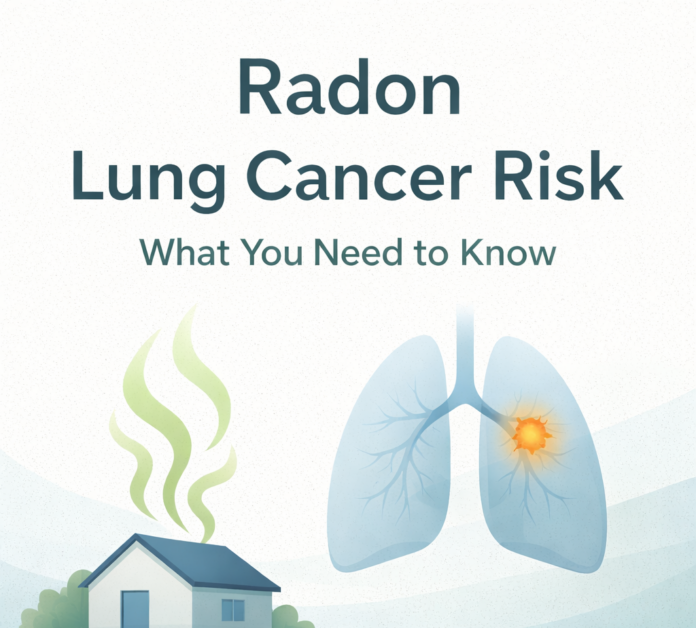
Radon is a naturally occurring radioactive gas that you can’t see, smell, or taste—but it can build up indoors and increase your risk of lung cancer. In the United States, radon is widely recognized as the second leading cause of lung cancer overall and the leading cause of lung cancer among people who don’t smoke.
This article explains how radon increases lung cancer risk, why smoking changes that risk dramatically, what radon levels mean in practical terms, and what you can do to reduce exposure.
Why radon exposure can lead to lung cancer
Radon forms naturally as uranium breaks down in soil and rock. Outdoors, it disperses quickly and is usually not a concern. Indoors, however, radon can enter through openings in foundations and accumulate—especially in lower levels like basements and crawl spaces.
Radon itself is radioactive, but the bigger problem is what happens after radon decays. As radon breaks down, it produces radioactive particles (often called radon progeny). When inhaled, these particles can lodge in the lungs and release radiation as they continue to decay. Over long periods of exposure, that radiation can damage lung tissue and DNA, increasing the chance that cells grow abnormally and eventually form cancer.
Radon risk is typically a long-term risk. There are no reliable “early warning symptoms” from radon exposure. The danger comes from breathing elevated levels over months and years, not from a single short exposure.
How big is the lung cancer risk?
Radon is common, and lung cancer is one of the deadliest cancers. That combination is why radon has a meaningful impact on public health. U.S. estimates often cited by major health agencies attribute about 21,000 lung cancer deaths per year to radon, including a significant number among people who have never smoked.
Because lung cancer has multiple causes, these figures are best understood as population-level estimates rather than a way to pinpoint a single individual’s cause. Still, the underlying scientific conclusion is clear: long-term radon exposure increases lung cancer risk enough that major public health agencies treat it as a preventable hazard worth testing for and fixing.
Radon and smoking: why the combination is especially dangerous
Radon increases lung cancer risk for everyone, but the risk rises much more sharply when smoking is involved. Cigarette smoke damages lung tissue and reduces the lungs’ ability to clear particles. Radon decay particles can then add radiation damage on top of smoke-related damage. In other words, the combined exposure is not simply “radon risk plus smoking risk”—it becomes a higher-risk combination.
Public health guidance commonly emphasizes that smokers exposed to radon are at far higher risk of lung cancer than non-smokers exposed to the same radon level. This doesn’t mean radon is harmless for non-smokers. Radon is still a leading cause of lung cancer among people who do not smoke, which is exactly why it matters even in households where no one uses tobacco.
If someone in the home smokes (or used to smoke), addressing radon becomes even more important. Reducing radon lowers one major risk factor, and quitting smoking lowers another—both steps can meaningfully reduce overall risk.
What radon level is considered “high”?
In the United States, radon is measured in pCi/L (picocuries per liter). The most widely used benchmark is the EPA “action level” of 4.0 pCi/L. If a home tests at or above this level, the EPA recommends fixing the home to reduce radon.
It’s also important to understand a second piece of guidance that’s often overlooked: because there is no known completely safe level of radon exposure, the EPA also recommends considering mitigation when levels fall between 2.0 and 4.0 pCi/L. In practical terms, this means “lower is better,” and if mitigation is feasible, reducing radon even below 4.0 can further reduce long-term risk.
Radon levels can vary by season, weather, and how a home is used. They can also vary widely from one house to the next—even between neighboring homes. That’s why “my neighbor tested low” does not guarantee your home is low.
Who is most at risk?
Radon risk depends on three main factors: the radon concentration in the indoor air, how long you’re exposed, and individual risk factors (especially smoking history).
People who may face higher risk include:
- Smokers and former smokers, due to the combined effect of radon and tobacco exposure.
- People who spend a lot of time in the lowest lived-in level of a building, such as a finished basement used as a bedroom, office, or family room.
- People living in homes where radon is elevated year-round, particularly if long-term tests confirm higher average levels.
One of the most important points is also the simplest: you cannot reliably tell if a home has high radon without testing. Home age, appearance, and “how sealed it feels” are not dependable indicators. Radon is invisible, and indoor levels can be high even in homes that look well-built and well-maintained.
How to reduce radon lung cancer risk
1) Test your home
Testing is the only way to know your radon level. Short-term tests can give a quick snapshot, while long-term tests provide a better estimate of your average exposure over time. If you’re making a long-term decision—like buying a home, finishing a basement, or setting up a downstairs office—long-term results can be especially useful.
If a short-term test shows a high result, many homeowners follow up with another test (often a long-term test) or move straight to mitigation depending on how elevated the level is and how quickly they want to reduce risk.
2) Mitigate when levels are elevated
If radon levels are elevated, mitigation can reduce indoor radon significantly. The most common mitigation approach is a venting system that draws radon from beneath the foundation and exhausts it outdoors, reducing the amount that enters the living space. The exact design depends on the building type (basement, slab-on-grade, crawl space), but the goal is the same: prevent radon from accumulating indoors.
Even after mitigation, it’s important to retest to confirm levels dropped, and to periodically retest over time to ensure the system continues working properly.
3) Combine radon reduction with smoking reduction when applicable
If someone in the household smokes, quitting smoking remains one of the most powerful ways to reduce lung cancer risk. But radon reduction still matters, because it removes an additional risk factor from the environment. If you want the greatest possible risk reduction, addressing both smoking and radon together is the most effective approach.
Common misconceptions that can increase risk
“My house is new, so I don’t need to test.”
New homes can have high radon levels too. Construction style, foundation characteristics, and local soil conditions can all influence radon entry. Testing is still recommended.
“I don’t have a basement, so radon can’t be a problem.”
Basements are common places for radon to be highest, but radon can also enter through slabs and crawl spaces. Any home can have elevated radon, regardless of whether it has a basement.
“If radon was dangerous, I’d notice symptoms.”
Radon exposure doesn’t come with reliable symptoms. The risk builds silently over time, which is exactly why testing is emphasized by public health agencies.
Bottom line
Radon is a serious and preventable lung cancer risk. It’s common, it’s invisible, and it can accumulate indoors without anyone realizing it. The most practical way to protect yourself is straightforward: test your home, fix elevated levels (especially at or above 4.0 pCi/L), and consider lowering levels even further if feasible—particularly when anyone in the home has a history of smoking.
Reducing radon exposure is one of the rare cases where a major cancer risk factor can be identified with a simple test and reduced with a proven home improvement approach. If you haven’t tested your home yet, testing is the first step.