
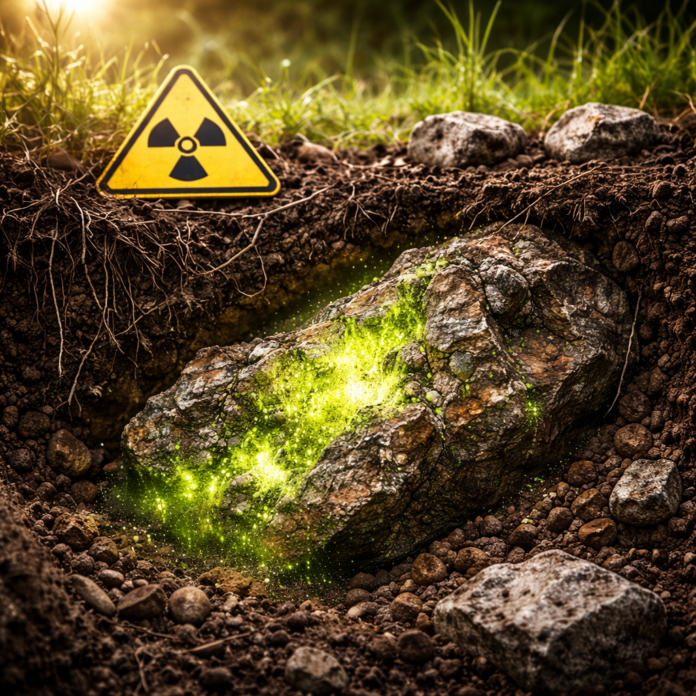
Uranium in Soil: Why It Matters for Radon, Geology, and Homeowners
Uranium in soil sounds alarming at first, but in most cases it is a normal part of the natural environment. Uranium is a naturally occurring radioactive element found throughout the Earth’s crust. That means it is present, in varying amounts, in rocks, soils, groundwater, and even trace amounts in everyday surroundings. For homeowners, the subject becomes important not because most soil is dangerously contaminated, but because uranium is the starting point in the radioactive decay chain that eventually produces radon gas.
That connection matters. Radon does not appear out of nowhere. It forms when uranium and its decay products break down in soil, rock, and groundwater beneath and around a home. In other words, uranium in soil is one of the root geological reasons radon exists at all. If you are trying to understand why one home has elevated radon while another nearby home does not, the answer often begins in the ground below the structure.
At the same time, this topic needs context. The presence of uranium in soil does not automatically mean a property is unsafe, and it does not mean every yard with uranium-rich soil will create a major indoor radon problem. Indoor radon levels depend on several overlapping factors, including the uranium content of the soil, the permeability and moisture of that soil, the local geology, and how the house itself is built. That is why uranium in soil is best understood as part of a larger radon picture rather than a standalone warning sign.
Table of Contents
- What Is Uranium?
- Why Uranium Is Found in Soil
- Natural Uranium in Soil vs. a Real Environmental Problem
- How Uranium in Soil Leads to Radon
- Why Uranium in Soil Does Not Always Mean High Indoor Radon
- When Homeowners Should Actually Care
- Testing and Practical Next Steps
- The Bottom Line
- Sources
What Is Uranium?
Uranium is a naturally occurring metallic element with atomic number 92. In nature, it is present primarily as a mixture of three isotopes: uranium-238, uranium-235, and uranium-234. By mass, natural uranium is overwhelmingly uranium-238, with a much smaller amount of uranium-235 and a trace amount of uranium-234. All of these isotopes are radioactive, but they decay very slowly over long periods of time.
That slow decay is important because uranium is not usually the immediate hazard most homeowners are dealing with. Instead, uranium is part of a long decay series. As it breaks down over time, it forms other radioactive elements such as radium, and eventually radon gas. That is the practical bridge between geology and indoor air quality. Uranium in the ground creates the long-term conditions that can lead to indoor radon problems later in the chain.
For most people, uranium is associated with nuclear fuel or mining, but natural uranium is far more ordinary than that. It has been part of the Earth’s crust since the planet formed, and small amounts of it are distributed naturally across many rock and soil types. The key issue is not whether uranium exists in soil at all, because it usually does. The question is how much is present, what type of geology it is associated with, and whether conditions allow radon derived from that uranium to move into a home.
Why Uranium Is Found in Soil
Soil comes from the breakdown of underlying rock and the movement of mineral material across the landscape. Because uranium occurs naturally in many rocks and minerals, it also ends up in many soils. Some areas have only low background levels. Other areas have higher natural concentrations because the local bedrock, sediment, or glacial deposits contain more uranium-bearing material.
This is one reason radon potential varies so much from place to place. The soil is not just dirt from a homeowner’s point of view. It is a geologic product. If the local soils formed from rock units that contain more uranium, the potential for radon generation may be greater. That does not mean every property in such an area will test high, but it does mean the ground itself is more capable of producing radon.
Geologists and radon researchers do not look only at uranium content by itself. They also consider the underlying rocks, the movement of groundwater, aerial radioactivity data, and the physical characteristics of the soil. EPA’s radon zone mapping and USGS geologic radon work both rely on this broader approach. In other words, uranium in soil is one major input, but not the only one, when estimating radon potential.
This is also why broad statements like “my county has uranium in the soil” are not very useful by themselves. Nearly all regions have at least some naturally occurring uranium. What matters more is whether the amount is elevated enough, accessible enough, and combined with the right transport conditions to produce radon that can move through the soil and enter indoor space.
Natural Uranium in Soil vs. a Real Environmental Problem
One of the most helpful distinctions for homeowners is the difference between natural background uranium and uranium contamination. Natural background uranium is part of normal geology. It contributes to what regulators and radiation scientists call natural background radiation. NRC notes that uranium, thorium, and radium exist naturally in soil and rock, and that radon from those sources makes up a large share of natural radiation exposure.
That is very different from a site with legacy mining waste, industrial residues, or other concentrated radioactive contamination. In those cases, uranium in soil may be present at much higher levels than normal background and may create different environmental and cleanup concerns. EPA and ATSDR materials on uranium distinguish between ordinary environmental presence and higher exposures associated with contaminated sites or specific industrial histories.
For most homeowners reading a radon information site, the issue is almost always the first one, not the second. The concern is usually naturally occurring uranium in the soil beneath the house, not a hazardous waste scenario in the yard. That matters because it keeps the discussion grounded. The average homeowner does not need to panic over the word uranium. They need to understand that naturally occurring uranium in the ground is common, but that it becomes a home health issue mainly when its decay leads to elevated indoor radon or, in some areas, elevated uranium in groundwater.
This distinction also matters for content strategy. A page about uranium in soil should not accidentally imply that every naturally radioactive soil is a cleanup emergency. Most of the time, the homeowner action step is not soil removal. It is indoor radon testing, and in some cases private well water testing if local conditions warrant it.
How Uranium in Soil Leads to Radon
The reason uranium in soil matters so much to a radon website is simple: radon begins with uranium. As uranium decays, it produces other radioactive elements, including radium. Radium then decays into radon gas. EPA explains that radon comes from the natural decay of uranium and radium found in nearly all rocks and soils. CDC and ATSDR similarly describe radon as a naturally occurring radioactive gas formed from the breakdown of uranium and thorium.
Once radon forms in the soil, it can move through pore spaces between soil particles. If a house is sitting above that soil, pressure differences between the home and the ground can draw soil gas inward. Radon can then enter through cracks in slabs, construction joints, crawl spaces, openings around pipes, sump pits, and other gaps in the parts of the home that touch the ground.
This is why uranium in soil is relevant even though the homeowner is breathing indoor air rather than handling soil directly. The issue is not usually touching uranium-bearing dirt in the yard. The issue is that uranium in the ground produces radon, and that radon can become trapped indoors where people spend large amounts of time. EPA and CDC both emphasize that testing is the only way to know whether this has happened in a specific home.
It is also worth remembering that the danger is not limited to obviously rocky or rugged terrain. Radon can be found all over the United States, and EPA states that any home may have a radon problem. Soil, rock, and groundwater all play a role, and even neighboring houses can test very differently depending on small differences in foundation condition, air pressure, and subsurface pathways.
Why Uranium in Soil Does Not Always Mean High Indoor Radon
This is where the topic gets more interesting. It would be convenient if high uranium in soil always translated into high radon indoors, but that is not how real houses work. The amount of uranium in the soil matters, but it is only part of the equation. Radon also has to be released from mineral grains, move through the soil, and find a path into the building.
Soil permeability is a major factor. USGS and EPA radon references note that permeability strongly affects radon transport. If the soil is loose and porous enough, soil gas can move more easily. If the soil is dense, saturated, or otherwise restrictive, radon movement may be slower or more limited. Moisture matters too. Very wet soils can either restrict gas movement or alter how radon behaves in the subsurface. This helps explain why radon levels can vary seasonally and why two homes in the same area can behave differently.
The structure itself matters just as much. Foundation cracks, slab openings, sump systems, crawl space conditions, and air pressure differences all affect how readily soil gas is drawn into a house. A home in a moderate uranium area with strong soil-gas entry pathways can sometimes test higher than a nearby home in a geologically stronger radon area but with fewer entry routes.
This is also one reason EPA’s radon zone maps are useful but limited. The maps are based on geology, indoor radon measurements, aerial radioactivity, soil parameters, and foundation data. They are good for broad planning, but they do not replace testing a particular house. Uranium in soil helps establish regional potential. A radon test tells you what is actually happening in your home.
When Homeowners Should Actually Care
Most homeowners should care about uranium in soil in an indirect but practical way. First, it explains why radon is a national issue and not just a rare local oddity. Second, it explains why some geologic areas are more prone to elevated radon than others. Third, it reinforces why testing matters even when there is no obvious sign of a problem.
If you live in an area known for elevated radon potential, uranium-rich geology may be part of the reason. If you have a home with a basement, slab-on-grade foundation, or crawl space, the soil beneath the structure is directly relevant to your indoor air. If you rely on a private well in an area where naturally occurring radionuclides are known in groundwater, uranium and radon may both be part of the local water-quality conversation as well.
What homeowners usually do not need to do is start trying to evaluate uranium content in their yard on their own. For normal residential decision-making, soil uranium testing is rarely the first step. Indoor radon testing is far more practical and directly tied to health risk. If radon is elevated, mitigation focuses on reducing radon entry and depressurizing the soil beneath the house rather than trying to remove all uranium-bearing soil from the property.
There are exceptions, especially around known legacy mining areas or documented contaminated sites. But for the typical homeowner, uranium in soil is best understood as the geologic source term behind radon, not as a DIY soil-remediation project.
Testing and Practical Next Steps
The most practical response to this entire topic is still the same one radon professionals and public-health agencies repeat over and over: test the home. Uranium in soil is the reason radon can exist, but radon testing is how you find out whether that geology is actually creating a problem inside the building.
EPA and CDC recommend testing homes for radon because radon is invisible, odorless, and impossible to detect without measurement. EPA’s action level remains 4 pCi/L, and CDC notes there is no known safe level of radon. If a home tests high, mitigation is the next step. Standard mitigation systems are designed to capture radon-laden soil gas and vent it safely above the home before it can accumulate indoors.
That is an important point for homeowners who feel uneasy after learning about uranium in soil. The existence of uranium in the ground does not mean you are powerless. In fact, radon is one of the more manageable indoor environmental risks because it can be tested for and, in most homes, reduced effectively with proven mitigation methods.
So the right takeaway is not fear. It is cause and effect. Uranium in soil is part of the natural geology. That geology can produce radon. Radon can enter homes. Testing tells you whether it has. Mitigation fixes the indoor air problem if needed.
The Bottom Line
Uranium in soil is normal, widespread, and usually part of natural background geology. It becomes relevant to homeowners mainly because uranium is the starting point in the decay chain that produces radon gas. That makes it a foundational part of the radon story, but not something that automatically signals danger by itself.
The presence of uranium in soil does not guarantee high indoor radon. Radon potential depends on geology, soil permeability, moisture, pathways into the home, and the structure itself. That is why regional maps are useful, but home testing is essential.
For most people, the practical message is simple. Uranium in soil is one reason radon exists. Radon is the actual indoor air hazard homeowners need to measure. If you want to know whether the geology beneath your house is affecting your health risk, the answer starts with a radon test, not a guess.
Sources
- U.S. Environmental Protection Agency: Radon
- U.S. Environmental Protection Agency: What is Radon?
- U.S. Environmental Protection Agency: EPA Map of Radon Zones and Supplemental Information
- Centers for Disease Control and Prevention: Radon and Your Health
- Centers for Disease Control and Prevention: How Radon Gets Into Your Home
- ATSDR / CDC: Clinician Brief on Radon
- ATSDR / CDC: Public Health Statement for Uranium
- U.S. Nuclear Regulatory Commission: Natural Background Sources
- U.S. Nuclear Regulatory Commission: Natural Uranium
- U.S. Geological Survey: The Geology of Radon