
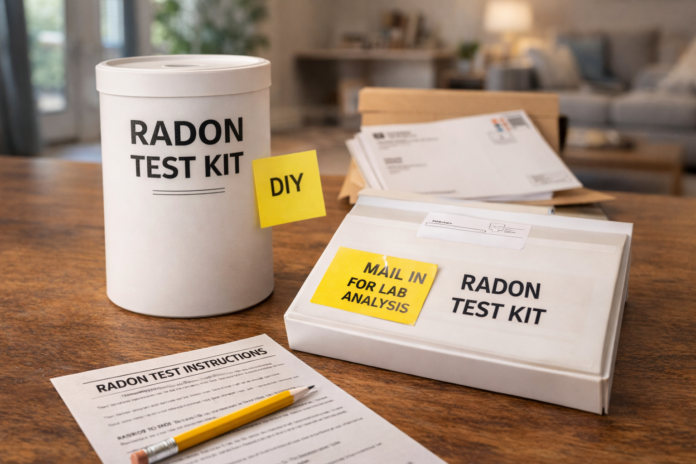
Radon Test Kit Cost: What You Pay and What You Get
Radon test kit pricing can look deceptively simple at first glance. You may see one kit for around $15, another for $30, and a digital detector for $150 or more. On the surface, they all appear to answer the same basic question: does my home have elevated radon? But what you are really paying for is not just the device itself. You are paying for speed, accuracy over time, convenience, included lab analysis, included return shipping, ease of use, and how much confidence the result gives you.
That matters because radon is not a problem you can judge with your senses. It is colorless, odorless, and invisible. Testing is the only way to know whether your home has an elevated level, and the EPA recommends taking action if your result is 4 pCi/L or higher. CDC guidance also notes that there is no known safe level of radon exposure, which is why many homeowners choose to pay more for better long-term visibility, not just a one-time snapshot.
So how much should a radon test kit cost? For most homeowners, the realistic answer is somewhere between about $20 and $30 for a basic mail-in test kit, and roughly $100 to $200 for a homeowner-grade digital detector. The right choice depends less on your budget alone and more on what question you are trying to answer. Are you screening a home quickly? Confirming a suspicious result? Monitoring over months? Or buying peace of mind and ongoing visibility?
Table of Contents
- Typical Radon Test Kit Cost Range
- Why Radon Test Kit Prices Vary
- What a Basic Short-Term Kit Usually Buys You
- What a Long-Term Kit Usually Buys You
- What a Digital Detector Buys You
- What Costs Are Included, and What May Not Be
- Which Option Is the Best Value for Most Homeowners
- Cheap vs. Expensive: What Actually Matters
- What You Should Do After You Get Your Results
- Final Thoughts
- Sources
Typical Radon Test Kit Cost Range
The cheapest radon tests are usually short-term passive kits. These are the classic homeowner kits you place on the lowest lived-in level of the home, leave in place for the required period, then mail to a lab. A very common price point is around $20. National Radon Program Services, which operates through a cooperative agreement with EPA, currently lists short-term kits at $20 and long-term kits at $30, both with analysis included. Retail pricing varies, but that general range is consistent with what you will find at major sellers.
As of March 2026, examples on major retail and manufacturer sites show how this market is typically priced. Home Depot lists short-term consumer kits around the $20 mark, including one AprilAire kit at $21.10 and a RadonAway short-term kit at $19.95. Lowe’s lists a First Alert test kit that includes lab fees, and Airthings lists its Corentium Home digital detector at $149.99. Those examples do not mean every good kit should cost exactly that amount, but they show the basic shape of the market: simple mail-in tests are relatively inexpensive, while ongoing digital monitoring costs significantly more upfront.
| Test Type | Typical Cost | Best For | What You Usually Get |
|---|---|---|---|
| Short-term passive kit | About $15 to $30 | Quick screening | One-time test, instructions, mail-in analysis, sometimes return envelope or postage |
| Long-term passive kit | About $30 to $60 | Better annual average estimate | Longer exposure period, lab analysis, better representation of year-round radon |
| Digital radon detector | About $100 to $200+ | Ongoing monitoring | Continuous readings, rolling averages, no lab fees, faster access to data |
Why Radon Test Kit Prices Vary
The biggest reason radon test kit prices vary is that these products are not all doing the same job in the same way. A short-term charcoal or liquid scintillation test is meant to give you a relatively quick snapshot. A long-term alpha-track test is designed to give a much more representative reading of your home’s average exposure over time. A digital detector is not just a test kit at all in the old sense. It is an active monitor that keeps watching the air and updating readings continuously.
That difference in purpose affects everything else. A cheap passive kit has no screen, no electronics, no ongoing monitoring, and no instant results. It is inexpensive because the homeowner is doing part of the process and the lab is doing the rest. A digital monitor costs more because it gives you immediate access to readings, lets you see trends, and removes the delay and hassle of mailing a device back for processing. You are paying for convenience and visibility as much as measurement.
Another reason price varies is what is bundled into the purchase. Some kits include lab fees and return materials. Others may require separate analysis fees or special handling, especially with certain retail kits or in certain states. Some are marketed for basic homeowner screening, while others are positioned for real estate transactions or follow-up testing. This is why the sticker price alone can be misleading. A $13 kit with extra fees may not really be cheaper than a $20 kit with everything included.
What a Basic Short-Term Kit Usually Buys You
For most homeowners, the first rung on the ladder is the short-term test kit. CDC says short-term tests can run from 2 to 90 days, and National Radon Program Services notes that testing must be conducted for at least 48 hours. In practice, many homeowner kits are designed for a few days of exposure. That is why they are the standard first step when someone wants a fast answer.
What do you get for that $20 or so? Usually, you get a passive device, printed instructions, a clear placement procedure, and lab analysis after you send the kit back. Many mainstream kits also include postage or at least a return mailer, although you should confirm that before buying. The result is a screening tool that helps you answer a simple question: is there enough reason for concern here that I should test again, monitor longer, or move toward mitigation?
This type of kit is often the best value for a homeowner who has never tested before. It is inexpensive, easy to find, and supported by mainstream public health guidance. EPA and CDC both point homeowners toward testing as the only way to know whether radon is present at elevated levels. A short-term kit is the easiest entry point.
But you are also accepting limitations. Radon levels fluctuate. They change with weather, home operation, season, ventilation, and heating patterns. National Radon Program Services specifically explains that short-term tests are less likely than long-term tests to tell you your true year-round average. That means a short-term kit is useful, but it is not the final word in every situation.
What a Long-Term Kit Usually Buys You
If a short-term kit is your quick snapshot, a long-term kit is your better long-view. CDC says long-term testing means more than 90 days, and National Radon Program Services states that the closer the measurement is to a full year, the more representative it becomes of your home’s annual average radon level. That is why long-term tests are often recommended when you want higher confidence rather than just speed.
The good news is that long-term kits are still affordable. National Radon Program Services currently lists long-term kits at $30, including all costs. That is not dramatically more than a short-term kit, but it gives you a much stronger sense of what your home is like over time. In pure value terms, long-term kits may actually be underappreciated. A small increase in price buys a major improvement in how meaningful the result may be.
What do you give up? Mostly speed and convenience. You do not get a fast answer. You need patience, and you need to leave the device undisturbed for a much longer period. That makes long-term kits less useful when you are in a hurry, such as during a real estate decision or when you want a quick initial screen. But if you are staying in the home and want a more realistic reading, spending a little more for long-term testing often makes sense.
What a Digital Detector Buys You
Digital radon detectors sit in a different category altogether. They are much more expensive upfront, but they change the homeowner experience. Instead of placing a kit, waiting, mailing it out, and checking for results later, you get an always-on device that keeps measuring radon in the home. Airthings, for example, currently lists its Corentium Home detector at $149.99 and markets it around rolling short-term and long-term averages with no lab fees.
What are you actually paying for here? First, convenience. There is no mailing cycle, no waiting for lab turnaround, and no wondering whether you filled out a card correctly. Second, you get continuous visibility. Radon levels can rise and fall, and a digital detector lets you watch those patterns rather than relying on a single test window. Third, it is useful after mitigation as well. Once a radon system is installed, a digital monitor can help you confirm performance over time.
That does not mean every homeowner needs one. If your goal is simply to screen the house once and decide whether follow-up testing is needed, a $20 to $30 mail-in kit is often enough. A digital monitor makes the most sense when you want ongoing awareness, when you have already dealt with elevated radon, when you are the sort of homeowner who wants to see trends, or when you simply value convenience enough to pay more for it.
What Costs Are Included, and What May Not Be
One of the easiest mistakes homeowners make is comparing kit prices without checking what is included. In many cases, the most important line item is not the device itself but the analysis. If a kit needs to be mailed to a lab, the lab has to process it and issue a result. Some manufacturers bundle that cost into the purchase price, and some retailers clearly advertise that lab analysis is included. Others may not.
For example, National Radon Program Services states that its short-term and long-term kits include all costs. Lowe’s describes the First Alert kit as including lab fees, except in New Jersey state tests. Home Depot’s AprilAire listing specifically says postage and lab processing fees are included. That is exactly the kind of detail worth checking before you buy.
The other hidden cost is shipping speed and delay. National Radon Program Services notes that short-term kits must reach the lab in time for results to remain accurate, and it specifically discusses optional shipping upgrades for faster return service. In other words, the cheapest kit price is not always the total practical cost if you need faster handling or if you are working under a deadline.
Then there is the cost of user error. A poorly placed kit, failure to follow instructions, or failure to maintain closed-house conditions during a short-term test can undermine the usefulness of the result. CDC and National Radon Program Services both emphasize careful placement and adherence to instructions. A slightly better kit with clearer instructions and a more complete package may save money in the long run if it prevents you from having to retest due to a mistake.
Which Option Is the Best Value for Most Homeowners
For the average homeowner who has never tested before, the best value is usually a reputable short-term kit in the $20 range that includes analysis. It gives you a fast, affordable starting point and aligns with public guidance that initial home measurements are often short-term tests placed in the lowest lived-in level. If the result is clearly low, you have gained useful information cheaply. If the result is elevated or borderline, you can move to follow-up testing with better context.
For homeowners who are not in a rush and want a better understanding of the home’s annual exposure, a long-term kit may actually be the smarter buy. Spending around $30 instead of around $20 is not a major leap, and the data can be more meaningful. If you are the kind of person who would rather test once more thoroughly than test twice quickly, the long-term route deserves serious consideration.
For homeowners who want the easiest and most informative ongoing solution, a digital detector offers the most utility, but also the highest upfront cost. It is less of a bargain for a one-time yes-or-no question and more of a long-term ownership tool. You are not just buying a test. You are buying ongoing awareness.
Cheap vs. Expensive: What Actually Matters
It is tempting to assume that the more expensive option must be more accurate. That is not always the right way to think about it. The better question is whether the product fits the job. A cheap but legitimate short-term kit from a reputable source can be exactly the right tool for initial screening. A more expensive digital device is not automatically better if you do not need continuous monitoring. Likewise, a bargain-bin kit with vague instructions or unclear lab handling is not a good value simply because it costs less.
What matters most is whether the test method is appropriate, whether the kit comes from a credible source, whether instructions are clear, and whether the result will be useful for the decision you need to make. That decision might be whether to test again, whether to mitigate, whether to confirm a borderline reading, or whether to keep monitoring after mitigation.
In other words, do not shop radon kits the way you might shop batteries or light bulbs. You are not buying a commodity alone. You are buying information, and the quality of that information depends on both the device and the testing process.
What You Should Do After You Get Your Results
The value of a radon test kit is not just in the number it gives you, but in what you do next. CDC says radon is measured in pCi/L and notes that the average radon level in American homes is about 1.3 pCi/L. If your result is at or above 4 pCi/L, EPA recommends action. If you used a short-term test and the reading is elevated, CDC recommends a second test using either another short-term or a long-term test. If the average of two short-term tests is 4 pCi/L or higher, or if a long-term test is 4 pCi/L or higher, that is the point where mitigation should move from abstract idea to practical next step.
Even results below 4 pCi/L are not a free pass forever. EPA states that no level of radon is truly safe, and its guidance also notes that homeowners may want to retest in the future, especially if living patterns change and a lower level such as a basement becomes occupied. That means the cheapest possible kit is not always the cheapest long-term strategy. Sometimes paying a little more for a better baseline, or for an ongoing monitor, is what actually reduces uncertainty.
Final Thoughts
Radon test kit cost is really about matching price to purpose. If you want the lowest-cost path to an initial answer, a reputable short-term kit around $20 is usually enough. If you want a more meaningful picture of your home’s average radon level, spending a little more on a long-term kit is often money well spent. And if you want continuing visibility without repeated mail-in testing, the higher upfront cost of a digital detector may be justified.
The good news is that radon testing is still one of the more affordable home health checks a homeowner can do. Compared with the cost of many home repairs, or the cost of mitigation if a problem is ignored for years, the entry price is low. The real goal is not finding the cheapest kit on the shelf. The goal is getting a result you can trust enough to act on.
Sources
- CDC: Testing for Radon in Your Home
- CDC: Radon and Your Health
- EPA: Map of Radon Zones and Basic Radon Action Guidance
- EPA: A Citizen’s Guide to Radon
- National Radon Program Services: Radon Test Kits Available for Purchase
- National Radon Program Services: Testing Devices
- Airthings: Corentium Home Digital Radon Detector
- Home Depot: AprilAire Short-Term Radon Gas Test Kit
- Home Depot: RadonAway Short-Term Test Kit
- Lowe’s: First Alert Home Radon Gas Test Kit